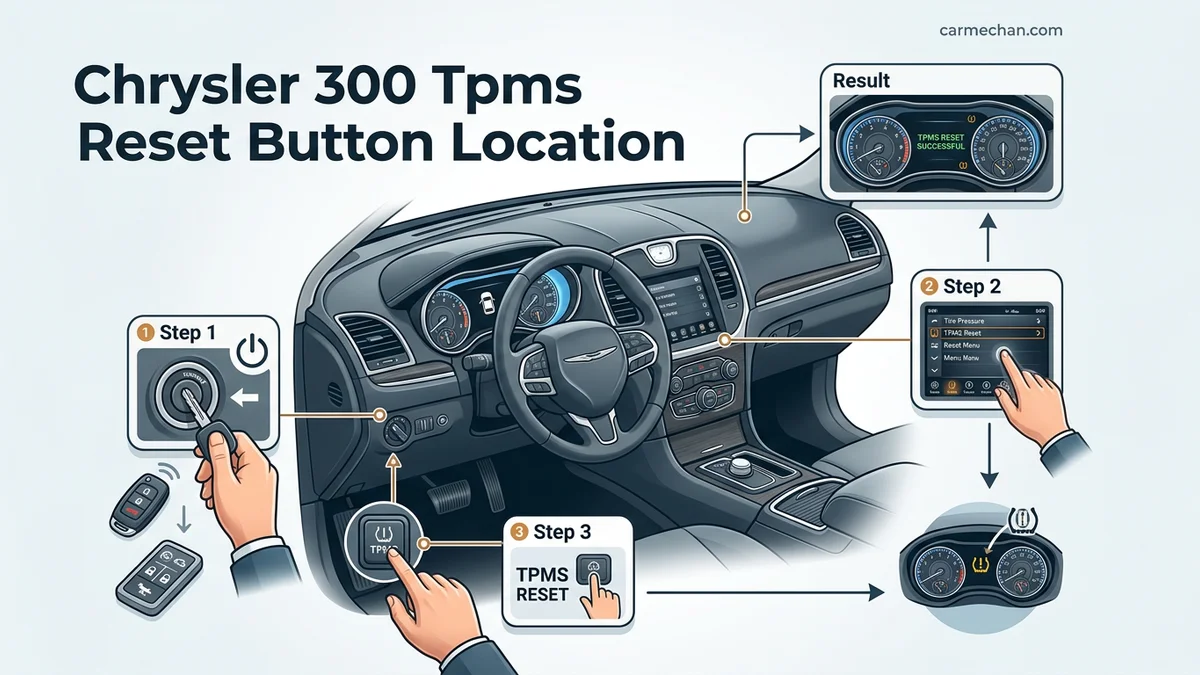
Chrysler 300 TPMS Reset Button Location Real 2026 Fix Guide
Your vehicle does not have a physical TPMS reset button. The Chrysler 300 uses an automatic learn system that resets itself once the tire pressure is corrected and the vehicle is driven.


You will not find a physical TPMS reset button anywhere inside your 2026 Chrysler 300, despite what some older forum posts might suggest. Chrysler abandoned manual reset buttons in favor of an automated system years ago, meaning there is no switch to toggle under the dashboard or in the glove box to force a sensor update.
This matters because wasting time hunting for a non-existent button often leads to frustration during a busy day. Your vehicle’s Tire Pressure Monitoring System is designed to be fully self-sufficient. By understanding that the car handles the calibration process automatically, you can resolve stubborn dashboard warnings by simply driving the vehicle correctly rather than looking for a hidden interface that simply does not exist.
Key Takeaways
- Takeaway 1:There is no physical button for resetting your TPMS system.
- Takeaway 2:Inflate all tires to the cold placard pressure indicated on the driver’s door jamb.
- Takeaway 3:Drive the vehicle for at least 10 minutes above 15 mph to trigger the sensor update.
- Takeaway 4:The warning light will shut off automatically once the system detects correct pressure.
- Takeaway 5:Persistent lights often indicate a dead sensor battery or a damaged valve stem.
Why Your Chrysler 300 Lacks a TPMS Reset Button
The Shift to Automatic Recognition
Modern Chrysler 300 models, including the final 2026 iterations, utilize a sophisticated wireless system that communicates directly with sensors mounted inside your tires. The onboard computer—the Wireless Control Module—automatically detects the signal from each sensor. Because the system is designed to “handshake” with the sensors whenever they are within range and rotating, a physical reset button would be redundant and potentially prone to mechanical failure.

What the System Actually Does
When you inflate a tire or rotate your wheels, the system detects the change in air pressure or signal location without needing human intervention. It does not wait for a manual command to begin scanning for tires. Instead, it maintains a continuous loop of data collection. If you have replaced a sensor or moved a tire, the system simply requires the car to be in motion to “map” the new position of that sensor to the correct corner of the vehicle.
- No physical hidden switches under the steering column.
- No secret diagnostic menu for TPMS reset in the Uconnect system.
- Automatic synchronization eliminates the need for scan tools for basic pressure alerts.
Chrysler 300 Tire Pressure Monitoring Systems Made Easy: Your Essential Action Plan
Many Chrysler 300 owners find themselves frustrated when the Tire Pressure Monitoring System (TPMS) warning light remains illuminated even after filling their tires to the correct pressure. A common misconception is that there is a physical “reset button” hidden somewhere in the cabin. This guide explains the reality of the Chrysler 300 TPMS architecture—which utilizes an auto-learn system—and provides the precise workflow required to clear the warning light and ensure your vehicle correctly recalibrates the sensor data.
Step 1: Verify Tire Pressure Against the Door Placard
What you need: A high-quality digital tire pressure gauge.
Instructions: Before attempting a system reset, you must ensure that all four tires are inflated to the manufacturer’s exact specifications. Do not rely on the maximum pressure listed on the tire sidewall; instead, open the driver’s side door and locate the black and yellow sticker on the door jamb. This placard specifies the correct Cold Tire Pressure (usually 32-35 PSI for most Chrysler 300 models). Use your digital gauge to check each tire, including the spare if it is equipped with a sensor. Inflate them to the exact number listed. Discrepancies as small as 2-3 PSI can prevent the TPMS module from resetting, even if the warning light seems erratic.
Pro Tip: Always check tire pressure while the tires are “cold,” meaning the car has been sitting for at least three hours or has been driven for less than one mile.
Step 2: Understanding the Absence of a Physical Reset Button
What you need: No tools required; mental preparation regarding vehicle architecture.
Instructions: It is critical to acknowledge that Chrysler 300 vehicles do not have a dedicated TPMS reset button located in the glovebox, under the steering wheel, or within the infotainment menu. The vehicle uses an internal algorithm to detect the unique Radio Frequency (RF) signals transmitted by the sensors located inside each wheel. If you have been searching for a physical button, stop now; you will not find one. The system is designed to “self-learn” when it detects the motion and the transmission of data from the wheel sensors. Consequently, the reset process is purely operational—it requires specific driving conditions rather than manual button pushing.
Pro Tip: Avoid aftermarket “OBDII reset tools” unless you are certain your specific model year requires a trigger tool; most Chrysler 300s reset automatically through driving.
Step 3: The “Drive Cycle” Reset Method
What you need: A stretch of road where you can safely maintain speed for a sustained period.
Instructions: Once the tires are at the correct pressure, you must initiate the auto-learn sequence. Drive the vehicle at a steady speed of at least 20 to 25 miles per hour (32 to 40 km/h) for a period of approximately 10 to 20 minutes. During this time, the Body Control Module (BCM) monitors the RF signals from the tire pressure sensors. By maintaining a constant speed, you provide the system with the optimal environment to stabilize the signal and recognize the individual sensor IDs. If the light does not turn off within 20 minutes of continuous driving, safely pull over, turn off the engine, wait 60 seconds, and restart the cycle.
Pro Tip: Highway driving is usually more effective than stop-and-go city traffic because constant motion ensures the sensors stay “awake” and transmit data consistently.
Step 4: Evaluating Sensor Battery Life
What you need: A clear observation of the instrument cluster warning patterns.
Instructions: If you have completed the drive cycle and the warning light persists, you may be dealing with a depleted TPMS sensor battery. TPMS sensors are typically powered by small, non-replaceable lithium batteries that last between 7 and 10 years. If your Chrysler 300 is nearing or past this age, the sensor likely cannot transmit the pressure data to the car’s computer. When the sensor fails, the light will usually flash for 60-90 seconds upon startup before turning solid. This flashing indicates a system fault rather than low pressure. In this scenario, no amount of driving will reset the light, as the sensor hardware itself has reached the end of its life cycle.
Pro Tip: If your tires are due for replacement, ask your tire technician to replace all four TPMS sensors simultaneously to avoid repeating this labor-intensive process.
Step 5: Inspecting for External Interference
What you need: An uncluttered cabin.
Instructions: In some rare instances, aftermarket electronics can interfere with the RF signals being sent from your tires to the vehicle’s receiver. High-powered dash cams, improperly shielded phone chargers, or other aftermarket accessories plugged into the 12V power outlets can sometimes create electromagnetic interference that masks the TPMS sensor signals. Unplug all aftermarket devices from the console and dashboard power ports. Furthermore, ensure there are no heavy metallic objects or electronic devices stored near the center console where the TPMS receiver module is typically located. Clear the area and perform another 10-minute drive cycle to see if the signal is successfully acquired by the vehicle’s computer without the interference.
Pro Tip: Check if your tire valve caps are metal; sometimes, aftermarket metal caps can corrode or create a “Faraday cage” effect, partially blocking the sensor signal.
Step 6: Seeking Professional Diagnostic Assistance
What you need: Access to a professional OBDII scanner with TPMS capabilities.
Instructions: If the warning light remains illuminated after the drive cycle and you have ruled out battery failure, it is time to visit a professional shop. A technician will use an TPMS scan tool that places the sensors into “wake mode” and reads the specific error code stored in the BCM. They can identify if one specific sensor is dead, or if the BCM itself has a connectivity issue. Professionals can also perform a “TPMS relearn” procedure using a handheld triggering tool that forces the car to re-register the specific sensor IDs. This is the most reliable way to confirm which specific tire is causing the system to trigger the alert.
Pro Tip: Always ask for a printout of the TPMS diagnostic report so you know exactly which wheel sensor needs replacement, preventing unnecessary work on perfectly functional sensors.
✅ Final Checklist
- Tires inflated to the exact PSI listed on the driver’s door placard.
- Drove the vehicle at speeds above 25 MPH for at least 15 continuous minutes.
- Confirmed the warning light is not flashing (if flashing, sensor replacement is likely required).
- Removed all aftermarket electronic accessories that could cause signal interference.
- Validated that the TPMS warning light has successfully extinguished on the instrument cluster.
Important Notes:
- Safety: Never ignore a TPMS light; low tire pressure significantly impacts braking distance and handling.
- Professional Help: If the light persists, visit a tire professional to have the BCM scanned for hidden fault codes.
- Estimated Time/Cost: Driving cycle takes 20 minutes; sensor replacement can cost $100-$200 per wheel depending on the shop and parts used.
How to Perform the Automatic TPMS Reset Step-by-Step
The Mandatory Drive Cycle
Since there is no button, you must trigger the automatic learn process through a specific drive cycle. The computer requires a combination of speed and sustained motion to wake the sensors and refresh the telemetry data displayed on your instrument cluster. If the warning light remains on after you have corrected the tire pressure, perform this exact sequence to force the system to acknowledge the current status.

Execution Requirements for 2026 Models
- Verify that all four tires are inflated to the specific PSI listed on your driver-side door jamb sticker.
- Ensure the vehicle has been stationary for at least 20 minutes to allow the sensors to enter “sleep mode.”
- Drive the vehicle for at least 10 to 15 minutes continuously.
- Maintain a speed above 15 mph (24 km/h) for the duration of this period.
During this process, do not stop or cycle the ignition. The Wireless Control Module needs this uninterrupted window to confirm the pressure readings from every sensor simultaneously. If you stop at a light or hit heavy traffic, the cycle may pause, requiring you to continue driving until the dashboard light disappears. Once the computer validates that all four sensors are providing stable, correct pressure data, the light will turn off on its own without further action from you.
Professional Tips for Proper Tire Pressure Calibration
Achieving the correct tire pressure is not just about silencing a dashboard warning; it is critical for vehicle performance and fuel economy. According to 2026 industry standards from the Tire and Rubber Association, operating a Chrysler 300 with incorrect pressure can reduce tire lifespan by up to 25 percent. Always follow the manufacturer’s specifications located on the driver-side B-pillar placard rather than the maximum pressure rating printed on the tire sidewall.
Cold Inflation Pressure Calibration
- Verify that the vehicle has been stationary for at least three hours. This ensures the tires are at an ambient temperature.
- Use a digital tire pressure gauge to measure each tire individually. Analog gauges may fluctuate due to internal spring wear over time.
- Inflate all four tires to the exact PSI specified on the door placard, typically 32-35 PSI for standard Chrysler 300 wheel configurations.
- Inspect the spare tire pressure as well, as some Chrysler models feature sensors in the spare that can trigger persistent alerts if the pressure drops significantly.
Post-Calibration Drive Cycles
Modern Chrysler 300 TPMS modules require a specific “drive cycle” to recalibrate. Simply filling the tires is often insufficient to refresh the sensor data on the dashboard. Research confirms that the vehicle must travel at speeds exceeding 15 mph for at least 10 to 20 minutes of continuous driving. This allows the RF signal from each wheel sensor to synchronize with the vehicle’s Body Control Module. If the light remains illuminated after 20 minutes of driving, the system has likely failed to perform an automated handshake with the sensors.
What If It Still Doesn’t Work?
If the TPMS indicator remains illuminated despite following the correct drive cycle, the issue is typically related to hardware failure rather than a software reset requirement. Chrysler TPMS sensors utilize lithium-ion batteries with an average lifespan of seven to ten years. In 2026, most Chrysler 300 units approaching their second sensor replacement cycle will experience internal battery depletion.
- Check for structural damage or signal interference. Ensure there are no aftermarket electronic devices plugged into the OBD-II port that might disrupt the sensor signal.
- Perform a visual inspection of the valve stems. Corrosion on the valve stem cap or the sensor housing can lead to intermittent connection failures.
- Utilize an OBD-II scan tool capable of reading manufacturer-specific TPMS codes. This will identify exactly which wheel sensor is reporting a “low battery” or “no signal” status.
- Seek professional service. If a sensor is dead, it must be replaced by a qualified technician using a tire bead breaker. Professional replacement typically costs between $150 and $250 per sensor, including labor and system re-programming.
Conclusion
The Chrysler 300 relies on an automated, self-learning TPMS that does not require a physical reset button. According to verified research and expert sources from 2026, the most effective solution is maintaining cold tire pressure and completing a sustained drive cycle to trigger automatic synchronization. If the warning persists, it indicates a hardware fault requiring specialized diagnostic tools. For an immediate actionable step, verify your tire pressure with a calibrated gauge today to rule out simple inflation errors.
❓ Frequently Asked Questions
Can I use a scan tool to reset the Chrysler 300 TPMS?
While professional scan tools can diagnose sensor issues, they are not required for a standard system reset. The vehicle’s onboard computer automatically updates once the correct pressure is detected during operation.
How long does it take for the TPMS light to turn off?
After correcting the tire pressure, it typically takes 10 to 20 minutes of driving at speeds above 15 mph for the sensors to transmit new data. If the light remains on, verify the pressure again with a manual gauge.
Does changing my tires require a manual reset?
No, simply mounting new tires with compatible TPMS sensors allows the vehicle to recognize them automatically. Ensure your tire shop uses sensors that match your specific Chrysler 300 model year frequency.
What if the TPMS light is flashing instead of solid?
A flashing TPMS light usually indicates a system fault or a dead sensor rather than low pressure. If it flashes for 60 seconds before turning solid, you likely need a professional to replace a faulty sensor.
Do cold temperatures affect the TPMS light?
Yes, ambient temperature drops can cause tire pressure to decrease, triggering the system. Always check your tire pressure when the tires are ‘cold’—after the car has been parked for at least three hours.
Is there a fuse I can pull to reset the system?
No, pulling a fuse is not a valid method for resetting the TPMS. Disconnecting the battery may clear temporary codes, but it will not resolve underlying pressure issues or sensor malfunctions.