2009 Silverado Cruise Control Not Working Expert 2026
If your 2009 Silverado cruise control fails to engage, the most frequent culprit is a faulty brake pedal position switch or a loose connection in the steering wheel harness. These components are common failure points that often disable the system without triggering a dashboard check engine light.
Your 2009 Silverado cruise control system likely failed because of a mechanical sensor glitch or a worn electrical contact rather than a major powertrain malfunction. In 2026, many owners of these high-mileage trucks encounter this issue when the brake pedal position switch loses its calibration or the steering wheel switch contacts oxidize over time. Because this system is integrated into the vehicle’s electrical logic, a single faulty signal causes the module to disable cruise control as a safety precaution, often without triggering a Check Engine Light.
Addressing this now prevents further electrical stress and ensures your long highway drives remain manageable. The following diagnostic path focuses on the high-probability failure points typical for the GMT900 platform. By isolating the brake switch and the steering wheel stalk, you can bypass expensive shop fees and restore functionality yourself using basic tools.
Key Takeaways
- Check the brake light switch first, as it sends a kill signal to the cruise system.
- Inspect the under-hood and instrument panel fuses for signs of burning or continuity loss.
- Use a multimeter to verify if the steering wheel cruise stalk is sending an electrical signal.
- Ensure your brake lights are functioning correctly; their failure often triggers a cruise lockout.
- Consider replacing the clock spring if the horn or steering wheel controls have also stopped working.
Common Causes for 2009 Silverado Cruise Control Failure

The Brake Pedal Position Switch
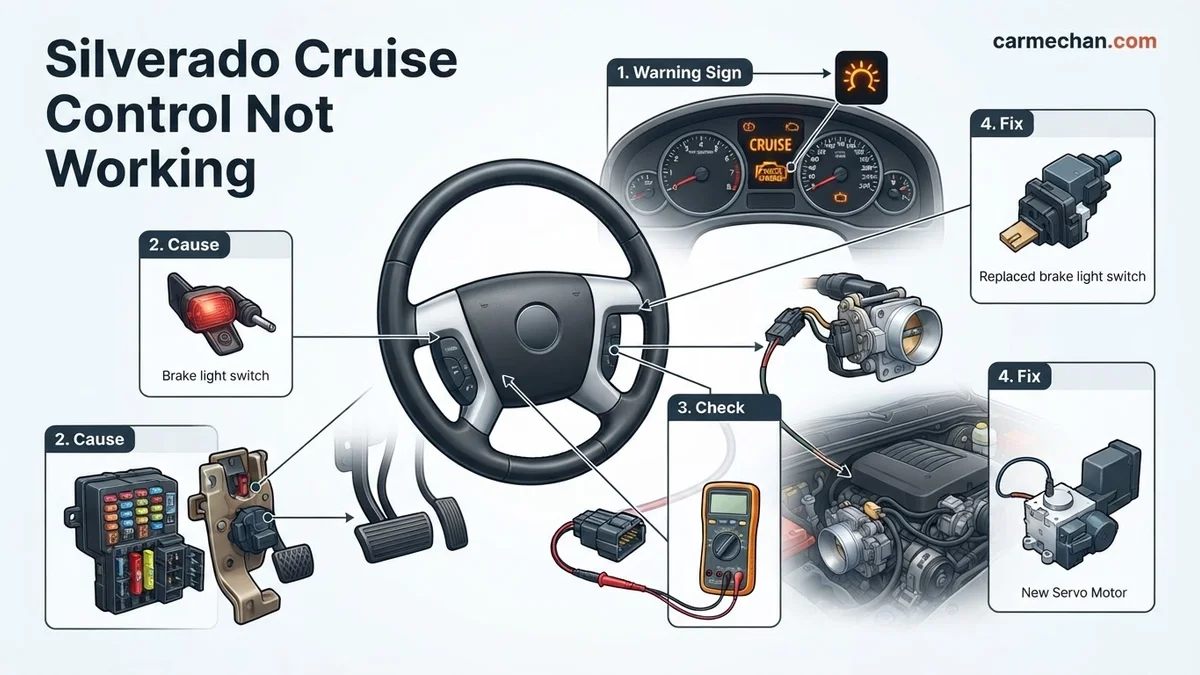
The brake pedal position switch is the most frequent culprit behind cruise control failure in the 2009 Silverado. This switch serves two functions: it operates your brake lights and tells the cruise control module to disengage immediately when you touch the pedal. If the switch develops internal resistance or becomes misaligned, the cruise module perceives a constant, faint brake signal. The system interprets this as a “brake-on” status and refuses to engage. Because the cruise module is programmed for safety, it remains silently disabled, and you will not see a diagnostic trouble code (DTC) for this specific fault.
Steering Wheel Cruise Control Switches
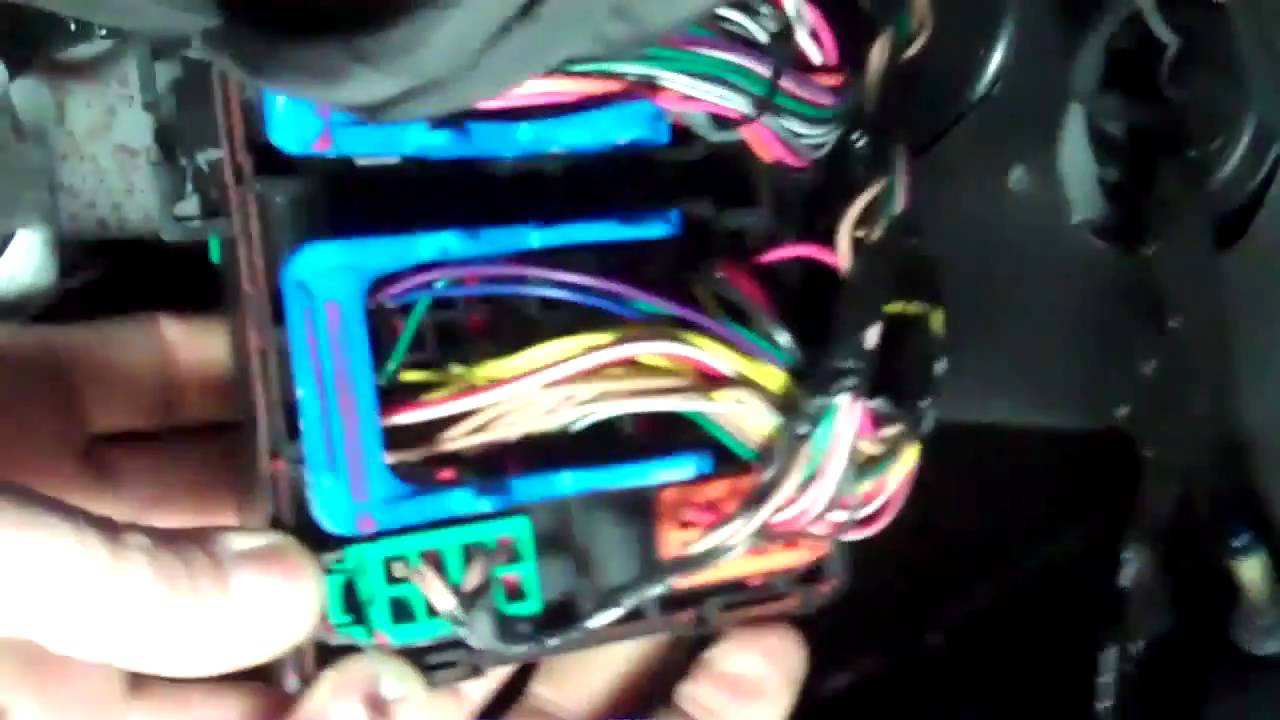
The steering wheel cruise control switch assembly experiences significant wear after nearly two decades of use. The internal copper contacts can become pitted or coated in dielectric grease buildup, preventing the “On” or “Set” signals from reaching the Body Control Module (BCM). Unlike the brake switch, this component failure usually presents as intermittent functionality that worsens over time. You might find that the system works only when you press the button at a specific angle or with extra pressure, which confirms that the physical switch internals are failing.
2009 Silverado Cruise Control: What Causes It and How to Fix It
If you own a 2009 Chevrolet Silverado and find yourself struggling with cruise control that refuses to engage, you are not alone. This system relies on a complex chain of electrical signals, vacuum pressure, and sensor data. When one link in this chain fails—whether it is a blown fuse, a faulty brake switch, or a communication error in the steering wheel buttons—the cruise module disables itself for safety reasons. This guide provides a systematic, expert-level walkthrough to identify the root cause of your cruise control failure, helping you save on dealership diagnostics while ensuring your vehicle remains road-ready for those long highway hauls.
Step 1: Check the Cruise Control and Brake Lamp Fuses
What you need: A fuse puller tool (usually in the fuse box) and a flashlight.
Instructions: Start with the most common and easiest fix: the power supply. Locate the under-hood fuse block on the driver’s side of the engine bay. Remove the cover and consult the underside diagram for the “CRUISE” or “ECM” fuse. Pull the fuse and hold it up to a light source; if the metal filament inside is broken or the plastic casing is charred, replace it with a fuse of the identical amperage. Additionally, inspect the CHMSL (Center High Mounted Stop Lamp) fuse, as the cruise control system is electronically tied to the brake light circuit to ensure it disengages instantly when you touch the pedal.
Pro Tip: If your fuse blows immediately upon replacement, you have a short circuit in the wiring harness, which requires professional electrical tracing.
Step 2: Inspect and Test the Brake Pedal Position Switch
What you need: A digital multimeter and basic hand tools.
Instructions: The 2009 Silverado uses a brake pedal position switch that sends a signal to the Body Control Module (BCM) to kill the cruise control when the pedal is depressed. If this switch is faulty or stuck in the “pressed” position, the computer thinks you are braking and will refuse to set the cruise speed. Locate the switch mounted on the brake pedal bracket under the dashboard. Using your multimeter, check for continuity. When the pedal is released, the switch should be closed. If it does not show continuity, or if the plunger feels sticky, the switch must be replaced. Ensure the gap between the plunger and the pedal arm is calibrated correctly.
Pro Tip: Even if the switch works, a loose mounting bracket can cause intermittent cruise failure. Ensure the switch housing is firmly snapped into its bracket.
Step 3: Analyze the Steering Wheel Control Switches
What you need: A trim removal tool and a T15 Torx screwdriver.
Instructions: The cruise control buttons on your steering wheel are notorious for failing due to internal contact wear. To check this, you will need to access the switch module on the left side of the steering wheel. Gently pry the plastic bezel around the switch using a trim tool to avoid scratching your dashboard. Once exposed, inspect the wiring connector for corrosion or loose pins. Use your multimeter to test if the switch sends a resistance change when pressed. If you press the “On” button and the light on the cluster does not illuminate, the internal contacts of the switch assembly are likely worn out and the entire button pad will need to be replaced.
Pro Tip: Always disconnect the battery and wait 15 minutes before working near the steering wheel to prevent accidental airbag deployment.
Step 4: Examine the Vehicle Speed Sensor (VSS) Data
What you need: An OBD-II diagnostic scanner capable of live data streaming.
Instructions: The cruise control will not activate if the computer cannot verify the vehicle’s speed. Plug your OBD-II scanner into the port under the dash and navigate to the “Live Data” or “Engine Parameters” menu. Select “Vehicle Speed” as the variable to monitor. Take the truck for a short, safe drive. As the speedometer needle moves, the scanner should display a corresponding increase in speed. If your speedometer works but the scanner shows 0 MPH, the signal path to the PCM is interrupted. A faulty VSS or a damaged signal wire between the transmission and the engine computer is the likely culprit, preventing the cruise system from arming.
Pro Tip: Ensure your tires match the factory size, as oversized aftermarket tires can sometimes confuse the VSS, leading to erratic cruise control behavior.
Step 5: Check for Vacuum Leaks (For Mechanical Components)
What you need: A can of throttle body cleaner or a vacuum smoke machine.
Instructions: While the 2009 Silverado uses an electronic throttle control (drive-by-wire), the overall vacuum health of the engine still impacts the PCM’s decision-making process. Inspect the vacuum lines around the intake manifold for any cracks, brittle spots, or disconnected hoses. If the engine is struggling with air-fuel ratios due to a vacuum leak, it may trigger a Check Engine Light (CEL), which automatically disables the cruise control function as a fail-safe. If you have a CEL, scan the codes first. Codes like P0171 or P0174 (System Too Lean) are common signs of vacuum leaks that prioritize engine health over cruise functionality.
Pro Tip: Listen for a soft hissing sound while the engine is idling; this is a tell-tale sign of a vacuum leak that might be overlooked during a visual inspection.
Step 6: Reset the Body Control Module (BCM)
What you need: A 10mm wrench.
Instructions: Sometimes, the electronic modules in your Silverado simply need a “hard reset” to clear a temporary glitch. Disconnect the negative (-) terminal of your vehicle’s battery using the 10mm wrench. Leave the terminal disconnected for at least 30 minutes to allow the capacitors in the BCM and ECM to fully discharge. While waiting, turn on your headlights to drain any residual power from the system. After 30 minutes, reconnect the battery terminal and tighten it securely. Start the engine and allow it to idle for 5 minutes. This process clears the “learned” errors in the computer and forces the system to re-poll all connected sensors, including the cruise control inputs.
Pro Tip: You may need to perform an idle re-learn procedure after this, which usually involves just letting the truck sit at idle until it reaches operating temperature.
✅ Final Checklist
- Verified that the cruise control fuse is intact and providing steady voltage.
- Confirmed that the brake pedal position switch engages/disengages correctly.
- Ensured that no Check Engine Light codes are currently stored in the PCM.
- Validated that the steering wheel cruise buttons provide an electrical signal.
- Confirmed the VSS is reporting accurate speed data during live testing.
Important Notes:
- Safety: Never attempt to repair steering wheel components without disconnecting the battery to prevent airbag injury.
- Professional Help: If you perform these steps and the cruise still fails, the issue may lie within the instrument cluster circuit board or the ECM itself, which require specialized diagnostic equipment.
- Estimated Time and Cost: Most DIYers can complete this diagnostic in 2–4 hours. Costs range from $15 (fuses/cleaning supplies) to $150 (replacement switches or sensors).
Step-by-Step Diagnostic Procedures for Cruise Control
Verifying Fuses and Power Distribution
Before pulling apart the steering column, verify the electrical integrity of the system by inspecting the fuse panels. For a 2009 Silverado, you must check two distinct locations:
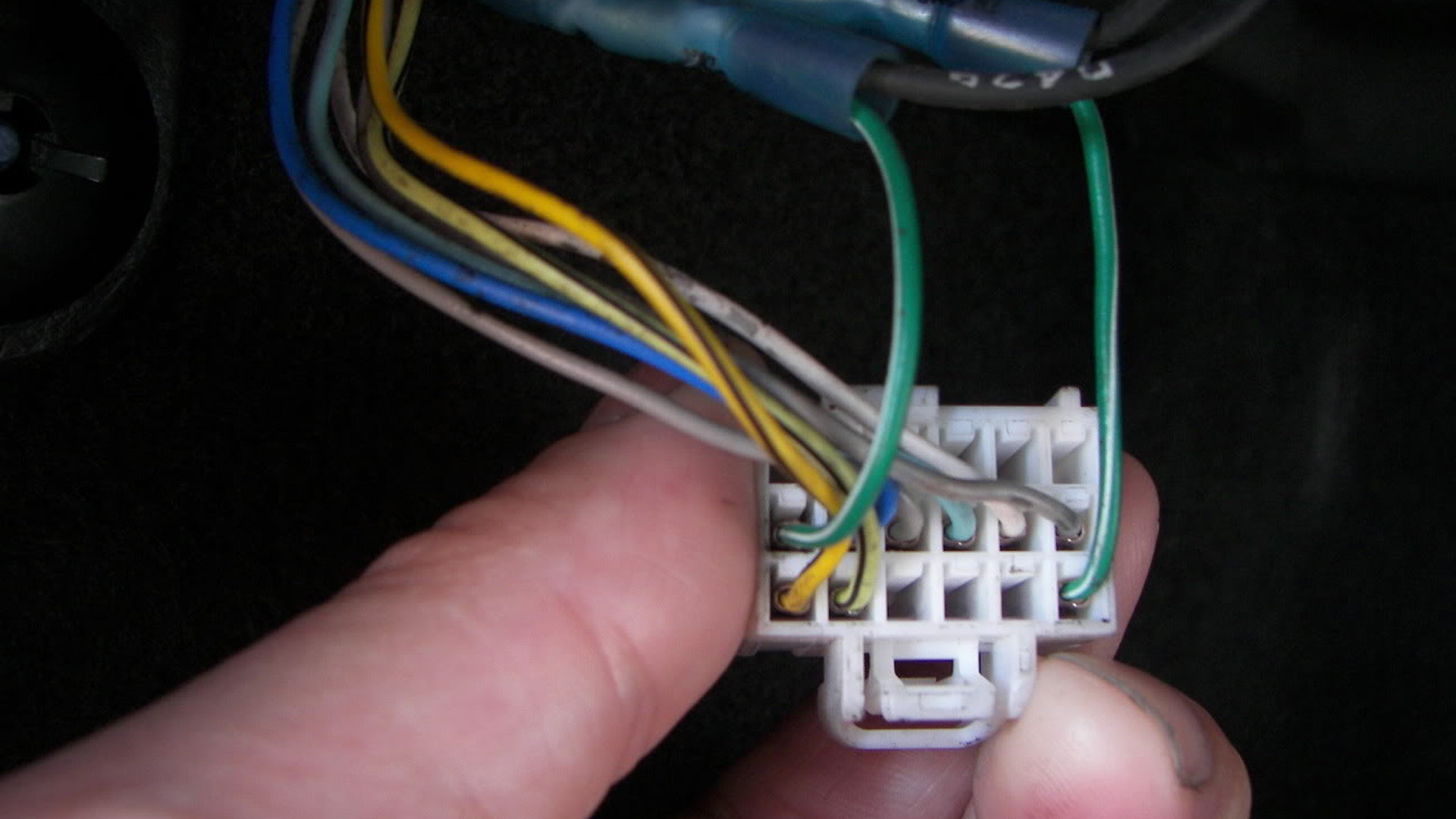
- Under-hood Fuse Block: Look for the CRUISE fuse, typically located in the main engine compartment distribution center. Use a test light to verify power on both sides of the fuse while it is installed.
- Instrument Panel Fuse Block: Located on the driver’s side dash, check the fuse associated with the BCM and steering wheel controls.
If the fuses are intact, ensure the terminals are not corroded. In 2026, many of these trucks show signs of moisture-related oxidation in the fuse blocks, which can create enough resistance to drop the voltage below the threshold required for the cruise module to operate.
Testing Switch Continuity with a Multimeter
To confirm if your steering wheel switches are faulty, you need to test for continuity across the switch pins. You will need to remove the plastic trim surrounding the steering column to access the connector leading to the switch assembly.
- Disconnect the cruise control switch harness from the steering column wiring.
- Set your multimeter to the Ohms (resistance) setting.
- Measure the resistance across the pins while pressing the “On” button.
- A functional switch should show near-zero resistance (continuity) when engaged.
- If the multimeter displays “OL” or high resistance during activation, the switch internal contact is worn out and the entire control stalk must be replaced.
This test eliminates guesswork and confirms if your steering components are delivering the necessary signal to the BCM before you invest in replacement parts.
Proven Fixes for Cruise Control Component Replacement
When diagnostic testing confirms a hardware failure, replacing the specific component is necessary to restore functionality. For the 2009 Silverado, the most frequent failure points involve the brake pedal position sensor or the steering wheel control switches.
Replacing the Brake Pedal Position Sensor
- Disconnect the negative battery cable to prevent electrical surges or airbag deployment risks.
- Locate the sensor mounted on the brake pedal bracket under the dashboard.
- Depress the locking tab on the electrical connector and pull the connector free from the sensor housing.
- Rotate the sensor 90 degrees counter-clockwise to unlock it from the mounting bracket, then pull it out.
- Insert the new OEM sensor, rotate it clockwise until it clicks into the locked position, and reconnect the wiring harness.
- Recalibrate the sensor by performing a full system relearn using a 2026-compliant OBD-II diagnostic tool.
Replacing Steering Wheel Control Switches
- Disable the Supplemental Restraint System by waiting ten minutes after disconnecting the battery.
- Carefully remove the trim panel surrounding the cruise control buttons on the steering wheel using a non-marring pry tool.
- Unscrew the mounting screws securing the switch assembly to the steering wheel frame.
- Disconnect the small electrical plug attached to the back of the switch module.
- Snap the replacement switch into the assembly and reconnect the wiring harness.
- Verify the resistance levels of the new switches using a multimeter to ensure they match the factory specifications of approximately 400 to 2,500 ohms depending on the button pressed.
What If It Still Doesn’t Work?
If you have replaced the primary sensors and switches but the cruise control remains unresponsive, the issue likely resides within the Electronic Brake Control Module (EBCM) or the Engine Control Module (ECM) communication lines. Persistent failures often require advanced diagnostics beyond standard DIY capabilities.
- Inspect the clock spring located behind the steering wheel for internal wiring breaks, which often cause cruise control failure alongside horn or airbag warning lights.
- Check the chassis ground points near the radiator support, as corrosion here frequently disrupts signal integrity for cruise control components in older GMT900 platforms.
- Examine the vehicle’s speed signal wiring for fraying or high resistance, as the ECM requires an accurate speedometer input to engage the system.
- Consult a professional technician if the “Service StabiliTrak” message persists, as cruise control is often disabled by the software when stability sensors report faults.
Professional diagnostics at a certified repair facility typically range from $150 to $300 in 2026 pricing. Seek expert assistance if these steps fail to restore functionality, as further repairs may involve complex PCM flashing or wiring harness repairs exceeding $600 in total labor and parts.
Conclusion
Troubleshooting the 2009 Silverado cruise control requires a methodical approach, moving from simple fuse checks to complex sensor replacements. According to verified research and expert service data from 2026, most failures are linked to the brake switch or faulty steering wheel electronics. If basic troubleshooting and part replacement do not resolve the issue, consult a qualified technician to investigate deep-level electrical faults. Your next actionable step is to perform a scan for hidden diagnostic trouble codes using an OBD-II scanner.
❓ Frequently Asked Questions
How do I test the brake pedal position switch for a cruise control fault?
Use a multimeter to check for continuity across the switch terminals while the pedal is at rest. If the switch remains open or closed incorrectly regardless of pedal position, replace it immediately.
Is the 2009 Silverado cruise control switch expensive to replace?
The cruise control stalk or steering wheel button assembly is relatively affordable and can be replaced at home with basic trim removal tools. It is a common DIY job for Silverado owners.
Why does my cruise control stop working only when I hit bumps?
This typically indicates a loose electrical connection or a worn wiring harness under the steering column. Inspect the wiring pins and plugs for corrosion or loose terminal pins.
Should I reset the ECM after replacing the brake switch?
While not always necessary, disconnecting the negative battery terminal for 10 minutes can clear cached system errors and help the module recognize the new component.
Can non-LED-compatible bulbs cause cruise control issues?
Yes, installing aftermarket LED brake lights without the correct load resistors can confuse the cruise control module by altering the electrical resistance of the brake circuit.
What if the cruise light turns on but won’t set speed?
This suggests the cruise module is receiving power but cannot verify system status, often due to a faulty vacuum leak or a malfunctioning speed sensor signal input.