Can I Add Coolant or Oil to My Car Myself? Complete Guide
Last Updated on September 1, 2026 by Albert Duke
Yes, both coolant and oil are safe to add yourself with basic tools and a few minutes of care. Coolant goes into the coolant reservoir once the engine has cooled down, and oil goes in through the oil filler cap after checking the dipstick. Neither job requires a mechanic if the level is simply low rather than a sign of a leak.

Prime for Young Adults — 6 Months Free
Students and 18–24s get six months of Prime free, then half price.
Start 6 Months FreeThis guide covers both fluids separately, since the steps, tools, and warning signs are different for each. If either fluid keeps dropping after you top it off, that’s a signal to look deeper rather than keep adding fluid indefinitely. We’ll walk through how to check each one, what to buy before you start, the exact steps, and when a simple top-off isn’t the real fix.
Part 1 Adding Coolant To Your Car
Recommended Best Deal Products


How To Tell If Your Car Needs Coolant
Check the coolant reservoir, a translucent plastic container in the engine bay usually marked with a warning label. It has “min” and “max” lines printed on the side, and the coolant level should sit somewhere between them when the engine is cold.
A temperature gauge creeping toward hot, a sweet smell near the engine, or weak heater performance in the cabin are all signs coolant may be running low. If your car has recently overheated, let it cool completely before checking anything under the hood. Opening a hot cooling system, even just the reservoir cap, can release scalding steam and coolant under pressure.
It’s worth checking the coolant level cold, meaning the car hasn’t run in at least a few hours, since a warm system can give a slightly misleading reading due to normal expansion.
What You Need Before Adding Coolant
- The correct coolant type for your vehicle, checked against your owner’s manual
- Distilled water, if your coolant isn’t pre-mixed
- A funnel to avoid spills
- Gloves and a rag, since coolant is toxic to skin and dangerous if ingested
Coolant types are not interchangeable. Traditional green coolant, orange or pink organic acid coolant, and yellow hybrid coolant use different chemistries, and mixing types can cause buildup that damages the cooling system over time. A step-by-step maintenance resource confirms that adding coolant to a hot engine is dangerous, and even with the engine still running, coolant should only go through the expansion tank rather than the main coolant tank. Stick to whatever your manual specifies for coolant type.
Step By Step How To Add Coolant
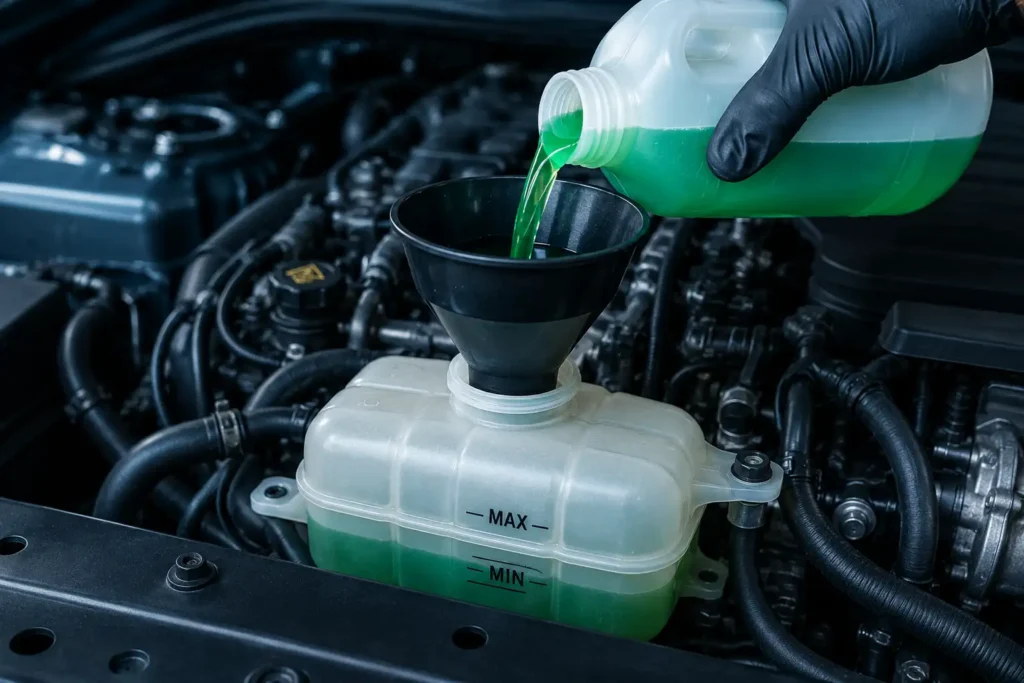
- Park on level ground and let the engine cool completely, ideally at least 20 to 30 minutes after driving.
- Open the hood and locate the coolant reservoir, not the radiator cap itself, which stays sealed under pressure and should not be opened on a hot or even warm engine.
- Remove the reservoir cap slowly, since pressure can still build up even in a cooled system.
- Place a funnel in the opening and pour coolant slowly until it reaches the max line. If your coolant isn’t pre-mixed, combine it with distilled water first, typically in a 50/50 ratio unless your manual says otherwise.
- Replace the cap securely and wipe away any spills right away, since coolant residue is harmful to pets and can damage paint over time.
- Start the engine and let it run for a few minutes with the heater on its hottest setting to help circulate the new coolant.
- Check underneath the car for drips once the engine has run, which can indicate a leak rather than a simple low level.
When Adding Coolant Isn’t Enough
If the coolant level drops again within a few days or weeks of topping it off, that points to a leak somewhere in the system rather than normal consumption. Common leak points include hose connections, the radiator itself, and the water pump. Our guide on how to find a coolant leak walks through tracking down exactly where the fluid is escaping.
If you’re wondering whether it’s safe to drive right after adding coolant, our guide on driving after adding coolant covers what to watch for on the way to your destination.
Part 2 Adding Oil To Your Car
How To Check If Your Car Needs Oil
Park on level ground. If the car has been running, let it sit for 5 to 10 minutes so oil drains back into the pan for an accurate reading. Open the hood and find the dipstick, usually marked with a bright yellow or orange handle near the front of the engine.

Audible — Listen Free for 30 Days
One free credit a month and thousands of titles included.
Listen Free for 30 DaysChecking on a slope, even a slight one, can give a false reading in either direction, so a flat driveway or parking spot matters more than it might seem. If you can’t find the dipstick, some newer vehicles use an electronic oil level monitor instead and display the reading on the dashboard, so check your owner’s manual if there’s no physical dipstick under the hood.
Pull the dipstick out, wipe it clean with a rag, then reinsert it fully and pull it out again. Look at where the oil film ends on the stick relative to the two marks near the bottom, often labeled min and max, or shown as two holes or crosshatched sections. Oil between the marks is fine. Oil at or below the lower mark means it’s time to add some. A dipstick maintenance guide notes that if the dipstick isn’t showing an oil level at all, oil needs to be added immediately, and how much make-up oil you’ll typically need varies with your engine’s age, type, and mileage.
What You Need Before Adding Oil
- The correct oil weight and type for your engine, listed in your owner’s manual or on the oil cap itself
- A funnel to avoid spills around the filler opening
- A rag for wiping the dipstick and cleaning up any drips
Using the wrong oil weight won’t cause immediate damage in most cases, but it’s still worth matching your manual’s specification, especially for engines with tight tolerances or turbochargers that depend on the right viscosity.
Step By Step How To Add Oil

- Locate the oil filler cap on top of the engine, usually labeled with the word “oil” or an oil can icon.
- Remove the cap and place a funnel in the opening to keep the pour controlled and mess-free.
- Add oil slowly, roughly half a quart at a time rather than pouring in a full quart at once if you’re close to the full mark.
- Wait a minute or two, then recheck the dipstick using the same clean-reinsert-check process from before.
- Repeat in small amounts until the level sits between the min and max marks, since overfilling can cause its own problems, including foaming and pressure buildup.
- Replace the oil cap securely once you’re satisfied with the level.
When Adding Oil Isn’t Enough
If your oil level keeps dropping noticeably between checks, especially close to one quart every 1,000 miles or more, that’s a sign of a leak or the engine burning oil, not something to solve by repeatedly topping off. A mechanic can pressure test the system or check for visible leaks around gaskets and seals.
Also pay attention to the oil’s condition while you’re checking the level. Oil that looks milky, gritty, or smells burnt is a different problem than a simple low level, and it’s worth having inspected rather than just adding fresh oil on top of it. Milky or cloudy oil in particular can point to coolant mixing into the engine oil, which is a more serious issue than a routine top-off and shouldn’t be ignored.
Coolant Versus Oil Quick Comparison
Recommended Best Deal Products


| Detail | Coolant | Oil |
|---|---|---|
| Where it’s checked | Coolant reservoir, min/max lines | Dipstick, min/max marks |
| Engine condition needed | Fully cooled, 20 to 30 minutes off | Off for 5 to 10 minutes, level ground |
| Repeated low level means | Leak in hoses, radiator, or water pump | Leak or engine burning oil |
| Never mix | Different coolant chemistries (IAT, OAT, HOAT) | Wrong oil weight from what the manual specifies |
Coolant And Oil FAQ
Can I add coolant or oil while the engine is running?
Oil should only be added with the engine off. Coolant should also be added with the engine off and cooled, except in specific emergency situations using the expansion tank rather than the main reservoir or radiator cap, which should be treated as a last resort, not routine practice.
How often should I check coolant and oil levels?
Checking both once a month is a reasonable habit for most daily drivers, along with a quick check before any long trip. Oil should also be checked between scheduled oil changes, especially on older vehicles or those with higher mileage.
Is it bad to overfill coolant or oil?
Yes, for both. Overfilled coolant has no room to expand as it heats up and can spill out or damage hoses. Overfilled oil can cause foaming, increased pressure, and potential damage to seals, so small additions checked frequently are safer than pouring in a large amount at once.
Can low coolant or oil damage my engine?
Yes, both can cause serious damage if ignored. Low coolant leads to overheating, which can warp the cylinder head or blow a gasket. Low oil reduces lubrication between moving parts, which can cause accelerated wear or complete engine failure if it runs dry.
Audible Premium Plus — Annual Membership
12 audiobook credits up front, plus the full Audible catalogue.
See Annual PlansDo I need a mechanic to add coolant or oil?
No, topping off either fluid is a task most car owners can safely do themselves with the right fluid and basic tools. A mechanic becomes necessary when the level keeps dropping, which points to a leak or another underlying issue rather than a simple top-off need.
Both coolant and oil are safe and straightforward to add yourself once you know where to check, what to use, and how much your car actually needs. The real skill isn’t the pouring, it’s noticing when a level that keeps dropping means something beyond a routine top-off. Check both fluids monthly, use the exact type your manual specifies, and don’t ignore a level that won’t hold steady after you’ve topped it off.