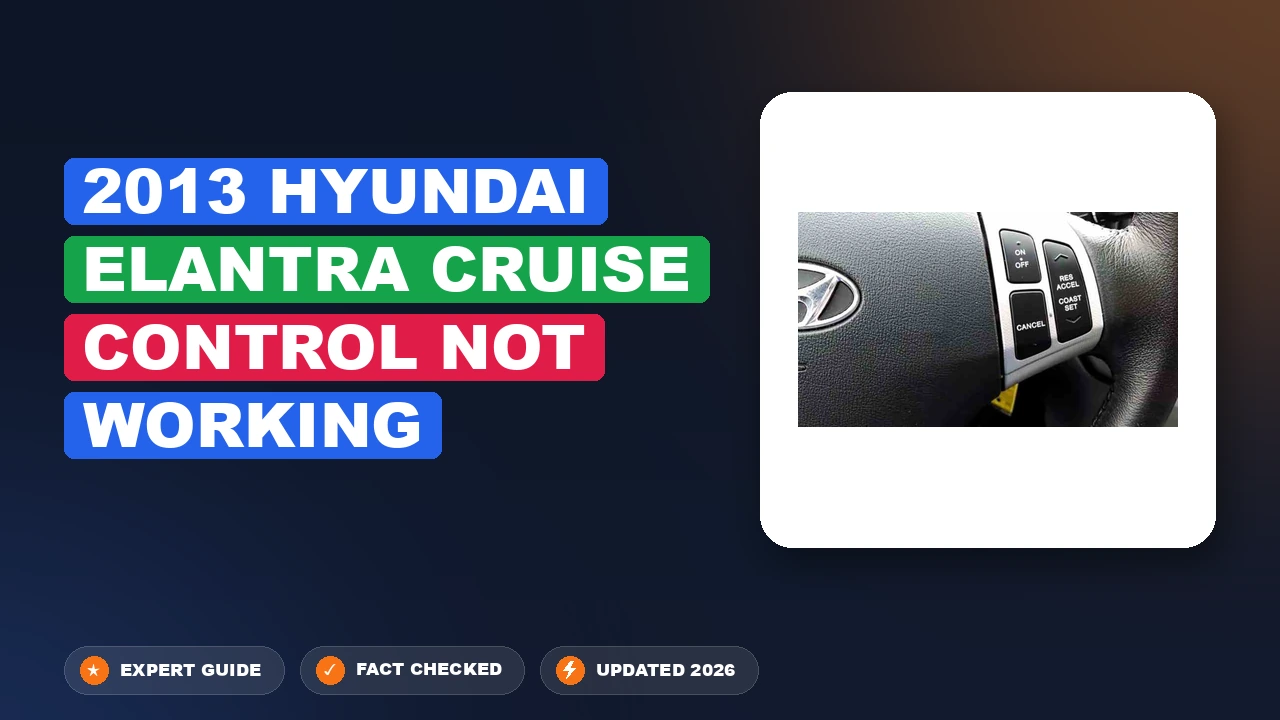
2013 hyundai elantra cruise control not working: Solved
Is your 2013 Hyundai Elantra losing its speed on the highway, leaving you manually managing the throttle during long drives? A non-functioning cruise control system is more than a mere convenience annoyance; it often serves as a diagnostic indicator of underlying electrical circuit issues that could, if left unaddressed, affect other integrated safety systems. In this guide, we break down exactly how to troubleshoot, diagnose, and fix your cruise control system, starting from the most common failure points and moving toward advanced electrical debugging.

Diagnosing 2013 Hyundai Elantra Cruise Control Not Working Causes
Recommended Best Deal Products


To effectively diagnose why your system is failing, you must view the cruise control not as a standalone unit, but as a complex circuit that relies on input from several sensors. Modern systems, including those in the 2013 Elantra, are safety-critical; they are hard-coded to disengage immediately upon sensing any brake pedal input to prevent unintended acceleration.

📤 Share Image

Why the Brake Light Switch Disables Cruise Control
The brake light switch is the most common culprit. In this model, the switch is a dual-function component: one circuit sends power to your brake lights, while the second circuit sends a logic signal to the ECM telling it to disable cruise control. Research indicates that the switch can fail on the internal logic side without affecting the exterior brake lights. If the switch sticks or fails, the ECM permanently assumes the driver is braking and inhibits all cruise functions.
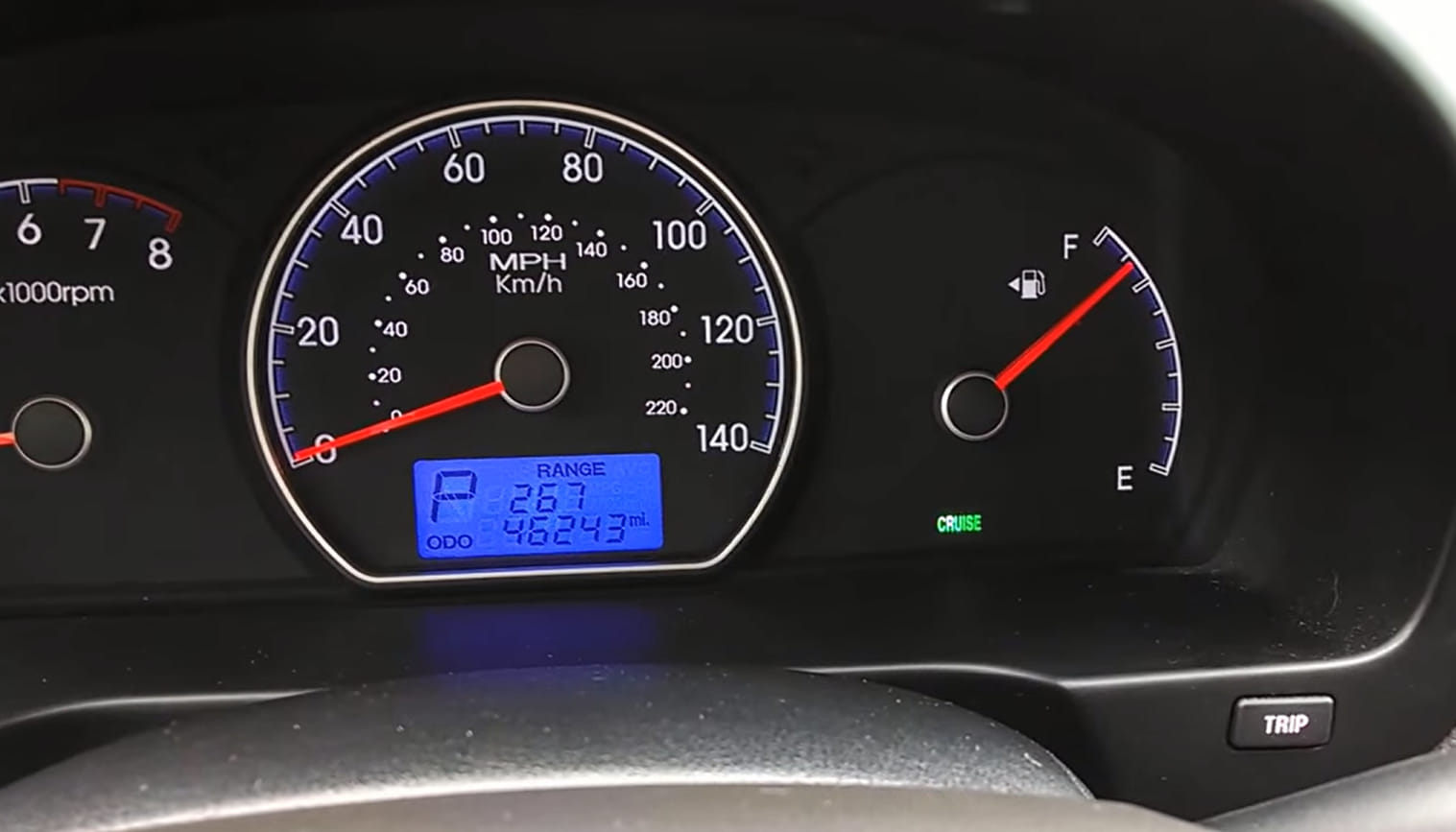
Identifying Clock Spring Failures and Steering Wheel Issues
The clock spring is a ribbon-cable assembly located behind the steering wheel. It facilitates electrical continuity between the steering wheel buttons (cruise, audio, etc.) and the steering column. Over time, physical rotation causes this ribbon to fatigue or tear. If your steering wheel controls work intermittently or fail entirely, the clock spring is likely the cause.

Understanding ECM and Vehicle Speed Sensor Feedback
The ECM requires a clean, consistent data signal from the Vehicle Speed Sensor (VSS) to maintain set speed. If the VSS output is erratic—due to wiring corrosion or internal sensor degradation—the system will disable itself for safety reasons. Furthermore, battery voltage fluctuations (outside the 11-14v range) can cause the sensitive internal logic of the cruise control module to enter a ‘fault state’ or lock out completely until power is stabilized.
Industry Data: Common Failure Frequency
Brake Switch Faults
Clock Spring Fatigue
How to Fix 2013 Hyundai Elantra Cruise Control Not Working Issues
Always disconnect the negative battery terminal and wait at least 10 minutes before performing any work on the steering wheel, airbag, or steering column components to prevent accidental deployment.
📋
Step-by-Step Fix Guide
Recommended Best Deal Products


Located under the dash near the pedal assembly. Depress the locking tab to unplug the connector, rotate the switch 45 degrees counter-clockwise to remove it, and install the new unit. Ensure the plunger is correctly adjusted to the pedal height.
After removing the steering column trim, check the harness for frayed wires or loose pins. Use a multimeter set to continuity mode to check the path from the switch back to the harness plug; if the circuit is open when buttons are pressed, the button module itself is faulty.
Use a high-quality OBD-II scanner capable of reading ‘B’ (Body) or ‘C’ (Chassis) codes. Standard engine code scanners often miss cruise control faults. Look for specific codes like ‘Cruise Control Switch Circuit Range/Performance’.

Audible — Listen Free for 30 Days
One free credit a month and thousands of titles included.
Listen Free for 30 DaysAdvanced Troubleshooting When Cruise Control Still Won’t Engage
If you have replaced the obvious culprits and the system remains unresponsive, you are likely dealing with intermittent electrical resistance or signal degradation. Use this advanced checklist to isolate the failure:
-
•
Engine Bay Grounding: Inspect the primary ground points near the battery tray and throttle body. Corrosion on these points can lead to ‘ghost’ electrical signals that confuse the ECM. Clean with a wire brush and apply dielectric grease. -
•
Vehicle Speed Sensor (VSS) Data: Use an OBD-II scanner to view ‘Live Data’ while driving. If the speedometer on your dash shows speed, but the OBD-II stream shows 0 or fluctuates wildly, the VSS or the wiring harness leading to the ECM is damaged. -
•
Clock Spring Verification: If your audio controls or horn also fail intermittently alongside the cruise control, this is a textbook symptom of a failing clock spring. The internal ribbon has likely lost the ability to maintain a connection throughout the steering wheel’s range of motion. -
•
Throttle Body Communication: The 2013 Elantra utilizes a Drive-by-Wire (Electronic Throttle Control) system. If the throttle body is excessively dirty, the ECM may receive out-of-range sensor feedback, leading it to disable the cruise control as a protective measure to ensure it retains full authority over throttle position.
2013 Hyundai Elantra Cruise Control Not Working Safety Precautions
Recommended Best Deal Products
![[2026 Upgrade] Windshield Sun Shade Umbrella for Hyundai Elantra/Sonata 2000–2026 Windshield Sun…](https://m.media-amazon.com/images/I/419wWYVbnQL._SS500_.jpg)

It is vital to respect the functional boundaries of your vehicle’s factory system. The factory cruise control is designed to operate within a specific window—typically between 25 mph and 90 mph. Operating outside these ranges, or attempting to use the system during adverse weather, negates the manufacturer’s safety protocols.
Standard Cruise Control Operating Limits
Never use the cruise control on slippery, wet, or icy roads. Because the system controls throttle application electronically, it cannot detect wheel spin in the same way a human driver can. If the system engages during a loss of traction, it may attempt to maintain speed by increasing power, which can lead to a total loss of vehicle control.
Avoid aftermarket cruise kits. The factory Elantra system is deeply integrated into the ECM and Electronic Throttle Control (ETC). Aftermarket add-ons often use clumsy, external actuators that can interfere with throttle response and may lead to check-engine lights or unintended acceleration events.
When to Consult a Professional Mechanic
If your troubleshooting indicates a fault deep within the wiring harness or if you are not comfortable handling airbag-related components, consult a certified technician. Attempting to probe the SRS (Supplemental Restraint System) wiring harness without proper training can result in airbag deployment or disabling the entire safety restraint system, creating a significant liability.
Summary and Final Advice
Addressing a 2013 Hyundai Elantra cruise control not working is usually a manageable task if you focus on the electrical signals and switches rather than the mechanical engine parts. Most issues are resolved by replacing the inexpensive brake light switch or the steering wheel clock spring. Always prioritize safety by disconnecting your battery before starting, and ensure you are using a scan tool capable of reading body-level diagnostic codes. If you have exhausted these steps without success, it is time to have a professional examine the vehicle to prevent damaging the sensitive ECM or the vehicle’s primary safety systems.
2013 Hyundai Elantra Cruise Control Not Working: Frequently Asked Questions
Why does the cruise light come on but the speed won’t set?
This indicates the system is powered but is receiving a ‘kill signal’ from a safety sensor. Most commonly, the brake light switch is stuck or sending a signal that the brake pedal is depressed, causing the cruise module to immediately disengage for safety reasons. Check your brake light operation first, as a misaligned switch is the primary cause of this specific symptom.
Can a blown brake light fuse stop cruise control from working?
Yes, absolutely. The cruise control system relies on the brake light circuit to detect when you press the pedal to disengage the cruise. If the ‘STOP LP’ fuse is blown, the cruise system loses its reference signal and defaults to ‘off’ to ensure that you do not accidentally accelerate while attempting to brake. Always replace the fuse and check for short circuits.
Is it safe to drive with the cruise control malfunctioning?
Yes, it is perfectly safe to drive your vehicle without a functioning cruise control system, as it is a convenience feature rather than a safety-critical mechanical system. However, if the cruise failure is accompanied by a check engine light or ABS warning light, you should have the vehicle inspected immediately to ensure that engine performance or braking systems are not also affected.
Audible Premium Plus — Annual Membership
12 audiobook credits up front, plus the full Audible catalogue.
See Annual PlansHow do I reset the cruise control system?
There is no ‘reset’ button for the cruise control; however, you can perform a hard reset by disconnecting the negative battery terminal for 10-15 minutes. This clears the volatile memory in the Engine Control Module (ECM). If the failure was due to a temporary electronic glitch, this may resolve it. If the underlying hardware is faulty, the system will fail again immediately.
How do I know if the steering wheel clock spring is the culprit?
A failing clock spring often presents with other symptoms alongside cruise control failure, such as the airbag (SRS) light illuminating or the steering wheel audio/phone controls becoming intermittent. Because the clock spring carries signals for these multiple systems, a failure rarely impacts just the cruise control buttons alone. If your horn also stops working, the clock spring is almost certainly the failed component.