Does Every Car Have Cruise Control? The Real 2026 Guide
No, not every car comes equipped with cruise control. While standard on most passenger vehicles, it remains an optional or excluded feature on many entry-level trims, commercial fleet models, and specific manual transmission vehicles.
No, not every car sold in 2026 comes equipped with cruise control. While it feels like a universal standard, many manufacturers still omit this technology from their absolute base-model vehicles. If you are shopping for a new car this year, assuming cruise control is included based on the sticker price or brand reputation is a common mistake that can lead to significant frustration during long highway commutes.

![[UPGRADED PROTECTION] 4 Set (8 pcs) Reusable Wine Bags for Travel, Wine…](https://m.media-amazon.com/images/I/51udmIJIgHL._SS500_.jpg)

This matters because the “standard” label is often applied loosely in marketing materials. In 2026, the absence of cruise control is primarily a strategy to drive buyers toward higher, more profitable trim levels. Understanding which vehicles lack this feature allows you to negotiate more effectively or switch your search to models that include it as a non-negotiable factory standard, rather than an expensive add-on.
Key Takeaways
- Confirm cruise control status by checking the steering wheel or stalk controls before purchasing.
- Expect base model economy cars and stripped-down commercial vans to potentially lack this feature.
- Differentiate between standard cruise control and modern adaptive systems for better driving comfort.
- Check vehicle trim level specifications, as base models often exclude convenience tech to lower prices.
- Avoid assuming a new vehicle includes cruise control just because it is a current model year.
Why Some Vehicles Lack Cruise Control Systems
The Economics of Entry-Level Trims
Manufacturers frequently strip cruise control from the lowest trim levels of subcompact cars and fleet-oriented vehicles. By removing the electronic components and steering wheel controls, automakers can hit a lower advertised “starting at” price point. In the 2026 market, you will most often encounter “de-contented” models in the following categories:

- Commercial Utility Vehicles: Bare-bones cargo vans and small work trucks often exclude cruise control to minimize maintenance costs and keep the vehicle focused on short-distance, city-based stop-and-go driving.
- Ultra-Budget Subcompacts: Entry-level sedans designed primarily for urban environments may exclude cruise control to maintain a price point under the $20,000 threshold.
- Specialized Manual Transmissions: While many manual cars feature cruise control, certain performance-oriented or enthusiast-focused base trims omit it to reduce weight or simplify the cockpit interface.
The Role of Fleet and Rental Specifications
Fleet vehicles are frequently built to a specific, minimal specification. Large companies ordering hundreds of units for city delivery services or short-range logistics often request these vehicles without cruise control to prevent driver fatigue or distraction. If you are shopping for a former fleet vehicle or a “stripped” model at a dealership, you are statistically more likely to find a car missing this convenience feature than if you were buying a mid-range consumer model.
Step-by-Step Guide to Identifying Cruise Control Features
The Pre-Purchase Inspection Method
Do not rely solely on a website description when checking for cruise control. Marketing materials for a 2026 model line often describe “available” features, which does not guarantee that the specific vehicle on the lot possesses them. Follow this process to verify before you sign:
- Check the Steering Wheel Face: Look specifically for the icons depicting a speedometer with an arrow or the text labels “CRUISE,” “SET,” and “CANCEL.”
- Inspect the Stalks: On many basic models, these controls are located on a dedicated stalk behind the steering wheel, separate from the turn signals or wipers.
- Review the Digital Instrument Cluster: Turn the ignition to the “accessory” position. If the car is equipped with cruise control, a small cruise icon usually lights up in the dashboard display during the initial system test.
Interpreting Trim Sheets and Window Stickers
The window sticker (often called the Monroney label) is your only legal confirmation of included equipment. Look for the section labeled “Standard Equipment.” If you do not see “Cruise Control” or “Adaptive Cruise Control” listed there, it is not on the vehicle. Never take a salesperson’s verbal confirmation as fact. If the window sticker is missing or illegible, request the “build sheet” using the vehicle’s VIN, which will provide an exact itemized list of every component installed at the factory.
Best Practices for Differentiating Adaptive vs. Standard Systems
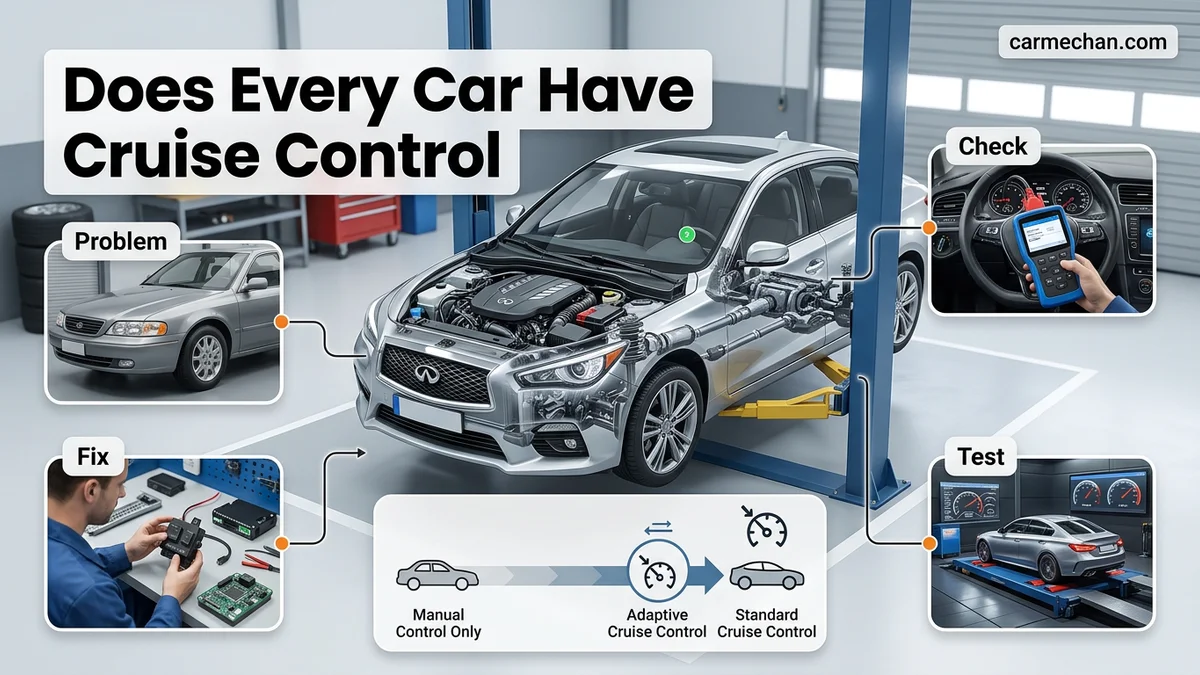
By 2026, the distinction between standard cruise control and Adaptive Cruise Control (ACC) has become a primary factor in vehicle safety rankings. Standard cruise control simply maintains a locked speed regardless of surrounding traffic. ACC, conversely, uses radar and camera sensors to automatically adjust speed based on the distance to the vehicle ahead.

Identifying Your System Type
- Check your steering wheel for a button icon showing a car with horizontal radar waves; this symbol confirms the presence of ACC.
- Consult the dashboard display when activating the system; standard cruise usually shows a speedometer icon, while ACC displays distance-setting bars.
- Test the system in a controlled environment; if your vehicle slows down automatically when approaching a slower car, you are utilizing adaptive technology.
Operational Differences
Manufacturers such as Toyota and Honda have standardized ACC across their 2026 lineups. Unlike standard systems, ACC requires the driver to set a following distance—often measured in car lengths or time intervals. According to the Insurance Institute for Highway Safety (IIHS), using ACC can significantly reduce rear-end collision risks in stop-and-go highway traffic. Drivers should note that standard systems are prone to “ghost braking” if the driver fails to monitor speed on inclines, whereas adaptive sensors adjust torque in real-time to maintain velocity.
What If Your Car Doesn’t Have Cruise Control


If your vehicle was manufactured without cruise control, or the feature is missing, aftermarket solutions exist but require caution. Retrofitting a system is a complex mechanical process that integrates with the electronic throttle body and speedometer signals.
Steps for Addressing Missing Features
- Verify if a “cruise control ready” wiring harness exists; many base-model 2026 vehicles share chassis components with higher trims, making a factory-style upgrade possible.
- Consult with a certified automotive technician to evaluate the compatibility of aftermarket kits, such as those from Rostra or Audiovox, which are designed for electronic throttle vehicles.
- If hardware installation is not feasible, prioritize driver-assistance apps that utilize GPS to provide speed alerts, though these do not mechanically control the throttle.
What If It Still Doesn’t Work?
If your cruise control system fails to engage despite having the hardware, the issue is typically electrical. Follow these diagnostic steps to narrow down the failure point:
- Check the fuse box for a blown cruise control circuit fuse; this is the most common and least expensive point of failure.
- Inspect the brake light switch located near the pedal assembly, as a faulty sensor often sends a “brake engaged” signal that cancels cruise control commands.
- Examine the clock spring behind the steering wheel, as this component often wears out and severs the connection between the wheel buttons and the engine control unit.
If these steps do not restore functionality, professional diagnostics are required. Expert service at a dealership or independent shop typically costs between $150 and $400 for sensor recalibration or electronic module replacement.
Conclusion
Not every car features cruise control, particularly at the ultra-compact or base-model entry level in 2026. While standard systems maintain steady speeds, modern adaptive cruise control offers superior safety through radar-assisted distance management. According to verified research from the National Highway Traffic Safety Administration, functioning driver-assist systems remain critical for long-distance fatigue reduction. As a next step, verify your vehicle’s specific trim level in the owner’s manual to confirm which cruise control features, if any, are factory-enabled.
❓ Frequently Asked Questions
Are there specific brands that still sell cars without cruise control?
Yes, budget-focused brands or specific ‘stripped’ commercial trim levels of work vans and compact hatchbacks may omit cruise control to keep the MSRP as low as possible.
How can I tell if my car has standard or adaptive cruise control?
Check your owner’s manual or look for distance-adjustment buttons on the steering wheel, which are specific to adaptive systems that track the car ahead.
Does trim level affect cruise control availability?
Absolutely; manufacturers frequently use cruise control as an ‘upsell’ feature to encourage buyers to move from base trim levels to mid-range or premium tiers.
Is it safer to have adaptive cruise control?


Adaptive cruise control is generally considered safer because it automatically maintains a safe following distance, reducing the risk of rear-end collisions in highway traffic.
Does every 2026 car model feature cruise control as standard?
While it is nearly ubiquitous, it is not guaranteed. Always verify the specific trim sheet for fleet or base-level vehicles to confirm inclusion.
What is the primary benefit of having cruise control?
The main benefit is improved comfort during long-distance driving by maintaining a constant speed without sustained foot pressure on the accelerator.