Ford F-250 Weight: Curb, GVWR, Payload, & Towing Specs 2025-2026
Last Updated on October 17, 2026 by Ryan
A 2026 Ford F-250 Super Duty weighs about 5,700 to 7,650 lbs empty (base curb weight, depending on cab, bed, drivetrain and engine) and has a GVWR of 10,000 to 11,400 lbs. Maximum payload is about 4,250 lbs, and maximum towing reaches 22,000 lbs conventional or about 23,000 lbs fifth-wheel and gooseneck with the diesel. The sticker on your own truck’s door jamb has the exact figures.
Planning to haul with your F-250? These towing accessories handle its full capacity:


As an Amazon Associate we earn from qualifying purchases.
🎯 Key Takeaways


- Check your specific F-250’s door jamb sticker for exact weights.
- Engine, cab, bed, and drivetrain significantly alter F-250 weight.
- Understand GVWR and payload limits for safe hauling.
- Conventional towing tops out at 18,200 lbs with the 7.3L gas V8 and 22,000 lbs with the 6.7L diesel (2026).
- Never exceed GCWR for combined truck and trailer weight.
Knowing your Ford F-250’s curb weight, GVWR, payload and towing limits keeps you inside legal and safe limits, whether you are hauling equipment, towing a fifth-wheel camper or loading up for a job site. This guide gives Ford’s own numbers first, then explains how to read them for your truck.
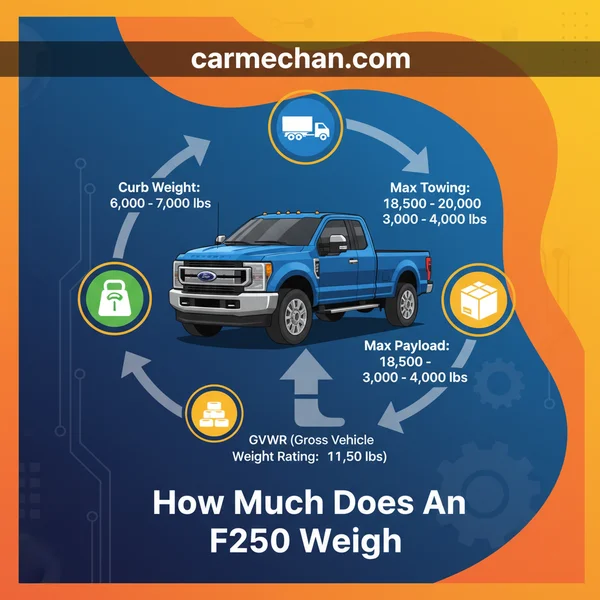
These numbers aren’t static; they fluctuate dramatically based on the model year, engine choice, cab configuration, bed length, and drivetrain (2WD vs. 4WD). Check the numbers for your exact build before you load or tow.
How Much Does a Ford F-250 Weigh? 2026 Numbers at a Glance



Empty weight means curb weight. GVW is the same number as GVWR, the maximum loaded weight Ford allows for the truck. These figures are for the F-250 Super Duty with single rear wheels, from Ford’s 2026 specifications.
| Measure | 2026 F-250 Super Duty | What decides it |
|---|---|---|
| Curb weight (empty) | 5,691 to 7,645 lbs | Base figures by cab, bed, drivetrain and engine. The 7.3L Regular Cab 4×2 is lightest; the high-output diesel Crew Cab 8 ft 4×4 is heaviest. |
| GVWR (GVW) | 10,000 to 11,400 lbs | Gas models run 10,000 to 10,600 lbs and diesels 10,600 to 11,400 lbs. Some diesel ratings need the Trailer Tow Package. |
| Maximum payload | 3,445 to 4,246 lbs | Minimum-equipment trucks. The top figure is the 7.3L Regular Cab 4×2. |
| GCWR | 21,000 to 31,000 lbs | Engine and axle ratio. The highest ratings need the High-Capacity Axle Upgrade Package. |
| Max conventional towing | 22,000 lbs | 6.7L diesels, 4×4 SuperCab or Crew Cab, with the axle package. |
| Max fifth-wheel / gooseneck | 22,300 / 23,000 lbs | Diesel Regular Cab 4×2. Ratings assume a 150 lb driver and passenger. |
Sources: Ford 2026 Super Duty technical specifications and Ford 2026 Super Duty towing guide. Your truck’s door jamb label has the figures that apply to it.
Understanding F-250 Weight Terminology: Curb Weight, GVWR, Payload, Towing Capacity, & GCWR


Before examining specific F-250 numbers, you need the basic terminology first. These figures define your truck’s operational capabilities and legal limits.
Curb Weight: The Truck’s Empty Mass
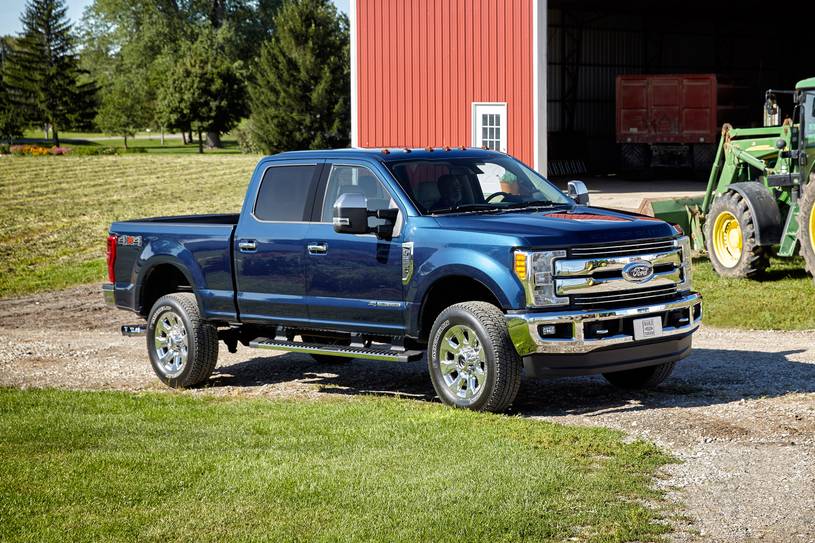
- Curb Weight: This is the weight of your F-250 exactly as it leaves the factory. It includes all standard equipment, fluids, and a full tank of fuel. Importantly, it excludes any passengers, cargo, or aftermarket accessories. Essentially, it’s the truck’s “empty” weight. For an F-250, base curb weights run from about 5,700 to 7,650 pounds in Ford’s 2026 specs. A heavier curb weight directly impacts your available payload capacity.
GVWR and Payload: What Your Truck Can Carry
- Gross Vehicle Weight Rating (GVWR): Your F-250’s GVWR is the maximum total weight allowed for the entire truck. This includes its curb weight plus the weight of all occupants, cargo, and any aftermarket additions. F-250 GVWRs run from 10,000 to 11,400 pounds in Ford’s 2026 specs. Exceeding this rating is unsafe, illegal, and can lead to mechanical issues or warranty invalidation.
- Payload: This is the maximum weight you can add to your truck (passengers, cargo, tools, accessories, and tongue/pin weight from a trailer). It’s calculated by subtracting your F-250’s Curb Weight from its GVWR. Always check the yellow sticker on your driver’s side door jamb for your specific truck’s exact payload capacity.
GCWR and Towing Capacity: Your Truck’s Hauling Power
- Gross Combined Weight Rating (GCWR): The GCWR is the absolute maximum weight of your truck, its contents, and any attached, loaded trailer combined. This total system weight must not exceed the GCWR. F-250 GCWRs run from about 21,000 to 31,000 pounds in Ford’s 2026 specs, depending on engine, axle ratio and packages.
- Towing Capacity: This specifies the heaviest trailer your F-250 can safely pull. It’s derived from the GCWR, minus your truck’s curb weight and all occupants/cargo. Conventional towing reaches 17,300 pounds with the 6.8L V8, 18,200 pounds with the 7.3L V8 and 22,000 pounds with the 6.7L diesel, and fifth-wheel and gooseneck ratings reach about 22,300 to 23,000 pounds on diesel trucks.
Everything You Need to Know About F250 Weight
Understanding the weight of your Ford F-250 Super Duty is far more than just knowing a number; it’s critical for safety, legal compliance, and maximizing your truck’s capabilities. Whether you’re planning to haul heavy loads, tow a substantial trailer, or simply want to ensure you’re operating within safe limits, knowing your F-250’s various weight specifications is paramount. This comprehensive guide will walk you through the process, from deciphering the stickers on your truck to calculating real-world payload and understanding how different configurations impact overall weight.
Step 1: Decoding the Numbers: Essential Weight Terminology
What you need: A basic understanding of automotive terms, or a willingness to learn; a pen and paper or digital notepad for jotting down definitions.
Instructions: Before you can understand your F-250’s weight, you need to speak the language. Familiarize yourself with these key terms: Gross Vehicle Weight Rating (GVWR) is the maximum permissible total weight of your fully loaded truck (including passengers, cargo, fuel, and the truck itself). Curb Weight is the weight of the truck itself with a full tank of fuel and all standard equipment, but no passengers or cargo. Payload Capacity is the maximum weight of cargo and passengers your truck can safely carry (GVWR minus curb weight). Gross Axle Weight Rating (GAWR) is the maximum weight that can be safely supported by a single axle. Finally, Gross Combined Weight Rating (GCWR) is the maximum allowable weight of the loaded tow vehicle and the loaded trailer combined.
Pro Tip: Don’t confuse “dry weight” (which typically excludes fuel) with “curb weight.” Your F-250’s curb weight already factors in a full tank of fluids, giving you a more accurate starting point for payload calculations.
Step 2: Locating Your F250’s Official Weight Specifications
What you need: Your F-250 truck, good lighting, and possibly a flashlight for dim areas.
Instructions: Your F-250’s official, legally binding weight specifications are printed on a certification label (often referred to as the “door jamb sticker”). Open the driver’s side door and look for a white or silver sticker typically located on the B-pillar (the post between the front and rear doors) or on the edge of the driver’s door itself. This label will clearly list your truck’s specific GVWR and GAWR for both front and rear axles. Some F-250s may also have additional stickers in the glove compartment or owner’s manual pouch that provide towing and payload capacities specific to your vehicle’s exact configuration.
Pro Tip: While owner’s manuals provide general specifications, always prioritize the information on your truck’s specific door jamb sticker. This sticker accounts for your vehicle’s exact options and factory configuration, which can vary significantly even within the same model year.
Step 3: Understanding Your Truck’s Curb Weight and GVWR
What you need: The GVWR from your door jamb sticker.
Instructions: The GVWR found on your door jamb sticker is a fixed, maximum limit set by the manufacturer for the safe operation of your F-250. This is the absolute heaviest your truck should ever be, including its own weight, all occupants, fuel, and cargo. While the GVWR is readily available, your F-250’s precise Curb Weight is not usually listed on the door jamb sticker because it varies based on factory options, engine choice, cab configuration, and drivetrain. In Ford’s 2026 base specs, F-250 curb weight runs from about 5,700 lbs (Regular Cab, 8 ft bed, 4×2, gas V8) to about 7,650 lbs (Crew Cab, 8 ft bed, 4×4, high-output Power Stroke diesel), and options and accessories add to that. You’ll either need to find your specific model’s curb weight online from Ford’s specifications or, for ultimate accuracy, weigh your empty truck.
Pro Tip: When researching curb weight online, be very specific about your F-250’s year, trim level, engine, cab style, bed length, and drivetrain (2WD/4WD). Even minor differences can impact the curb weight by hundreds of pounds.
Step 4: Calculating Your F250’s Practical Payload Capacity
What you need: Your F-250’s GVWR (from the door sticker) and its actual Curb Weight (from a specific source or scale ticket).
Instructions: The payload capacity is one of the most important numbers for any F-250 owner planning to haul. To calculate your truck’s practical payload capacity, subtract its actual Curb Weight from its GVWR. For example, if your F-250 has a GVWR of 10,000 lbs and a Curb Weight of 7,200 lbs, your payload capacity is 2,800 lbs (10,000 – 7,200 = 2,800). This 2,800 lbs must cover everything you put into the truck: all passengers, their luggage, tools, a fifth-wheel hitch (if applicable), and any cargo in the bed. Do not exceed this calculated payload under any circumstances, as it compromises safety and can lead to excessive wear and tear or even accidents.
Pro Tip: Always remember that the weight of a driver and any passengers counts towards your payload. If you regularly travel with a full crew, factor their combined weight into your available payload before loading any cargo.
Step 5: The F250 Weight Spectrum: How Configuration Matters
What you need: An understanding of your F-250’s specific configuration (engine, cab, bed, drivetrain, trim level).
Instructions: Not all F-250s weigh the same, even within the same model year. The specific configuration of your truck significantly impacts its curb weight and, consequently, its available payload. Key factors include: Engine Type (the 6.7L Power Stroke diesel adds roughly 750 to 800 lbs compared with the gasoline V8s in Ford’s 2026 base specs). Cab Style (Regular Cab is lightest, SuperCab is heavier, Crew Cab is heaviest). Bed Length (Long Bed adds weight over a Short Bed). Drivetrain (4WD adds roughly 350 to 450 lbs over 2WD). Trim Level and Options (higher trims like Lariat, King Ranch, or Platinum often come with heavier features like power running boards, heavier seating, and more sound deadening). Be mindful of these differences when comparing specifications or making purchasing decisions.
Pro Tip: When upgrading your F-250, remember that adding factory or aftermarket options (e.g., larger wheels, heavier tires, spray-in bed liners, sunroofs) directly reduces your available payload capacity, even if they aren’t considered “cargo.”
Step 6: Real-World Verification: Weighing Your F250 at a CAT Scale
What you need: Your F-250 (loaded as desired for weighing), payment method (cash/card), a pen and paper or smartphone for notes.
Instructions: For the most accurate measure of your F-250’s actual weight, either empty (for true curb weight) or loaded (to check against GVWR), visit a certified public scale, commonly found at truck stops (CAT Scales are prevalent). Drive your F-250 onto the scale so that the front axle, rear axle, and any trailer axles are on separate pads if weighing a combination. Follow the instructions from the scale operator (usually via intercom). You’ll receive a weigh ticket detailing the weight on each axle and the total combined weight. This is invaluable for understanding your truck’s real-world figures and ensuring you’re within legal limits when loaded or towing.
Pro Tip: Weigh your truck both empty (with a full tank of fuel) to establish your true curb weight, and then weigh it fully loaded with all passengers, cargo, and a full tank of fuel to see how close you are to your GVWR. This allows for precise payload calculation.
Step 7: Accounting for Accessories and Modifications
What you need: A list of all aftermarket accessories and modifications installed on your F-250, an estimate of their individual weights.
Instructions: Every item you add to your F-250, whether it’s a heavy-duty bumper, a winch, a full-size spare tire, a toolbox full of tools, a lift kit, or even a robust bed liner, increases its curb weight. This increase directly reduces your available payload capacity. For instance, if your stock F-250 has a 3,000 lb payload capacity and you add a 300 lb aftermarket bumper, your new effective payload capacity becomes 2,700 lbs. Count these additions in your calculation. If you’ve made significant modifications, consider visiting a CAT scale with your “accessorized empty” truck to get an updated curb weight before loading it.
Pro Tip: Don’t forget the weight of “always-in-the-truck” items like emergency kits, recovery gear, or even a child’s car seat. These seemingly small items add up and contribute to the overall curb weight for practical purposes.
Step 8: Connecting the Dots: F250 Weight and Towing Capacity (GCWR)
What you need: Your F-250’s GCWR (from the door sticker or owner’s manual), your truck’s actual loaded weight (from a CAT scale or calculation), and your trailer’s Gross Trailer Weight (GTW).
Instructions: When towing, your F-250’s curb weight, and specifically its loaded weight, plays a critical role in determining your effective towing capacity, as limited by the Gross Combined Weight Rating (GCWR). The GCWR is the maximum weight of your fully loaded truck AND your fully loaded trailer combined. To ensure you’re within limits, subtract your F-250’s actual loaded weight (including driver, passengers, and all cargo) from its GCWR. The result is the maximum weight your trailer can be. For example, if your F-250’s GCWR is 25,000 lbs and your truck itself weighs 8,500 lbs when loaded for a trip, your maximum trailer weight is 16,500 lbs (25,000 – 8,500 = 16,500). This figure is typically lower than the maximum conventional towing capacity found in marketing materials, as that often assumes a base truck with only a 150lb driver.
Pro Tip: Always weigh your truck and trailer combination on a CAT scale when fully loaded for a trip. This is the only way to be absolutely certain you are not exceeding your GCWR, GVWR, or individual GAWRs, ensuring maximum safety and legal compliance.
✅ Final Checklist
- ✅ You have located and understood all weight ratings (GVWR, GAWR, GCWR) on your F-250’s door jamb sticker.
- ✅ You have researched or accurately measured your F-250’s curb weight based on its specific configuration.
- ✅ You have calculated your F-250’s practical payload capacity (GVWR minus curb weight).
- ✅ You have accounted for the weight of all occupants, fuel, and aftermarket accessories when calculating loaded weight.
- ✅ You understand how different F-250 configurations (engine, cab, bed, 2WD/4WD) impact its curb weight and payload.
- ✅ You know how to use a CAT scale to verify your F-250’s actual loaded weights for safe operation and towing.
Important Notes:
- Safety Considerations: Exceeding any of your F-250’s weight ratings (GVWR, GAWR, GCWR, or payload) is extremely dangerous. It compromises braking performance, handling, stability, and can lead to tire failure, suspension damage, and loss of control, increasing the risk of accidents. Always err on the side of caution.
- When to Seek Professional Help: If you’re unsure about any weight calculations, interpreting your truck’s specific ratings, or have questions about safe towing or hauling practices, consult with a certified truck dealer, a professional towing and trailering specialist, or a vehicle weighing expert. They can provide accurate advice tailored to your F-250 and your specific needs.
- Estimated Time and Cost Range: This guide involves primarily research and calculation, which can take anywhere from 30 minutes to a few hours depending on your familiarity. Visiting a CAT scale typically takes 10 to 15 minutes per weigh-in and costs a modest fee, so check the price at the scale.
Key Factors Influencing F-250 Weight and Capacities
The “how much does an F-250 weigh” question has no single answer because numerous factors significantly alter its curb weight, and consequently, its payload and towing capabilities. Understanding these influences is essential for precise capacity assessment.
Engine, Drivetrain, and Cab/Bed Configurations
- Engine Choice: The engine is a major factor. Gasoline engines (the 6.8L and 7.3L V8s in 2025 and 2026, a 6.2L V8 in earlier years) give a lighter curb weight than the 6.7L Power Stroke diesel, whose heavier construction and emissions equipment add mass. The diesel also tows more, but its extra weight usually cuts payload: in Ford’s 2026 figures the Regular Cab 4×2 carries up to 4,246 lbs with the 7.3L gas V8 and 4,048 lbs with the 6.7L diesel.
- Drivetrain (2WD vs. 4WD): A 4×4 F-250 is always heavier than an equivalent 4×2 model. The added components for four-wheel drive, such as the transfer case and front differential, add roughly 350 to 450 lbs. This extra curb weight directly reduces both payload and towing capacity.
- Cab and Bed Configuration: Larger cabs and longer beds increase curb weight. A Crew Cab (four full doors) is the heaviest cab option, followed by the SuperCab and then the Regular Cab. Similarly, an 8-foot long bed adds more weight than a 6.75-foot standard bed. More materials mean more weight, directly impacting your available payload.
Model Year, Trim Level, and Options
- Model Year: Ford continually refines the F-250. Changes in materials (like the aluminum body introduced in 2017), chassis design and available powertrains affect curb weight and rated capacities. Even between 2025 and 2026, Ford’s published base curb weights for the 7.3L V8 dropped by about 110 lbs, so check the year that matches your truck.
- Trim Level and Options: A base XL model will have a lower curb weight than a luxurious Platinum trim. Factory options like premium wheels, larger infotainment systems, sunroofs, power running boards, and advanced towing packages all add weight to the truck. Each additional feature consumes a portion of your overall payload capacity, making a fully optioned truck capable of carrying less cargo or tongue weight.
Ford F-250 Weight Specifications: Model Year & Configuration Breakdown
Understanding the general weight categories is a great start, but the true picture of an F-250’s weight and capacities comes from its specific configuration and model year. Ford offers a range of options that significantly impact the final numbers.
How Configurations Impact Curb Weight
The curb weight of an F-250 is not a single, fixed number. It’s highly dependent on how the truck is built. Different engines, cab styles, bed lengths, and drivetrain options (2WD vs. 4WD) all contribute to the overall weight of the vehicle before any cargo or passengers are added. For instance, opting for the mighty 6.7L Power Stroke diesel engine significantly increases the truck’s curb weight compared to the standard gasoline engines, often adding hundreds of pounds due to its robust design and supporting systems. Similarly, a Crew Cab (four-door) with an 8-foot long bed will naturally weigh more than a Regular Cab (two-door) with a 6.75-foot bed.
- Engine Choice: Diesel engines are heavier than gasoline engines.
- Cab Style: Crew Cabs are heavier than SuperCabs, which are heavier than Regular Cabs.
- Bed Length: Longer beds add more weight.
- Drivetrain: 4×4 models are heavier than 4×2 due to additional components.
- Trim Level & Options: Luxury trims (e.g., Platinum) with added features like power running boards, larger wheels, and advanced safety tech can also increase curb weight.
As a practical example, a 2026 F-250 Regular Cab 4×2 with the 6.8L V8 and an 8-foot bed has a base curb weight of 5,697 lbs in Ford’s specs. A Crew Cab 4×4 with the 8-foot bed and the high-output 6.7L diesel starts at 7,645 lbs, about 1,950 lbs heavier before any options.
GVWR and Towing Capacity Variations
Just like curb weight, the Gross Vehicle Weight Rating (GVWR) of an F-250 also varies by model year and configuration. In Ford’s 2026 specs, gas F-250s carry a GVWR of 10,000 to 10,600 lbs, and diesels carry 10,600 to 11,400 lbs, with some of the higher diesel ratings requiring the Trailer Tow Package. Payload is the GVWR minus the truck’s curb weight, so a higher GVWR does not always mean more payload: the diesel’s extra weight takes back part of its extra rating.
Ford engineers carefully design each F-250 configuration to meet specific performance goals, meaning the axles, suspension, tires, and frame components are all matched to support the stated GVWR. Do not assume your F-250’s GVWR matches another truck’s specifications, even if it looks similar. Always refer to your truck’s unique ratings.
Finding Your F-250’s Exact Weight and Capacity Limits
While online resources and brochures offer general specifications, the most critical information for your specific Ford F-250 is found directly on the truck itself. These manufacturer-provided labels are your definitive source for legal and safe operation.
The Importance of Your Truck’s Specific Labels
Every F-250 comes equipped with a series of labels that detail its exact weight ratings and capacities. The most important of these is typically found on the driver’s side door jamb. This certification label and the “Tire and Loading Information” sticker provide precise, legally binding figures for your individual truck, considering all its factory options and features.
Look for these key pieces of information on your door jamb sticker:
- Gross Vehicle Weight Rating (GVWR): The maximum permissible weight of the fully loaded truck (including itself, passengers, and cargo).
- Gross Axle Weight Ratings (GAWR): Maximum weight permissible on each axle (front and rear). These matter for proper load distribution.
- Payload Capacity: Often stated as “The combined weight of occupants and cargo should never exceed X lbs.” This is the real-world payload capacity calculated specifically for your truck.
- Tire Information: Recommended tire sizes and pressures vital for safety and proper load handling.
These figures are specific to your VIN and reflect the truck’s design limits, ensuring you operate it safely and legally. Relying on these stickers helps you avoid guesswork and potential overloading issues.
Real-World Weighing for Precision
Even with the door jamb sticker, there’s a strong case for taking your F-250 to a certified scale. Truck stops, public weigh stations, and even some recycling centers offer scales that can provide an accurate, real-time curb weight for your vehicle, especially once you’ve added common accessories like toolboxes, a full tank of fuel, and the weight of regular passengers.
By weighing your F-250 on a scale, you can determine its actual operating curb weight, allowing you to precisely calculate your remaining available payload for any given trip. This is incredibly helpful when you’re preparing to haul a significant load or connect a trailer. Knowing your actual weight helps you stay well within your GVWR and GAWR limits, preventing excessive strain on your truck’s components and ensuring a safer driving experience. It’s a proactive step for anyone who regularly pushes their F-250 to its working limits.
Navigating Your F-250’s Weight Capacities
Understanding “how much an F-250 weighs” is more nuanced than a simple number. We’ve explored how curb weight, GVWR, payload, and towing capacities are interconnected and influenced by your truck’s specific configuration. From the engine choice to the cab style, every detail plays a role in defining your truck’s operational limits. Remember, your F-250 is a workhorse designed for specific tasks, and knowing its true capabilities is key to maximizing its potential safely.
To ensure you’re always operating within safe and legal parameters:
- Always refer to your F-250’s door jamb sticker for its precise GVWR, GAWR, and payload capacity.
- Consider a visit to a certified weigh station to establish your truck’s actual curb weight with typical occupants and gear, which will give you the most accurate real-world payload for your specific setup.
By taking these steps, you’ll gain confidence in managing your loads and towing with peace of mind. Drive smart, drive safe!
❓ Frequently Asked Questions
How much does a Ford F-250 weigh empty?
In Ford’s 2026 specs, base curb weight runs from 5,691 lbs (7.3L V8, Regular Cab, 8 ft bed, 4×2) to 7,645 lbs (high-output diesel, Crew Cab, 8 ft bed, 4×4). Options, accessories and fuel level change the number for a specific truck.
What is the GVWR of a Ford F-250?
The F250 GVWR in Ford’s 2026 specs is 10,000 to 11,400 lbs for the Super Duty with single rear wheels. Gas models run 10,000 to 10,600 lbs and diesels 10,600 to 11,400 lbs. The exact GVWR is on your door jamb label.
Why does the weight of an F-250 matter for towing and hauling?
The weight of an F-250 directly determines its legal payload and towing capacities, ensuring safe operation and compliance with vehicle regulations by preventing overloading. Exceeding these limits can lead to diminished performance, safety risks, and potential legal issues like fines or insurance complications.
How do different F-250 engines impact its curb weight and towing capacity?
The 6.7L Power Stroke diesel adds roughly 750 to 800 lbs of curb weight compared with the gas V8s in Ford’s 2026 base specs. However, these heavier engines often enable significantly higher towing and GCWR capacities due to their increased torque and durability.
What is the difference between Curb Weight, GVWR, and GCWR for an F-250?
Curb Weight is the F-250’s weight with all fluids and a full tank of fuel but no passengers or cargo. GVWR (Gross Vehicle Weight Rating) is the maximum total safe loaded weight of the truck itself, including passengers, cargo, and trailer tongue weight. GCWR (Gross Combined Weight Rating) is the absolute maximum safe weight of the fully loaded truck and its attached trailer combined.
Can an F-250’s trim level affect its overall weight?
Yes, higher F-250 trim levels often include more standard features, luxury additions, and sometimes larger wheels or heavier components, which can incrementally increase the truck’s curb weight compared to a base model. These additions reduce the available payload capacity that the truck can carry.
What is the typical towing capacity range for a modern F-250?
In Ford’s 2026 specs, conventional towing tops out at 17,300 lbs for the 6.8L V8, 18,200 lbs for the 7.3L V8 and 22,000 lbs for the 6.7L diesel. Fifth-wheel and gooseneck ratings reach about 22,300 to 23,000 lbs on diesel trucks. Other axle ratios and configurations tow less, so check Ford’s towing guide for your model year.
How much weight can a Ford F-250 carry?
Its payload. Payload is GVWR minus curb weight, so it changes with the build. In Ford’s 2026 specs the maximum payload for a base F-250 runs from 3,445 lbs to 4,246 lbs, with the top figure on the 7.3L V8 Regular Cab 4×2. Passengers, cargo, accessories and trailer tongue weight all come out of that number, so your door jamb label gives the real figure for your truck.
What ton is an F-250?
An F-250 is a three-quarter-ton truck by class name. That label is a naming convention left over from older payload ratings, not a measure of what the truck can carry today. In Ford’s 2026 specs the maximum payload is 3,445 to 4,246 lbs, well above 1,500 lbs (three-quarters of a ton).
How many kilograms does a Ford F-250 weigh?
Using Ford’s 2026 pound figures, base curb weight of 5,691 to 7,645 lbs is about 2,581 to 3,468 kg. GVWR of 10,000 to 11,400 lbs is about 4,536 to 5,171 kg, and maximum payload of 3,445 to 4,246 lbs is about 1,563 to 1,926 kg. To convert any other figure, multiply pounds by 0.4536.
How does adding aftermarket accessories impact an F-250’s weight ratings?
Every pound of aftermarket accessories (e.g., heavy bumpers, winches, toolboxes, camper shells, lift kits) added to your F-250 directly subtracts from its available payload capacity. It’s essential to account for these additions to avoid exceeding your truck’s GVWR, which can compromise safety, handling, and potentially void warranties.
2025-2026 Ford F-250 Super Duty: Updated Weight Specs
Ford’s 2025 and 2026 F-250 specs list a 6.8L V8 as the base gas engine, alongside the 7.3L V8 and the 6.7L Power Stroke diesel. Trucks from 2024 and earlier used a 6.2L base V8 and have different numbers, so use the door jamb label or Ford’s archived specs for those years.
F-250 Super Duty Engine Weight Impact (2026)
- 6.8L V8: 5,697 lbs (Regular Cab, 8 ft bed, 4×2) to 6,699 lbs (Crew Cab, 8 ft bed, 4×4)
- 7.3L V8: 5,691 to 6,673 lbs for the same two configurations
- 6.7L Power Stroke diesel: 6,455 to 7,502 lbs
- 6.7L High Output diesel: 6,598 to 7,645 lbs
- GVWR range: 10,000 to 11,400 lbs
- Maximum payload: 4,246 lbs (7.3L V8, Regular Cab 4×2, minimum equipment)
- Maximum conventional towing: 22,000 lbs (6.7L diesels)
2025 vs 2026: What Changed
Between Ford’s 2025 and 2026 figures, 7.3L V8 base curb weights are about 110 lbs lower, the diesels are 15 to 35 lbs lower, and the 6.8L is unchanged. The GVWR range (10,000 to 11,400 lbs) and the 22,000 lb maximum conventional towing rating are the same in both years.
F-250 Super Duty Weight by Configuration (2026)
Ford publishes base curb weights by cab, bed, drivetrain and engine rather than by trim. Higher trims such as Lariat, King Ranch, Platinum, Limited and Tremor add equipment and weight on top of these base numbers.
Base curb weight (lbs)
| Configuration | 6.8L V8 | 7.3L V8 | 6.7L diesel | 6.7L High Output diesel |
|---|---|---|---|---|
| Regular Cab, 8 ft bed, 4×2 | 5,697 | 5,691 | 6,455 | 6,598 |
| Regular Cab, 8 ft bed, 4×4 | 6,093 | 6,082 | 6,853 | 6,996 |
| SuperCab, 6.75 ft bed, 4×4 | 6,415 | 6,389 | 7,140 | 7,283 |
| Crew Cab, 6.75 ft bed, 4×2 | 6,041 | 6,014 | 6,835 | 6,978 |
| Crew Cab, 6.75 ft bed, 4×4 | 6,396 | 6,370 | 7,178 | 7,321 |
| Crew Cab, 8 ft bed, 4×4 | 6,699 | 6,673 | 7,502 | 7,645 |
GVWR and maximum payload (lbs)
| Configuration | GVWR (gas) | GVWR (diesel) | Payload: 6.8L / 7.3L / 6.7L / High Output |
|---|---|---|---|
| Regular Cab, 4×2 | 10,000 | 10,600 | 4,240 / 4,246 / 4,048 / 3,903 |
| Crew Cab, 6.75 ft bed, 4×4 | 10,500 | 11,100 | 4,008 / 4,034 / 3,684 / 3,669 |
| Crew Cab, 8 ft bed, 4×4 | 10,600 | 11,200 (11,400 High Output) | 3,800 / 3,826 / 3,445 / 3,640 |
Maximum towing by engine (lbs)
| Engine | Max GCWR | Conventional | Fifth-wheel | Gooseneck |
|---|---|---|---|---|
| 7.3L V8 | 26,000 | 18,200 | 19,500 | 19,500 |
| 6.7L Power Stroke diesel | 30,000 | 22,000 | 22,300 | 22,900 |
| 6.7L High Output diesel | 31,000 | 22,000 | 22,300 | 23,000 |
Source: Ford 2026 Super Duty technical specifications (edition 02/27/26) and 2026 towing guide. Payload is for minimum-equipment trucks with 17-inch tires. The highest GCWR ratings need the High-Capacity Axle Upgrade Package, and the 6.8L V8 tows up to 17,300 lbs conventionally. Conventional maximums apply to 4×4 SuperCab and Crew Cab trucks; fifth-wheel and gooseneck maximums apply to the Regular Cab 4×2. Always check your own door jamb label.
⚖️ See Also: Vehicle Weight Guides
Looking for weight specs on other vehicles? Here are our other weight guides with curb weight, GVWR, payload and towing data by trim and year.
- See also: Ford Maverick Towing & Weight Guide: Hybrid vs EcoBoost specs compared
- See also: Ford Explorer Weight Guide: Weight by trim level and towing capacity by year
- See also: Mazda MX-5 Miata Weight Guide: Lightest sports car compared by generation