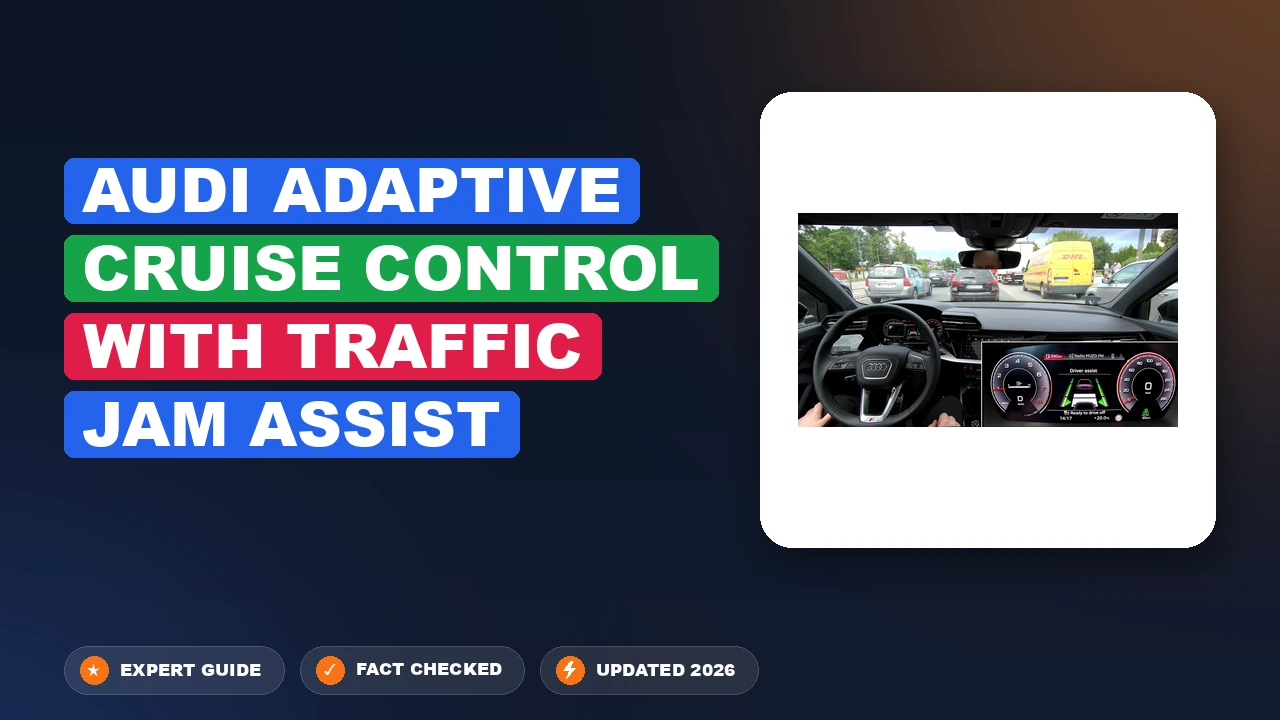
Audi Adaptive Cruise Control with Traffic Jam Assist Demystified
Ever wondered how much work your Audi is actually doing during that grueling morning commute? While modern luxury vehicles boast impressive technological suites, many drivers confuse high-level assistance systems with true autonomous driving, often leading to a dangerous over-reliance on automated features. This guide provides an expert look at what Audi Adaptive Cruise Control with Traffic Jam Assist can do, how the system functions under the hood, and the vital safety boundaries every driver must respect to ensure a professional and reliable driving experience.
Understanding Audi Adaptive Cruise Control With Traffic Jam Assist
Recommended Best Deal Products


📤 Share Image
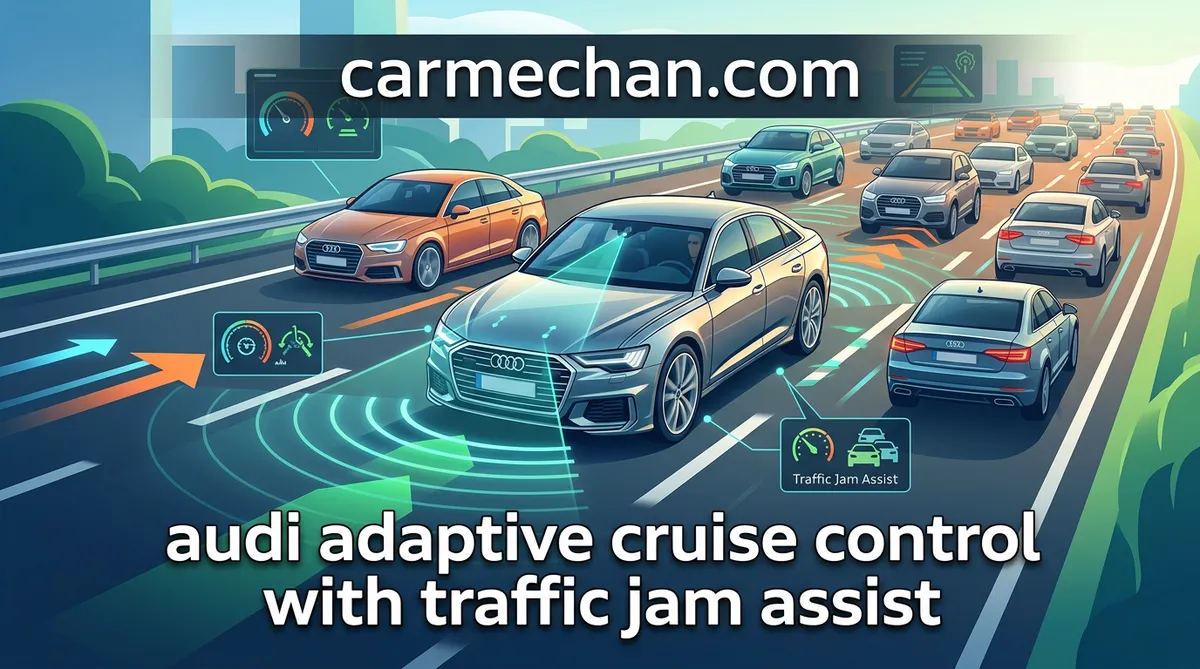
To master your vehicle’s capabilities, one must first distinguish between standard convenience features and active safety systems. Audi Adaptive Cruise Control (ACC) is designed to maintain a set distance from the vehicle in front, adjusting speed based on traffic flow. Traffic Jam Assist (TJA) extends this logic into dense, stop-and-go scenarios.
SAE Level 2 Automation Defined
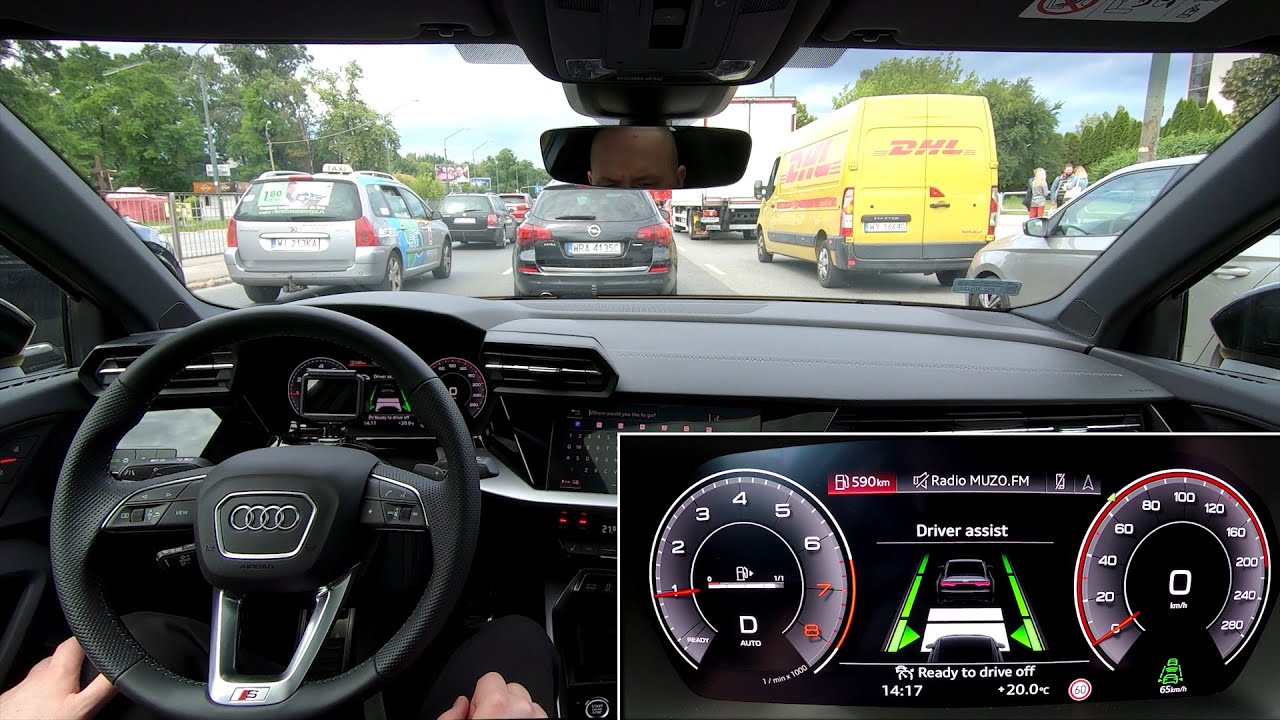
The system operates within the framework of SAE Level 2 automation. This means the vehicle provides both steering and acceleration/braking support simultaneously; however, it remains a “human-in-the-loop” technology. Unlike higher levels of automation, the driver is legally and physically responsible for the vehicle’s movement. TJA is specifically optimized for low-speed congestion, typically active between 0 and 65 km/h, assisting with lane guidance and distance maintenance in heavy traffic.

The Role of Sensor Fusion in Audi Systems
The true “brain” behind this operation is the zFAS (Zentrales Fahrerassistenzsteuergerät) controller. In older models, such as a 2018 A4, the system relies on mature radar and camera processing. In contrast, a 2026 model utilizes refined software algorithms within the zFAS to interpret complex urban environments with significantly higher fidelity. By integrating data from multiple sensors—a process known as sensor fusion—the vehicle creates a reliable model of its surroundings, allowing it to navigate stop-and-go traffic smoothly without erratic braking or steering inputs.
Technical Components of Audi Driver Assistance Systems
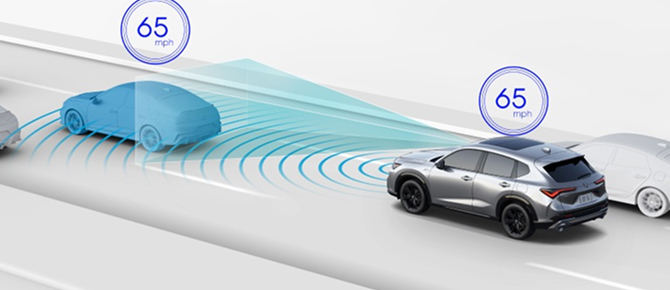
The reliability of Audi’s suite is rooted in its robust hardware architecture. Each component contributes to a cohesive environmental awareness, ensuring the vehicle maintains its trajectory and gap even in challenging conditions.
Front Radar and Camera Integration
Front Radar Sensors: Located in the front bumper or grille, these provide high-precision distance and relative speed data for vehicles ahead, regardless of lighting conditions.
Front Camera: Typically mounted behind the windshield, the camera reads lane markings and traffic flow patterns. Sensor fusion ensures that if radar data is blocked, the camera can still provide basic lane centering information.
Steering and Braking Control Modules
Electronic Stability Control (ESC) Unit: This module manages the brake pressure required to bring the vehicle to a complete, controlled stop in gridlock, and it facilitates the seamless restart of motion.
Steering Control Module: This provides active steering torque to keep the vehicle centered within the lane. It works in conjunction with the electric power steering motor to provide gentle, intuitive corrections that do not fight the driver’s natural inputs.
If your lane markings fade, the system may rely on the trajectory of the vehicle in front to maintain its path. Always monitor the instrument cluster icons to confirm whether the system is detecting the lane (green lines) or only the lead vehicle.
How to Operate Audi Adaptive Cruise Control With Traffic Jam Assist
Recommended Best Deal Products


Operational proficiency requires an understanding of how to engage and adjust the system effectively. Following these steps will ensure you utilize the technology safely and consistently.
📋
Step-by-Step Activation Procedures
Use the cruise control stalk or steering wheel buttons to toggle the system “On.” Set your desired speed once you have reached a comfortable driving pace.
Use the MMI interface or dedicated steering buttons to cycle through the 3–5 distance settings. A higher setting is recommended for inclement weather or higher speeds.
Newer models use a capacitive steering wheel that senses your touch. Older models rely on torque sensing—requiring slight resistance on the wheel to prove you are engaged.
Performance Limits and Environmental Constraints
Recommended Best Deal Products


Expert drivers understand that the most reliable system is one that recognizes its own limitations. Environmental conditions often dictate when the system must be disengaged.
Weather Impact on Sensor Reliability
Heavy rain, dense fog, or thick snow can obstruct radar frequencies and degrade camera visibility. When the sensors cannot “see” the road or the vehicle ahead, the system will disengage, issuing an auditory and visual warning. It is critical to take manual control immediately upon these warnings.
Recognizing System Disengagement Scenarios
Construction zones are notorious for confusing advanced driver assistance systems. Temporary lane markings, concrete barriers, and irregular traffic patterns can lead to false positives in lane centering. Never trust the system to navigate complex, non-standard road layouts. Additionally, if the vehicle detects that you are not providing steering input, it will initiate a tiered alert system, eventually leading to a complete deactivation if ignored.
Over-reliance on Traffic Jam Assist is a primary cause of driver inattention accidents. The system is designed to supplement your driving, not replace it. Never remove your hands from the steering wheel for extended periods.
Industry Data: Audi Driver Assistance Performance
Understanding how these systems compare is essential for any professional driver. The table below highlights the functional differences between standard cruise, ACC, and the more advanced Traffic Jam Assist.
By The Numbers
KM/H OPERATING RANGE
FOLLOW DISTANCE LEVELS
Final Assessment of Audi Traffic Jam Assist
Audi Adaptive Cruise Control with Traffic Jam Assist represents a pinnacle of convenience for the modern commuter, provided it is treated with the appropriate level of caution. It functions as a powerful tool to reduce fatigue during high-density traffic, relying on precise sensor fusion to maintain vehicle safety. However, it is fundamentally a support system, not an autonomous pilot.
To ensure the best results, always keep your windshield clean, as the camera relies on a clear view of the road markings. Furthermore, check your vehicle’s specific MMI settings to personalize the sensitivity of your alerts and distance intervals. By remaining the ultimate arbiter of safety behind the wheel, you allow Audi’s technology to perform its role while ensuring your journey remains secure, efficient, and reliable.
Audi Adaptive Cruise Control with Traffic Jam Assist: Frequently Asked Questions
Does Traffic Jam Assist steer the car for me?
Yes, but with significant limitations. It provides steering input to keep the vehicle centered within recognized lane markings at speeds under 40 mph. However, it is not a self-driving system. It requires the driver to monitor the path continuously and be ready to assume full control immediately if the road geometry changes or the system encounters an ambiguous situation.
Do I need to keep my hands on the steering wheel?
Yes. Audi’s system utilizes torque sensors in the steering column to verify that you are alert. If the system does not detect pressure or movement on the wheel, it will issue audible and visual warnings. If you continue to ignore these prompts, the system will initiate a controlled deceleration and eventually bring the vehicle to a safe stop.
Will the car come to a complete stop and restart on its own?
In most traffic scenarios, yes. If the vehicle ahead comes to a halt, your Audi will brake to a stop. If the traffic moves again quickly, the system will resume automatically. If the vehicle remains stopped for an extended period, you may need to briefly touch the accelerator pedal or press the ‘Resume’ button to signal your intent to proceed.
Does it work on winding roads?
Traffic Jam Assist is designed primarily for clearly marked, highway-style roads. While it can handle gentle curves, it is not intended for sharp, winding, or unpainted backroads. The system relies on high-quality lane detection to function reliably. If the curves are too tight for the cameras to maintain a clear lane path, the system will disengage and request manual input.
Can the system detect motorcycles or pedestrians?
Yes. The radar and camera fusion used in Audi’s suite is highly capable of identifying motorcycles and other vehicles. While it does include pedestrian detection as part of the Pre-Sense safety umbrella, Traffic Jam Assist specifically focuses on vehicle-to-vehicle follow distances. Always rely on your own vision for pedestrian safety, especially in dense urban environments where sensor occlusion is common.