Ford F-150 AC Not Working Causes and Fixes 2026
Last Updated on June 24, 2026 by Albert Duke
If your Ford F-150 AC is not working, start by identifying what the system is doing before replacing parts. Air conditioning failure can come from low refrigerant, a leak, compressor failure, electrical faults, a stuck blend door, or weak airflow through the vents.
RepairPal lists the most common Ford F-150 AC failure areas as refrigerant leak, electrical climate control issue, and AC compressor problem. Its symptom data shows refrigerant leak at 37 percent, climate control electrical issue at 21 percent, AC compressor at 12 percent, and other causes at 30 percent.
Do not blindly add refrigerant every time the air gets warm. That may hide a leak, overcharge the system, or delay the real repair. Start with the symptom you can see or feel, then narrow the fault from there.
5 Common Reasons Ford F-150 AC Stops Working

Most Ford F-150 AC problems fall into five fault groups. Once you understand those groups, you can avoid replacing the wrong part.
Low Refrigerant Leak
Low refrigerant is one of the most common reasons an F-150 AC blows warm air. The refrigerant is the chemical that moves heat out of the cabin.
A leak can happen at hoses, seals, the condenser, evaporator, compressor, or service ports. If the system is low, the compressor may not turn on because the pressure switch protects it from damage.
RepairPal identifies refrigerant leak as the largest listed cause category for Ford F-150 AC not working, at 37 percent of reported causes on its symptom page.
Compressor Not Engaging
The compressor is the pump that moves refrigerant through the AC system. If it does not engage, the air from the vents may stay warm even when fan speed feels normal.
A non-engaging compressor can mean a bad clutch, low refrigerant, bad relay, blown fuse, pressure switch issue, damaged wiring, or a failed compressor. Before replacing the compressor, confirm that it is receiving the correct command and power.
Electrical Control Fault
Modern F-150 HVAC systems use electrical controls, sensors, relays, fuses, and modules. HVAC means heating, ventilation, and air conditioning.
A bad fuse, relay, control head, wiring fault, or HVAC module issue can stop the compressor or blower from working. Some issues need a scan tool that can read body or HVAC codes, not just basic engine codes.
Blend Door Stuck
A blend door controls how much heated or cooled air enters the cabin. The blend door actuator is a small electric motor that moves that door.
If the actuator sticks, the AC system may be cold, but the cabin still gets warm air. Clicking behind the dash or one side blowing hot while the other side blows cold often points toward this area.
Weak Cabin Airflow
Weak airflow can come from a clogged cabin air filter, blower motor issue, blower resistor or control module fault, recirculation door problem, or evaporator icing.
This is different from “AC not cold.” The system may be cold, but the cabin is not getting enough air through the vents.
Once you know these five groups, the fastest path is matching them to your exact symptom.
If Your Ford F-150 AC Blows Warm Air
If your F-150 has strong airflow but only warm air, the problem is usually cooling production, not the blower. Start by checking whether the compressor clutch engages when AC is selected.
If the compressor clutch never engages, check the owner manual for the correct fuse and relay locations for your exact year. Fuse layouts can change across F-150 generations, so do not use a random diagram from another model year.
If the clutch engages but the air stays warm, suspect low refrigerant, a weak compressor, poor condenser airflow, or a blend door that is mixing in heat. A cheap low-side recharge gauge can give a rough clue, but it does not replace proper high-side and low-side pressure testing.
If you hear clicking behind the dash or the temperature does not change when you move from hot to cold, the blend door actuator becomes a stronger suspect. For electrical checks, a guide on how to clear check engine light codes can help explain why stored codes matter, but basic OBD2 readers may not read HVAC module data.
Do not keep adding refrigerant if the system loses cooling again. A working AC system should not need frequent top-offs. Warm air is one problem, but weak airflow points to a different part of the HVAC system.
If Your Ford F-150 Has Weak AC Airflow
Weak airflow means the AC may be cooling, but the cabin is not getting enough air through the vents. The first check is simple: move the fan speed from low to high and confirm the airflow changes clearly.
If fan speed does not change much, suspect the blower motor, blower resistor, blower control module, or control circuit. If airflow changes normally but still feels blocked, check the cabin air filter if your year and configuration uses one.
If the air starts cold, then airflow fades after driving, the evaporator may be icing. That can happen from airflow restriction, refrigerant charge problems, sensor faults, or control issues.
There are owner and forum reports about some 2021 to 2023 F-150 trucks showing warm air, lack of airflow, or evaporator freezing tied to HVAC software updates. This needs manual verification through Ford OASIS or an official Ford service information source before publishing as a confirmed TSB. Mark it as Ford OASIS or official Ford TSB database.
If weak airflow is the main symptom, do not begin with the compressor. Start with the air path, blower behavior, and freeze-up pattern. If the air starts cold and then turns warm, the next branch is intermittent cooling.
If Your Ford F-150 AC Works Then Stops
Intermittent AC is harder to diagnose because the system may test normal when it is cold. The timing of the failure gives the best clue.
| Symptom | Likely Area | First Check |
|---|---|---|
| Cold at first, then warm | Evaporator icing or pressure issue | Check if airflow fades before air gets warm |
| Cold on highway, warm at idle | Condenser airflow or pressure issue | Check fan operation and front condenser blockage |
| Works after restart | Sensor, module, clutch, or control fault | Scan for HVAC or body control codes |
| Compressor cycles rapidly | Low charge or pressure switch issue | Check for leak before recharging |
| AC quits after engine heat builds | Compressor clutch or electrical fault | Test power and clutch behavior when hot |
If the AC works at highway speed but warms up in traffic, the condenser may not be shedding heat well. Dirt, bugs, damaged fins, fan problems, or pressure issues can all show up more at idle.
If the AC quits after the truck gets hot, the compressor clutch coil or electrical connection may fail only under heat. That kind of fault can be missed during a quick cold test.
If the lines freeze, airflow drops, or the system behaves normally only after sitting, stop guessing. The truck needs proper pressure testing and leak diagnosis. Temperature problems can also come from the air-mixing doors inside the dash.
If One Side Blows Hot and One Side Blows Cold
If one side of the cabin is cold and the other side is warm, the refrigerant system may not be the first suspect. Dual-zone trucks can have separate air-mixing control for each side.
Dual Zone Temperature Split
A driver-side cold and passenger-side warm split often points toward a blend door actuator, mode door issue, or calibration problem. The AC system may still be cooling correctly.
This is why adding refrigerant may do nothing. The cold air exists, but the air door is not sending the right mix to one side.
Clicking Behind Dash
Clicking behind the dashboard often points to an actuator gear slipping or a door motor trying to move past its limit. The sound may happen during startup, after changing temperature, or when switching vent modes.
Do not remove the dash based only on sound. Actuator location changes by year, trim, and HVAC setup.
No Temperature Change
If the temperature knob or digital control changes on the screen but vent temperature does not change, the actuator or control command needs diagnosis. Dual-zone trucks may need separate checks for each side.
After checking the symptom, the next step is deciding what you can safely test at home.
How To Diagnose Ford F-150 AC Problems at Home
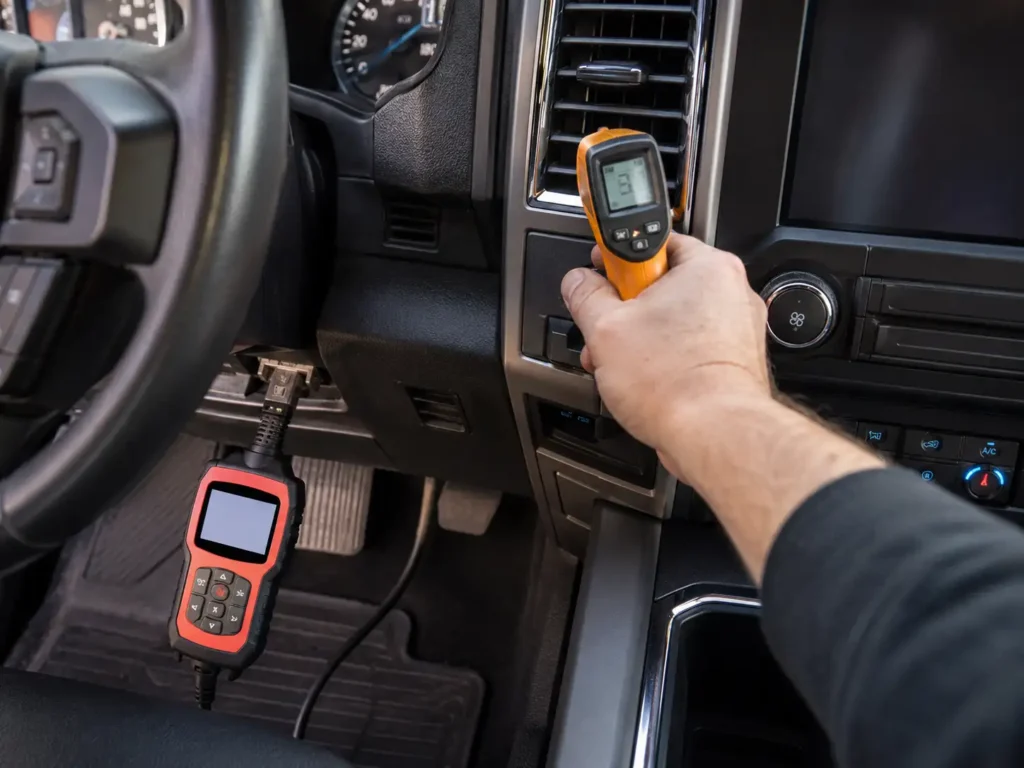
You can narrow many F-150 AC problems at home before touching refrigerant. These checks help you decide whether the issue is airflow, electrical control, cooling performance, or a dash air door.
- Confirm Fan Speed and Vent Mode
Turn the fan from low to high. Switch between dash vents, floor, and defrost.
If airflow does not change, start with the blower circuit and vent doors. If airflow is strong but warm, move to compressor and cooling checks.
- Check Compressor Engagement
With the engine running and AC selected, look at the compressor pulley area. The clutch face should engage on clutch-style systems when the system commands the compressor on.
Some newer systems may use different compressor control designs, so do not rely on clutch movement alone for every year. If you are checking electrical behavior, use your year-specific service data.
- Look for Visible Leaks
Check for oily residue near AC hoses, condenser edges, compressor body, and service ports. Refrigerant oil can leave dirt-sticking residue around leak points.
A large leak needs proper repair, evacuation, and recharge. A refill can make the AC cold briefly, but it does not fix the leak.
- Check Fuses and Relays by Year
Use your owner manual or fuse box cover for exact fuse and relay identification. Ford changes fuse layouts between generations and trims.
Do not replace the compressor because a random video mentioned one fuse number. The correct fuse for a 2012 truck may not match a 2021 truck.
- Scan for HVAC or Body Codes
OBD2 means On-Board Diagnostics. Basic OBD2 scanners usually read engine and emissions codes, but many do not read HVAC, body control, or climate module codes.
A more capable scan tool may show actuator faults, pressure sensor data, or module communication issues. For broader tool selection, Car Mechan’s best OBD2 scanner for the money guide is useful if you need more than a basic code reader.
- Stop Before Opening the System
Do not open AC lines, replace the compressor, or vent refrigerant at home. Refrigerant work needs the right recovery and recharge equipment.
These checks tell you whether the fix is simple or whether the truck needs pressure testing.
When Ford F-150 AC Repair Needs a Shop
Some F-150 AC checks are owner-friendly, but opening the refrigerant system is shop work. The EPA says technicians who service motor vehicle AC systems for payment must be trained and certified under Clean Air Act Section 609.
Call a shop if you find any of these issues:
- The AC system is empty or loses refrigerant again after recharge.
- The compressor needs replacement.
- The condenser or evaporator may be leaking.
- The lines are freezing.
- You need high-side and low-side pressure testing.
- The system was overcharged.
- The truck needs module programming or Ford service software.
RepairPal estimates Ford F-150 AC compressor replacement at $887 to $1,092, with labor estimated at $175 to $257 and parts at $712 to $836. That estimate does not include taxes, fees, location differences, or related repairs.
If the problem is a fuse, relay, actuator, or clogged filter, the repair may be far less than a compressor job. But if the system needs recovery, leak testing, and recharge, a proper AC shop is the safer path.
With the repair limit clear, a quick decision table can point you to the next best action.
Ford F-150 AC Not Working Quick Decision Guide
Use this table to match your F-150 AC symptom to the next check. It is not a replacement for pressure testing, but it helps you avoid guessing.
Ford F-150 AC Symptom Decision Guide
Match the symptom you feel in the cabin to the most likely system area before replacing parts.
Strong Airflow But Not Cold
Likely area: low refrigerant, compressor command, condenser airflow, or blend door fault.
Low Air From Vents
Likely area: cabin filter, blower motor, blower control, recirculation door, or evaporator icing.
Cold Then Warm
Likely area: evaporator freeze-up, pressure issue, compressor clutch heat failure, or control fault.
One Side Hot One Side Cold
Likely area: blend door actuator, dual-zone temperature door, or HVAC control calibration.
| F-150 AC Symptom | Most Likely Fault Area | First DIY Check | Stop DIY When |
|---|---|---|---|
| Strong airflow but warm air | Low refrigerant, compressor, blend door | Check compressor engagement and temperature response | Refrigerant is low or system pressure is unknown |
| Weak airflow | Cabin filter, blower, evaporator icing | Test fan speeds and vent modes | Airflow fades while lines freeze |
| Cold then warm | Freeze-up, pressure issue, clutch heat fault | Note when cooling stops | AC only returns after truck sits |
| One side hot one side cold | Blend door actuator | Change both temperature zones | Dash disassembly is needed |
| Compressor not engaging | Fuse, relay, low charge, pressure switch | Check year-specific fuse and relay | Power and pressure checks are needed |
| Works only while driving | Condenser airflow or high pressure issue | Inspect condenser blockage | Idle cooling fails repeatedly |
The table gives you the path, but a few mistakes can make the repair more expensive.
4 Ford F-150 AC Mistakes To Avoid
Many F-150 AC repairs get expensive because the first diagnosis is rushed. Avoid these four common mistakes before buying parts.
Adding Refrigerant Repeatedly
A sealed AC system should not need frequent refrigerant. If it keeps getting warm again, there is likely a leak or control issue.
Repeated recharge cans can also overcharge the system. Too much refrigerant can reduce cooling and make diagnosis harder.
Replacing The Compressor Too Soon
A compressor that does not engage is not always bad. Low refrigerant, a blown fuse, bad relay, pressure switch issue, or wiring fault can stop engagement.
Confirm power, command, clutch behavior, and system pressure before replacing the most expensive part.
Ignoring Blend Door Symptoms
Warm air does not always mean the AC system cannot make cold air. If one side is hot, temperature controls do nothing, or the dash clicks, check blend door behavior.
A refrigerant refill will not fix a stuck air door.
Using Wrong Fuse Locations
Ford F-150 fuse layouts vary by year, engine, and trim. Using the wrong diagram can waste time or cause electrical mistakes.
Use the owner manual, fuse box cover, or verified service information for your exact truck.
Avoiding those mistakes makes the final decision much simpler.
What To Do Next With Your Ford F-150 AC
The right fix for a Ford F-150 AC not working starts with the symptom, not the most expensive part. Warm air, weak airflow, intermittent cooling, and one-side temperature problems point to different fault areas.
Start with safe checks: fan speed, vent mode, compressor engagement, visible leaks, fuse location, and blend door behavior. Use your exact model year before checking fuses or relays.
If the system needs refrigerant recovery, pressure testing, leak repair, or compressor replacement, stop and use a qualified AC shop. That is how you protect the system and avoid paying for parts that were never the real problem.
FAQ
Why Is My Ford F-150 AC Blowing Warm Air?
Your Ford F-150 AC may blow warm air because of low refrigerant, a leak, compressor trouble, an electrical control issue, or a stuck blend door. If airflow is strong but not cold, start by checking compressor engagement and whether the temperature changes when you adjust the controls.
Why Does My F-150 AC Work Then Stop?
An F-150 AC that works then stops may have evaporator icing, low refrigerant, pressure switch problems, compressor clutch heat failure, or a control issue. Note whether airflow fades first or the air simply turns warm, because those symptoms point to different checks.
Can I Recharge My Ford F-150 AC Myself?
You can use a recharge kit for a basic low-side reading, but it is not a complete diagnosis. If the truck keeps losing cold air, needs repeated refrigerant, or shows abnormal pressure behavior, the system needs leak testing and professional service.
Why Is One Side of My F-150 Blowing Hot Air?
One side blowing hot while the other side blows cold often points to a blend door actuator or dual-zone temperature control problem. The refrigerant system may still be cooling correctly, but the air door may not be sending cold air to one side.
How Much Does Ford F-150 AC Compressor Replacement Cost?
RepairPal estimates Ford F-150 AC compressor replacement at $887 to $1,092. The estimate lists labor at $175 to $257 and parts at $712 to $836, but taxes, fees, location, and related repairs can change the final bill.
Can a Bad Fuse Stop the F-150 AC Compressor?
Yes, a bad fuse or relay can stop the F-150 AC compressor from engaging. Always check the fuse diagram for your exact year, because Ford changes fuse layouts across generations and trim levels.