
How to Check Car Engine Oil Step by Step for Any Brand
Last Updated on October 21, 2026 by Albert Duke


To check car engine oil, park on level ground, turn the engine off, and wait 15 minutes unless your manual says otherwise. Then pull the dipstick, wipe it clean, push it in fully, and read the level on the second pull.
Wait times differ by brand, so a table built from owner’s manuals is included below. You will also learn how to read the marks and color, what to do if the level is off, and what to do if your car has no dipstick.
5 Things to Do Before You Check Engine Oil
Five quick checks make the reading trustworthy.
- Park on level ground. Put the car in Park (Neutral for a manual) and set the parking brake. Even a slight slope can change the reading.
- Keep the engine off. Hot parts under the hood can burn you, so do not reach in while everything is still hot.
- Grab a clean, lint-free rag. A flashlight helps you see the oil line.
- Open your owner’s manual to the oil page. It sets the wait time and tells you which marks to use.
- Know your dipstick. The handle is usually a bright color, often yellow, though one Honda manual page describes orange or black. Some engines have more than one dipstick, so confirm it is the engine oil one.
How to Check Car Engine Oil in 6 Steps
These six steps work on any car with a dipstick. Each one shows what to do and what you should see.
- Park and shut off the engine.
- Do: Stop on level ground, shift to Park, set the parking brake, and turn the engine off.
- See: A car sitting flat with the engine silent.
- Wait for the oil to drain back.
- Do: Wait 15 minutes unless your manual gives a shorter time. <a href=”https://www.ford.com/support/how-tos/oil-change/oil-change-information/adding-engine-oil” target=”_blank” rel=”noopener”>Ford’s support page says to wait at least 15 minutes</a> so the oil can return to the pan.
- See: Nothing yet. The oil is draining from the upper engine back into the pan.
- Open the hood and find the dipstick.
- Do: Pull the hood release inside the cabin, then lift the safety catch and prop the hood.
- See: A brightly colored handle at the top of a thin metal stick.
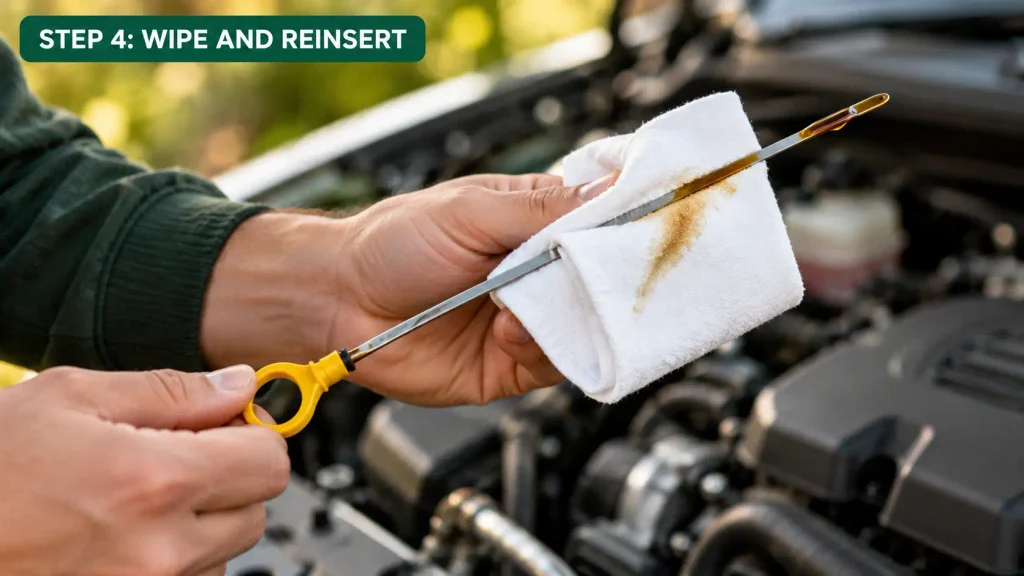
- Pull, wipe, and reinsert.
- Do: Pull the dipstick out, wipe it with a clean rag, and push it back in all the way.
- See: A clean, dry stick, ready for the real reading.
- Pull again and read the level.
- Do: Pull it out and hold it level. Check both sides and go by the lower mark, as Ford advises.
- See: An oil line between the lower and upper marks.
- Add oil if needed and close up.
- Do: If the line is at or below the lower mark, add a little oil and recheck. Then reinsert the dipstick and close the hood.
- See: A level at or just below the top mark.
Oil Check Wait Times for 6 Popular Car Brands
Wait times are not the same across brands, so use the row for your car.
Oil Check Wait Times by Brand
Based on owner’s manual and manufacturer support pages. Your own manual always wins.
| Brand | Source | Engine state | Wait time | Dipstick marks |
|---|---|---|---|---|
| Honda | Owner’s manual page (model not shown) | Engine off | About 3 min | Upper and lower |
| Mazda | 2019 CX-5 manual (European) | Warm up, then off | At least 5 min | MIN and MAX |
| Ford | Ford support page | Engine off | At least 15 min | MIN and MAX |
| Hyundai | 2026 U.S. owner’s manual | Warm up, then off | 15 min | L and F |
| Kia | 2023 manual (non-U.S.) | Warm up, then off | 15 min | See your manual |
| Nissan | 2025 Juke manual (Ireland) | Warm up, then off | At least 15 min | MIN and MAX |
When your manual gives no figure, 15 minutes is a safe default. Toyota and Subaru are not listed, so use the oil page of your own manual.
Ford, Hyundai, Kia, and Nissan all point to 15 minutes. Mazda’s manual asks for at least 5 minutes, and a Honda manual page says about 3 minutes with the engine off. When your manual gives no figure, 15 minutes is a safe default.
The Kia, Nissan, and Mazda rows come from non-U.S. manuals, so check the edition for your market. For Toyota and Subaru, use the oil page of your own manual. For the full timing breakdown, see our guide on <a href=”https://carmechan.com/troubleshooting/how-long-to-wait-to-check-oil-after-driving/”>how long to wait to check oil after driving</a>.
Should You Check Oil With a Hot or Cold Engine
Check with the engine off, never while it runs. The oil needs time to drain back into the pan, and every manual above builds that wait into its steps.
The Hyundai, Kia, Nissan, and Mazda manuals say to run the engine to normal operating temperature, shut it off, then wait. The Ford and Honda pages we reviewed only say to shut it off and wait.
<a href=”https://www.motul.com/en-MY/information/engine-oil-dipstick-levels” target=”_blank” rel=”noopener”>Motul recommends about 10 minutes</a> and warns that checking right after driving can give a misleading reading.
Pick the method your manual allows and use it every time. That keeps your readings comparable from one check to the next.
How to Read the Dipstick Marks and Oil Color
Read two things on the dipstick: the level and the condition of the oil. Mark labels differ by brand. Ford, Nissan, and Mazda use MIN and MAX, Hyundai uses L and F, and Honda refers to upper and lower marks.
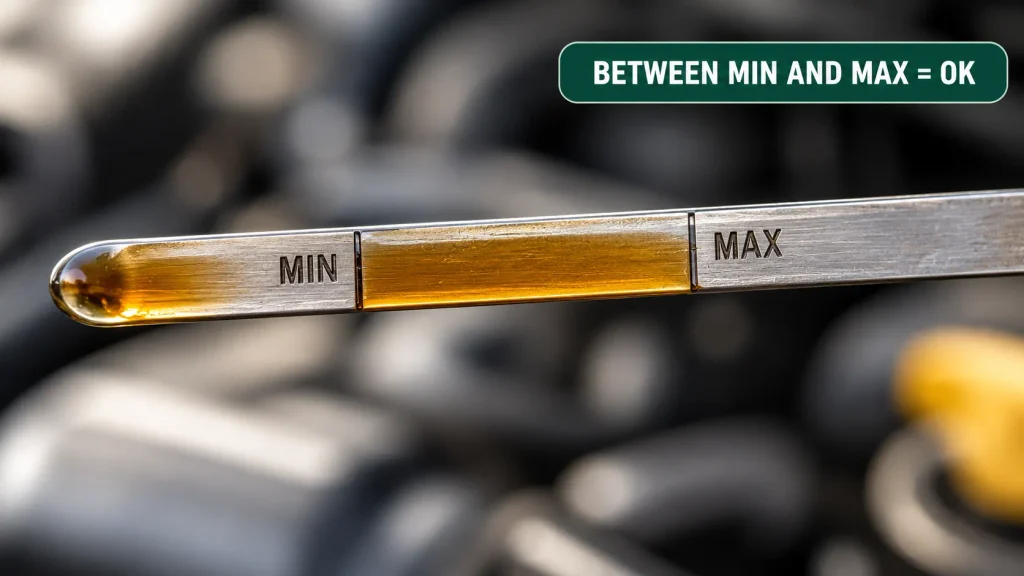


For the level, use this quick logic:
- If the line is below the lower mark, add oil now.
- If it sits between the marks, the level is fine.
- Read the second pull. Motul notes the first pull may carry oil splashed higher up the stick.
- If it is above the upper mark, the engine is overfilled. See the next section.
None of the manuals above say how much oil sits between the marks. Check your manual’s capacity information before you pour.
Color tells you the oil’s condition, according to Motul’s dipstick guide:
- Golden to amber: fresh oil.
- Brown: normal after several thousand kilometers.
- Black: common in diesel and turbocharged engines. Judge by smell, grit, and rough running, not color alone.
- Milky or coffee-colored: a possible sign of coolant contamination. Have it inspected immediately.
What to Do If Oil Is Low or Overfilled
If the level is low, add oil in small amounts. Ford says to wait about a minute, recheck, and never go above MAX. Make sure the oil suits your engine before you pour.
If you are choosing oil for an older engine, our guide to the <a href=”https://carmechan.com/buying-guide/best-synthetic-oil-for-high-mileage/”>best synthetic oil for high mileage</a> covers the options.
Overfilling is also harmful. Too much oil can foam as the crankshaft churns through it, which Motul says may reduce lubrication. <a href=”https://www.jdpower.com/cars/shopping-guides/how-to-check-oil” target=”_blank” rel=”noopener”>J.D. Power adds that it can damage gaskets and seals</a>, wear out the oil filter faster, and foul spark plugs.
If the line is above the upper mark, the extra oil should be drained. Honda’s page notes the level can sit above that mark in some cases, so confirm against your own manual.
What If Your Car Has No Dipstick
Some newer cars have no dipstick and report oil level through the dash display or settings menu. J.D. Power says the option is often labeled “Oil Level” in the engine section of the vehicle settings.
<a href=”https://volvocars.com/bg/support/car/v40/article/0a2bf4d563f03f67c0a801e801fd7e96″ target=”_blank” rel=”noopener”>Volvo’s V40 support page</a> shows how strict these systems can be. The car must have been driven about 30 km (20 miles), then parked on level ground for 5 minutes with the engine off.
Then you turn the key to position II and use the thumbwheel to select the oil level. If the display says “Not available,” the conditions were not met, and Volvo says that is not a fault.
J.D. Power adds that these sensors can respond with some delay. Menus vary by brand, so follow your owner’s manual.
How Often Should You Check Engine Oil
For older cars without maintenance alerts, J.D. Power says it is best to check the oil once a month, especially past 100,000 miles. Newer cars with a maintenance alert system usually warn of low oil on the dash.
We also recommend a check before any long drive. Write down each reading so you can spot oil use early. Checking is separate from changing, so see our guide on <a href=”https://carmechan.com/troubleshooting/how-often-to-change-synthetic-oil/”>how often to change synthetic oil</a> for timing.
3 Habits for Accurate Engine Oil Checks
The best way to check car engine oil is to do it the same way every time. Three habits make that easy.
Park on level ground and wait the time your manual gives, or 15 minutes if you are unsure. Read the second pull of the dipstick and check both sides. Follow your manual over any general advice, since marks and wait times vary by brand.


Check about once a month, and add oil in small amounts only when the level is at or below the lower mark. If the oil looks milky or coffee-colored, or the dipstick reads above the upper mark, do not keep driving without having it looked at. Your owner’s manual always has the final word on your engine.
5 Engine Oil Check Questions Answered
Should you check engine oil with the engine on or off?
Check it with the engine off. Ford tells owners to wait at least 15 minutes after shutdown so the oil drains back into the pan. Hyundai, Kia, and Nissan manuals give the same 15-minute figure, while Mazda asks for at least 5 minutes.
Can you check engine oil when the engine is hot?
Not right after driving. Motul says checking immediately after driving can give a misleading reading, and hot parts under the hood can burn you. Several manuals have you warm the engine first, then shut it off and wait before reading.
What color should engine oil be?
Fresh oil is golden to amber, and brown is normal after a few thousand miles. Black is common in diesel and turbocharged engines, so judge by smell and grit too. Milky or coffee-colored oil can mean coolant contamination, so have it inspected immediately.
Is it bad to overfill engine oil?
Yes. Too much oil can foam and reduce lubrication, according to Motul. J.D. Power adds that it can damage gaskets and seals, wear out the oil filter, and foul spark plugs. If the level is above the upper mark, the extra oil should be drained.
How do I check oil in a car with no dipstick?
Use the dash display or settings menu, usually under an engine or oil level option. Many cars need the engine off, level ground, and a few minutes of rest first. Volvo’s V40 asks for about 30 km of driving and 5 minutes parked.