Ford Adaptive vs Intelligent Cruise Control Compared Side-by-Side
Modern Ford vehicles are equipped with sophisticated technology designed to take the stress out of long highway drives and busy commutes. However, many drivers find it confusing to distinguish between standard Adaptive Cruise Control and the more advanced Intelligent Adaptive Cruise Control. In this guide, we will break down the features, hardware, and best practices for navigating Ford’s driver-assist systems safely.
Ford Adaptive Vs Intelligent Cruise Control: Understanding the Basics


📤 Share Image

Core Capabilities of Standard Ford ACC
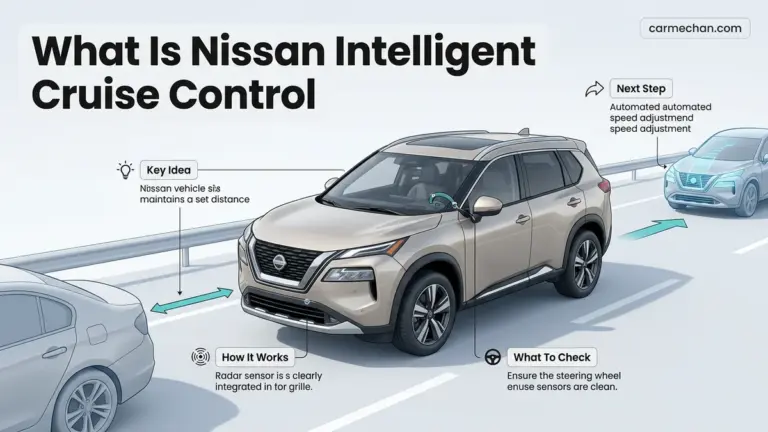
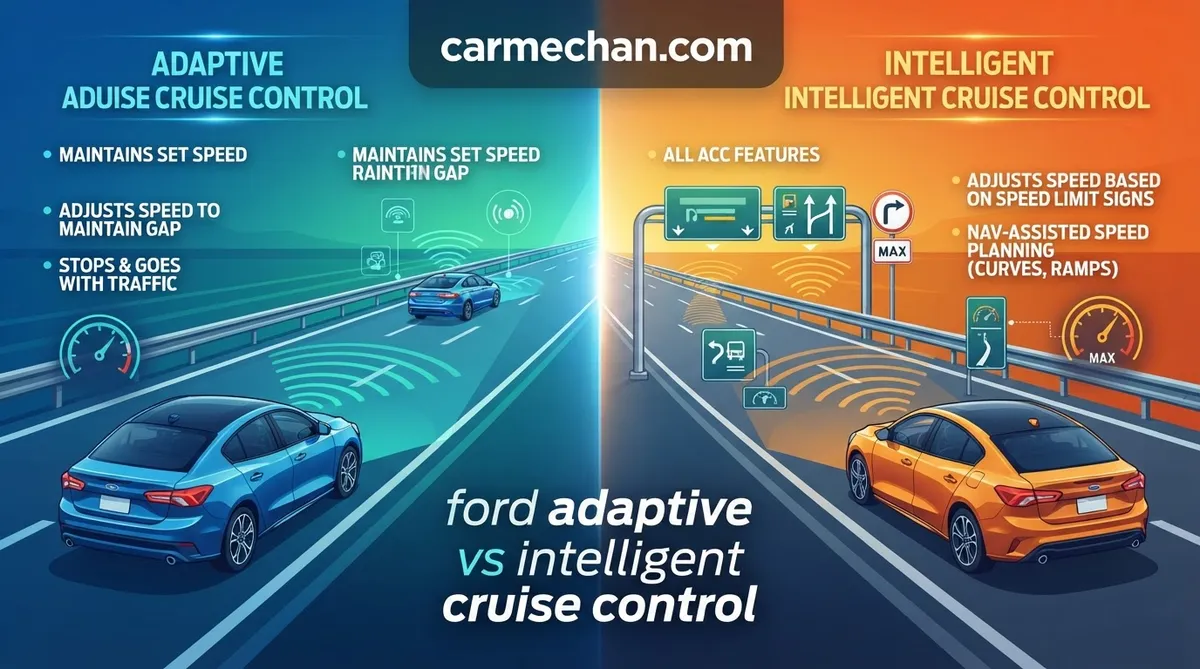
Standard Adaptive Cruise Control (ACC) serves as an evolution of traditional cruise control. While older systems only maintained a set speed, ACC uses sensors to monitor the distance to the vehicle directly ahead. If that vehicle slows down, your Ford automatically reduces your speed to maintain a driver-selectable gap. Once the path is clear, the system returns your vehicle to the original set speed. It is a reliable tool for highway travel, though the driver must remain fully engaged.
How Intelligent Adaptive Cruise Control Expands Functionality
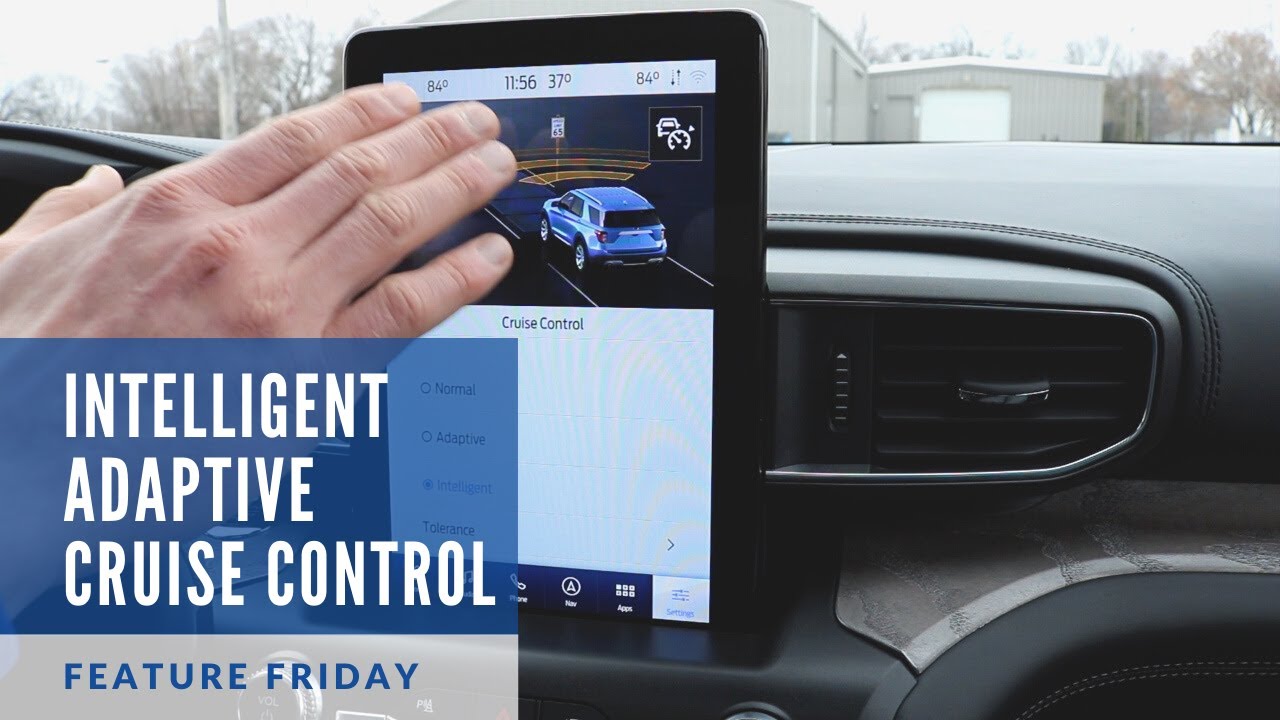
Intelligent Adaptive Cruise Control (iACC) builds upon the foundational ACC logic by integrating Traffic Sign Recognition (TSR). When active, the system reads speed limit signs using the forward-facing camera. If the limit changes—for example, dropping from 65 mph to 55 mph—the vehicle can automatically adjust your cruise set speed to match the new limit. This creates a more seamless experience in environments with frequent speed zone shifts.

The Role of Ford Co-Pilot360 Assist
Both features reside under the umbrella of the Ford Co-Pilot360 suite. It is crucial to understand that these are strictly driver-assist technologies, not autonomous driving platforms. Whether using standard ACC or the intelligent variant, the driver is legally and physically responsible for the vehicle at all times. Stop-and-Go capability, often paired with these systems, allows the car to come to a complete halt in traffic and resume movement automatically if the stop is brief, significantly reducing fatigue in stop-and-go commuting.
Technical Specs: How Ford Sensor Fusion Powers Your Drive
To operate effectively, Ford employs a sophisticated “Sensor Fusion” approach that combines data from multiple inputs to create a comprehensive view of the road.
- Forward-facing Radar: Located in the front bumper, the radar sensor is the primary tool for distance and velocity calculation. It has a detection range typically spanning 100 to 200 meters, allowing the vehicle to react to closing speeds long before a driver might manually hit the brakes.
- Front Camera and Traffic Sign Recognition: Mounted behind the rearview mirror, this camera is the eyes for Intelligent Adaptive Cruise Control. It identifies speed limit signage and relays this data to the vehicle’s computer.
- Electronic Control Unit (ECU) Processing: The vehicle’s onboard computer acts as the brain, aggregating radar distance data and camera-based speed limit information. If the inputs conflict—or if conditions degrade—the ECU dictates the system’s reaction, ensuring the vehicle maintains a safe operating profile.
- Sensor Fusion Calibration: Modern Ford systems require that both the radar (for distance) and the camera (for traffic signs) are calibrated correctly. Any blockage—such as a dirty windshield or bumper damage—can trigger a system fault, requiring professional service to restore full functionality.
By The Numbers
Max Radar Range
Driver Responsibility
How to Configure Ford Adaptive Vs Intelligent Cruise Control
📋
Step-by-Step Guide
Press the ‘Cruise’ button on the steering wheel to toggle the system into standby mode. Once you reach your desired speed, press ‘SET+’ to engage the cruise control at your current velocity.
Use the gap adjustment buttons on the steering wheel to select your preferred distance (represented by bars on the display). Navigate the instrument cluster menu to define speed offsets if you want to travel slightly above the detected limit.
Most drivers prefer an offset of 3-5 mph. Setting this early prevents the system from slowing you down unnecessarily when entering a zone with a slightly lower speed limit than your actual flow of traffic.
Common Pitfalls and Limitations of Driver-Assist Tech
Environmental Hazards and Sensor Degradation
Even the most reliable systems are susceptible to environmental interference. Heavy rain, dense fog, or thick snow can block the radar or obscure the camera’s view, leading to system messages that indicate “Cruise Control Unavailable.” In these situations, the hardware is not failing—it is being cautious. Never attempt to override or force the system to engage when it reports sensor interference.
Limitations in Sign Recognition Accuracy
Intelligent Adaptive Cruise Control relies on camera data, which is imperfect. The system may occasionally misread an exit ramp speed limit sign as the speed limit for the main highway. Always be prepared to take manual control of the accelerator if the vehicle begins to slow down or speed up unexpectedly based on an incorrect sign reading.
Crucial Distinctions from Ford BlueCruise
Do not confuse iACC with Ford BlueCruise. While iACC is a speed-management tool, BlueCruise is a hands-free highway driving system that also manages lateral control (steering). Even if your vehicle has both, they function differently. Using iACC still requires you to keep your hands on the wheel and your attention on the road, whereas BlueCruise allows for hands-free operation in designated Blue Zones while utilizing the internal camera to ensure the driver is still looking at the road.
Over-reliance is the leading cause of incidents in vehicles with advanced driver-assist systems. Always treat these features as “assistants” that require a secondary layer of human verification.
Ford Adaptive Vs Intelligent Cruise Control Comparison Table
✅ Pros
- Significant reduction in driver fatigue.
- Consistent spacing in dense traffic.
- iACC automates speed limit compliance.
- Refined braking and acceleration logic.
❌ Cons
- Radar can be blocked by mud/snow.
- Camera may misidentify speed signs.
- Requires constant driver vigilance.
- Not fully autonomous in any mode.
Mastering Your Ford Driver-Assist Information
Standard ACC reliably maintains your distance, while iACC adds the intelligent convenience of speed limit awareness to your daily commute. Always remain alert, as weather and road conditions significantly impact sensor performance. Use your vehicle’s infotainment settings to customize your comfort and speed offset preferences to best suit your driving style. Above all, remember these are high-quality assistant tools, not substitutes for a professional, attentive driver. Check your specific Ford model’s manual or infotainment settings today to identify which suite of features is currently active on your vehicle and familiarize yourself with their unique behaviors.
Ford Adaptive vs Intelligent Cruise Control: Frequently Asked Questions
Does my Ford automatically slow down for speed limit changes?
Yes, if your vehicle is equipped with Intelligent Adaptive Cruise Control (iACC). The system uses a forward-facing camera to identify posted speed limit signs and automatically adjusts the vehicle’s set speed to match the detected limit. You can customize the ‘speed tolerance’ in the settings menu if you prefer the vehicle to travel slightly above the posted limit.
Can I turn off the ‘Intelligent’ speed adjustment?
Absolutely. Through the Ford SYNC settings under the Driver Assistance menu, you can toggle the Intelligent speed adjustment feature off. This effectively reverts your vehicle to standard Adaptive Cruise Control, where the vehicle maintains the speed you manually set regardless of road speed limit signs, while still maintaining a distance-based gap to the car ahead.
Does iACC work on all road types?
iACC is designed primarily for highways and well-marked secondary roads. While the system is highly capable, it may struggle on complex rural roads, construction zones with inconsistent signage, or areas with poor map data. It is a driver-assist tool, not an autonomous system, so you must always remain attentive and prepared to take manual control of the vehicle.
What happens when the radar is blocked by snow or mud?
When the radar or camera sensor is obstructed by debris, snow, or mud, the system will lose its ability to track the vehicle ahead or read signs. It will typically issue a visual and audible alert on the instrument cluster, and the cruise control will automatically deactivate or downgrade to standard cruise mode, prompting the driver to take full control.
Are there subscription fees for using these features?
Generally, the hardware and software features for ACC and iACC are included at the point of sale for equipped vehicles. Unlike Ford’s BlueCruise, which may involve a subscription model for hands-free highway driving, standard Adaptive and Intelligent Cruise Control are considered core safety and convenience features and do not typically require ongoing subscription payments to remain operational.