What Kind Of Oil Does A Nissan Altima Take Nissan 2026 2026
Last Updated on September 1, 2026 by Albert Duke


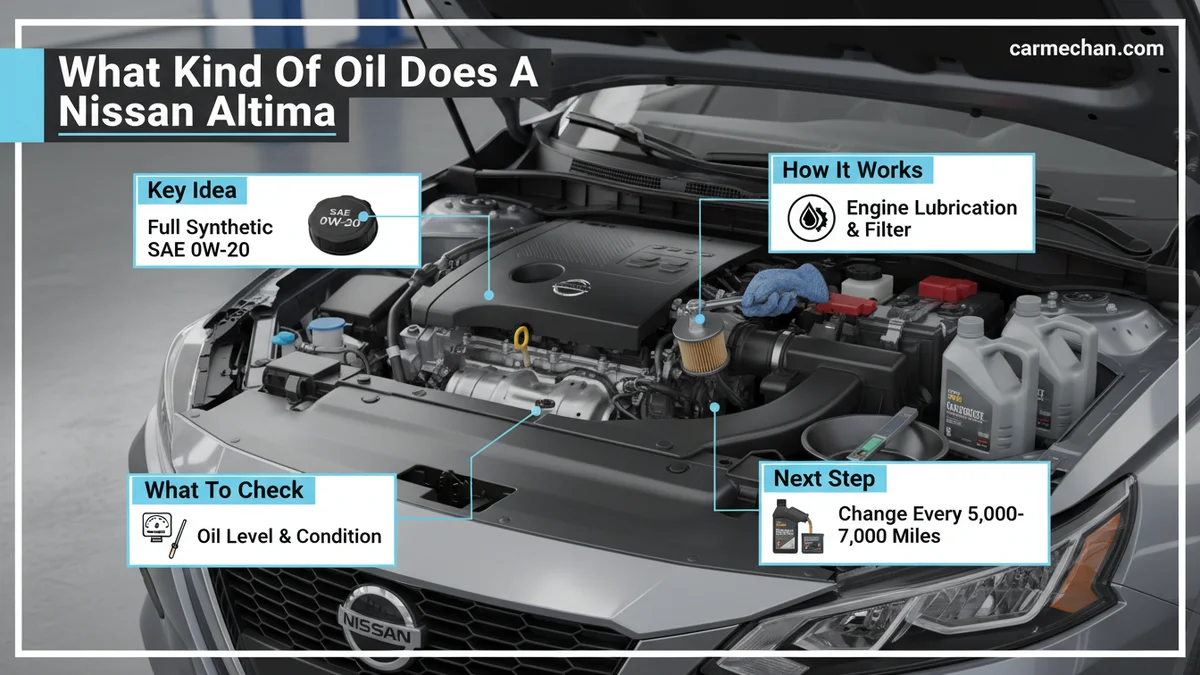
For most modern Nissan Altima models, a 0W-20 or 5W-30 full synthetic oil meeting API SN PLUS or SP and ILSAC GF-6 standards is recommended. The precise oil type and capacity depend critically on your specific model year and engine variant.
For most modern Nissan Altima models, a 0W-20 or 5W-30 full synthetic oil meeting API SN PLUS or SP and ILSAC GF-6 standards is recommended. The precise oil type and capacity depend critically on your specific model year and engine variant.
The question of what kind of oil does a Nissan Altima take is crucial for engine longevity and performance. Choosing the correct engine oil is not just a recommendation; it is a fundamental aspect of vehicle maintenance. This guide provides specific details on oil types, viscosities, and capacities tailored for different Nissan Altima model years and engine configurations.
We explore key specifications and best practices to ensure your Altima operates efficiently in 2026 and beyond. This comprehensive information empowers you to make informed decisions for your vehicle’s care.
We will now explore the specific oil recommendations tailored for different Altima model years and engine configurations.
Key Takeaways
- Always consult your Altima’s owner’s manual.
- Oil type and capacity vary by model year.
- Full synthetic oil is often recommended.
- Adhere to API SN PLUS/SP and ILSAC GF-6.
- Regular oil changes extend engine life.
3 Essential Nissan Altima Engine Oil Types by Year
Understanding the specific oil types for Nissan Altima engines across different model years is paramount for proper maintenance. Engine technology evolves, leading to varied lubrication requirements. Nissan engineers design each engine to perform optimally with specific oil characteristics.

Early Model Requirements
For Nissan Altima models manufactured from approximately 2002 to 2006, engines often relied on different oil specifications. The 2.5L QR25DE I4 and 3.5L VQ35DE V6 engines typically called for 5W-30 motor oil. While conventional oil was common, a synthetic blend could offer enhanced protection. These earlier engines operated with wider tolerances and different material compositions than their modern counterparts.
Always consult your specific owner’s manual for definitive recommendations. An under-hood sticker often provides this information.
Mid-Generation Specifications
Mid-generation Altimas, generally from 2007 to 2012, continued to use the 2.5L I4 and 3.5L V6 engines but saw some updates. For these models, 5W-30 oil remained the primary recommendation. However, Nissan increasingly encouraged the use of synthetic blend or full synthetic options for improved performance and longevity. The change interval might also vary with oil type.
Here is a general guide for mid-generation models, but always verify with your vehicle’s specific manual:
| Model Year Range | Engine Type | Recommended Oil Viscosity | Recommended Oil Type |
|---|---|---|---|
| 2007-2012 | 2.5L I4 | 5W-30 | Synthetic Blend or Full Synthetic |
| 2007-2012 | 3.5L V6 | 5W-30 | Synthetic Blend or Full Synthetic |
Current Year Suggestions
Modern Nissan Altimas, particularly from 2013 onwards, feature more advanced engines. The 2.5L QR25DE I4 and the 3.5L VQ35DE V6 (and later the 2.0L Variable Compression Turbo, VC-Turbo) often require lower viscosity oils. For many contemporary Altimas, 0W-20 full synthetic oil is the standard. This lower viscosity oil helps improve fuel economy and provides excellent cold-start protection.
For the latest models in 2026, 0W-20 full synthetic is almost universally recommended for efficiency and engine health. The VC-Turbo engine, for instance, is highly sensitive to oil specifications due to its complex variable compression ratio technology. Using the wrong oil can compromise its performance and durability.
Consult Nissan’s official guidelines or your car’s manual for the most accurate information for your specific Altima model. .
Beyond the basic oil type, adhering to industry-standard specifications ensures your Altima’s engine receives the exact protection it demands.
What Important Oil Specifications Do Nissan Altimas Need?
To ensure your Nissan Altima’s engine receives optimal care, understanding key oil specifications is as vital as choosing the correct viscosity. These standards are developed by industry bodies to guarantee a minimum level of performance and protection.
Understanding API Standards
The American Petroleum Institute (API) establishes service categories for engine oils. For most modern Nissan Altimas, you will look for oils rated API SN PLUS or API SP. These classifications indicate oils that provide enhanced protection against low-speed pre-ignition (LSPI), chain wear protection, and improved high-temperature deposit control.
Using an API-certified oil helps maintain engine cleanliness and longevity. .
ILSAC Grade Importance
The International Lubricant Standardization and Approval Committee (ILSAC) grades are also critical, particularly GF-5 and the newer GF-6. ILSAC GF-6, introduced in 2020, offers even better fuel economy, engine protection, and durability benefits. It also helps prevent LSPI and protects against timing chain wear. Oils meeting ILSAC GF-6 are backward compatible with engines that previously required GF-5.
Your Altima’s manual will specify the required ILSAC grade. .
Nissan Specific Requirements
Beyond API and ILSAC, Nissan may sometimes recommend its own Genuine Nissan Motor Oil. This oil is formulated to meet specific Nissan engine requirements. While not strictly mandatory, it assures full compatibility. Always ensure any aftermarket oil you choose explicitly states it meets or exceeds Nissan’s recommended specifications.
This adherence protects your engine and preserves your vehicle’s warranty. Ignoring these specifications can lead to engine damage over time. Your owner’s manual is the definitive source for these detailed requirements.
Once you have selected the appropriate oil type and confirmed its specifications, the next crucial step is knowing precisely how much oil your Altima’s engine requires for a complete change.
How Many Quarts of Oil Does Your Altima Need?
Knowing the exact oil capacity for your Nissan Altima’s engine is fundamental to performing a proper oil change and preventing over or under-filling. Incorrect oil levels, whether too high or too low, can cause significant engine damage and affect performance.
2.5 Liter Engine Capacity
The popular 2.5-liter four-cylinder engine in the Nissan Altima typically holds between 4.5 to 5 quarts of oil, depending on the specific model year and generation. For instance, many recent models, such as a 2018 Altima with the 2.5L engine, require approximately 4.88 quarts (4.62 liters) during an oil change with a filter.


Always confirm this in your owner’s manual. A small difference in capacity can occur with or without a filter change, so ensure you account for both.
3.5 Liter V6 Volume
For Nissan Altimas equipped with the more powerful 3.5-liter V6 engine, the oil capacity is generally higher. These engines often require around 5.1 to 5.4 quarts (approximately 4.8 to 5.1 liters) of engine oil. The V6 engine’s larger displacement naturally necessitates more lubricant. Again, refer to your specific model year’s manual for the precise figure.
Overfilling a V6 engine can lead to foaming and decreased lubrication.
Hybrid Model Amounts
If you own a Nissan Altima Hybrid (available in certain model years), the oil capacity might differ due to the integration of the hybrid system. For instance, the 2.5L engine in a 2007-2009 Altima Hybrid could have slightly different requirements than its purely gasoline counterpart.
These models typically use around 4.5 quarts (4.3 liters) of oil. .
Always double-check the oil level using your dipstick after an oil change. Start the engine briefly, then allow it to rest for a few minutes on a level surface before checking. This ensures the oil has settled. Filling too much oil can cause serious damage, while too little can lead to premature wear.
Your owner’s manual provides the most accurate capacity details.
With the correct oil type and capacity established, you might wonder about the fundamental choice between synthetic and conventional oils and which is best for your Altima.
Synthetic Versus Conventional Oil for Nissan Altima Longevity
The choice between synthetic and conventional oil for your Nissan Altima can significantly impact its engine’s performance and long-term health. Understanding their differences helps you make an informed decision for your vehicle’s care.
Synthetic Oil Benefits
Full synthetic oils are engineered to perform under extreme temperatures and pressures. They offer superior protection against wear, excellent flow at cold starts, and greater resistance to oxidation and thermal breakdown. This means less sludge buildup and longer intervals between oil changes. For modern Altima engines, especially those requiring lower viscosities like 0W-20, synthetic oil is often the only recommended choice.
It contributes to better fuel efficiency and extended engine life. .
Conventional Oil Limitations
Conventional oils are refined from crude oil and have a simpler molecular structure. While suitable for some older engines, they break down faster and offer less protection against extreme conditions. They are prone to sludge formation and have shorter change intervals. Using conventional oil in an engine designed for synthetic can compromise performance and protection.
It may also lead to premature wear, especially in precision-engineered modern Altima engines.
Choosing for Your Altima
For most Nissan Altima models from 2013 onwards, and certainly for new models in 2026, full synthetic oil is the clear recommendation. Its benefits far outweigh the slightly higher cost, especially when considering engine longevity and overall performance. Synthetic blends offer a middle ground, combining some benefits of synthetic with a lower price point.
However, always defer to your owner’s manual. It provides the definitive oil type based on your Altima’s specific engine design and technology.
Regardless of your oil choice, knowing the precise intervals for oil changes remains critical to maximizing your Nissan Altima’s engine lifespan and maintaining its optimal condition.
When to Change Your Nissan Altima’s Engine Oil Properly
Adhering to appropriate oil change intervals is perhaps the most crucial maintenance task for ensuring the enduring health of your Nissan Altima’s engine. These intervals are not arbitrary; they are carefully determined by Nissan engineers.
Manufacturer Interval Guide
Nissan’s recommendations typically fall into two categories: “normal driving conditions” and “severe driving conditions.” For normal conditions, conventional oil might suggest changes every 3,000 to 5,000 miles or every 3 to 6 months. For full synthetic oil, this extends significantly, often to 7,500 to 10,000 miles or 6 to 12 months.
Always check your specific model year’s owner’s manual for precise figures for your 2026 Altima. .
Driving Condition Factors
“Severe driving conditions” significantly shorten recommended intervals. This includes frequent short trips, extensive idling, towing, driving in extreme heat or cold, or navigating dusty environments. If your driving habits align with any of these, consider changing your oil and filter more frequently. Even if you drive less, oil degrades over time. Moisture and contaminants can build up, regardless of mileage.
Mileage Versus Time Limits
Oil change intervals have both a mileage and a time component. Always follow whichever comes first. For example, if your Altima’s manual states “10,000 miles or 12 months,” and you only drive 5,000 miles in a year, you should still change the oil after 12 months.
Regular checks of your oil level and its appearance (color, consistency) on the dipstick between changes are also a wise practice. This proactive approach helps identify potential issues before they become serious problems.
Armed with this comprehensive knowledge of Nissan Altima oil requirements, we can now address some common questions.
Maintaining Your Altima’s Engine Health


Understanding what kind of oil does a Nissan Altima take is fundamental to its long-term health and performance. We have explored the critical factors that dictate your choice, from specific model year and engine type to essential industry specifications and capacities. Always prioritize consulting your vehicle’s owner’s manual for the definitive recommendations.
By using the correct viscosity and type of oil, adhering to API and ILSAC standards, and changing your oil at the appropriate intervals, you actively contribute to the efficiency, reliability, and longevity of your Nissan Altima. This simple maintenance task is one of the most impactful ways to protect your investment.
Embrace informed decisions for your vehicle’s ongoing care and enjoy many more miles of smooth driving.
Your Top Questions About Nissan Altima Oil
Can I Use Conventional Oil in My Newer Nissan Altima?
While some older Altima models might allow conventional oil, most newer models (typically 2013 onwards) are designed for full synthetic oil. Using conventional oil in a modern Altima can reduce engine protection, impact fuel efficiency, and potentially void parts of your warranty. Always refer to your owner’s manual for the definitive recommendation for your specific model.
What Happens If I Put the Wrong Oil in My Nissan Altima?
Using the wrong oil in your Nissan Altima can lead to several problems. Incorrect viscosity can cause poor lubrication, increased engine wear, reduced fuel economy, and potential engine damage. Oils that do not meet API or ILSAC specifications might not protect against issues like low-speed pre-ignition. Always use the oil recommended in your owner’s manual.
How Often Should I Check My Altima’s Oil Level?
You should check your Nissan Altima’s oil level at least once a month, or more frequently if you drive under severe conditions. Regular checks help detect leaks or excessive oil consumption early. It ensures your engine always has sufficient lubrication. Perform this check when the engine is warm but has been off for a few minutes to allow oil to settle.
Is 0W-20 Oil Always Required for Newer Altimas?
For many newer Nissan Altima models, especially those from 2013 onwards, 0W-20 full synthetic oil is indeed the recommended viscosity. This lower viscosity oil enhances fuel efficiency and provides excellent cold-start protection. However, always consult your specific owner’s manual. Some models or regional variants might still recommend 5W-30, particularly for the V6 engines.
Where Can I Find My Altima’s Specific Oil Information?
The most accurate and comprehensive oil information for your Nissan Altima is in your owner’s manual. You can also often find a sticker under the hood that specifies the recommended oil type and viscosity. Reputable online resources like Nissan’s official website or a trusted automotive repair guide can also provide model-specific details.