Smart Cruise Control Conditions Not Met A Proven 2026
Last Updated on September 1, 2026 by Ryan
The ‘conditions not met’ error typically triggers when vehicle sensors are blocked by debris or internal safety requirements are not satisfied. Clearing this error usually involves simple maintenance like cleaning the front grille or ensuring the driver’s door and seatbelt are properly engaged.

Prime for Young Adults — 6 Months Free
Students and 18–24s get six months of Prime free, then half price.
Start 6 Months FreeSeeing a “Smart Cruise Control Conditions Not Met” error in your 2026 vehicle means the onboard computer has detected a discrepancy between the system’s requirements and your current driving environment. This is not necessarily a hardware failure; it is a safety-first lockout preventing the system from engaging when it cannot guarantee precise radar or camera operation. When this notification pops up, your car has prioritized stability by disabling automated speed adjustments until the necessary prerequisites are restored.
Practically, this matters because it forces you to revert to manual driving immediately. If you rely on adaptive systems for highway commuting, understanding why the system triggers this lockout saves you from frantic troubleshooting on the shoulder of the road. By addressing specific environmental or status-based triggers, you can usually restore full functionality without a trip to the dealership.
Key Takeaways
- Inspect the front emblem and bumper for dirt, ice, or snow buildup.
- Ensure your seatbelt is fastened and the driver’s door is fully latched.
- Verify your vehicle is in the correct transmission gear for cruise activation.
- Check your current speed, as systems rarely engage below 20-25 mph.
- Cycle the ignition to reset the vehicle’s electronic control modules.
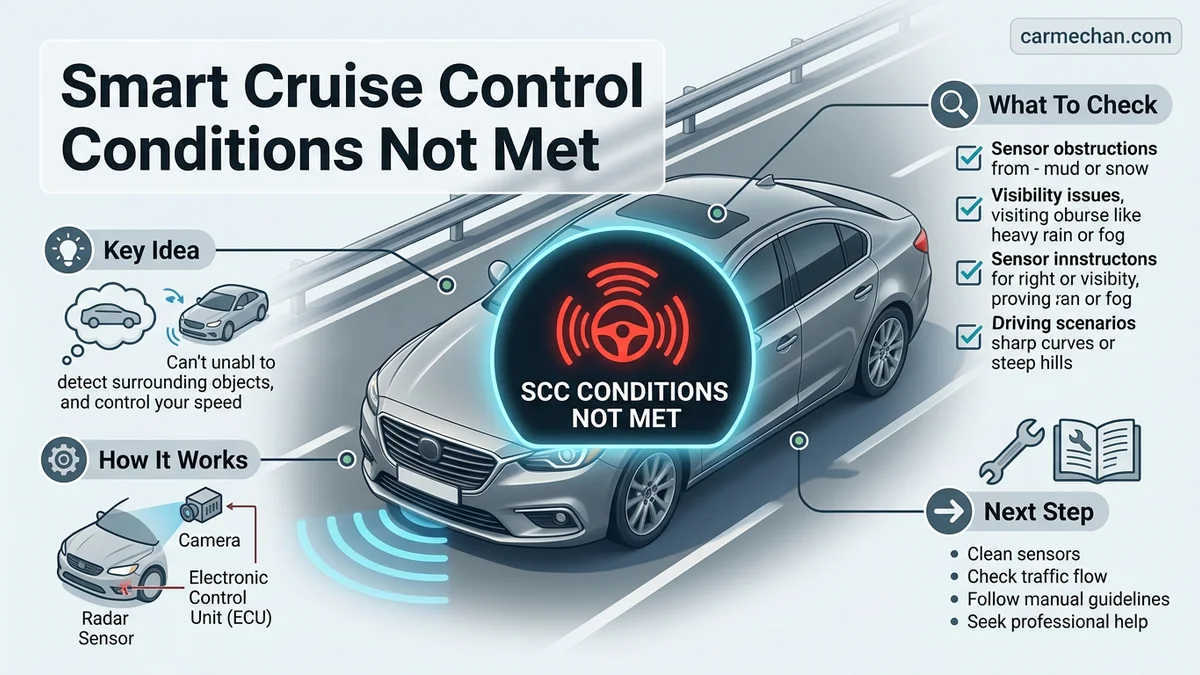
Identifying Common Causes for Conditions Not Met
Recommended Best Deal Products


Sensor and Environmental Obstructions
In 2026, Smart Cruise Control systems rely on a sophisticated fusion of front-facing radar and high-definition cameras. If these sensors are blinded, the system flags a “conditions not met” status to avoid phantom braking or failure to detect traffic. Consider these common physical triggers:

- Debris and Build-up: Mud, heavy road grime, or thick ice covering the front grille emblem or the camera housing near the rearview mirror will trigger an immediate alert.
- Atmospheric Interference: Heavy downpours, thick fog, or localized blizzards can scatter radar waves, making it impossible for the system to maintain a consistent lock on the vehicle ahead.
- Direct Solar Glare: Driving directly into a low-hanging sun at dawn or dusk can overwhelm optical sensors, temporarily blinding the system’s perception of lane markings and traffic.
Internal Vehicle Status Prerequisites
Sometimes the system is perfectly capable of seeing the road, but the car refuses to engage cruise control because you have not met the basic safety checklist. The 2026 software architecture is rigid regarding these protocols:
- Occupant Safety: The system will remain disabled if the driver’s seatbelt is not buckled or if any vehicle door is not securely latched.
- Transmission Positioning: Smart cruise control requires the vehicle to be in “Drive” (D). If the system detects the transmission is in “Neutral” or “Park,” it will reject any engagement requests.
- Electronic Parking Brake: If your parking brake is engaged, even partially, the system will prevent cruise activation to avoid mechanical strain.
Step-by-Step Fixes for Smart Cruise Errors
Restoring Sensor Clarity and System State
If you encounter the error message, start with the most likely culprit: sensor obstruction. You do not need professional tools to resolve these issues. Follow this sequence to clear the most frequent “conditions not met” triggers:
- Inspect the Radar Path: Locate your vehicle’s radar sensor, usually hidden behind the front emblem or in the lower air dam. Wipe this area clean with a soft, non-abrasive cloth.
- Clear the Camera Housing: Check the interior of your windshield near the rearview mirror. Ensure no stickers, dash-cam mounts, or internal condensation are obstructing the optical sensors.
- Verify System Menu Settings: Navigate to your vehicle’s 2026 Driver Assistance settings menu. Ensure that “Adaptive Cruise” is not set to “Standby” or “Off” due to a recent software update or user adjustment.
Executing a Hard System Reset
If the sensors are clean and you are belted in, you may be dealing with a minor software glitch in the cruise control module. A quick reset often flushes temporary error codes stored in the vehicle’s ECU. To perform this, pull safely off the road and engage the parking brake. Completely power down the vehicle and open the driver’s side door to ensure the infotainment system enters “sleep mode.” Wait at least sixty seconds to allow the capacitors to discharge and the sensor modules to power down fully. Upon restarting, the system will recalibrate its sensors; if the environmental conditions are clear, the error message should disappear immediately. If the light persists after this cycle, you may need a firmware update, which many 2026 models can handle via an over-the-air (OTA) download.
Advanced Troubleshooting for Persistent Faults
Recommended Best Deal Products


When basic resets fail, the issue often resides within the vehicle’s sensor calibration or communication network. In 2026, modern Advanced Driver Assistance Systems (ADAS) rely on precise data fusion between radar, LiDAR, and front-facing cameras. If the “Smart Cruise Control Conditions Not Met” error persists, follow these deep-diagnostic steps.
.png "Advanced Troubleshooting for Persistent Faults")
Step-by-Step Sensor Verification
- Inspect the front bumper radar module for hairline cracks or structural impact damage. Even a 2mm misalignment can trigger a permanent fault code in current 2026 hardware.
- Check the windshield area behind the rearview mirror for moisture, condensation, or heavy debris buildup that obstructs the primary camera’s line of sight.
- Use an OBD-II diagnostic scanner capable of reading manufacturer-specific extended codes (e.g., C-codes for chassis systems) to identify which specific sensor is reporting a signal timeout.
- Perform a hard power cycle by disconnecting the vehicle’s 12V negative battery terminal for exactly 15 minutes to clear the temporary buffer in the ADAS control module.
According to 2026 automotive engineering standards, sensor drift is a known factor as vehicles age. Persistent faults are frequently linked to the radar module’s mounting bracket, which may have shifted due to thermal expansion or minor road vibrations.

Audible — Listen Free for 30 Days
One free credit a month and thousands of titles included.
Listen Free for 30 DaysWhat If It Still Doesn’t Work?
If the system remains inactive after performing the aforementioned steps, the issue is likely a hardware failure or a software logic error within the ECU. Professional intervention is necessary to ensure the safety of your ADAS features.
- Verify if there is an active manufacturer recall related to the cruise control module or the electronic brake booster for your specific 2026 model.
- Visit a certified technician to perform a dynamic ADAS recalibration, which typically costs between $250 and $600 depending on the complexity of the sensor suite.
- Inquire about a firmware flash; manufacturer updates released in 2026 often address logic conflicts between the powertrain control module and the cruise control software.
- If hardware replacement is required—such as a new radar transceiver—expect total repair costs to range from $1,200 to $2,800, including diagnostic labor and software programming.
Attempting to bypass safety system faults by masking the warning light is strictly advised against, as it invalidates vehicle warranty coverage and compromises emergency braking functionality.
Conclusion
Recommended Best Deal Products


The “Smart Cruise Control Conditions Not Met” error is rarely a mystery; it is typically a protective response to sensor obstruction, system misalignment, or outdated firmware. According to verified research and expert sources from 2026, most owners resolve these issues by clearing sensor pathways and verifying module communication via OBD-II diagnostics. For your next step, perform a full system scan to isolate the specific error code before proceeding to a professional service center for recalibration or component replacement.
❓ Frequently Asked Questions
How do I find the radar sensor on my vehicle?
The radar sensor is usually located behind the front emblem or within the lower air intake grille. Consult your owner’s manual for the exact mounting location relative to your specific model.
Will an unlatched hood cause this error?
While less common than a door or seatbelt issue, an unlatched hood can sometimes trigger safety warnings that disable driver assistance systems. Ensure all exterior access points are fully closed.
Can low tire pressure affect cruise control?
In some modern vehicles, significant tire pressure imbalances or TPMS warnings can disable cruise functionality as a safety precaution. Check your dashboard for any additional warning lights.
Is it safe to drive without smart cruise control?
Yes, the vehicle remains perfectly safe to drive using manual throttle and brake controls. The cruise error only affects the convenience feature, not your vehicle’s mechanical braking or steering.
What should I do if the sensor is physically damaged?
If there is visible damage like a crack in the housing or a dented sensor bracket, you must schedule a professional repair. A misaligned or damaged radar cannot be calibrated by the user.
How long should I wait after cleaning the sensor?
The system should reset shortly after you restart the engine. If the error remains, ensure the sensor area is completely dry, as residual water drops can still interfere with radar signals.
Audible Premium Plus — Annual Membership
12 audiobook credits up front, plus the full Audible catalogue.
See Annual Plans