RPMS jumping while in cruise control: Expertly Diagnosed
Is your engine surging or the RPMs oscillating while you’re trying to maintain a steady speed on the highway? RPMS jumping while in cruise control can be unnerving and often points to a breakdown in communication between your throttle, transmission, and computer. In this guide, we break down the causes—from simple vacuum leaks to complex transmission shudder—and provide the steps you need to diagnose and fix the issue.

Understanding Root Causes of Rpms Jumping While In Cruise Control
Recommended Best Deal Products


📤 Share Image

Differentiating Transmission Slip From Engine Surging
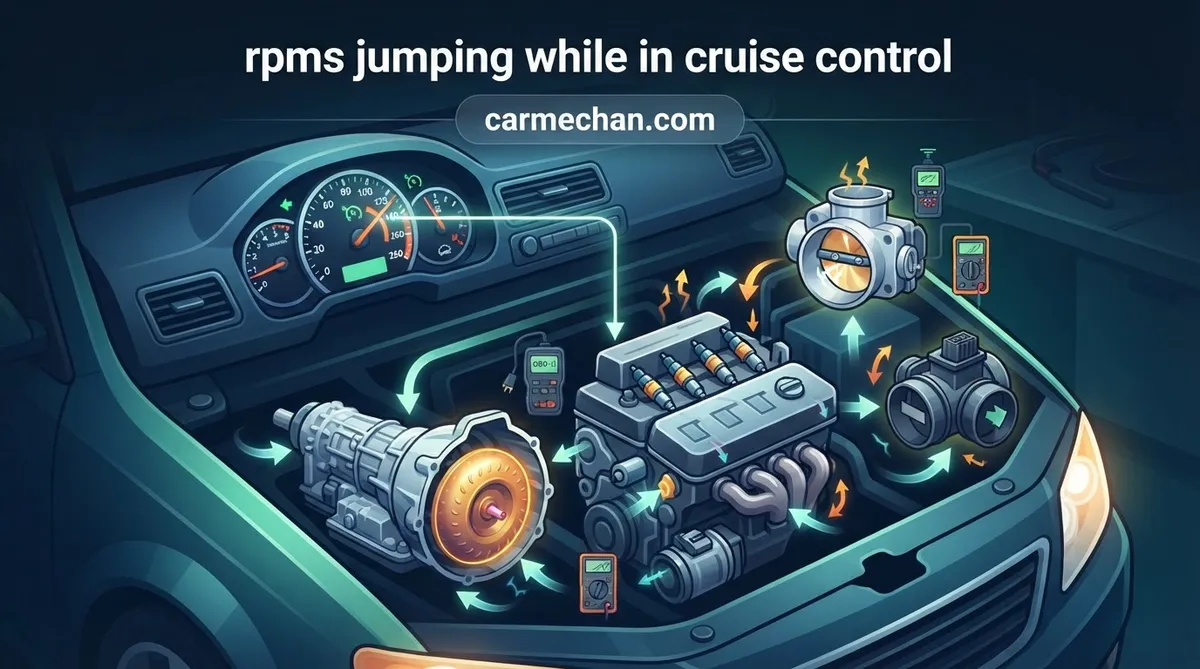
The most common point of confusion for drivers is distinguishing between a mechanical drivetrain slip and an air/fuel delivery surge. When RPMs jump while in cruise control, the difference lies in the rhythm. A 50 RPM fluctuation on an incline is often normal behavior for a modern Powertrain Control Module (PCM) adjusting throttle to maintain set speed. However, a 300 RPM spike on flat, level ground suggests a genuine malfunction. If the needle jumps without a corresponding change in vehicle speed, you are likely looking at transmission torque converter shudder—a condition where the clutch fails to maintain a locked state. Conversely, engine “hunting” often involves a rhythmic pulsing that feels like a slight tugging or surging of the vehicle’s momentum.
How Vacuum Leaks Disrupt Closed-Loop Operation
Your vehicle’s engine operates in a “closed-loop” state once it reaches operating temperature, meaning the PCM uses oxygen sensor data to adjust the air-fuel mixture constantly. A vacuum leak introduces “unmetered air” into the intake manifold. During cruise control, the PCM is trying to maintain a razor-thin balance of fuel and air. When a leak exists, the air-fuel ratio becomes unstable, causing the PCM to overcompensate by rapidly adjusting the throttle position. This constant micro-adjustment manifests as flickering or jumping RPMs. It is a common pitfall to assume the throttle body is failing; always pressure-test your vacuum lines before replacing expensive electronic components.

Sensor Input: Wheel Speed and Airflow Metrics
Cruise control stability is entirely dependent on accurate data. The system relies on wheel speed sensors to determine vehicle velocity and the Mass Air Flow (MAF) sensor to measure the air entering the engine. If a wheel speed sensor has an intermittent electrical connection, the cruise control may “think” the car has slowed down or sped up, causing erratic throttle adjustments. Similarly, a fouled MAF sensor can report inconsistent data to the PCM, leading to jerky engine performance.
By The Numbers
Cases caused by non-cruise components
Avg. miles for TCC solenoid wear
Diagnostic Steps to Identify Cruise Control RPM Fluctuations
Interpreting Stored PCM Fault Codes
Never assume a lack of a “Check Engine” light means the system is healthy. The PCM often stores “pending codes” for issues that are occurring frequently enough to cause problems but haven’t yet triggered a hard fault. Use an OBD-II scanner to pull both active and history codes. Look specifically for misfire codes (P0300-P0308) or lean condition codes (P0171/P0174), which are common indicators of a vacuum leak or fuel delivery issue.
Testing for Transmission Fluid Degradation
Transmission fluid is a hydraulic fluid used to actuate the torque converter clutch. Over time, heat breaks down the friction modifiers in the fluid, leading to “chatter” or shuddering. Pull the transmission dipstick—if the fluid is brown or smells like burnt toast, the torque converter is likely failing to maintain its lock-up state, causing the RPM oscillations you see on the tachometer.
Recognizing Engine Misfire Symptoms
A misfire under load (cruise control) is distinct from a dead-stop misfire. If the RPM jump is accompanied by a slight “stumble” or “jerk,” check your ignition coils and spark plugs. As coils age, they become susceptible to heat-soak. During steady-state driving, they may struggle to fire consistently, forcing the PCM to adjust timing and throttle to prevent a stall, resulting in erratic RPM readings.
How to Fix Rpms Jumping While In Cruise Control
📋
Step-by-Step Repair Procedure
Remove the intake boot and spray an approved throttle body cleaner onto a lint-free cloth. Wipe the carbon buildup from the butterfly valve edges. Never spray directly into the intake, as this can damage the internal electronics.
After cleaning, the PCM may need to calibrate the throttle position. Turn the key to the ‘On’ position (without starting) for 30 seconds. Turn it off, wait 10 seconds, and start the engine. Idle for 3 minutes to allow the system to map the new flow parameters.

Audible — Listen Free for 30 Days
One free credit a month and thousands of titles included.
Listen Free for 30 DaysReplacing Mass Air Flow Sensors
If cleaning the throttle body does not resolve the surging, the MAF sensor is your next target. These sensors are delicate; avoid touching the internal filaments with anything. Use a dedicated MAF cleaner aerosol. If the RPM jumping persists after cleaning, the sensor’s internal thermistor has likely drifted out of spec and requires replacement with an OEM-grade part to ensure calibration accuracy.
If you drive an older vehicle with a mechanical vacuum-actuated cruise system, check the physical cruise actuator cable. If it’s frayed or binding, it will cause the throttle to “hunt” as it attempts to pull against the friction, mimicking a surge.
When Professional Intervention is Required
Advanced Torque Converter Lock-up Diagnostics
When the transmission torque converter clutch (TCC) solenoid fails or internal seals degrade, the torque converter will cycle in and out of “lock-up” mode. This is often accompanied by a audible shudder and a 200-500 RPM fluctuation. This is not a DIY repair; it requires a transmission specialist to perform a line-pressure test. Driving with a slipping TCC will rapidly accelerate wear on the transmission fluid and clutch packs, leading to total unit failure.
Fuel System and Pressure Regulation Issues
Sometimes, the issue is not the amount of fuel, but the pressure. A failing fuel pump or a clogged fuel filter may cause a drop in pressure when the engine is held at a steady state. A fuel pressure gauge is required to verify that the system maintains steady PSI under load. If the pressure drops when you hold a specific RPM, the pump motor is likely overheating or losing voltage connectivity.
Recognizing When Component Failure is Imminent
If you have addressed the throttle body, MAF, and verified the vacuum system, you must accept that the issue may be deep-seated. Continuing to drive with aggressive surging can lead to:
- Catastrophic Transmission Failure: Constant TCC cycling generates extreme heat.
- Engine Misfire Damage: Long-term misfires can ruin your catalytic converter due to unburnt fuel hitting the hot core.
- Safety Hazards: Erratic throttle control can be dangerous in slick road conditions.
Never attempt to force a torque converter to lock up or “ignore” a shuttering transmission. The friction material shedding from the clutch pack will circulate through your transmission cooler and valve body, potentially destroying the entire transmission.
Summary and Expert Recommendations
Addressing RPMS jumping while in cruise control requires a methodical, top-down diagnostic approach. Start with the simplest, most accessible components: check for vacuum leaks, clean your throttle body, and inspect the MAF sensor. Never neglect the health of your transmission fluid, as torque converter shutter is a leading cause of RPM fluctuations that often gets misdiagnosed as an engine performance issue.
Always perform an Electronic Throttle Control (ETC) relearn after cleaning or replacing components to ensure the PCM correctly maps the new input data. If you have ruled out these common faults and the RPM jumping persists, consult a certified technician to inspect the torque converter lock-up system or fuel pressure regulation. By identifying the root cause early, you protect your vehicle from expensive, secondary damage to the engine and transmission.
Rpms Jumping While in Cruise Control: Frequently Asked Questions
Is it safe to drive if my RPMs jump in cruise?
While it is rarely an immediate safety threat, you should disengage cruise control and operate the throttle manually. Persistent surging puts unnecessary strain on your torque converter and drivetrain, potentially leading to expensive transmission failures. If the surging is accompanied by a ‘Check Engine’ light or reduced engine power, drive the vehicle to a trusted mechanic for an inspection immediately.
Audible Premium Plus — Annual Membership
12 audiobook credits up front, plus the full Audible catalogue.
See Annual PlansDoes a vacuum leak cause RPM surging?
Yes. A vacuum leak allows unmetered air to enter the intake manifold, which confuses the engine’s computer. The ECU constantly adjusts fuel injection to compensate for this excess air, causing the engine to hunt for a steady idle or cruising RPM. This creates the characteristic surging sensation while the cruise control attempts to maintain speed against varying engine power levels.
Could bad spark plugs cause this?
Absolutely. Worn spark plugs cause intermittent misfires, especially under load. When an engine misfires while in cruise control, the ECU detects a drop in RPM and opens the throttle to compensate, causing a sudden spike. If your spark plugs are nearing the end of their service life, they should be replaced as part of your initial diagnostic troubleshooting process.
How do I know if it is a transmission problem or an engine problem?
If the RPMs jump specifically while the vehicle shifts or during lock-up, it is likely the transmission’s torque converter clutch. If the RPM fluctuation occurs regardless of gear and correlates with load changes, it is typically an engine-side issue, such as a vacuum leak or ignition misfire. A diagnostic scanner can often differentiate by looking for specific TCC solenoid fault codes.
Does weather affect cruise control performance?
Extreme weather can exacerbate existing issues. For example, cold, dense air amplifies the impact of a minor vacuum leak, while high humidity can affect the performance of aging ignition coils. Furthermore, if your vehicle uses radar-based adaptive cruise control, heavy rain or snow can interfere with the sensors, leading to the system disengaging or behaving erratically as it struggles to track objects.