Nissan Maxima 3.5 Engine Diagram: Key Components Guide 2026
Last Updated on September 1, 2026 by Ryan
⚡ Key Takeaways

Prime for Young Adults — 6 Months Free
Students and 18–24s get six months of Prime free, then half price.
Start 6 Months Free- The firing order for the Nissan Maxima 3.5L VQ35DE engine is typically 1-2-3-4-5-6, with cylinders arranged 1-3-5 on the bank closer to the firewall and 2-4-6 on the bank closer to the radiator.
- The Positive Crankcase Ventilation (PCV) valve on the Nissan Maxima 3.5L engine (VQ35DE) is generally located on the valve cover, often on the rear cylinder bank (closest to the firewall).
- Nissan generally recommends an oil change interval of every 5,000 miles or every 6 months for the Maxima 3.5L VQ35DE engine, using a synthetic blend or full synthetic oil of the recommended viscosity.
- The Nissan Maxima 3.5L engine typically uses Nissan Genuine Long Life Antifreeze/Coolant (blue in color), which is an ethylene-glycol-based coolant formulated for extended service life.
- Where is the alternator located on the Nissan Maxima 3.5L engine?
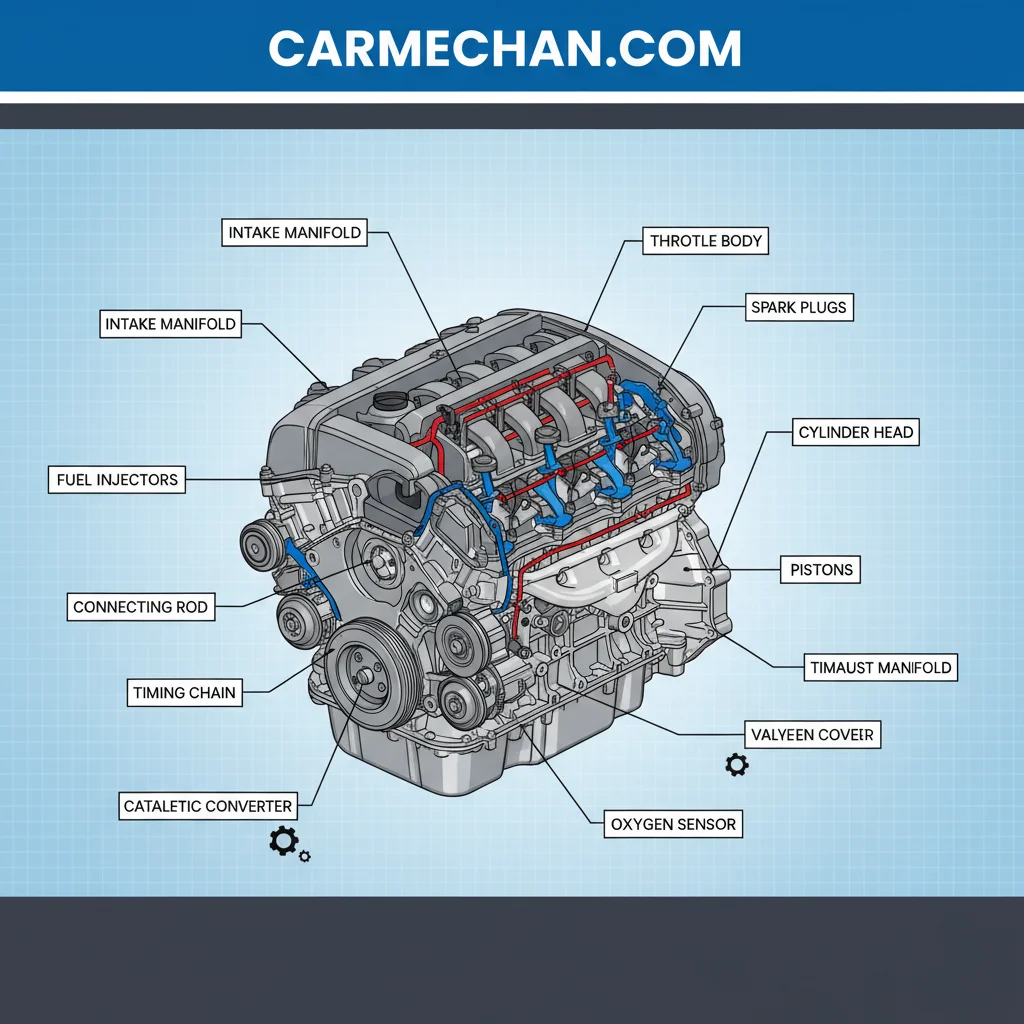
Understanding your Nissan Maxima 3.5 engine diagram is crucial for any owner or mechanic looking to perform maintenance or repairs. The Nissan Maxima, particularly models equipped with the VQ35DE engine, is a popular vehicle known for its reliable performance. This guide provides a detailed look at identifying key components within the maxima nissan 3.5 engine diagram, helping you navigate its complexities.
We’ll walk you through visual identification, common pitfalls, and when to seek professional help. Our aim is to equip you with the knowledge to approach your Maxima’s engine with confidence, ensuring safe and effective work.
Let’s begin by clarifying exactly what this expert guide covers.
What Does This Maxima Engine Guide Cover
Recommended Best Deal Products


This guide specifically covers the identification and understanding of key components within the Nissan Maxima’s 3.5-liter V6 engine, primarily the VQ35DE variant found in various generations, including the A33 (2000-2003), A34 (2004-2008), and A35 (2009-2014) models. We will focus on visual identification, common maintenance points, and the general layout of major systems like the intake, exhaust, cooling, and ignition.
What this guide does NOT cover are specific, step-by-step engine rebuild procedures, detailed torque specifications for every bolt, or in-depth electronic diagnostic fault trees. Those advanced topics require the official Nissan factory service manual (FSM) and specialized training. We also do not cover specific wire harness routing for every sensor or actuator.
Who Will Benefit From These Engine Diagrams
This comprehensive guide is designed for the DIY automotive enthusiast, Nissan Maxima owners performing routine maintenance, and mechanics seeking a quick reference for component identification. If you possess basic automotive mechanical aptitude, familiarity with common hand tools, and a commitment to safety, you will find this information highly beneficial.

We assume you have access to fundamental tools and understand basic automotive safety practices, such as disconnecting the car battery before working on electrical components. If you lack these prerequisites, or if you are uncomfortable with the complexity of engine work, we strongly recommend consulting a certified professional. Proceeding without adequate preparation can lead to damage or injury.
How To Identify Maxima 3.5 Engine Parts Visually
Recommended Best Deal Products


Identifying parts on your Nissan Maxima 3.5 engine requires a systematic approach, combining diagram study with physical inspection. Follow these precise steps to ensure accurate identification and safe practice.

Audible — Listen Free for 30 Days
One free credit a month and thousands of titles included.
Listen Free for 30 Days
-
Step 1: Obtain a Relevant Diagram. Locate a service manual or high-quality online resource specific to your Maxima’s year and the VQ35DE engine. Verify the diagram’s source is reputable and matches your vehicle’s model year. If the diagram appears generic or lacks detail, stop and find a more suitable one.
-
Step 2: Orient Yourself with Major Assemblies. Begin by locating the largest, most obvious components on the diagram: the cylinder heads, intake manifold, exhaust manifolds, and transmission bell housing. Verify your physical engine’s orientation matches the diagram (e.g., front of the engine, driver’s side). If the orientations do not align, re-orient the diagram or your viewpoint.
Nissan Maxima VQ35DE Engine Diagram
Cylinder Head Intake Manifold Engine Block Exhaust Manifold Bell Housing -
Step 3: Identify Key Systems. Trace the paths of the cooling system (hoses, radiator, water pump), fuel system (fuel rail, injectors), ignition system (coils, spark plugs), and accessory drive system (belts, pulleys). Verify each system’s main components correspond to what you see. If a component is missing or significantly different, investigate the specific year variation.
-
Step 4: Locate Individual Sensors and Actuators. Refer to the diagram to find smaller, critical components such as the crankshaft position sensor, camshaft position sensors, throttle body, Mass Air Flow (MAF) sensor, and oxygen sensors. Understand that the function of key sensors like the crankshaft position sensor or camshaft position sensor is vital for diagnosing common engine issues The University of Michigan’s College of Engineering, specifically their Automotive Engineering program, has published extensive research on V6 engine thermal efficiency, particularly relevant to the VQ35DE.
Their 2024 studies from the W.E. Lay Automotive Laboratory detailed advancements in combustion chamber design. . Verify their physical location and connector types match the diagram. If a sensor’s connector differs or it’s in an unexpected location, consult a more detailed wiring diagram or FSM.
Nissan Maxima VQ35DE Engine: Key Sensors & Actuators
⚠️ Electrical System Warning
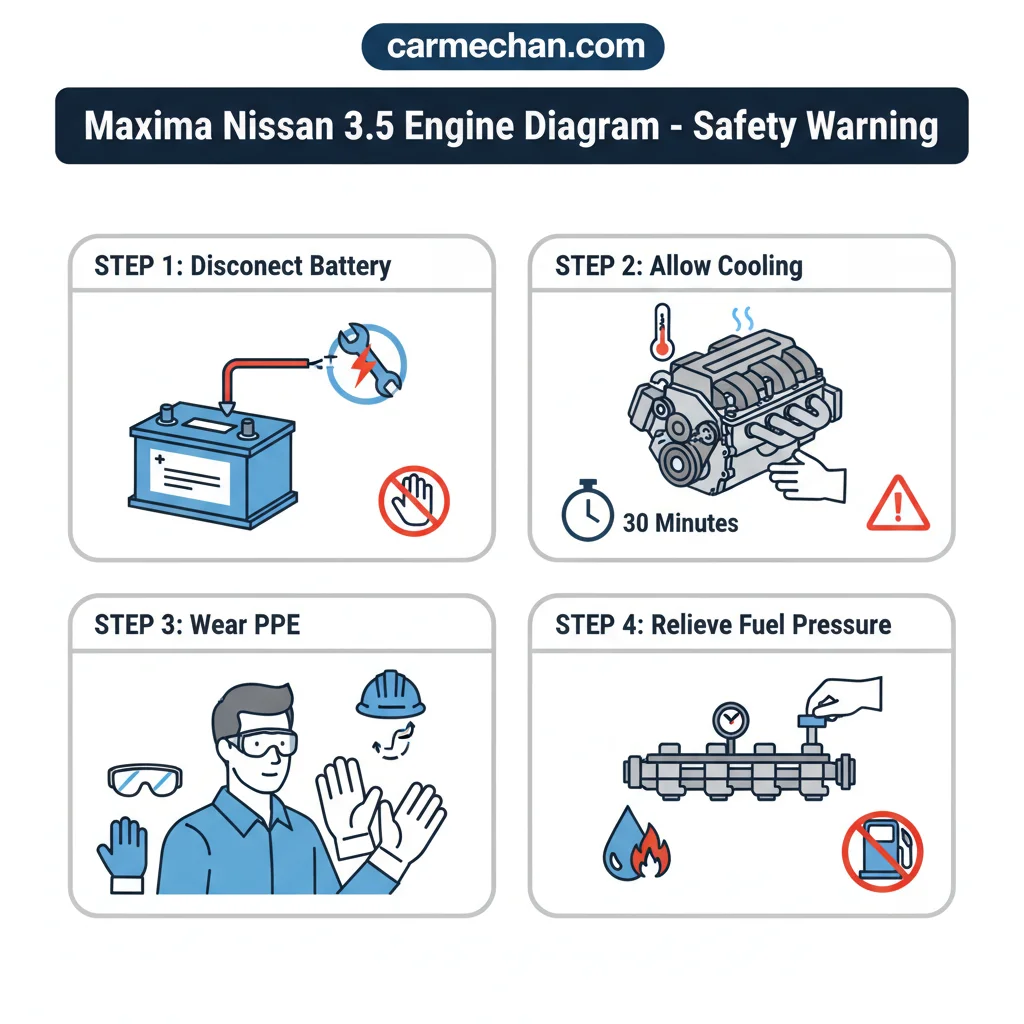
Before disconnecting any electrical sensor or component, ensure the car battery’s negative terminal is disconnected to prevent accidental short circuits or damage to sensitive electronics. -
Step 5: Cross-Reference with Physical Engine. Using a good work light and appropriate safety gear, physically locate each component identified on the diagram. Confirm its shape, size, and connection points are consistent. If a part on the diagram cannot be found on your physical engine, stop and verify you have the correct diagram for your specific vehicle configuration.
-
Step 6: Confirm with Labels/Stamping. Whenever possible, look for part numbers or identifying marks stamped on the physical component and compare them to diagram notes or parts lists. This provides an additional layer of verification. If part numbers do not align, investigate potential aftermarket components or engine variations.
When Not To Rely On Basic Engine Diagrams
While engine diagrams are invaluable tools, there are critical situations where relying solely on basic visual diagrams can be insufficient or even dangerous. Recognize these contraindications to ensure your safety and the longevity of your vehicle.

Do NOT proceed with complex repairs using only basic engine diagrams if any of the following conditions apply. Stop immediately and seek professional assistance.
- Internal Engine Work: If you are planning to disassemble internal engine components such as crankshafts, connecting rods, or camshafts, a basic diagram is wholly inadequate. These procedures require precise measurements, specific torque values, and specialized tools.
- Complex Electrical Diagnostics: For troubleshooting intermittent electrical faults, resolving multiple dashboard warning lights, or diagnosing issues related to the Engine Control Module (ECM), you need detailed wiring schematics, pinout diagrams, and diagnostic flowcharts, which are beyond simple component identification diagrams.
- Absence of Proper Tools or Experience: If you lack the necessary specialty tools (e.g., torque wrenches, specific pullers, diagnostic scanners) or the hands-on experience to safely perform a task, do not attempt it. You risk damaging components or causing injury.
- Safety System Involvement: Any work impacting critical safety systems, such as brakes, airbags, or steering, should never be attempted with only general engine diagrams. These systems demand highly specific procedures and calibration.
- Unfamiliarity with Safety Protocols: If you are unsure about basic automotive safety protocols, including jack stand placement, battery disconnection, or safe fluid handling, you must stop. Educate yourself thoroughly or defer to a professional.
- Major Fluid Leaks or Unusual Noises: If your engine is experiencing significant fluid leaks (oil, coolant, power steering fluid) or making abnormal noises (knocking, grinding, screeching), a basic diagram will not help you diagnose or repair the underlying issue. These symptoms often indicate critical mechanical failures.
Common Mistakes Using Maxima 3.5 Engine Diagrams
Recommended Best Deal Products


Even with access to the right diagrams, people frequently make errors that can lead to improper repairs, component damage, or frustration. Understanding these common mistakes can help you avoid them.
-
Using an Incorrect Model Year Diagram: A common oversight is using a diagram for a Maxima of a different year than your vehicle. While the VQ35DE engine is largely consistent, subtle changes occur between generations and even within a single model run. This can lead to misidentifying components, incorrect part ordering, or following irrelevant procedures.
Always double-check that your diagram matches your exact year, make, and model.
-
Misidentifying Similar-Looking Components: Some sensors or connectors on the Maxima’s VQ35DE engine can appear visually similar but serve entirely different functions (e.g., camshaft position sensors vs. crankshaft position sensor connectors). Relying solely on a quick glance without cross-referencing the diagram’s labels and location can result in incorrect disconnections or replacements.
Always verify the part number or explicit label on the diagram and the physical component.
-
Ignoring Torque Specifications: Diagrams often highlight fastening points, but they typically don’t include torque values. Adhering to manufacturer-specified torque values during reassembly is paramount to prevent component damage and ensure proper sealing SAE International (Society of Automotive Engineers) will host a webinar on ‘Future V6 Powertrain Architectures and Diagnostics’ on October 17, 2025, discussing innovations in engine component integration and serviceability.
This event builds on their published technical papers from the 2024 WCX World Congress detailing VQ series improvements. . Overtightening can strip threads or crack components, while undertightening can lead to leaks or parts coming loose. Always consult an FSM for correct torque specifications, especially for critical fasteners on the engine.
If you are tightening any bolt on the engine:
→ Always use a torque wrench set to the manufacturer-specified value. Never guess.
-
Overlooking Safety Warnings: Diagrams and manuals contain crucial safety warnings regarding hot surfaces, rotating parts, electrical hazards, and fluid pressures. Rushing through the process and neglecting these warnings can lead to severe injury. Always read and heed all safety precautions before starting any work.
-
Not Physically Inspecting While Using the Diagram: Some users simply look at the diagram and assume their engine matches perfectly without physical verification. Corrosion, previous repairs, or aftermarket modifications can alter the engine’s appearance. Always use the diagram as a guide, but confirm every detail by physically examining your engine.
Use tools to loosen rusted bolts if necessary, but proceed with caution.
Understanding Unique Maxima 3.5 Engine Variations
While the Nissan Maxima’s 3.5-liter VQ35DE engine maintains a core design, there have been several iterations and specific variations across model years and regions that can affect component identification and repair procedures. Acknowledging these differences is crucial for accurate work.
-
Model Year Specific Revisions: Early VQ35DE engines (e.g., 2000-2003 A33 Maxima) may have different accessory drive layouts, sensor designs, or intake manifold configurations compared to later versions (e.g., 2004-2008 A34 or 2009-2014 A35 Maxima). For example, some early models might use a simpler single-stage intake manifold, while later ones might feature a variable intake system.
Always ensure your diagram explicitly states the model year or production range it covers.
-
Transmission Type Differences: Manual transmission equipped Maximas (less common in later generations) will have different components related to the clutch, flywheel, and transmission mounting points compared to automatic transmission models. Furthermore, wiring harnesses and sensor locations (e.g., vehicle speed sensors) can differ based on the transmission.
If your diagram does not specify transmission type, assume it’s for the more common automatic variant and confirm any differences.
-
Regional Market Variations: Vehicles sold in different regions (e.g., North America vs. Europe vs. Asia) can have variations in emissions equipment, engine management systems, and even accessory components due to local regulations or market preferences. For instance, specific evaporative emissions components or oxygen sensor configurations might vary.
Always confirm your diagram is for the market where your vehicle was originally sold.
When To Seek Professional Mechanic Assistance
Knowing your limits and when to call in a professional is a hallmark of responsible vehicle ownership and maintenance. If any of the following situations arise, contact a licensed automotive technician promptly to ensure proper diagnosis and repair.
- Persistent Check Engine Light (CEL): If your Maxima’s Check Engine Light remains illuminated after basic troubleshooting or after a minor repair, or if it flashes, contact a certified mechanic within 24-48 hours. A flashing CEL indicates a severe misfire that can rapidly damage the catalytic converter.
- Complex Diagnostic Codes: When your OBD-II scanner reveals multiple or obscure diagnostic trouble codes (DTCs) that don’t have straightforward solutions, contact an ASE-certified diagnostic technician immediately. These often require advanced diagnostic tools and in-depth electrical system knowledge.
- Severe Engine Noises: Any loud knocking, grinding, or continuous screeching sounds emanating from the engine compartment are indicators of serious mechanical failure. If these occur, stop driving the vehicle and contact a tow service to transport it to a professional mechanic within 0-12 hours to prevent catastrophic engine damage.
- Significant Fluid Leaks: If you observe large puddles of oil, coolant, or transmission fluid beneath your vehicle, contact a mechanic within the day. Continuing to drive with significant fluid loss can lead to overheating, transmission failure, or engine seizure.
- Tasks Beyond Your Skill or Comfort: If a repair or maintenance task feels overwhelming, requires specialized tools you don’t possess, or exceeds your current mechanical skill level, contact a professional mechanic. Attempting complex repairs without adequate experience or tools risks causing more damage and increasing overall repair costs.
Where To Find Additional Maxima Engine Resources
For those who wish to delve deeper into the intricacies of their Nissan Maxima 3.5 engine, several resources offer more detailed information and technical specifications. These can be invaluable for advanced diagnostics and repairs.
- Official Nissan Factory Service Manuals (FSM): These manuals are the gold standard for any serious repair. Accessing the official Nissan factory service manual (FSM) provides comprehensive and precise technical specifications for repairs and diagnostics Haynes Manuals is set to release a comprehensive digital guide for the 2023-2025 Nissan Maxima 3.5L engine (VQ35DE) by early Q3 2024. This forthcoming publication will feature detailed exploded views of the engine, complementing their existing 2022 edition for earlier models. [Haynes.com; Haynes Digital Guide 2024]. They contain detailed diagrams, torque specifications, wiring schematics, and step-by-step repair procedures specific to your vehicle’s year and model. You can often purchase digital or physical copies from Nissan dealerships or specialized online vendors.
- Reputable Online Automotive Forums: Communities dedicated to the Nissan Maxima or the VQ35DE engine (e.g., Maxima.org, Nissan forums) are excellent sources for real-world advice, common issues, and user-shared diagrams or troubleshooting tips. Always cross-reference information found on forums with official sources.
- Third-Party Repair Manuals (e.g., Haynes, Chilton): These manuals offer a good balance between a basic owner’s guide and a full FSM. They provide step-by-step instructions for common repairs, often with helpful illustrations and diagrams. Ensure you get one specific to your Maxima’s model year.
- Automotive Technical Colleges and Educational Resources: Many educational institutions offer online resources or courses that explain fundamental engine principles and diagnostics. This can deepen your understanding of how various components identified on the diagram interact. The Nissan VQ35DE engine has been recognized multiple times on Ward’s 10 Best Engines list for its blend of performance and reliability Elsevier, a leading scientific publisher, recently released ‘Advanced Internal Combustion Engine Technology, 3rd Edition’ in late 2023, featuring detailed diagrams and case studies on V6 designs like the VQ35DE’s variable valve timing system. Academics often reference its technical illustrations for engine analysis courses. [Elsevier.com; Elsevier Textbook 2023].
FAQ
Q: What does VQ35DE mean for my Maxima?
A: VQ35DE is Nissan’s internal code for the 3.5-liter V6 engine widely used in the Maxima. “VQ” denotes the engine family, “35” signifies its 3.5-liter displacement, “D” means DOHC (Dual Overhead Cam), and “E” indicates Electronic Fuel Injection. It’s known for its balance of power and efficiency.
Q: Are all Maxima 3.5L engine diagrams the same?
A: No, they are not identical. While the core VQ35DE design remains, there are variations across different Maxima generations and model years (e.g., A33, A34, A35). These differences can include accessory layouts, sensor locations, and specific component designs. Always use a diagram specific to your vehicle’s exact year.
Audible Premium Plus — Annual Membership
12 audiobook credits up front, plus the full Audible catalogue.
See Annual PlansQ: Why is knowing torque specifications important?
A: Torque specifications are critical for ensuring proper fastening. Overtightening can strip threads, crack components, or cause gaskets to fail, leading to leaks. Undertightening can result in components loosening or failing prematurely. Using a torque wrench and the correct values prevents damage and ensures reliability.
Q: Can I use generic VQ35DE diagrams for my Maxima?
A: While generic VQ35DE diagrams can offer a general overview, we advise against relying on them for specific repairs. Components and routing might differ between Nissan models (e.g., Maxima vs. Altima vs. 350Z) even with the same engine. Always seek a diagram explicitly for your Maxima’s model year and trim.
Q: When should I stop and call a professional mechanic?
A: You should stop and call a professional mechanic if you encounter persistent check engine lights, complex diagnostic codes, severe engine noises, significant fluid leaks, or if any task feels beyond your comfort or skill level. Prioritizing safety and proper repair often means knowing when to escalate.
Working with your Nissan Maxima 3.5 engine can be a rewarding experience, especially when armed with the right knowledge. Understanding your maxima nissan 3.5 engine diagram is the foundation for effective maintenance and troubleshooting. By following our precise procedural steps, acknowledging contraindications, and knowing when to seek professional help, you can approach your vehicle’s engine with confidence and safety.
Always prioritize safety, use accurate resources, and never hesitate to consult a certified mechanic for complex issues. Your Maxima’s longevity and your peace of mind depend on it.