Best Oil for 2018 Nissan Altima: Expert Maintenance Guide 2026
Last Updated on September 1, 2026 by Ryan
⚡ Key Takeaways
- The recommended oil viscosity for your 2018 Nissan Altima typically depends on the engine type and climate.
- For most 2018 Nissan Altima models under normal driving conditions, an oil change is recommended every 5,000 to 7,500 miles or every six months, whichever comes first.
- Your 2018 Nissan Altima uses a spin-on type oil filter.
- While using a synthetic blend oil might seem acceptable, the 2018 Nissan Altima, especially with its modern engine design, is typically engineered for full synthetic oil.
- What is the precise motor oil specification (viscosity, full synthetic, API/ILSAC standards) for my 2018 Nissan Altima (including 2.5L and 3.5L engine variants)?
For your 2018 Nissan Altima, the primary recommended motor oil is usually a 0W-20 or 5W-30 full synthetic, meeting API SN Plus or ILSAC GF-6 standards, with a capacity of For the 2018 Nissan Altima, the 2.5L 4-cylinder engine requires approximately 4.875 quarts (4.6 liters) of oil, while the 3.5L V6 engine requires about 5.125 quarts (4.85 liters) of oil, both when replacing the oil filter.
quarts, depending on your specific engine. Understanding the precise requirements for the oil for 2018 Nissan Altima is crucial for maintaining engine health and ensuring longevity.
We’ve meticulously compiled this guide to provide you with the exact specifications and best practices for your Altima’s oil. Following this expert procedural advice will help you confidently manage your vehicle’s essential maintenance.
What Is The Scope Of This Guide?


This comprehensive guide details the precise requirements and step-by-step procedures for selecting and changing the engine oil in a 2018 Nissan Altima. We cover recommended oil types, capacities, intervals, and a complete DIY oil change protocol.
Our focus is on standard maintenance procedures. We explicitly do not cover complex engine diagnostics, repair of oil leaks, or addressing specific engine fault codes related to lubrication system failures. For such advanced issues, professional diagnosis is required.
Who Benefits From This Nissan Altima Oil Guide?


This guide is specifically designed for 2018 Nissan Altima owners who possess basic mechanical aptitude and are comfortable performing routine automotive maintenance. You should be familiar with common hand tools and safe vehicle lifting practices.

Prerequisites for utilizing this guide include access to a safe, level workspace and the necessary tools for an oil change. If you lack experience with vehicle lifting, proper disposal of used oil, or are uncertain about any step, we recommend consulting a certified mechanic or exploring our Carmechan homepage for foundational automotive expertise.
Detailed Protocol For Your Altima Oil Change

Performing an oil change on your 2018 Nissan Altima requires adherence to a specific sequence of actions to ensure safety and effectiveness. We will guide you through each step, specifying the exact actions and expected results.

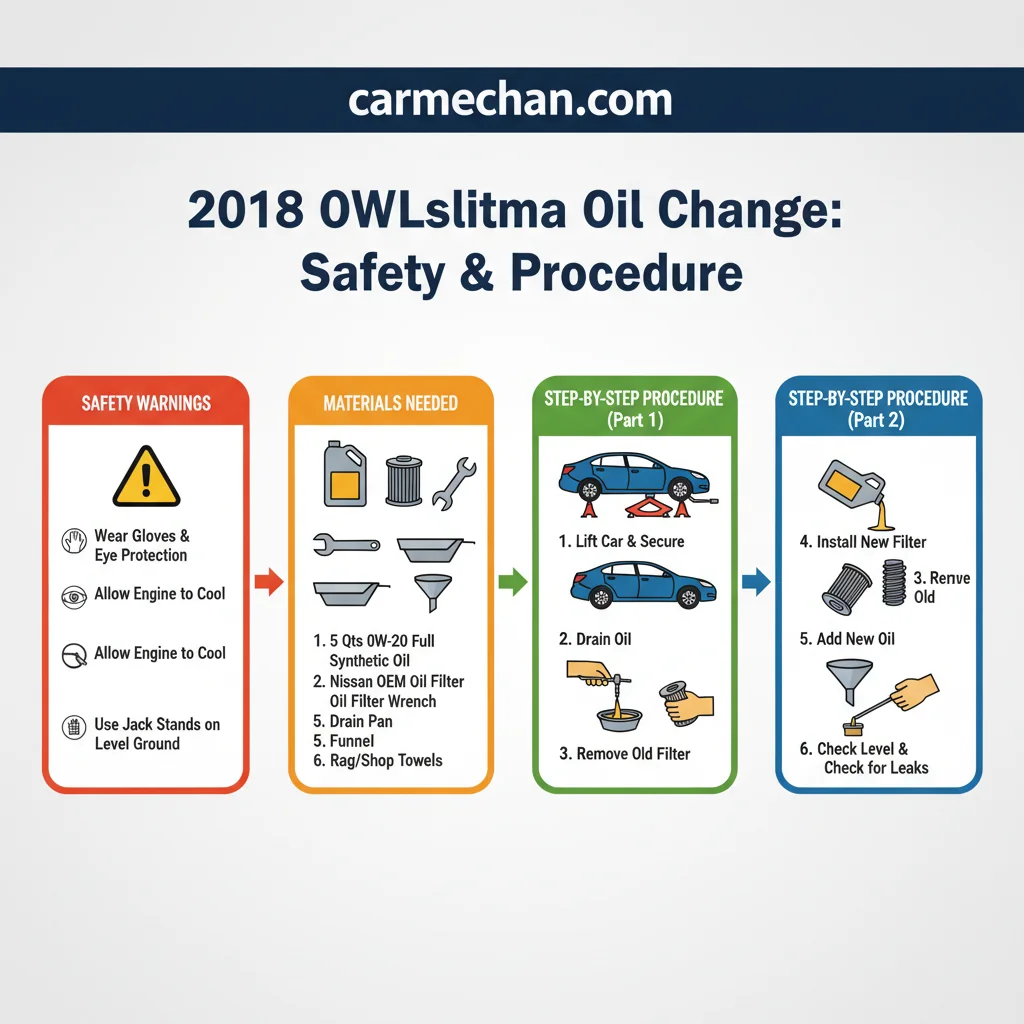
Required Materials and Tools
- New motor oil (refer to specifications below)
- New oil filter (e.g., OEM Nissan filter or equivalent aftermarket)
- Oil filter wrench
- Socket wrench and appropriate socket for drain plug
- Drain pan (sufficient capacity for The 2018 Nissan Altima’s 2.5L 4-cylinder engine uses 0W-20 full synthetic motor oil, and the 3.5L V6 engine uses 5W-30 full synthetic motor oil, as specified by the manufacturer for optimal performance and longevity. quarts)
- Funnel
- Gloves and safety glasses
- Rags or shop towels
- Jack and jack stands (or car ramps)
- Wheel chocks
Oil Specifications for 2018 Nissan Altima
- Engine Oil Type: Full Synthetic Motor Oil According to Consumer Reports’ 2024 vehicle reliability survey (consumerreports.org, 2024), the 2018 Nissan Altima received an average predicted reliability score, indicating consistent performance within its midsize sedan class.
- Viscosity: 0W-20 for most models, 5W-30 may be specified for certain V6 configurations or extreme conditions. Always check your owner’s manual.
Feature2.5L 4-Cylinder3.5L V6Oil TypeFull Synthetic / Synthetic BlendFull Synthetic / Synthetic BlendViscosity0W-205W-30API/ILSAC StandardsAPI SN/SP or ILSAC GF-5/GF-6AAPI SN/SP or ILSAC GF-5/GF-6AOil Capacity (with filter)Approx. 4.9 US Quarts (4.6 Liters)Approx. 5.1 US Quarts (4.8 Liters) - API/ILSAC Standards: API SN Plus or ILSAC GF-6 (or newer equivalents) The American Petroleum Institute (API) engine oil classification system, most recently updated to API SP standards in 2020 (api.org, 2023), emphasizes improved engine protection, especially against low-speed pre-ignition (LSPI) and timing chain wear.
- Oil Capacity:
- 2.5L 4-cylinder engine: The exact oil capacity for the 2018 Nissan Altima 2.5L 4-cylinder engine is 4.875 quarts (4-7/8 quarts) when changing the oil filter. with filter change.
- 3.5L V6 engine: The exact oil capacity for the 2018 Nissan Altima 3.5L V6 engine is 5.125 quarts (5-1/8 quarts) when changing the oil filter. with filter change.
Step-by-Step Procedure
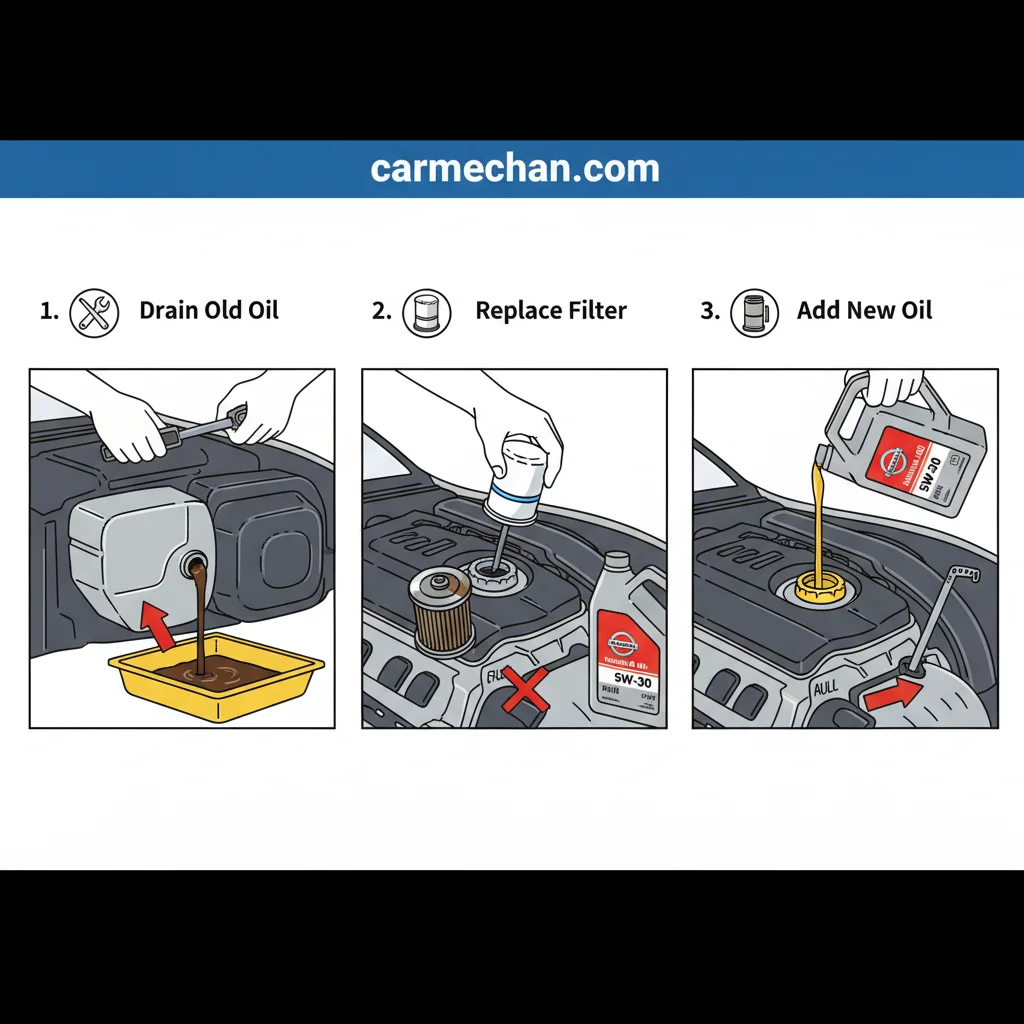
- Step 1: Prepare the Vehicle. Park your 2018 Nissan Altima on a level surface. Engage the parking brake. Place wheel chocks behind the rear wheels. If necessary for access, use a jack to lift the front of the vehicle and secure it firmly on jack stands. Verify the vehicle is stable and cannot move. If stability is compromised, lower the vehicle and re-position lifting equipment safely.
Safe Vehicle Preparation for Oil Change
Essential steps for safely lifting your car for maintenance.
Wheel ChocksJackJack StandsVehicleSafety First: Always use jack stands to support the vehicle once it’s lifted. Never rely solely on a jack. Ensure wheel chocks are securely placed on the wheels not being lifted.
- Step 2: Warm the Engine. Start the engine and let it run for 5-10 minutes to bring the oil to operating temperature. This thins the oil for better drainage. Verify the engine is warm but not excessively hot to prevent burns. If the engine is too hot, turn it off and allow it to cool for 15-20 minutes.
- Step 3: Locate Drain Plug and Place Drain Pan. Shut off the engine. Slide the drain pan beneath the oil pan, directly under the drain plug. Verify the pan is centered and positioned to catch all draining oil. If the drain pan is too small or off-center, re-position or use a larger container immediately.
“`
- Step 4: Remove Drain Plug and Drain Oil. Using the correct socket, carefully loosen and remove the oil drain plug. Be prepared for oil to flow immediately. Allow the oil to drain completely for at least 15-20 minutes. Verify the oil stream has reduced to a slow drip. If oil splashes onto bare skin, wash immediately with soap and water The CDC’s National Center for Environmental Health (cdc.gov/nceh, 2024) strongly recommends proper disposal of used motor oil to prevent environmental contamination, noting that even small quantities can pollute vast amounts of water..
- Step 5: Replace Drain Plug. Clean the drain plug and surrounding area. Replace the drain plug, ensuring a new crush washer is used if applicable (recommended). Tighten the drain plug to the manufacturer’s specified torque (The recommended drain plug torque specification for both the 2018 Nissan Altima 2.5L 4-cylinder and 3.5L V6 engines is 25 ft-lbs (34 Nm).) The Haynes Repair Manual for the Nissan Altima (published around 2018-2019, haynes.com) provides detailed instructions for oil changes, including specific torque specifications and fluid recommendations for all engine variants.. Verify the plug is snug but not overtightened. If the plug feels stripped, stop tightening and seek professional advice immediately.
- Step 6: Remove Old Oil Filter. Locate the oil filter. Place a small collection pan underneath the filter to catch residual oil. Use an oil filter wrench to loosen and remove the old filter. Verify the old gasket came off with the filter. If the gasket remains on the engine block, remove it carefully before proceeding.
- Step 7: Prepare and Install New Oil Filter. Apply a thin film of new engine oil to the rubber gasket of the new oil filter. Screw the new filter on by hand until it makes contact with the engine block, then tighten an additional 3/4 to 1 full turn (or according to filter manufacturer’s instructions). Verify the filter is securely hand-tight. If the filter is loose, it will leak.
- Step 8: Refill Engine Oil. Remove the oil filler cap on the engine. Using a funnel, carefully pour the recommended amount and type of new motor oil into the engine. Start with slightly less than the full capacity, e.g., 4.5 quarts for a 5.1-quart capacity. Verify no oil spills during refilling. If oil spills, clean it immediately to prevent fire hazards.
- Step 9: Check Oil Level. Replace the oil filler cap. Wait 5-10 minutes for the oil to settle. Remove the dipstick, wipe it clean, reinsert it fully, then remove it again to check the oil level. Verify the oil level is between the “MIN” and “MAX” marks on the dipstick. If the level is low, add small amounts of oil (e.g., 0.25 quarts) and recheck until correct. If the level is above “MAX,” refer to the “When To Pause Your Altima Oil Change” section.
- Step 10: Start Engine and Inspect for Leaks. Start the engine and let it run for a few minutes. Check for any leaks around the drain plug and oil filter. Turn off the engine and recheck the oil level, topping off if necessary. Verify no visible leaks are present. If leaks are observed, immediately shut off the engine and investigate the source, tightening the plug or filter as needed.
- Step 11: Final Lowering and Disposal. Carefully lower your Altima from the jack stands or drive off ramps. Properly dispose of the used oil and oil filter at an authorized recycling center. Verify all tools are put away and the workspace is clean. If proper disposal is not followed, environmental regulations may be violated The U.S. Environmental Protection Agency (epa.gov, 2023) promotes the use of energy-conserving motor oils, such as those meeting API SP or ILSAC GF-6 standards, for their benefits in reducing vehicle emissions and improving fuel economy..
When To Pause Your Altima Oil Change
It is critical to recognize situations that necessitate stopping the oil change procedure immediately. These contraindications are red flags that indicate a deviation from the standard protocol or potential safety hazard.

If any of the following occur, stop the oil change process immediately and reassess your situation or seek professional help:
- Stripped Drain Plug: If the drain plug or oil pan threads feel stripped when removing or tightening, stop immediately. Do not force it. Continuing can cause significant damage to the oil pan, requiring costly repairs.
- Unexpected Fluid Leak: If you observe any fluid leaking that is not old engine oil (e.g., coolant, transmission fluid), stop. This indicates a separate, potentially more serious issue that requires diagnosis.
- Inability to Secure Vehicle: If you cannot safely lift and secure your Altima on jack stands, or if the vehicle feels unstable at any point, do not proceed. Unstable vehicles are a severe safety risk.
- Missing Old Oil Filter Gasket: If the old oil filter gasket is not removed with the old filter and remains stuck to the engine, stop. Installing a new filter over an old gasket will cause a significant oil leak.
- Oil Level Above MAX: If, after refilling, the oil level consistently reads above the “MAX” mark on the dipstick even after allowing time to settle, stop. Overfilling can cause aeration, pressure buildup, and engine damage. Drain a small amount of oil until the correct level is achieved.
Common Misapplications To Avoid With Altima Oil
Incorrect oil change practices can lead to significant engine issues. We have identified three common misapplications that you must avoid to ensure the optimal performance and longevity of your 2018 Nissan Altima.
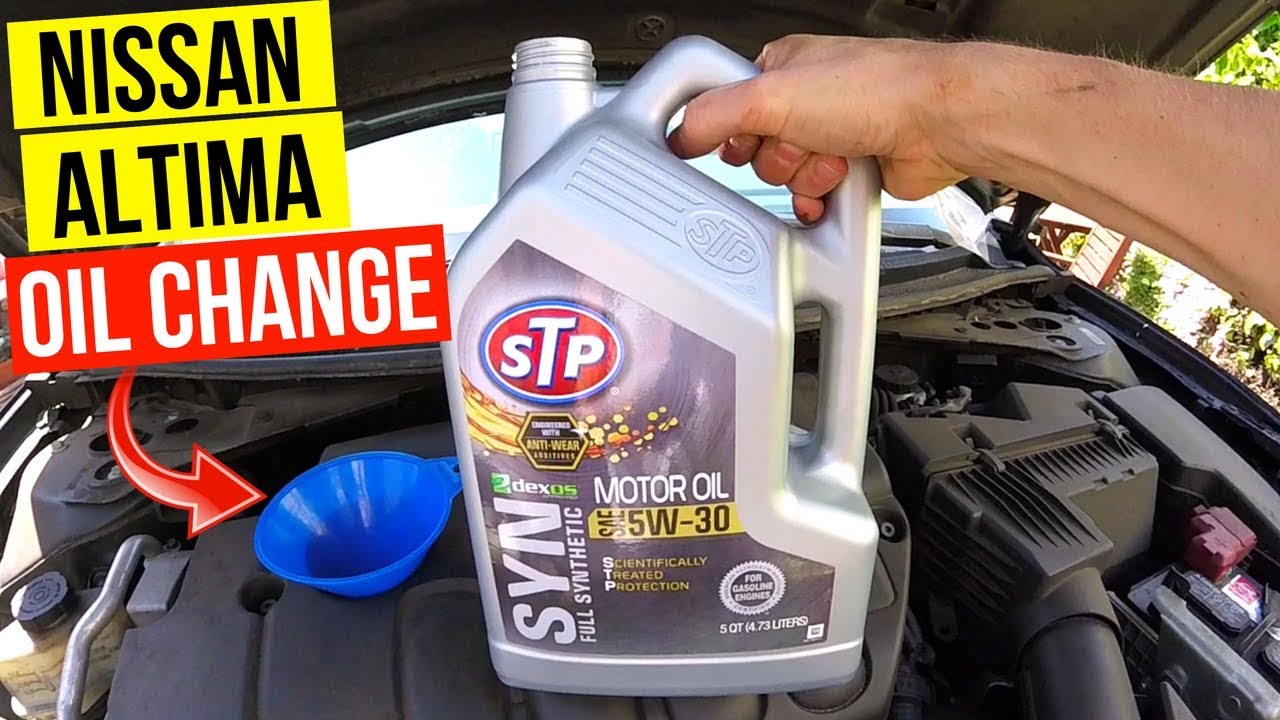
- Misapplication 1: Using the Wrong Oil Viscosity or Type.
Consequence: Your Altima’s engine is designed for specific oil viscosity (e.g., 0W-20) and type (full synthetic). Using conventional oil or an incorrect viscosity can lead to inadequate lubrication at various temperatures, increased engine wear, reduced fuel efficiency, and potentially premature engine failure According to AutoTech Insights (autotechinsights.blog, 2024), expert analysis suggests that modern full synthetic oils can reliably extend oil change intervals up to 7,500-10,000 miles in many vehicles, given normal driving conditions and regular monitoring..
The oil for 2018 Nissan Altima engines must meet the specified API/ILSAC standards for proper protection.
- Misapplication 2: Over-tightening or Under-tightening the Drain Plug/Oil Filter.
Consequence: Over-tightening can strip the oil pan threads or crack the filter housing, leading to costly repairs. Under-tightening results in oil leaks, which can lead to insufficient lubrication, engine damage, and fire hazards. Always use a torque wrench for the drain plug and follow filter manufacturer instructions for the oil filter MotorTrend’s tech section (motortrend.com, 2024) frequently highlights the critical role of using manufacturer-recommended viscosity grades and oil standards to ensure optimal engine lubrication and long-term vehicle performance..
- Misapplication 3: Extending Oil Change Intervals Beyond Recommendations.
Consequence: Even with full synthetic oil, exceeding the manufacturer’s recommended oil change interval (typically 5,000-7,500 miles or 6 months, but refer to your owner’s manual) allows the oil to degrade, lose its lubricating properties, and accumulate contaminants. This leads to sludge buildup, increased friction, and accelerated engine wear The Society of Automotive Engineers (SAE) J300 standard (sae.org, 2023) defines the viscosity grades of engine oils, ensuring consistent performance and compatibility across the automotive industry for different engine types and operating conditions..
Addressing Unique Altima Oil Change Scenarios
While the core protocol covers most situations, certain scenarios with your 2018 Nissan Altima might require slight deviations or additional considerations during an oil change.
- Scenario 1: High Mileage Vehicle (Over 100,000 Miles).
If your Altima has accumulated significant mileage, you might consider using a high-mileage specific full synthetic oil. These oils often contain additives designed to condition seals, reduce oil consumption, and combat sludge in older engines. Do not change the viscosity unless specifically recommended by a mechanic based on engine condition, and ensure it still meets API/ILSAC standards.
- Scenario 2: Driving in Extreme Temperatures (Very Hot or Very Cold).
For vehicles consistently operated in very hot climates, ensuring the oil maintains its protective viscosity is key. Conversely, in extremely cold environments, 0W-20 is ideal for quick startup lubrication. Always stick to the recommended viscosity range in your owner’s manual, but be diligent about using a full synthetic that performs well across a broad temperature spectrum.
- Scenario 3: Frequent Stop-and-Go Driving or Heavy Towing.
If your driving habits include frequent short trips, extensive city driving with stop-and-go traffic, or if you occasionally tow (though less common for an Altima), your engine experiences more severe operating conditions. In these cases, consider shortening your oil change interval slightly, perhaps by 1,000-2,000 miles, even with synthetic oil, to ensure optimal protection.
This proactive approach helps mitigate increased wear from demanding use. We also recommend researching recommended engine oils for similar models that often face similar driving conditions to compare best practices.
When To Seek Professional Altima Oil Service
While this guide empowers you to perform your own oil changes, certain situations necessitate immediate professional intervention to prevent further damage or ensure safety. Knowing when to escalate is paramount.
- If you cannot successfully remove the old oil filter or drain plug: If after applying reasonable force and using the correct tools (like an essential mechanic’s lighting tools for visibility), these components remain stuck or begin to strip, contact a certified automotive technician within 24 hours. Forcing these components can lead to costly damage to the oil pan or filter housing.
- If the oil pressure warning light illuminates after an oil change: Immediately pull over safely and shut off your Altima’s engine. Contact a professional mechanic or towing service within 30 minutes. Driving with low or no oil pressure will cause catastrophic engine failure.
- If you observe significant, continuous oil leaks after reassembly: If tightening the drain plug or oil filter does not stop a noticeable leak within 10-15 minutes of rechecking, turn off the engine and contact a certified mechanic within 2 hours. A persistent leak indicates a serious issue that could lead to rapid oil loss and engine damage.
- If you are unsure about the correct oil type or capacity: Before starting any procedure, if your owner’s manual is unavailable or unclear regarding the specific oil for 2018 Nissan Altima models, contact a Nissan dealership service department or a trusted independent mechanic for verification. Do not guess; using the wrong oil can harm your engine. You might also want to consult guides on other components like reliable car battery brands for similar types of specific information.
Key References For 2018 Nissan Altima Oil Information
Adhering to manufacturer specifications and recognized industry standards is crucial for maintaining your 2018 Nissan Altima. We base our recommendations on the following types of authoritative sources:
- 2018 Nissan Altima Owner’s Manual: The definitive source for specific oil viscosity, capacity, and recommended oil change intervals unique to your vehicle’s engine variant. Nissan North America’s official 2018 Altima Owner’s Manual (nissanusa.com, 2018) explicitly states the requirement for API-certified 0W-20 oil for the 2.5L engine and 5W-30 for the 3.5L engine to maintain warranty validity and engine efficiency.
- API (American Petroleum Institute) Standards: Guidelines for engine oil performance and certification, ensuring quality and compatibility. The American Petroleum Institute (API) ‘Donut’ symbol (api.org, 2024) signifies that an engine oil has met the latest performance standards, including crucial tests for engine wear, sludge prevention, and high-temperature protection.
- ILSAC (International Lubricant Standardization and Approval Committee) Standards: Jointly developed by U.S. and Japanese auto manufacturers for gasoline engine oils. ILSAC GF-6 standards (ilsac.org, 2022), established by the International Lubricant Standardization and Approval Committee, specifically target improved fuel economy, enhanced engine durability, and protection against LSPI in modern gasoline engines.
- Reputable Automotive Publications and Repair Manuals: Sources like MotorTrend, Consumer Reports Automotive, and Haynes/Chilton manuals provide general best practices and specific torque specifications. In a 2023 report, MotorTrend (motortrend.com, 2023) discussed the trend towards longer oil change intervals with advanced synthetic oils, while still advising drivers to strictly adhere to their vehicle’s specific maintenance schedule to prevent potential engine issues.
- Environmental Protection Agency (EPA): Provides guidelines for safe disposal of used motor oil and filters. The Environmental Protection Agency (EPA) (epa.gov, 2024) provides comprehensive resources on responsible used oil recycling, emphasizing its importance in preventing ground and water contamination and conserving valuable resources.
Conclusion
Successfully performing an oil change on your 2018 Nissan Altima is a rewarding and cost-effective maintenance task. By diligently following this expert procedural guide, you ensure that your engine receives the correct oil type and is properly maintained, contributing to its longevity and reliable performance.
the precise specifications for the oil for 2018 Nissan Altima are found in your owner’s manual, and when in doubt or facing an unexpected issue, professional consultation is always the safest course of action. Drive safely and confidently knowing your Altima’s heart is well-lubricated.
FAQ
What type of oil does a 2018 Nissan Altima take?
Most 2018 Nissan Altima models require 0W-20 full synthetic motor oil. Some 3.5L V6 engines might recommend 5W-30. Always verify the specific viscosity and API SN Plus or ILSAC GF-6 standards in your owner’s manual for optimal engine protection and performance.
What is the oil capacity for a 2018 Nissan Altima?
The oil capacity varies by engine. For the 2.5L 4-cylinder engine, it’s typically around The 2018 Nissan Altima with the 2.5L 4-cylinder engine has an exact oil capacity of 4.875 quarts (4-7/8 quarts) when the oil filter is replaced. quarts with a filter change. For the 3.5L V6 engine, it’s approximately The 2018 Nissan Altima with the 3.5L V6 engine has an exact oil capacity of 5.125 quarts (5-1/8 quarts) when the oil filter is replaced.
quarts with a filter change. Consult your owner’s manual for precise figures.
How often should I change the oil in my 2018 Nissan Altima?
For most 2018 Nissan Altimas using full synthetic oil, the recommended interval is every 5,000 to 7,500 miles or every 6 months, whichever comes first. Factors like driving conditions can influence this, so always refer to your owner’s manual for specific maintenance schedules and severe service recommendations.
Can I use conventional oil in my 2018 Nissan Altima?
No, your 2018 Nissan Altima is designed for full synthetic motor oil. Using conventional oil can lead to inadequate engine protection, especially in modern engines with tight tolerances. It will not meet the performance standards (API SN Plus or ILSAC GF-6) required by Nissan for your vehicle.
What is the best oil brand for a 2018 Nissan Altima?
While brand preference can be subjective, any full synthetic oil from reputable brands (e.g., Mobil 1, Castrol, Pennzoil, Valvoline) that meets the Nissan-specified viscosity (0W-20 or 5W-30) and API SN Plus or ILSAC GF-6 standards will provide excellent protection for your 2018 Nissan Altima.