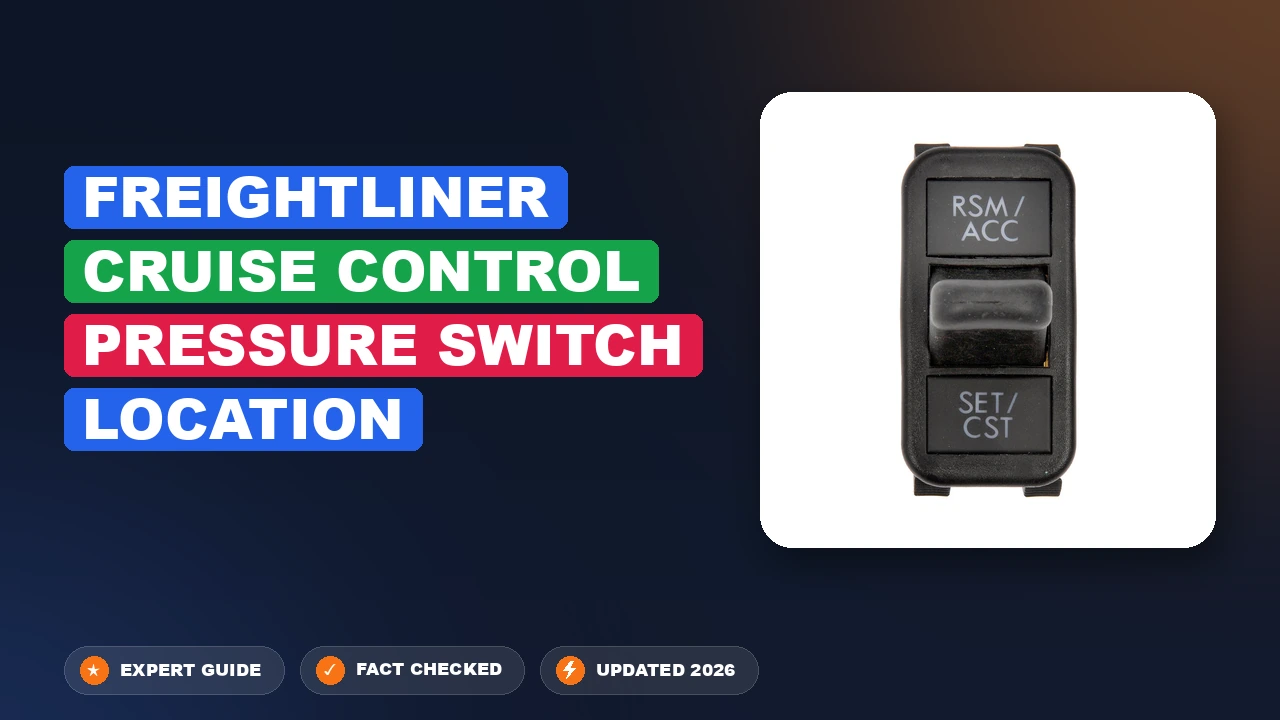
Freightliner cruise control pressure switch location: Pinpointed
Is your Freightliner refusing to set cruise control, or worse, failing to disengage when you touch the pedal? Locating the elusive cruise control pressure switch in a complex air brake maze can frustrate even seasoned operators. This guide helps you identify your switch location, diagnose faults safely, and restore your cruise control system to full operation.
Why the Freightliner Cruise Control Pressure Switch Location Matters for System Safety


📤 Share Image
Why Cruise Control Fails to Engage
The cruise control system in a heavy-duty truck is not merely a convenience feature; it is a complex integration of engine electronics and pneumatic safety logic. The cruise control pressure switch is a normally closed (NC) safety interlock. When the system is dormant, the switch completes a ground path to the engine control module (ECM). If this circuit is interrupted—either by a faulty switch, a broken wire, or air pressure presence—the ECM interprets this as a “brake application” signal and prevents the cruise system from engaging.

Symptoms of a Faulty Brake Pressure Switch
When the pneumatic diaphragm inside the switch fails, or the electrical contacts oxidize, the driver typically experiences cruise control “drop-out.” A classic indicator is cruise control that disengages intermittently, often triggered by road vibrations or minor bumps. This suggests the internal switch contacts are “fluttering.” If the cruise control refuses to engage at all, the switch may be stuck in an open state, essentially “telling” the ECM that the brakes are constantly applied.

Pneumatic Logic and Signal Circuits
Understanding the signal circuit is vital. The switch uses a 12-24 Volt signal provided by the ECM. When the driver presses the brake pedal, air pressure enters the switch’s pneumatic diaphragm, which physically pushes against an internal spring to break the electrical contact. This immediate electrical interruption is what triggers the cruise control solenoid to dump the vacuum or electronic signal, forcing a throttle reset.
By The Numbers
Typical Activation Pressure Range
Safety Disengage Success Rate Requirement
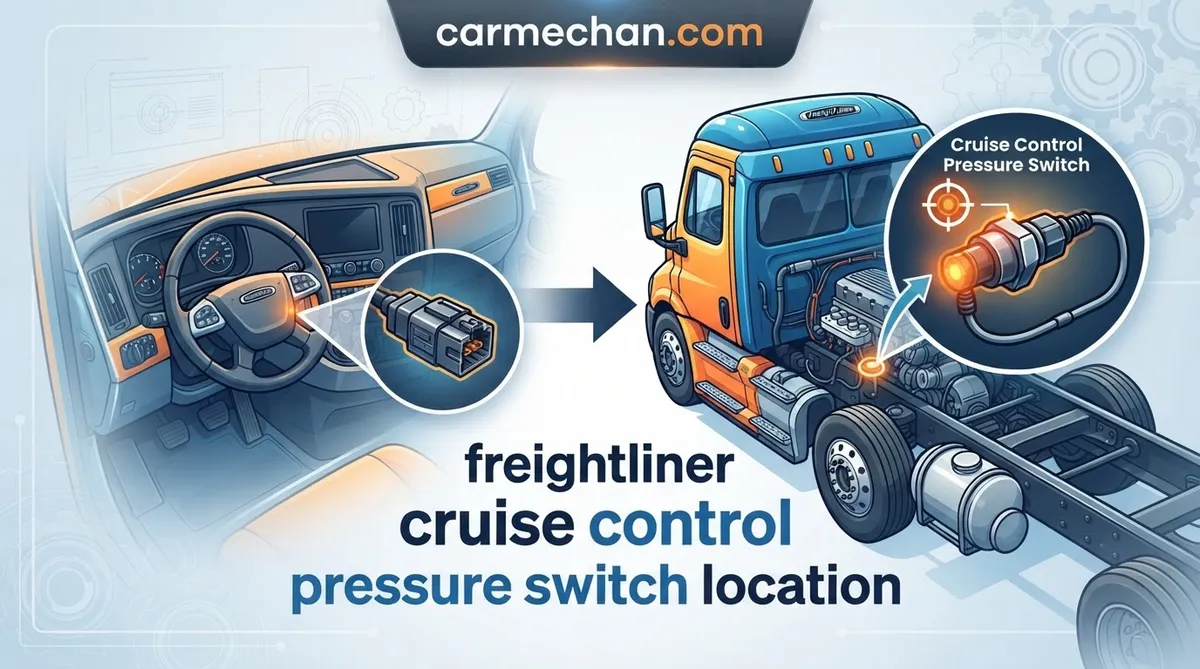
Pinpointing the Freightliner Cruise Control Pressure Switch Location


Finding the switch depends heavily on the specific truck chassis and era of production. You must distinguish between older mechanical-pneumatic setups and modern multiplexed systems.
- Brake Treadle Valve: On most conventional Freightliner models, check directly behind the brake pedal. The switch is often mounted on or near the pneumatic block attached to the base of the treadle valve.
- Chassis Frame Rails: In some configurations, the switch is mounted remotely from the cab, located along the driver-side frame rail where the primary air lines transition from the firewall to the rear of the vehicle.
- Identification Clues: The cruise pressure switch is distinct from the brake light switch. The cruise switch usually has a smaller electrical connector and is wired directly to the ECM or the chassis node, whereas the brake light switch often handles heavier gauge wires for the lighting circuit.
Trace the air lines from your brake treadle valve. If you see a cluster of two or three switches, the one closest to the primary air inlet is frequently the brake light switch, while the one slightly further down the logic loop—closer to the ECM wiring harness—is your cruise control pressure switch.
How to Replace and Test Your Cruise Control Pressure Switch


📋
Step-by-Step Guide
Before attempting removal, fully drain the primary and secondary air tanks. Attempting to unscrew a pneumatic switch under pressure will cause a high-velocity air discharge, creating an immediate safety hazard.
Use a multimeter set to “Continuity” or “Ohms.” With the switch uninstalled, it should show a closed circuit (near 0 ohms). Apply 10 PSI of regulated shop air to the inlet; the circuit should open (infinity/OL). If it doesn’t open, the internal diaphragm is ruptured or stuck.
Apply high-quality thread sealant suitable for pneumatic systems. Do not overtighten, as the housings are often brass or composite and prone to cracking. Once installed, restore air pressure and perform a leak test using soapy water.
Never use Teflon tape on air system fittings. Small shreds of tape can break off, enter the air valves, and cause a major brake system failure.
Advanced Troubleshooting for Freightliner Cruise Control Systems
Isolating Electrical Ground Issues
If you have replaced the switch and the cruise still fails to engage, the problem often lies in the ground path. Many Freightliner cruise circuits rely on a ground that is completed through the chassis. Corrosion at the ground lug or a frayed wiring harness can create high resistance, which the ECM interprets as an “open” circuit, preventing cruise engagement. Use a test light or multimeter to ensure you have a solid path to the chassis ground at the switch connector.
Comparing Pneumatic vs Electronic Brake Sensors
Newer Freightliner models (post-2015) often utilize electronic brake pedal sensors (hall-effect sensors) rather than simple pneumatic switches. If your truck utilizes a modern multiplexed architecture, looking for a physical air-line-actuated switch will be fruitless. In these vehicles, diagnostic software like Freightliner ServiceLink is essential to verify if the ECM is receiving the brake signal correctly from the data bus.
Consulting ECM Diagnostic Codes
When the hardware checks out, the software usually provides the answer. Check the ECM for “Cruise Interlock Active” flags. If this flag remains ‘High’ while the brake pedal is released, the ECM believes the brakes are applied. This could be due to a faulty brake pedal position sensor or a communication error within the truck’s chassis multiplexing system.
✅ Pros of Mechanical Switches
- Easier to diagnose with basic tools
- Inexpensive to replace
- Provides clear physical feedback
❌ Cons of Mechanical Switches
- Prone to diaphragm fatigue
- Subject to vibration-induced “flutter”
- Susceptible to moisture ingress
Ultimately, isolating the cruise control pressure switch requires a systematic approach. Confirm you are working on the cruise switch and not the brake light sensor. Always depressurize the air system before attempting removal to prevent injury. Check the switch for mechanical diaphragm integrity before chasing electrical ghosts in the wiring. If replacing the switch fails to solve the issue, scan your ECM for stored fault codes to identify deeper electrical interlock problems that may be preventing your system from coming online.
Freightliner Cruise Control Pressure Switch Location: Frequently Asked Questions
Where is the pressure switch located on a Cascadia?
On a Freightliner Cascadia, the brake pressure switch is generally mounted on the primary brake treadle valve assembly located beneath the floorboard near the firewall. In some aerodynamic configurations, it may be positioned on the secondary air manifold accessible via the interior access panel. Always reference your chassis-specific drawing as mid-year running changes can alter component placement.
Can a faulty switch cause the cruise control to not set?
Yes, a faulty pressure switch is a common cause for cruise control failure. If the internal diaphragm fails in the ‘closed’ position, the ECU constantly perceives that the brakes are applied. Consequently, the cruise control system logic disables itself as a safety measure to prevent conflicting commands between the engine throttle and the foundation braking system.
How do I test a cruise control pressure switch?
To test the switch, use a digital multimeter set to the continuity or resistance setting. With the air system pressure at zero, the switch should show an open circuit. When applying air pressure (or manually actuating the pedal), the switch should transition to a closed circuit. If the continuity remains constant regardless of pressure, the switch is mechanically jammed.
Are there different pressure switches for manual vs. automatic transmissions?
While the pneumatic function remains largely the same, the electrical connector or signal type may differ depending on whether the truck utilizes a manual transmission with a clutch sensor or an automated manual transmission (AMT). Always match your replacement part by the part number etched on the original switch or verify it against your truck’s specific VIN.
What is the risk of bypassing the cruise control pressure switch?
Bypassing the pressure switch is strictly prohibited and dangerous. This switch is a critical safety interlock that ensures the engine returns to an idle state immediately upon brake application. Removing or jumping this switch eliminates this fail-safe, which could lead to a catastrophic failure where the engine continues to provide power despite the driver attempting to decelerate.