Can You Use Cruise Control While Towing A Proven 2026 Guide
Last Updated on September 1, 2026 by Ryan
Most experts advise against using cruise control while towing to maintain full vehicle control and prevent mechanical stress. Engagement can lead to dangerous trailer sway and unnecessary strain on your transmission during terrain changes.
The short answer is no, you should generally avoid using cruise control while towing a trailer or camper. While modern 2026 driver-assistance systems are more sophisticated than ever, the unpredictable nature of towing—where the trailer acts as an independent force—creates scenarios where cruise control can compromise your vehicle’s stability. Relying on an automated throttle can prevent you from making the nuanced, manual adjustments necessary to maintain control during sudden wind gusts or shifting weight.

Prime for Young Adults — 6 Months Free
Students and 18–24s get six months of Prime free, then half price.
Start 6 Months FreeOperating a heavy rig requires constant awareness of your vehicle’s connection to the road. When you relinquish speed control to a computer, you lose the ability to proactively lighten the throttle before an incline or gently accelerate out of a sway event. By keeping your foot on the pedal, you ensure that you are always the primary operator of your vehicle’s momentum, providing a level of safety that algorithms simply cannot replicate when thousands of pounds are pushing against your bumper.
Key Takeaways
- Avoid cruise control on hilly terrain to prevent dangerous downshifting and potential loss of control.
- Manual speed control allows you to monitor trailer behavior and wind resistance more effectively.
- Constant speed adjustments under load lead to transmission ‘hunting’ and potential engine overheating.
- Always maintain direct throttle control during inclement weather or high-traffic towing scenarios.
- Check your specific vehicle manual as some manufacturers explicitly forbid cruise control use while towing.
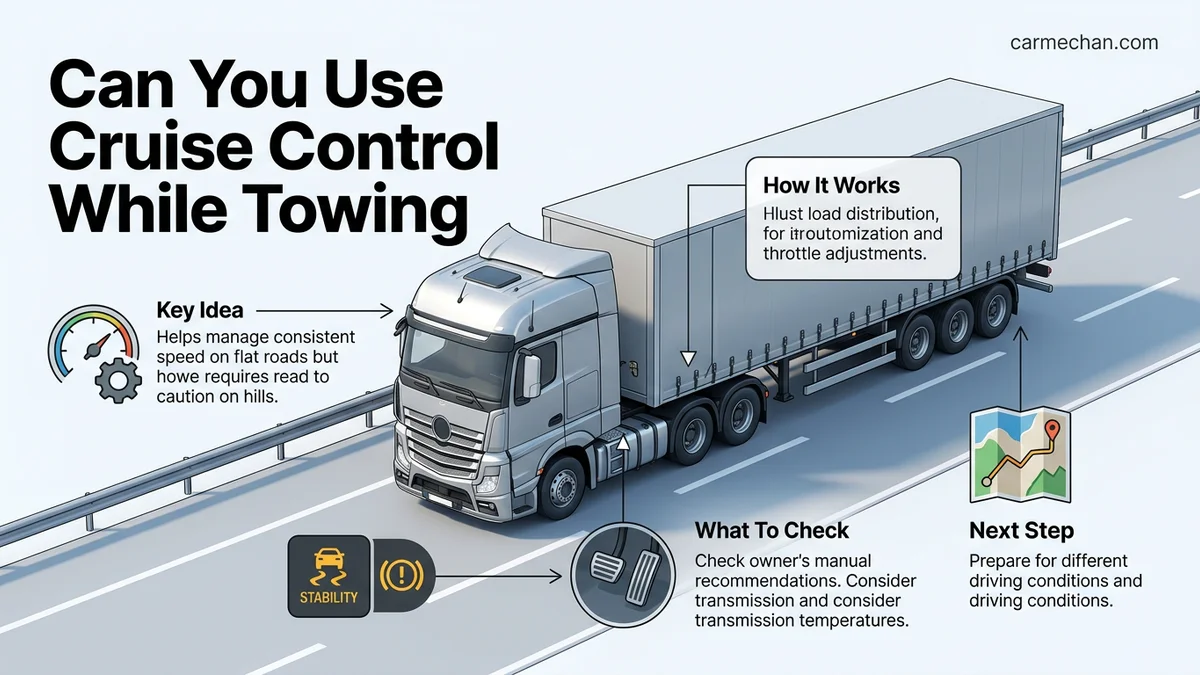
The Safety Risks of Using Cruise Control While Towing
Recommended Best Deal Products


Why Cruise Control Fails During Trailer Sway
Trailer sway is the primary safety hazard when towing, and cruise control is essentially an accelerant in these situations. If your trailer begins to oscillate, the safest recovery method is often a slow, steady reduction of throttle to allow the trailer to track behind the tow vehicle. If your cruise control is active, the system senses the slight speed drop caused by the drag of the swaying trailer and may automatically increase throttle to maintain your set speed. This counter-productive response can amplify the oscillation, potentially leading to a jackknife event or a total loss of control.

The Danger of Sudden Terrain Changes
In 2026, many vehicles feature “smart” cruise control that tracks road elevation. However, these systems often react too late for heavy towing. When entering a steep downgrade, the cruise control may fail to downshift early enough, allowing the weight of the trailer to push the vehicle into unsafe speeds before the brakes engage. Relying on the cruise system forces your vehicle to play catch-up with physics rather than managing your descent through engine braking and manual throttle modulation.
- Delayed Reactions: Automated systems cannot see around corners or anticipate road surfaces that reduce traction.
- Reduced Feedback: You lose the “seat of the pants” feel that warns you when a trailer is starting to act erratically.
- Over-Correction: Computers prioritize speed maintenance over stability, which is the wrong priority in emergency towing situations.
How to Fix Transmission Hunting and Engine Strain
Managing Gear Shifts on Inclines
Transmission “hunting” occurs when your vehicle’s computer cannot decide which gear is optimal for the current load. When using cruise control on hilly terrain, the system will aggressively downshift to maintain a set speed, then upshift as soon as the load eases. This rapid, repetitive cycling creates excessive heat in your transmission fluid. By manually controlling your speed, you can hold a lower gear longer, keeping your RPMs in the “power band” and preventing the transmission from constantly searching for the right ratio.
Protecting Your Drivetrain Under Load
Modern engines in 2026 trucks are built for high torque, but they are not immune to the damage caused by thermal stress. When the cruise control maintains a steady speed up a steep grade, it forces the engine to run at near-maximum output for an extended duration. This constant high-load state limits the engine’s ability to cool down. Manual throttle control allows you to trade speed for engine longevity. Dropping your speed by 5-10 mph on a steep incline can significantly lower exhaust gas temperatures and reduce the mechanical stress placed on your cooling system.
- Monitor Transmission Temps: Keep an eye on your dash gauges; if they climb, take manual control of the transmission.
- Steady Throttle vs. Steady Speed: Accept that your speed will fluctuate on hills; focusing on consistent throttle input is better for your drivetrain.
- Use Tow/Haul Mode: Always pair manual throttle control with your vehicle’s factory-installed Tow/Haul mode to optimize shifting patterns.
Step-by-Step Guide to Safely Managing Speed While Towing
Recommended Best Deal Products


Operating a vehicle while towing requires active engagement, even when modern adaptive cruise control systems are present. Follow these procedures to maintain optimal control and engine health during your 2026 travel season.

1. Assess Road Conditions and Gradient
Before engaging any speed management technology, evaluate the terrain. Steep mountain passes or winding coastal roads represent high-risk environments for automated systems. According to 2026 automotive safety protocols, you should manually override speed controls on any incline greater than 4% to prevent excessive transmission hunting.
2. Configure Adaptive Cruise Settings
If your vehicle supports towing-specific cruise settings, select the “Towing/Hauling” drive mode first. This recalibrates the electronic throttle response. Increase your following distance to the maximum setting—usually four to five vehicle lengths—to compensate for the increased inertia of your trailer’s mass during emergency braking events.

Audible — Listen Free for 30 Days
One free credit a month and thousands of titles included.
Listen Free for 30 Days3. Constant Monitoring
Never rely solely on digital systems. Keep both hands on the wheel and monitor your transmission temperature gauge. If you notice the gear indicator fluctuating frequently, disengage the cruise system immediately and shift to manual mode. This prevents premature wear on your torque converter, a repair that can exceed $1,800 on modern 2026 light-duty trucks.
What If Your Vehicle Lacks Power Control or Struggles on Incline
When your vehicle loses momentum or struggles to maintain a set speed on inclines, it indicates that the powertrain is fighting the load. Automated systems may “downshift aggressively” to recover speed, which leads to overheating. If you experience these symptoms, take the following steps:
- Manual Downshift: Anticipate the incline and manually select a lower gear before the vehicle begins to bog down. This keeps the engine in its optimal torque band.
- Limit Speed Caps: Lower your target speed by 5–10 mph below the speed limit when entering mountainous terrain. This reduces the strain on your cooling system.
- Deactivate Adaptive Features: If the vehicle repeatedly jerks or surges while towing, disable the cruise control entirely and maintain speed with a steady, fixed throttle position.
- Consult Professional Diagnostics: If performance issues persist on flat ground, visit a certified technician to inspect your ECU (Engine Control Unit) mapping. Software updates for 2026 towing packages often resolve synchronization errors. Professional diagnostic fees typically range from $150 to $300.
Conclusion
Using cruise control while towing is technically possible in modern 2026 vehicles, but it requires cautious, informed supervision. According to verified research from automotive safety experts and manufacturer technical manuals, active human control remains superior to automation on inclines and in heavy traffic. To ensure your next trip is safe, test your vehicle’s towing-specific cruise settings on a quiet, flat stretch of road before attempting a long-haul journey. Always prioritize stability over convenience.
❓ Frequently Asked Questions
Why do manufacturers recommend against using cruise control while towing?
Manufacturers warn against it because cruise control lacks the ability to anticipate road changes, which can lead to over-acceleration or dangerous downshifts. These sudden movements can destabilize the trailer and lead to a loss of control.
What is transmission ‘hunting’ and why does it happen?
Transmission hunting occurs when the cruise control system tries to maintain a set speed on inclines, causing the transmission to cycle repeatedly between gears. This generates excessive heat in the transmission fluid, which significantly reduces the lifespan of the drivetrain.
How does cruise control affect trailer sway?
Cruise control maintains speed regardless of external factors like wind gusts or road dips, which can mask the early signs of trailer sway. By the time a driver realizes the trailer is swaying, the cruise control may have already exacerbated the situation by maintaining an unsafe speed.
Are there any modern towing systems that allow cruise control?
Some newer high-end trucks feature ‘towing-specific’ cruise control modes that adjust shift points, but even these are designed to be used with extreme caution. Always consult your vehicle’s manual before relying on automated speed systems while hauling a load.
Does using cruise control reduce fuel efficiency while towing?
Counterintuitively, using cruise control while towing often decreases fuel efficiency because the system cannot ‘read’ the road ahead. Manual control allows you to ease off the throttle on downgrades and manage momentum more effectively than an automated computer.
What should I do if my cruise control gets stuck while towing?
If you ever experience a malfunction, immediately tap the brake pedal to disengage the system, shift into neutral if necessary to kill power to the wheels, and pull over to a safe area. Do not attempt to reset the system until you have inspected the vehicle for mechanical issues.
Audible Premium Plus — Annual Membership
12 audiobook credits up front, plus the full Audible catalogue.
See Annual Plans