What Does 4×4 Mean on a Car Your Expert 2026 Guide
Last Updated on September 1, 2026 by Albert Duke
When you see ‘4×4’ on a car, it signifies that the vehicle has four wheels and all four of those wheels can be driven by the engine simultaneously. This capability provides enhanced traction and control, particularly in challenging driving conditions or off-road terrains.
When you see ‘4×4’ on a car, it signifies that the vehicle has four wheels and all four of those wheels can be driven by the engine simultaneously. This capability provides enhanced traction and control, particularly in challenging driving conditions or off-road terrains.
The term “4×4” on a car precisely indicates a vehicle’s drivetrain configuration. It immediately tells us how many wheels the vehicle has in total and how many of those wheels receive power from the engine. This system is crucial for improved grip and stability in adverse weather or demanding terrains, which sets it apart from standard vehicles.
We will explore its mechanics and various types.
Key Takeaways
- 4×4 means four wheels, four driven.
- Provides enhanced traction and control.
- Differs from AWD in operation and intent.
- Part-time, full-time, and automatic 4×4 exist.
- Improves off-road capability but impacts fuel economy.
What Exactly Do the Two Fours in 4×4 Signify
Breaking down the ‘4×4’ designation clarifies a vehicle’s fundamental drivetrain configuration. The first ‘4’ in the term represents the total number of wheels on the vehicle. This is straightforward for most passenger cars, SUVs, and trucks, which typically have four wheels.

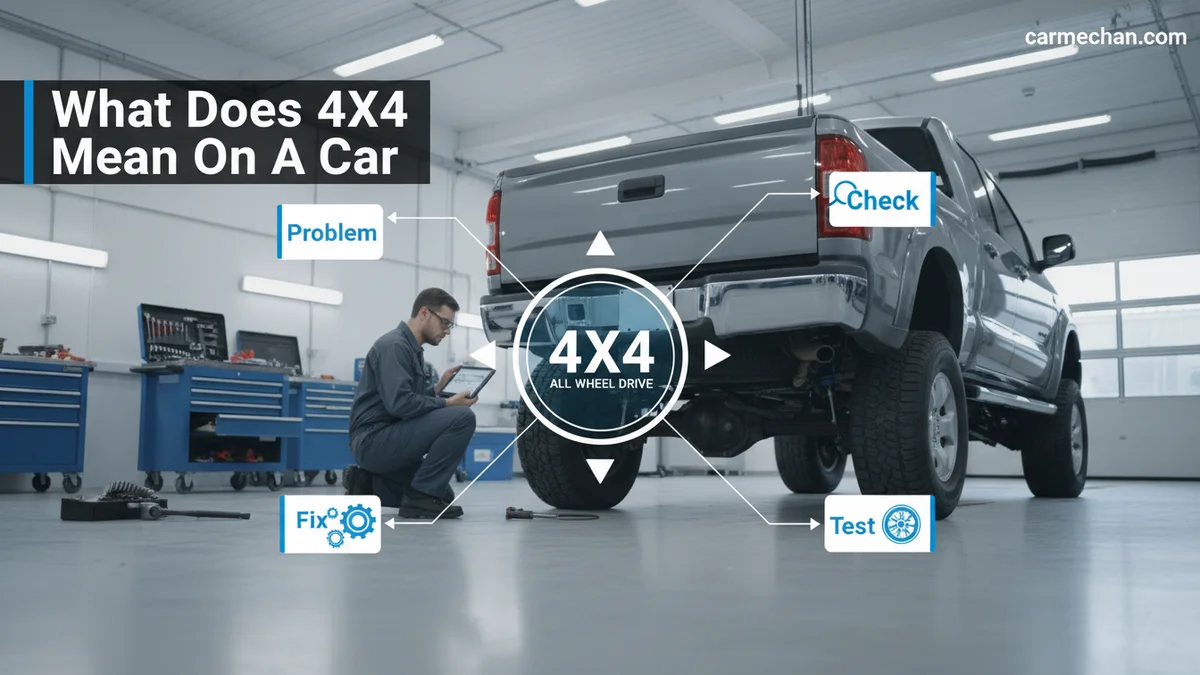
The second ‘4’ then denotes how many of those wheels are capable of being driven by the engine. In a 4×4 system, all four wheels can receive engine power. This contrasts sharply with a conventional 4×2 or 2WD vehicle, where only two wheels (either the front or the rear pair) are driven.
The ability to distribute power to all four wheels significantly enhances traction and grip, especially when navigating loose surfaces or steep gradients. This setup fundamentally dictates how a vehicle delivers power to the ground.
How Does a 4×4 System Actually Work Through 5 Key Components
A 4×4 system orchestrates power delivery through a series of specialized components working in concert. We will examine how each part contributes to its enhanced traction capabilities.
Engine and Transmission Power
The journey of power begins with the engine, which generates torque, and the transmission, which modulates this power into usable speed and force. In a 4×4, the transmission sends its output to a central distribution unit rather than directly to an axle.
Transfer Case Engagement
The heart of a 4×4 system is the transfer case. This gearbox allows the driver to select between 2-wheel drive (2WD) and 4-wheel drive (4WD) modes. It also often provides low-range gearing for increased torque during extreme off-roading. The transfer case splits the power from the transmission, sending it to both the front and rear driveshafts.
Driveshaft Power Delivery
Once power leaves the transfer case, it travels through two driveshafts: one extending to the front axle and another to the rear axle. These sturdy shafts rotate to transmit the engine’s torque efficiently over varying distances. They ensure power reaches both ends of the vehicle for maximum traction.
Differential Action Explained
At each axle, differentials manage power distribution to the individual wheels. A differential allows wheels on the same axle to rotate at different speeds during turns, preventing binding and tire scrub. In a 4×4 system, both front and rear axles have differentials, ensuring smooth operation on diverse terrains.
Traction Distribution Benefits
This coordinated effort of components means that if one wheel loses traction, the others can still receive power and propel the vehicle forward. The ability to distribute torque across all four wheels provides superior grip and control in challenging conditions, making the vehicle far more capable.
While the basic mechanics are consistent, not all 4×4 systems are identical; different types offer varied capabilities and driving experiences.
Four Distinct Types of 4×4 Systems Compared With AWD
Modern vehicles offer several variations of four-wheel drive, each with unique operational characteristics and intended uses. Understanding these differences is key to choosing the right vehicle for your needs.

Part Time 4×4 Explained
Part-time 4×4 systems are common in traditional pickup trucks and dedicated off-road vehicles. These systems require the driver to manually engage 4WD mode, typically via a lever or a button. They are designed for use on slippery or loose surfaces like snow, mud, or gravel.
Driving with part-time 4×4 engaged on dry, paved roads can cause severe drivetrain damage because the system locks the front and rear driveshafts, preventing the necessary speed differences between wheels during turns.
Full Time 4×4 Dynamics
Full-time 4×4 systems operate differently, featuring a center differential or a viscous coupling that allows the front and rear wheels to rotate at different speeds. This enables continuous 4WD operation on all surfaces, including dry pavement, without damaging the drivetrain. Vehicles with full-time 4×4, often found in certain luxury SUVs and larger expedition vehicles, offer enhanced traction and stability under varied driving conditions without driver intervention.
Automatic 4×4 Operation
Automatic 4×4, sometimes called “Auto 4WD,” blends aspects of both part-time and full-time systems. These systems primarily operate in 2WD but can automatically engage 4WD when wheel slippage is detected. They often use electronic sensors to monitor traction and seamlessly transfer power to the wheels with the most grip.
This offers convenience and improved safety without requiring driver input, making them popular in many modern SUVs and crossovers. Some systems also allow manual selection of 4WD modes for specific conditions.
4×4 Versus AWD Demystified
The distinction between 4×4 and All-Wheel Drive (AWD) is crucial for buyers in 2026. While both systems power all four wheels, their design and intended use differ significantly. 4×4 systems, especially part-time ones, are generally more and engineered for serious off-roading, often featuring low-range gearing and stronger components.
They demand driver engagement for proper use. AWD systems, by contrast, are typically lighter and operate automatically, designed to enhance on-road traction and stability in light snow or rain. They are not usually built for extreme off-road conditions and lack low-range options. For more information, you can explore the differences between AWD and 4WD.
Understanding the different types of 4×4 systems naturally leads to the crucial question of when and where to best utilize their capabilities.
When Is the Right Time to Engage Your Vehicle’s 4×4
Knowing when to properly engage your vehicle’s 4×4 system is vital for maximizing its benefits and preventing potential damage. Using 4×4 incorrectly can lead to expensive repairs or compromised handling.
Deep Snow and Ice
When driving through deep snow or on icy, slippery roads, 4×4 provides a significant advantage. It distributes power to all four wheels, maximizing the available grip and reducing the chance of wheel spin. This helps maintain control and allows for more confident acceleration and braking on slick surfaces.
Muddy Trails and Fields
For navigating muddy trails, construction sites, or unpaved fields, 4×4 is indispensable. The increased traction helps prevent the vehicle from getting stuck by ensuring power reaches any wheel that might still have purchase. Low-range 4×4 settings are particularly effective here, offering more torque at lower speeds.
Loose Sand Conditions
Driving on loose sand, such as beaches or desert dunes, often requires 4×4. The wide distribution of power prevents individual wheels from digging in too deeply and getting bogged down. It helps the vehicle “float” over the sand rather than sinking into it.
Steep Off Road Inclines
Ascending or descending steep, unpaved inclines is another prime situation for 4×4 use. It provides the necessary grip and stability to climb without losing traction and aids in controlled descents, reducing the risk of sliding. Engaging 4×4 ensures all tires are working together to tackle the grade.
Situations to Avoid 4×4
Crucially, avoid using part-time 4×4 on dry, paved roads. Doing so can cause drivetrain binding, leading to excessive wear on tires, axles, and the transfer case. This occurs because the system forces all wheels to rotate at the same speed, which is impossible during turns on high-traction surfaces.
Only full-time 4×4 or automatic 4×4 systems are suitable for continuous use on all road types. We must exercise caution and refer to our vehicle’s owner’s manual for specific guidelines. While 4×4 offers undeniable advantages in challenging conditions, it also comes with a set of trade-offs that potential owners should consider.
What Are the Top Three Advantages and Disadvantages of Owning a 4×4
Choosing a 4×4 vehicle involves weighing its significant advantages against certain inherent drawbacks. We should consider these factors before making a purchase decision.
Enhanced Traction Benefits
A primary benefit of 4×4 is superior traction and stability. By delivering power to all four wheels, the system minimizes wheel slippage on loose, wet, or uneven surfaces. This translates to better grip in snow, mud, and sand, enhancing safety and control in adverse conditions.
Off Roading Capability
For enthusiasts and professionals who venture off paved roads, 4×4 offers unmatched off-road capability. Vehicles with 4×4 systems are designed to tackle challenging terrains, including rocky trails, steep inclines, and deep ruts. This makes them ideal for adventurers, construction workers, and anyone needing to access remote locations.
Increased Towing Capacity
Many 4×4 vehicles, particularly trucks and larger SUVs, boast higher towing capacities compared to their 2WD counterparts. The added traction allows for greater control and stability when pulling heavy loads like trailers, boats, or campers, especially over varied terrain or up hills. This capability is invaluable for those who regularly tow.
Fuel Efficiency Compromises
One of the most notable disadvantages is reduced fuel economy. The additional weight and complexity of the 4×4 drivetrain components mean the engine works harder, consuming more fuel. For example, a 4×4 model might achieve lower miles per gallon than its 2WD equivalent.
Higher Purchase and Maintenance
4×4 vehicles typically come with a higher sticker price due to the extra components and engineering involved. Furthermore, maintenance costs can be higher over the vehicle’s lifespan. These systems have more parts that can wear out, such as the transfer case, front differentials, and additional driveshafts, leading to more complex and potentially expensive repairs.
Added Vehicle Weight
The additional mechanical components required for a 4×4 system add significant weight to the vehicle. This increased weight can affect handling dynamics, contribute to reduced payload capacity, and further exacerbate the fuel economy issue. It also influences acceleration and braking performance compared to lighter 2WD models.
With a clearer understanding of what 4×4 entails, let’s address some frequently asked questions that often arise about these capable vehicles.
Frequently Asked Questions About 4×4 Vehicles
Is 4×4 the Same as AWD?
No, 4×4 (four-wheel drive) and AWD (all-wheel drive) are distinct systems. 4×4 systems are typically more , often requiring manual engagement, and are designed for severe off-road conditions. AWD systems operate continuously or engage automatically, providing improved traction for varied on-road conditions and light off-roading, prioritizing ease of use.
What Are the Main Differences Between Part-time and Full-time 4×4 Systems?
Part-time 4×4 systems must be manually engaged and are only suitable for low-traction surfaces, as they lack a center differential. Full-time 4×4 systems incorporate a center differential, allowing continuous operation on all surfaces, including dry pavement, without drivetrain binding. This provides constant traction without driver intervention.
Can I Drive With 4×4 Engaged on Dry Pavement?
You should generally avoid driving with part-time 4×4 engaged on dry, paved roads. This can cause drivetrain binding, leading to excessive wear and potential damage to components like the transfer case and tires. Only full-time 4×4 or automatic 4×4 systems are designed for continuous use on all road surfaces.
Does a 4×4 Vehicle Consume More Fuel Than a 2WD Equivalent?
Yes, 4×4 vehicles typically consume more fuel than their 2WD counterparts. The additional weight and mechanical resistance from the 4×4 drivetrain components require more energy from the engine, resulting in lower fuel efficiency. This is a common trade-off for enhanced traction and capability.
Are 4×4 Vehicles More Expensive to Maintain?
Generally, 4×4 vehicles can incur higher maintenance costs. They have more complex drivetrain components, including a transfer case, additional differentials, and driveshafts, which require servicing and can be more costly to repair or replace if damaged. Regular maintenance of these systems is crucial.
Making an Informed 4×4 Vehicle Decision in 2026
Understanding what 4×4 means on a car goes beyond a simple definition; it encompasses mechanics, types, and practical applications. We have explored how these systems provide enhanced traction and off-road capability, making them invaluable for challenging conditions. Whether you’re a new car buyer or an experienced driver, knowing the distinctions between part-time, full-time, and automatic 4×4, and how they compare to AWD, is essential for making an informed choice.
Weighing the benefits of superior grip and towing against potential compromises in fuel economy and cost allows you to select the vehicle that best suits your lifestyle and driving needs for the year 2026 and beyond.