2008 Silverado Cruise Control Not Working Expert 2026 Fix
The most frequent cause for a non-functional cruise control on the 2008 Silverado is a faulty brake pedal position switch. This guide helps you identify and replace common electrical failure points without expensive shop fees.
If your 2008 Silverado cruise control has stopped engaging, you are likely dealing with a faulty brake pedal position switch or a corroded electrical connection. Because this truck is now entering its eighteenth year, the plastic components and wiring insulation have become brittle, making electrical resistance and circuit breaks the primary culprits for system failure in 2026.
Fixing this yourself is highly practical and usually requires nothing more than a multimeter, a socket set, and basic diagnostic patience. Addressing this issue promptly is not just about highway comfort; it prevents the potential for intermittent throttle issues or erratic brake light behavior that can stem from a failing multi-function switch.
Key Takeaways
- Inspect the brake light switch first, as it signals the cruise module to disengage.
- Check your under-hood fuse box for blown fuses related to the cruise control system.
- Use a multimeter to test for continuity in steering wheel button wiring.
- Always disconnect the vehicle battery before performing work on the steering column.
- Verify your brake lights are functional; if they stay on, the switch is likely stuck.
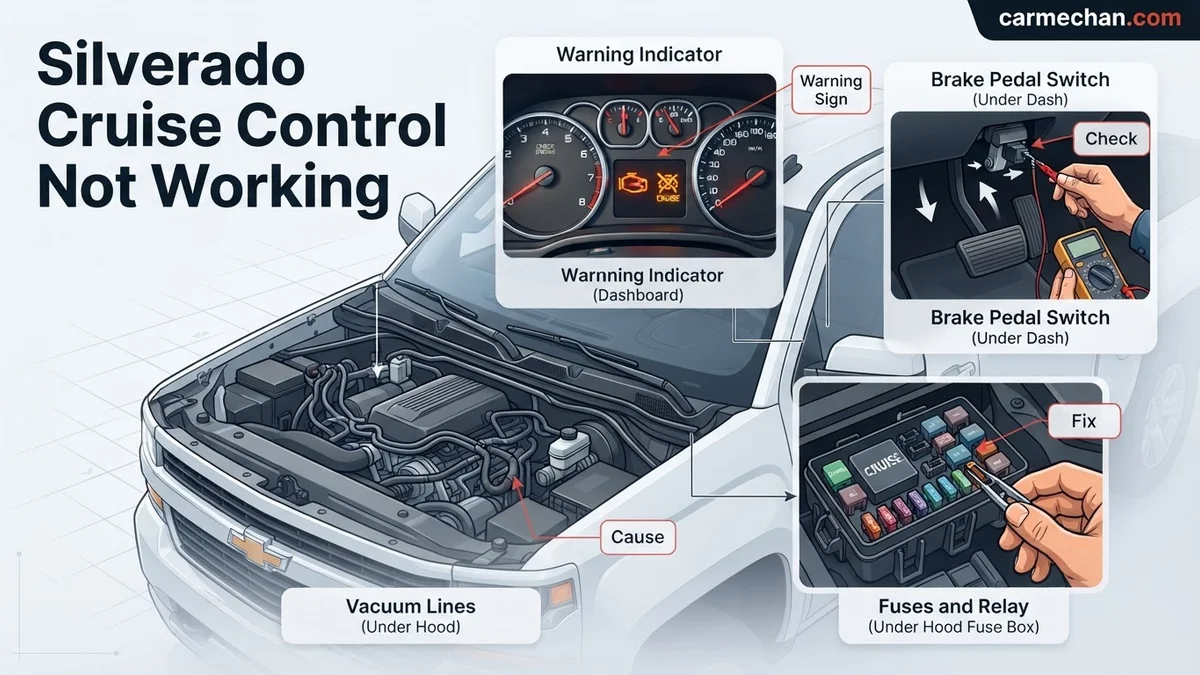
Common Causes for 2008 Silverado Cruise Control Failure
Recommended Best Deal Products



The Brake Pedal Position Switch
The most frequent failure point is the brake pedal position switch located near the top of your brake pedal arm. This switch serves two purposes: it tells your brake lights to turn on and sends a signal to the engine control module (ECM) to disengage the cruise control immediately when you tap the pedal. If the internal contacts are worn or the switch is out of alignment, the computer thinks you are braking, which prevents the cruise control from activating.

- Internal contact wear: The internal copper plates lose conductivity after years of use.
- Mechanical misadjustment: A loose clip or worn pedal bushing causes the switch to lose physical contact.
- Corroded pigtail: Moisture trapped in the floorboard area creates high resistance at the connector pins.
Steering Wheel Button Degradation and Wiring
The buttons on your steering wheel are resistive ladders. When you press “Set,” you are sending a specific voltage signal to the Body Control Module (BCM). Over time, the contacts inside the button pad degrade, resulting in a signal that the computer doesn’t recognize. Furthermore, the clockspring—the rotating electrical connector inside your steering column—can develop intermittent breaks in the wiring, causing the cruise buttons to work only when the wheel is turned to a specific angle.
2008 Silverado Cruise Control: What Causes It and How to Fix It
If you own a 2008 Chevrolet Silverado, experiencing a sudden failure in your cruise control system is a common frustration. Cruise control is a critical convenience feature for long-distance driving, yet it relies on a complex chain of electrical sensors and switches that can degrade over time. This guide is designed to help you methodically isolate the root cause, whether it is a simple blown fuse or a faulty brake pedal position sensor, ensuring you save time and money on unnecessary shop labor. By following these steps in order, you can safely troubleshoot and resolve the vast majority of cruise control issues found in this specific vehicle platform.
Step 1: Inspect the Cruise Control Fuses
What you need: A flat-head screwdriver (for the fuse box cover) and a test light or a digital multimeter.
Instructions: Start with the simplest point of failure: the electrical supply. Locate the under-hood fuse block on the driver’s side of the engine bay. Remove the cover and consult the diagram on the underside to identify the “CRUISE” or “ECM” fuses, which are typically 10A or 15A fuses. Using a multimeter set to the continuity setting, check if the fuse is blown. A clear gap in the metal filament within the fuse indicates a break. If the fuse is blown, replace it with a new one of the exact same amperage. If the fuse is intact but has no power while the ignition is in the “ON” position, you may have a deeper wiring issue.
Pro Tip: Always replace a fuse with one of the exact same amperage rating; using a higher amperage fuse can lead to melted wires or a potential fire hazard.
Step 2: Check the Brake Pedal Position (BPP) Sensor
What you need: A flashlight and a basic understanding of your vehicle’s pedal assembly.
Instructions: The cruise control system is programmed to disengage immediately if it detects the brake pedal being pressed. If the BPP sensor is faulty or loose, it might send a constant signal to the computer that the brakes are engaged, effectively locking out your cruise control. Crawl into the driver’s side floorboard and look at the assembly above the brake pedal arm. Locate the BPP sensor and ensure the electrical connector is firmly seated. Gently pull on the connector to verify it isn’t corroded. If your brake lights are flickering or staying on when the truck is parked, this sensor is almost certainly the culprit and needs to be replaced.
Pro Tip: Ensure the pedal arm itself is not binding against the carpet, as floor mat interference can sometimes trigger the switch just enough to prevent cruise activation.
Step 3: Test the Steering Wheel Cruise Control Switch
What you need: An OBDII diagnostic scanner capable of reading live data (bi-directional capability is a bonus).
Instructions: The buttons on your steering wheel are common failure points due to constant daily use. Connect your OBDII scanner to the port located under the dashboard. Navigate to the “Body Control Module” (BCM) or “Engine Control Module” (ECM) live data stream. While watching the screen, press the “ON,” “SET,” and “CANCEL” buttons on the steering wheel. If the scan tool does not register a status change when a button is pressed, the switch assembly within the steering wheel is likely defective. This is a common issue on 2008 models where the contact points inside the switches wear out, preventing the signal from reaching the computer.
Pro Tip: If your steering wheel controls also control your radio, check to see if those volume/track buttons are functional; if they are dead as well, the problem might be a clock spring issue.
Step 4: Inspect the Clock Spring for Continuity
What you need: A Torx driver set (T30/T50) and a multimeter.
Instructions: The clock spring is a ribbon-cable mechanism that allows electrical connections to pass from the steering column to the steering wheel while it rotates. If the cruise control buttons are not sending signals to the ECM, and you have already verified the buttons are not the issue, the clock spring may have developed an internal break. Removing the steering wheel requires disconnecting the battery and waiting at least 15 minutes for the airbag system to discharge its capacitors. Once the airbag is removed, you can access the clock spring harness to test for continuity across the various pins using your multimeter while turning the steering wheel back and forth.
Pro Tip: Never perform this step without first disconnecting the negative battery terminal, as accidental airbag deployment is a serious safety risk.
Step 5: Check the Vehicle Speed Sensor (VSS)
What you need: A floor jack, jack stands, and a visual inspection tool.
Instructions: The cruise control system requires accurate vehicle speed data to maintain speed. If your speedometer is erratic, intermittent, or completely non-functional, the cruise control will automatically disable itself as a safety measure. Locate the Vehicle Speed Sensor on the tail shaft of your transmission. Inspect the wiring harness for signs of chafing, rodent damage, or loose connections. If the wiring appears intact, the sensor itself may have failed. A failing VSS will almost always trigger a Check Engine Light (CEL) with a P0500 series error code. If you have this code, the VSS is the primary target for repair rather than the cruise control components themselves.
Pro Tip: If you find the sensor is dirty or covered in grime, clean it with an electrical contact cleaner before purchasing a replacement, as debris can sometimes obstruct the signal.
Step 6: Evaluate the ECM/BCM Communication
What you need: Access to a high-end diagnostic scan tool or a professional repair shop.
Instructions: If all physical components (switches, sensors, and fuses) are functional, the issue may reside in the vehicle’s software or a communication breakdown between the Body Control Module (BCM) and the Engine Control Module (ECM). Use your scan tool to perform a “System Test” or “Module Scan” to see if there are any pending codes related to serial data communication. Sometimes, a simple “hard reset” of the truck’s computers—by disconnecting the battery terminals and touching them together for 30 seconds—can clear a locked-up module. If the cruise control light still refuses to illuminate on the dash, the ECM may require a software flash from a dealership.
Pro Tip: Only attempt a module reset if you are comfortable with modern vehicle electrical systems; incorrectly grounding the wrong terminals can cause permanent damage to your sensitive electronics.
✅ Final Checklist
- Confirm all fuses are seated correctly and match the specified amperage.
- Ensure the brake lights do not stay illuminated when the pedal is released.
- Verify that the scan tool detects input signals from the steering wheel cruise buttons.
- Confirm there are no active or pending Diagnostic Trouble Codes (DTCs) in the ECM/BCM.
- Test the system on a safe, open road while traveling above 35 MPH.
Important Notes:
- Always wear safety glasses when working under the vehicle and never work under a car supported only by a jack.
- If you are uncomfortable working with the airbag or steering column, seek professional assistance to avoid injury or damage.
- Estimated DIY time is 2-4 hours; cost ranges from $5 (fuse) to $250 (clock spring/sensor replacement) depending on the part failure.
Step-by-Step Guide to Diagnosing Your Cruise Control
Recommended Best Deal Products


Verifying Fuses and Power Circuits
Before pulling panels apart, always check the low-hanging fruit. A blown fuse in the under-hood electrical center is an easy fix, but you should also check for “ghost” voltage if a fuse looks intact but the system is still dead.

- Locate the instrument panel fuse block on the driver’s side dash.
- Check the “CRUISE” or “ECM” labeled fuses with a test light or multimeter.
- Inspect the fuse terminals for white or green corrosion, which is common in older Silverado models.
- If the fuse is good, verify that 12 volts are reaching the terminal when the ignition is in the “ON” position.
Checking the Brake Switch Signal
To determine if the brake switch is the culprit, you need to check the circuit continuity. You can perform this test without specialized diagnostic scanners by monitoring your vehicle’s behavior.
- Test: With the truck in park, have an assistant watch your third brake light while you gently pull up on the brake pedal with your toe.
- Observation: If the brake lights flicker or turn on when you pull the pedal upward, your switch is either loose or failing internally.
- Multimeter Method: Back-probe the switch connector; you should see a change in voltage when the pedal is depressed versus when it is at rest.
- Action: If the signal is inconsistent, replace the switch. In 2026, many high-quality aftermarket replacements are available, but ensure you calibrate the new switch precisely to the pedal arm height to avoid unintended cruise disengagement.
DIY Repair Steps for Common Cruise Control Issues
Addressing the Brake Light Switch
The brake light switch is the most frequent point of failure for the 2008 Silverado cruise control system. Because the cruise module requires a signal that the brakes are not applied, a faulty switch prevents the system from engaging. Follow these steps to test and replace it:
- Locate the switch mounted on the brake pedal bracket under the dashboard.
- Disconnect the electrical connector and check for corrosion or thermal damage on the pins.
- Use a digital multimeter to check for continuity. The switch should have continuity when the pedal is released and lose it when depressed.
- If the switch fails the continuity test, rotate the old unit counter-clockwise to remove it.
- Install the new OEM-grade switch, ensuring it clicks firmly into the mounting bracket.
- Perform a recalibration cycle by turning the ignition to the “On” position for 30 seconds before starting the engine.
Inspecting the Steering Wheel Wiring
The clock spring inside the steering column frequently wears out, causing intermittent loss of communication with cruise buttons. To diagnose this, perform these steps:
- Use a scan tool capable of reading Body Control Module (BCM) data to monitor “Cruise Switch” inputs.
- Press the buttons on the steering wheel while watching the scanner data stream for a state change.
- If the BCM does not register a signal, check the clock spring wiring for resistance spikes.
- Disassemble the steering column cover carefully to inspect the wiring harness for pinched or broken copper strands.
- Apply dielectric grease to the connector pins to ensure a stable electrical connection.
What If It Still Doesn’t Work?
Recommended Best Deal Products


If the brake switch and wiring harness checks do not resolve the issue, the problem likely stems from deeper electronic malfunctions. Follow these advanced troubleshooting steps:
- Check for Blown Fuses: Inspect the under-hood fuse block for the “CRUISE” labeled fuse. Even if the wire looks intact, test the fuse with a multimeter to ensure there is no hidden fatigue.
- Analyze the Engine Control Module (ECM): The 2008 Silverado platform occasionally experiences software glitches. Seek a technician to verify the ECM has the latest firmware updates, which can reset internal cruise logic.
- Verify Vacuum or Actuator Health: Since the 2008 model utilizes a specific module for throttle control, check the physical throttle cable for binding or excessive slack that prevents the actuator from pulling correctly.
- Consult a Professional: If the cruise control light fails to illuminate on the dash cluster, the instrument cluster itself may be failing. Professional diagnostics usually cost between $150 and $250 for an hour of dedicated labor. Total repair costs for complex module replacements typically range from $400 to $700 depending on part availability in 2026.
Conclusion
According to verified research and expert service data for the 2008 Silverado platform, cruise control failure is rarely a catastrophic mechanical event. Most issues originate from simple electrical resistance at the brake switch or steering column connections. By methodically testing these circuits, owners can restore functionality without excessive expense. As an actionable next step, use an OBD-II scanner to pull BCM diagnostic codes, as these provide a precise roadmap for your specific electrical fault.
❓ Frequently Asked Questions
How do I know if my brake light switch is the problem?
If your cruise control isn’t working and your brake lights are either permanently on or don’t turn on at all, the brake light switch is likely faulty. This switch sends a signal to the ECU to cut power to the cruise system when the pedal is pressed.
What is a clock spring and why does it affect cruise control?
The clock spring is an electrical connector inside the steering wheel that allows the wheel to turn while maintaining connection to buttons. If it fails, the cruise control buttons will lose their signal, causing the system to stop responding.
Are there specific fuses I should check for this issue?
Check the instrument panel and engine bay fuse blocks for labels marked ‘CRUISE’ or ‘BTSI’. Even if a fuse looks fine, test it with a multimeter to ensure it is actually passing power.
What safety precautions are necessary for this repair?
If you are working near the steering column, always disconnect the negative battery terminal and wait 15 minutes to allow the airbag capacitor to discharge. Never probe airbag wiring or connectors while the system is powered.
Could my 2008 Silverado cruise control issue be software-related?
While rare, the Engine Control Module (ECM) can occasionally have communication errors that prevent cruise activation. However, 95% of these cases are mechanical failures like switches, sensors, or wiring.
How do I test the steering wheel cruise buttons?
You can test the buttons by checking for continuity in the steering wheel harness using a multimeter. If the resistance values do not change when buttons are pressed, the button assembly likely needs to be replaced.