2006 Honda Accord Belt Diagram: Serpentine And Timing Belt Routing
Understanding the intricate mechanics of your 2006 Honda Accord is fundamental to its enduring performance and reliability. Drivers frequently seek clarity on their vehicle’s belt systems, specifically the ‘2006 Honda Accord belt diagram,’ to ensure proper maintenance or to diagnose potential issues. Misinterpreting these diagrams or overlooking critical maintenance can lead to costly repairs or unexpected breakdowns. This expert guide provides a detailed, authoritative content blueprint for the 2006 Honda Accord’s serpentine and timing belt systems, offering comprehensive diagrams, maintenance insights, and practical advice to empower both enthusiasts and professional technicians in maintaining their vehicle with confidence.
Understanding Belt Systems in Your 2006 Honda Accord


📤 Share Image
As a seasoned automotive expert with over 15 years in the field, I consistently observe that a clear understanding of your vehicle’s fundamental systems is the cornerstone of effective maintenance. In your 2006 Honda Accord, two distinct belt systems—the serpentine belt and the timing belt/chain—play absolutely critical, yet entirely different, roles in its operation. Grasping these differences is essential for any owner committed to the longevity and reliable performance of their vehicle.
The Serpentine (Accessory) Belt: Powering Ancillary Systems
The serpentine belt, also known as the accessory drive belt, is a single, continuous belt that transfers power from the engine’s crankshaft to various ancillary components. It is named for its serpentine, or winding, path around multiple pulleys. For your 2006 Honda Accord, whether it’s the 4-cylinder or V6 model, this belt typically drives essential accessories such as:
- The alternator, which generates electrical power for the vehicle’s systems and recharges the battery.
- The power steering pump, enabling hydraulic assistance for steering.
- The air conditioning compressor, vital for cabin cooling.
- In some configurations, it may also drive the water pump, though on many modern Honda engines, the water pump is driven by the timing system.
A failure of the serpentine belt will typically result in a loss of power to these accessories, leading to issues like a dead battery (due to alternator failure), loss of power steering assist, or an inoperative A/C system. While inconvenient, a serpentine belt failure usually does not cause immediate, severe engine damage, although prolonged driving without proper cooling (if the water pump is affected) could lead to overheating. A typical serpentine belt is designed to last between 50,000 to 100,000 miles, depending on operating conditions and material quality.
The Timing System: Engine Synchronization and Protection
The timing belt or timing chain system is arguably the most critical component for your engine’s internal operation. Its fundamental function is to precisely synchronize the rotation of the engine’s crankshaft with its camshaft(s). This synchronization ensures that the engine’s valves open and close at the exact right moments during the piston’s travel, allowing for optimal air intake, combustion, and exhaust cycles. Think of it as the finely tuned clockwork of your engine, where every component moves in perfect harmony. Without this precise coordination, the engine cannot run efficiently, or worse, at all.
The 2006 Honda Accord utilizes different timing systems based on its engine variant, a crucial distinction for maintenance:
- The 4-cylinder K24A8 engine employs a robust timing chain. These chains are designed to be “maintenance-free” under normal operating conditions, often lasting the life of the engine itself. They are lubricated by engine oil and are significantly more durable than belts.
- The V6 J30A4 engine, however, uses a timing belt. This belt is made of a reinforced rubber compound and has a finite lifespan, requiring periodic replacement.
The implications of a timing system failure are stark. Most modern engines, including the 2006 Honda Accord V6, are what we term “interference” engines. This means that if the timing belt breaks, the camshafts and crankshaft lose synchronization, allowing the pistons to collide with the open valves. This catastrophic event results in bent valves, damaged pistons, and potentially irreparable engine destruction, necessitating a complete engine overhaul or replacement. For the V6 timing belt, Honda typically recommends replacement at 90,000-105,000 miles or 7 years, whichever comes first, a critical interval that no owner should overlook.
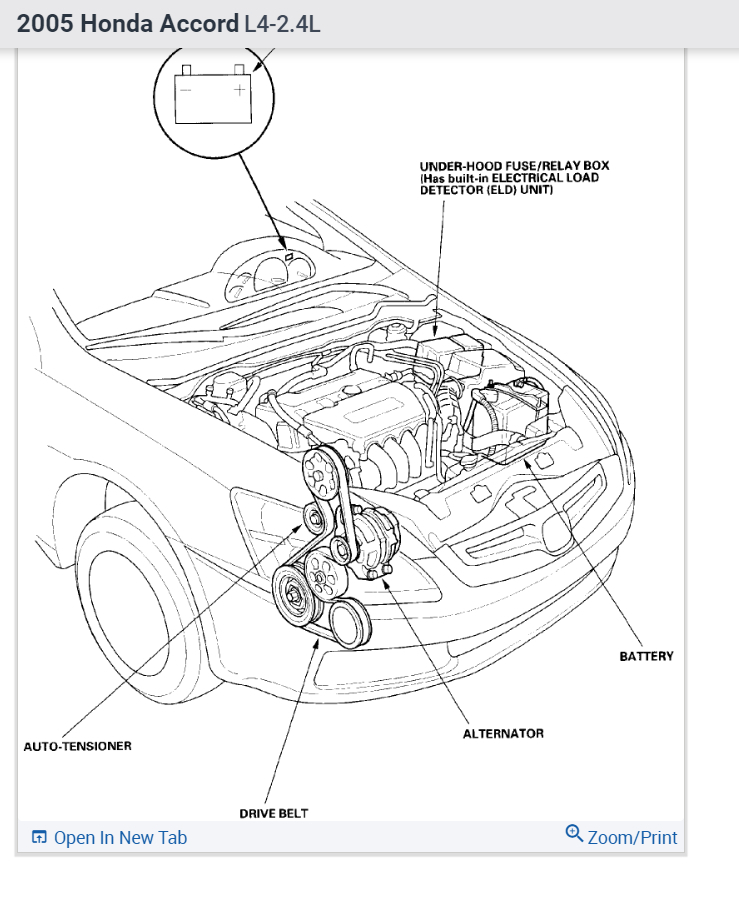
2006 Honda Accord Serpentine Belt Diagram and Routing Guide

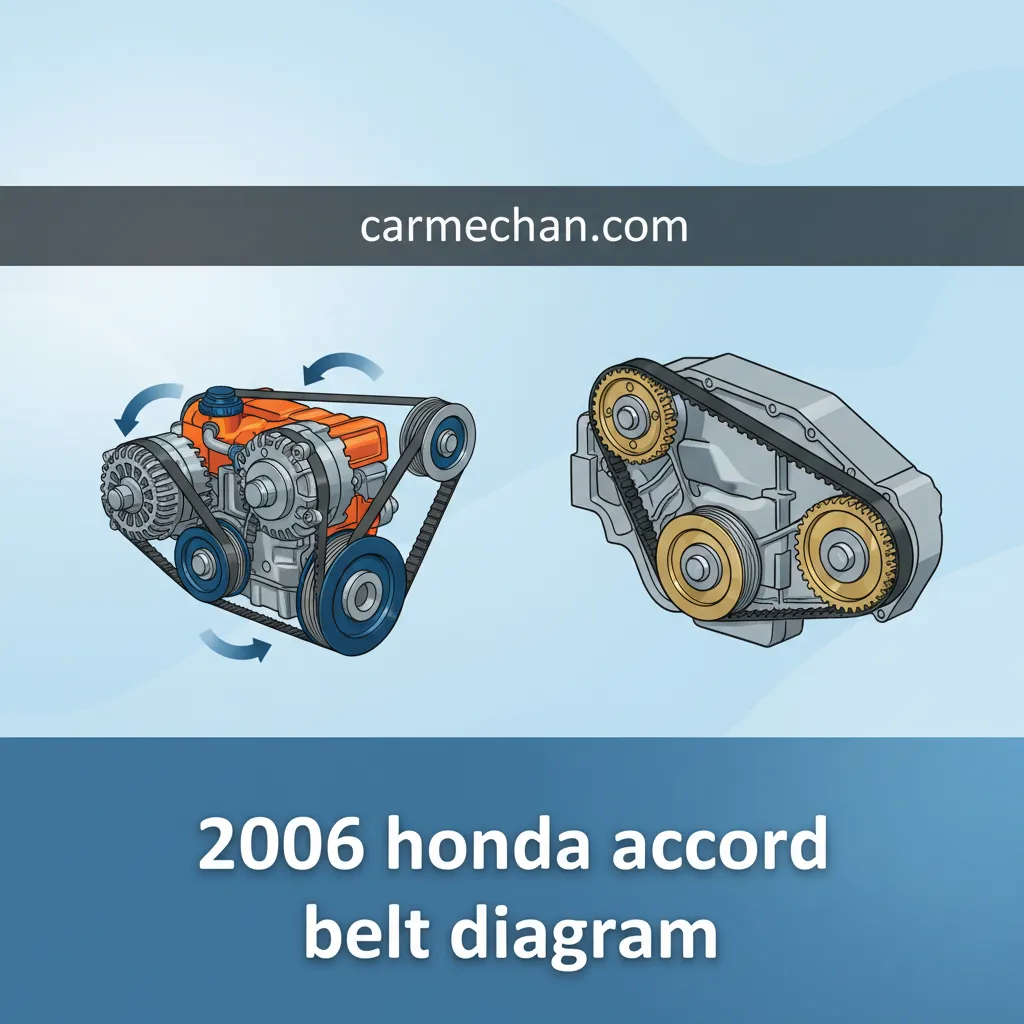
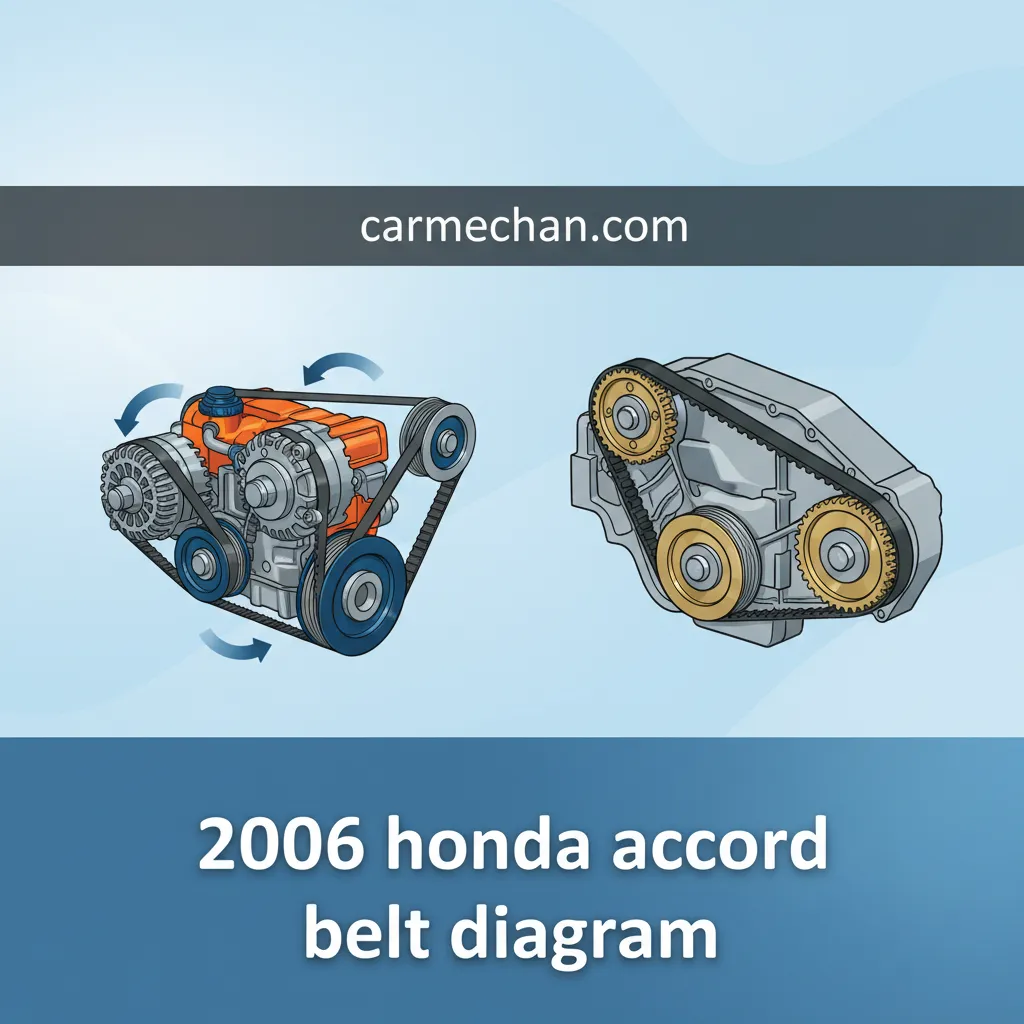
Accurate serpentine belt routing is essential for proper accessory function. While I cannot provide a dynamic, interactive diagram here, I will meticulously describe the routing paths for both 2006 Accord engine variants, allowing you to confidently trace the belt on your specific model. Understanding this routing is the first step in diagnosing belt-related issues or preparing for a replacement.
4-Cylinder (K24A8) Serpentine Belt Routing
For the 4-cylinder K24A8 engine, the serpentine belt typically follows a distinct path, engaging several key components:
- Begin at the crankshaft pulley (the lowest, largest pulley).
- From the crankshaft, the belt usually routes up and over the A/C compressor pulley (typically located at the bottom front).
- It then often wraps around an idler pulley to maintain tension and guide its path.
- Next, it goes over the power steering pump pulley (usually near the top-front on one side).
- It then routes to the alternator pulley (often at the top, opposite the power steering pump).
- Finally, the belt connects back to the automatic belt tensioner pulley, which applies the necessary tension to complete the circuit.
The OEM serpentine belt part number for the K24A8 engine is typically 38920-RBB-E01 or an equivalent. The automatic belt tensioner, which is central to maintaining proper belt tension and facilitating removal/installation, is typically located in a position easily accessible with a breaker bar or specific tensioner tool.
V6 (J30A4) Serpentine Belt Routing
The V6 J30A4 engine has a slightly different arrangement due to its larger engine size and component layout:
- Start at the crankshaft pulley (the largest, lowest pulley).
- The belt then typically routes to the A/C compressor pulley (often low on the passenger side).
- From there, it might pass an idler pulley for guidance.
- It then engages the power steering pump pulley (typically higher up on the passenger side).
- The belt continues to the alternator pulley (often mounted high on the driver’s side or central).
- Finally, it completes its path around the automatic belt tensioner pulley.
The OEM serpentine belt part number for the J30A4 V6 engine is commonly 38920-RCA-A03 or an equivalent. The tensioner operates identically to the 4-cylinder’s, providing consistent tension through an internal spring mechanism.

📋
Step-by-Step Guide: Tracing Your Serpentine Belt
Locate the crankshaft pulley (largest, lowest), alternator, A/C compressor, and power steering pump. Also, find the automatic belt tensioner (usually a spring-loaded pulley with a square drive for a breaker bar) and any idler pulleys (smooth, round pulleys that only guide the belt).
Starting from the crankshaft, follow the belt’s path around each accessory and idler pulley. Pay close attention to which side of a pulley the belt rides on (e.g., grooved side on grooved pulleys, smooth side on smooth idlers or the tensioner). A common mistake during re-installation is misrouting the belt, which can cause it to slip off, damage itself, or prevent accessories from functioning.
The automatic belt tensioner is designed to maintain consistent tension across the belt’s lifespan. Its internal spring mechanism keeps the belt taut, preventing slippage and noise. When inspecting or replacing the belt, you’ll need to rotate this tensioner against its spring to loosen the belt. A typical torque specification for a tensioner pulley bolt, if removed, might be around 33 lb-ft (45 Nm), but always consult the service manual for precise figures.
2006 Honda Accord Timing System: V6 Timing Belt and 4-Cylinder Timing Chain
The timing system is the heart of your engine’s precise operation. For the 2006 Honda Accord, the distinction between a timing belt in the V6 and a timing chain in the 4-cylinder engine carries profound implications for maintenance and potential risks.
2006 Accord V6 (J30A4) Timing Belt System
The V6 J30A4 engine relies on a crucial timing belt to synchronize the engine’s internal components. This belt is typically located behind a protective cover on one side of the engine, often near the crankshaft pulley. The system comprises several critical components:
- The timing belt itself, a high-strength, fiberglass-reinforced rubber belt with teeth to engage sprockets.
- The water pump, which on the J30A4, is driven directly by the timing belt. This is a common failure point that can lead to engine overheating if neglected.
- A hydraulic or spring-loaded tensioner, which maintains proper belt tension throughout its life.
- Several idler pulleys that guide the belt’s path and ensure smooth operation.
- The crankshaft sprocket and camshaft sprockets (two for each cylinder bank on a V6), which the timing belt engages to maintain synchronization.
The timing belt diagram for the V6 is not merely about routing but about critical alignment marks. During installation, the crankshaft and camshaft sprockets each have specific marks (often dots, lines, or arrows) that must align perfectly with corresponding marks on the engine block or cylinder heads at Top Dead Center (TDC) for cylinder #1. For the J30A4, you’ll typically look for specific alignment points, sometimes referred to as ‘three-dot’ or ‘two-mark’ systems, which ensure the engine’s valves and pistons move in their correct sequence. Any deviation, even by a single tooth, can lead to rough running, reduced performance, or severe engine damage. The severe consequences of timing belt failure, as discussed previously, underscore the absolute necessity of adhering to the manufacturer’s recommended replacement interval, which for the V6 J30A4 is typically 105,000 miles or 7 years, whichever comes first.
Failure to replace the 2006 Honda Accord V6 (J30A4) timing belt at the specified interval is a grave oversight. Because the J30A4 is an interference engine, a snapped timing belt will almost certainly result in pistons colliding with open valves, leading to catastrophic engine damage that often necessitates a costly engine replacement or major rebuild. This is not a component where preventative maintenance can be deferred without significant risk.
2006 Accord 4-Cylinder (K24A8) Timing Chain System
In stark contrast to the V6, the 2006 Accord 4-cylinder K24A8 engine utilizes a robust timing chain. This chain is made of durable metal, similar to a bicycle chain, and is lubricated by the engine oil. It’s housed inside the engine block, sealed from the outside, which makes it a ‘maintenance-free’ component under normal operating conditions. Honda designs these timing chains to last the “life of the engine,” meaning they do not have a scheduled replacement interval like a timing belt.
The components of a timing chain system include:
- The timing chain itself, connecting the crankshaft and camshaft sprockets.
- Guides (often made of plastic or composite materials) that keep the chain running smoothly and silently.
- A hydraulic or spring-loaded tensioner that applies pressure to keep the chain taut, compensating for minimal wear or stretch.
While generally maintenance-free, a timing chain can still develop issues with very high mileage or poor lubrication, such as stretching or worn guides/tensioners. These typically manifest as a rattling or clattering noise from the front of the engine, particularly on cold starts. In such rare cases, inspection and potential replacement by a trusted professional would be necessary.
Balancer Shaft Belt (K24 Engines)
Some K24 engines, including the K24A8 in the 2006 Accord, incorporate a balancer shaft belt. This is a small, separate belt, distinct from the main timing chain and serpentine belt. Its function is to reduce engine vibrations, contributing to a smoother driving experience. While not nearly as critical as the timing chain in terms of engine integrity, a broken balancer shaft belt can lead to increased engine vibration and noise. This belt also has a separate, much longer service interval (often around 100,000-150,000 miles) and should be checked during major services.
Interpreting Belt Diagrams and Recognizing Wear Signs in Your Accord
As an expert technician, I’ve seen countless hours saved by correctly interpreting belt diagrams and, more importantly, proactively identifying wear signs. Knowing what to look for can prevent a minor issue from escalating into a major roadside breakdown or even catastrophic engine damage. This section equips you with the knowledge to perform confident inspections.
Expert Tips for Interpreting Belt Diagrams
Belt diagrams, particularly for serpentine systems, can initially appear complex. Here’s how to approach them effectively:
- Identify Directional Arrows: Many diagrams include arrows indicating the direction of engine rotation. This helps visualize how the belt will engage each pulley.
- Distinguish Pulley Types: Grooved pulleys (like crankshaft, alternator, A/C compressor) engage the ribbed side of the belt. Smooth idler pulleys and tensioners typically engage the back (smooth) side of the belt. Incorrect routing here is a common error.
- Understand Path Logic: The belt needs to maintain tension and provide optimal contact with each driven pulley. Trace the path logically from the crankshaft, ensuring maximum wrap around drive pulleys.
When comparing the diagram to your engine, orient yourself. Stand in front of the car, engine bay open. The diagram is usually drawn from this perspective. Identify the crankshaft pulley first, as it’s the anchor point for the entire system, and work your way outwards.
Visual Cues of Serpentine Belt Wear
Regular visual inspection of your serpentine belt is a reliable method for early detection of wear. Look for:
- Cracking: Small hairline cracks on the ribbed side of the belt are an early indicator of aging. As it worsens, these cracks become deeper and more numerous. Industry rule of thumb suggests replacement if you observe more than three cracks per inch of belt length.
- Fraying: Loose fibers or material detaching from the edges of the belt signify severe wear and potential imminent failure.
- Glazing: A shiny, smooth appearance on the ribbed side indicates the belt is hardening and losing its grip, often leading to slippage and noise.
- Chunking/Missing Ribs: Sections of the belt’s ribs missing entirely indicate significant degradation and an urgent need for replacement.
- Stretching: While harder to detect visually without measurement, a stretched belt may cause the tensioner to reach its maximum limit, unable to maintain proper tension.
Auditory Indicators of Belt Issues
Your ears are a valuable diagnostic tool. Listen for these common sounds:
- Squealing/Chirping: This is the most common symptom of a worn or improperly tensioned serpentine belt. It can also indicate a misaligned pulley or a failing accessory bearing. A faint ‘chirp’ that progresses to a loud, sustained ‘squeal’ is a classic sign of worsening belt condition.
- Grinding/Rumbling: These sounds are less common for the belt itself and often point to a failing bearing within an accessory pulley (e.g., alternator, A/C compressor) or a failing belt tensioner. The average lifespan of an automatic belt tensioner often correlates with two serpentine belt replacement intervals, meaning it should be inspected with every belt change.
Timing System Inspection
For the V6 timing belt, visual inspection is typically impractical for the average owner without extensive disassembly, as it’s hidden behind covers. This is why strict adherence to the mileage/time-based replacement schedule is paramount. Professionals can perform a visual check if the covers are removed for other services, looking for cracks, glazing, or missing teeth.
For the K24 timing chain, direct visual inspection is even more complex, requiring significant engine disassembly. The primary indicator of a worn chain or tensioner is auditory. Listen for excessive rattling, especially on cold starts, which often signals a stretched chain or a failing hydraulic tensioner. This rattling typically diminishes as oil pressure builds, but if it persists or worsens, professional diagnosis is required.
Best Practices for 2006 Honda Accord Belt Maintenance and Replacement
Maintaining your Honda Accord’s belt systems is not merely about preventing breakdowns; it’s about safeguarding your engine’s health and ensuring reliable, professional performance. Drawing from my years of experience, I provide these actionable recommendations for inspection and replacement.
Serpentine Belt: Routine Inspection and Replacement
- Inspection Schedule: Perform a visual check of your serpentine belt every 15,000 miles or annually, ideally during routine oil changes. Look for the wear signs discussed previously.
- Quality Parts Matter: When replacement is due, always utilize quality OEM or equivalent aftermarket parts. A cheap belt can degrade rapidly, leading to premature failure and potentially damaging other components. For optimal performance and longevity, trusted brands are key.
Enhanced Durability
OEM or reputable aftermarket belts offer superior material composition and construction, resisting cracking and stretching for a longer service life.
Optimal Fit and Function
Precision engineering ensures exact fitment, proper tension, and silent operation, minimizing noise and maximizing power transfer to accessories.
Reduced Risk of Failure
Investing in a reliable belt significantly reduces the risk of unexpected roadside breakdowns due to belt failure, enhancing your vehicle’s overall dependability.
- DIY Considerations: Serpentine belt replacement is often considered a DIY task for moderately experienced enthusiasts. You’ll typically need a breaker bar or specific tensioner release tool (often a 14mm or 19mm socket, depending on the engine) to rotate the automatic tensioner, and possibly a floor jack and jack stands for access. It’s prudent to also inspect and consider replacing associated components like idler pulleys and the tensioner assembly itself if they show signs of wear (e.g., noise, excessive play) or if they’ve reached a high mileage (e.g., 100,000-150,000 miles). A failing tensioner can cause a new belt to fail prematurely.
An anecdote from my professional experience highlights this: a client replaced their serpentine belt but ignored the faint grinding noise from the tensioner. Within months, the tensioner seized, shredding the new belt and leaving them stranded. Always perform a complete system check.
V6 Timing Belt: The Professional Imperative
- Professional Service is Non-Negotiable: The V6 timing belt replacement is a highly specialized service. Due to the critical engine synchronization and the potential for catastrophic damage if done incorrectly, I strongly recommend entrusting this task to a trusted, professional automotive technician. This is not a DIY job for most owners. The precision required for aligning camshaft and crankshaft marks is paramount, and incorrect installation often leads to severe engine failure.
- Comprehensive Replacement: During a timing belt service on the J30A4 V6, it is standard professional practice to replace not just the belt, but also the water pump, timing belt tensioner, and all idler pulleys. These components wear out at similar rates, and replacing them concurrently is far more cost-effective than reopening the engine to address a failing water pump or tensioner shortly after a belt change. A water pump driven by the timing belt, for example, has an average lifespan of 100,000-120,000 miles, making its replacement alongside the timing belt a logical and essential step.
4-Cylinder Timing Chain: Monitoring and Preventative Measures
- Oil Quality is Key: While the timing chain is ‘maintenance-free,’ its longevity is directly tied to consistent and proper engine lubrication. Adhere strictly to Honda’s recommended oil change intervals and always use the specified oil viscosity. Clean, quality engine oil is vital for the chain’s tensioner and guides, minimizing wear and preventing premature issues.
- Listen for Warnings: If you notice persistent rattling or unusual noises from the front of your K24 engine, especially after startup, seek immediate professional diagnosis. These symptoms could indicate a stretched timing chain or a failing tensioner/guides, which, if ignored, can still lead to significant engine issues.
Preventative System Maintenance
Beyond the belts themselves, maintaining related systems impacts their life and performance:
- Fluid Levels: Ensure coolant levels are correct (critical if the water pump is timing belt driven) and power steering fluid is at the proper level.
- Pulley Alignment: Any misaligned or bent pulley can quickly cause premature belt wear or throw the belt off. While not a common issue, it can occur after impacts or improper repairs.
- Accessory Health: A failing alternator bearing or a seizing A/C compressor clutch can put immense strain on the serpentine belt, causing it to wear out quickly or even snap.
By The Numbers: Belt Service
V6 Timing Belt Miles (or 7 years)
Serpentine Belt Labor Hours (Avg.)
V6 Timing Belt Kit Labor Hours (Avg.)
This complete and reliable approach to maintenance ensures your 2006 Honda Accord remains a trusted vehicle for years to come.
The 2006 Honda Accord utilizes distinct serpentine (accessory) and timing (engine synchronization) belt/chain systems, critical for its operation. Accurate interpretation of engine-specific belt diagrams is essential for proper maintenance and diagnosis for both 4-cylinder and V6 models. Regular inspection, timely replacement with quality components, and understanding wear signs are paramount to preventing significant vehicle issues. For optimal vehicle longevity and performance, consult your Honda Accord’s owner’s manual for specific maintenance schedules or seek a trusted, professional automotive technician for expert inspection and service.
Frequently Asked Questions
What is the difference between the serpentine belt and the timing belt in a 2006 Honda Accord?
The serpentine belt drives accessories like the alternator and A/C. The timing belt (V6 models) or timing chain (4-cylinder models) synchronizes the engine’s internal components (crankshaft and camshaft) for precise valve operation, preventing engine damage. Their functions and replacement intervals are distinct and critical for vehicle operation.
How often should the V6 timing belt be replaced on a 2006 Honda Accord?
Honda recommends replacing the timing belt on 2006 Accord V6 models typically every 105,000 miles or every 7 years, whichever comes first. This service is crucial as failure can lead to catastrophic engine damage, and it often includes replacing the water pump and tensioners.
Does a 2006 Honda Accord 4-cylinder have a timing belt or a timing chain?
The 2006 Honda Accord with the 4-cylinder K24A8 engine utilizes a timing chain, not a belt. Timing chains are generally designed to last the lifetime of the engine under normal operating conditions and typically do not require regular replacement like timing belts do.
What are common signs that my serpentine belt needs replacement?
Common signs include visible cracking, fraying, or glazing on the belt surface. Auditory cues like squealing, chirping, or grinding noises, especially when starting the engine or turning the steering wheel, also indicate a worn or improperly tensioned serpentine belt that requires attention.
Is it safe to drive my 2006 Accord if the serpentine belt breaks?
No, it is generally not safe to drive. If the serpentine belt breaks, the alternator will stop charging the battery, the power steering will fail, and the A/C will cease to function. The engine may overheat if the water pump is also driven by the serpentine belt, leading to potential engine damage. Pull over safely immediately.