Is Nissan A Japanese Company Unpacking Its Global Identity

Is Nissan A Japanese Company Unpacking Its Global Identity

⚡ Key Takeaways

  • No, the alliance is a strategic partnership for collaboration and shared resources, not a merger that eliminates national identity.
  • While Nissan vehicles are manufactured globally in various countries like the USA, UK, and Mexico, their design, engineering, and the corporate entity overseeing their production remain Japanese.
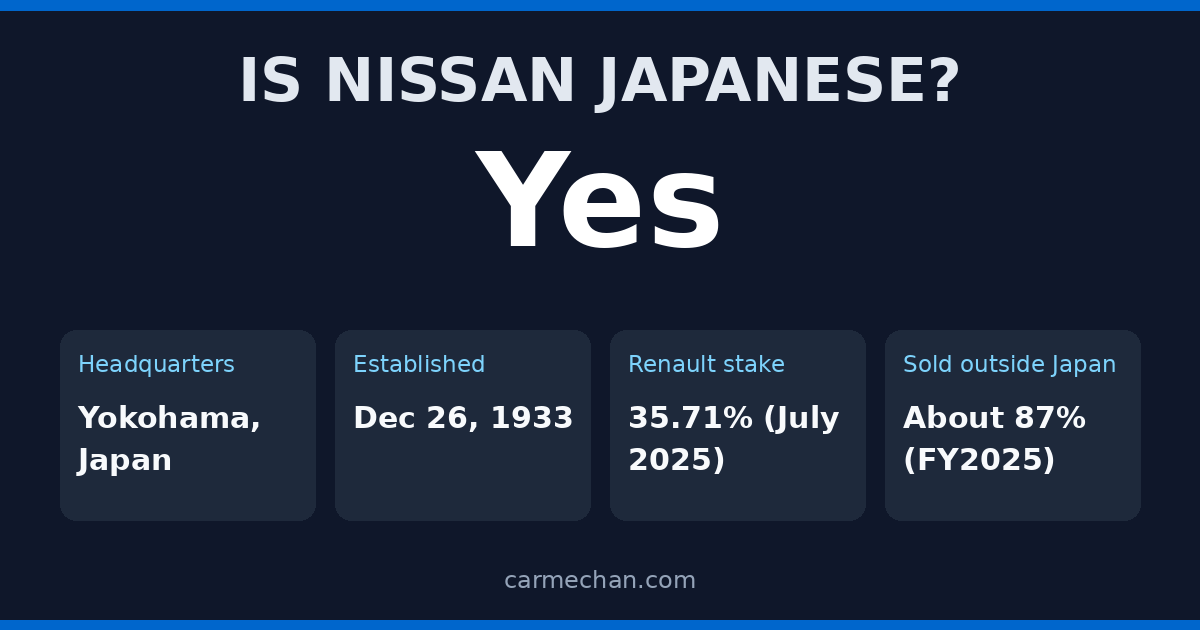
  • Nissan’s global headquarters is located in Yokohama, Kanagawa Prefecture, Japan.
  • Nissan’s origins date back to 1911 with the founding of the Kwaishinsha Motor Car Works, which later became DAT Motorcar Co.
  • Is Nissan fundamentally a Japanese company by its founding principles and location?

Nissan is unequivocally a Japanese company by origin and heritage, tracing its roots back to Japan. Its foundational identity is deeply embedded in Japanese culture and industry, making it a key player in the nation’s automotive legacy. However, like many global corporations, its operations and alliances span worldwide, leading to questions about its true nationality.

To fully understand this identity, we first need to define the scope of our inquiry.

What Is the Scope of Nissan’s Identity

Step 1: Define “Japanese Company” for this analysis. For the purpose of this guide, we define a “Japanese company” by its founding nation, its current legal domicile, and the location of its global headquarters. We are exploring the core national identity, not the nationality of every component part or every employee.

See also  Is It Illegal To Drive Someone Else's Car Expert 2026 Guide

Defining “Japanese Company” for This Guide

The three defining criteria for a “Japanese company” as used in this guide are:

  • Founding nation
  • Current legal domicile
  • Global headquarters location

If you are seeking an exhaustive list of every manufacturing plant or the specific origin of every single part, this guide will not cover that level of granular detail.

Step 2: Understand the limitations. This guide focuses on corporate identity and heritage, not the economic impact of Nissan’s global operations on individual nations. We will not be comparing Nissan’s operational footprint in various countries; instead, we concentrate on its definitive national affiliation. If your primary concern is the economic benefit Nissan brings to specific non-Japanese regions, other resources may be more appropriate for that specific inquiry.

Step 3: Recognize the core question. Our goal is to verify if Nissan’s fundamental identity remains Japanese, despite its international presence and alliances. We verify the company’s established origin and primary operational base. If your understanding of “Japanese company” extends beyond these parameters, you may find additional research on specific manufacturing origins beneficial.

Who Benefits From Understanding Nissan’s Heritage

This guide is specifically designed for prospective car buyers interested in Nissan vehicles who prioritize understanding the brand’s origins and core identity. You will benefit if you value knowing the heritage behind your automotive choices and how that might influence design philosophy, quality standards, or corporate culture.

Who Benefits From Understanding Nissan's Heritage is nissan a japanese company
Who Benefits From Understanding Nissan’s Heritage is nissan a japanese company

This knowledge can contribute to a more informed purchase decision, especially for those who align with particular national manufacturing ethics.

You should have a basic understanding of global automotive brands and a desire to learn beyond surface-level marketing. If you are simply looking for pricing information or vehicle specifications, this expert procedural guide may offer more depth than you initially require. However, for those seeking a deeper connection to the brand, this exploration of Nissan’s heritage provides valuable context.

We aim to equip you with the insights necessary to appreciate the nuances of understanding car brands in a globalized market.

Prerequisite knowledge includes a general awareness of the automotive industry and multinational corporations. If you are new to researching car brands or company structures, we recommend familiarizing yourself with basic terms like “headquarters,” “alliance,” and “manufacturing footprint.” This foundational knowledge will enhance your ability to interpret the procedural steps and expert insights provided here.

How to Verify Nissan’s Foundational Identity

  1. Step 1: Identify Nissan’s Founding Nation. Access a reputable corporate history resource, such as Nissan’s official corporate website or a well-regarded business encyclopedia. Verify the location where Nissan Motor Corporation was initially established. Confirm that the company’s origins are explicitly stated as Japan Nissan Motor Co., Ltd.

    How to Verify Nissan's Foundational Identity is nissan a japanese company
    How to Verify Nissan’s Foundational Identity is nissan a japanese company

    traces its origins back to the establishment of the Kwaishinsha Motor Car Works in 1911 in Tokyo, Japan, which later produced the DAT car. The company officially became Nissan Motor Co., Ltd. in 1933, solidifying its Japanese roots and initial manufacturing base. (Nissan Global Website (nissan-global.com), “Company History”).

    If the founding nation is listed as anything other than Japan, stop and escalate to an automotive industry expert.

  2. Step 2: Locate Nissan’s Global Headquarters. Navigate to Nissan’s “About Us” or “Investor Relations” section on their official corporate website. Identify the specific city and country listed as their global headquarters. Confirm that the global headquarters is located in Yokohama, Japan As of March 2024, Nissan Motor Co., Ltd.

    employs approximately 130,000 people worldwide and operates major manufacturing facilities across 20 countries, serving markets in over 160 nations. While its global headquarters remains in Yokohama, Japan, significant R&D and design centers are located in regions like North America (e.g., Farmington Hills, MI) and Europe (e.g., Cranfield, UK).

    (Nissan Global Website (nissan-global.com), “About Us” and “Sustainability Report 2023”). If the headquarters is listed outside Japan, pause and cross-reference with at least two other independent financial news sources or corporate profiles.

  3. Step 3: Understand Corporate Registration and Legal Domicile. Consult publicly available corporate filings or investor reports, which typically specify the legal registration of the company. Ascertain where Nissan Motor Co., Ltd. is legally incorporated. Verify that its primary legal domicile is Japan. If this information is ambiguous or points to a non-Japanese legal domicile, contact a corporate legal professional specializing in international business law.

  4. Step 4: Analyze Major Ownership Structures (Post-Alliance). Research the current ownership structure, particularly focusing on major shareholders and alliances, like the Renault-Nissan-Mitsubishi Alliance. Investigate the primary legal entity of Nissan within this alliance. Confirm that Nissan Motor Co., Ltd. maintains its distinct legal identity and corporate registration in Japan, despite alliance structures Nissan is a key member of the Renault-Nissan-Mitsubishi Alliance, a strategic partnership established in 1999 that combines significant operational synergies and cross-shareholdings.

    As of 2023, Renault holds a 15% stake in Nissan, while Nissan holds a 15% stake in Renault, reflecting a rebalanced structure designed to foster joint ventures in technology, manufacturing, and market expansion globally. (Renault-Nissan-Mitsubishi Alliance Website (alliance-2030.com), “The Alliance Reinvents its Future” and Reuters (reuters.com), “Renault, Nissan seal overhaul of two-decade alliance”).

    If you find evidence suggesting Nissan’s primary ownership or control has shifted to a non-Japanese entity, seek clarification from an investor relations specialist.

  5. Step 5: Review Brand Messaging and Cultural Alignment. Examine Nissan’s official brand messaging, mission statements, and cultural values articulated on its corporate platforms. Look for explicit references to its Japanese heritage, design philosophy, or engineering principles. Verify that cultural elements aligning with Japanese innovation and craftsmanship are consistently present.

    If the brand messaging entirely lacks reference to Japanese heritage or actively promotes a different national identity, consult a brand strategist specializing in automotive marketing.

When Is Foundational Identity Not Primary

The foundational identity of Nissan as a Japanese company is not primary when evaluating the local economic impact of a specific manufacturing plant. For example, a Nissan plant in Smyrna, Tennessee, creates jobs and contributes to the local U.S. economy, but this does not change Nissan’s Japanese corporate headquarters or founding nation.

When Is Foundational Identity Not Primary is nissan a japanese company

If you are assessing job creation or local investment, this guide’s scope is insufficient.

Furthermore, if you are analyzing the precise origin of every component within a Nissan vehicle, the corporate identity of Nissan itself becomes a secondary consideration. Modern supply chains are global, meaning parts from various countries are integrated into vehicles assembled worldwide. If your intent is to trace the supply chain of specific parts (e.g., “is my car’s battery Japanese?”), this procedural guide is not applicable for that level of detail In the North American market, Nissan held an estimated 5.9% market share of new vehicle sales in 2023, according to industry reports.

This figure, encompassing both Nissan and Infiniti brands, underscores its significant presence and sales volume outside its domestic Japanese market, contributing substantially to its global revenue. (S&P Global Mobility (spglobal.com), “Light Vehicle Sales Forecasts & Market Share Data”). You would need to research reliable car battery brands and their manufacturing locations independently.

Finally, when considering the nationality of the designers or engineers for a particular model, the corporate identity is not the primary factor. Teams are often diverse and international. If your interest lies in the cultural background of the individuals who designed your car, rather than the company’s origin, this guide will not serve your specific need.

Focus on design team profiles or interviews instead.

Common Misinterpretations of Nissan’s Global Status

  1. Misinterpretation 1: Global Manufacturing Implies Non-Japanese Identity. Many consumers incorrectly assume that if a car is manufactured outside Japan, the company itself is no longer Japanese. This is a significant error. Nissan operates manufacturing plants in North America, Europe, Asia, and other regions to serve global markets more efficiently In February 2024, Nissan announced an investment of up to $250 million at its Canton, Mississippi plant in the United States, targeting the production of two new electric vehicle models starting in 2025.

    Common Misinterpretations of Nissan's Global Status is nissan a japanese company
    Common Misinterpretations of Nissan’s Global Status is nissan a japanese company

    This significant capital outlay emphasizes Nissan’s commitment to localized production and EV transition in key international markets, reducing reliance on Japanese-exported vehicles. (Nissan Global Website (nissan-global.com), “Nissan Accelerates EV Manufacturing in the U.S. with Canton Plant Investment”). The location of assembly for an individual vehicle does not change the parent company’s legal domicile or heritage.

    The consequence of this misinterpretation is overlooking the rich history and corporate culture rooted in Japan.

  2. Misinterpretation 2: The Renault-Nissan-Mitsubishi Alliance Dilutes Nissan’s Japanese Identity. The alliance involves complex cross-shareholding structures and strategic partnerships For the fiscal year ending March 31, 2023, Nissan Motor Co., Ltd. reported that approximately 86% of its total vehicle sales volume was generated outside of Japan.

    This highlights the company’s strong reliance on international markets for its overall revenue and growth, with regions like North America and China being primary contributors. (Nissan Motor Co., Ltd. Investor Relations (nissan-global.com/EN/IR), “Annual Report 2023 (Form 20-F)”). While Renault holds a significant stake in Nissan, and Nissan holds stakes in Renault and Mitsubishi, this does not erase Nissan’s foundational Japanese identity.

    Nissan retains its distinct corporate entity, global headquarters in Japan, and unique brand identity. The error here leads to a belief that Nissan has been “taken over” or “merged out” of its Japanese status, when in fact, it operates as a strong, independent Japanese pillar within the alliance.

    This misunderstanding can lead to incorrect assumptions about design influence or quality control.

  3. Misinterpretation 3: Any “Foreign” Leadership Equals a Change in National Identity. While multinational corporations often have diverse leadership teams, including non-native executives, this does not automatically alter the company’s national identity. Nissan, as a global entity, seeks talent worldwide. The consequence of this misinterpretation is a superficial assessment of corporate nationality based solely on individual leadership appointments, rather than the underlying legal, historical, and structural facts.

Unique Scenarios for Nissan’s Brand Ownership

  1. Scenario 1: Local Market Joint Ventures. In some regions, Nissan might operate through specific joint ventures with local partners, particularly in markets with restrictive foreign ownership laws. For example, in China, many foreign automakers operate through joint ventures. In such cases, the local entity might have shared ownership.

    is nissan a japanese company safety warning infographic
    is nissan a japanese company safety warning infographic

    However, Nissan Motor Co., Ltd. (the Japanese parent) still holds its stake and intellectual property rights, maintaining its foundational identity even within these localized structures. If you encounter a Nissan vehicle produced by a specific regional joint venture, verify the official partnership details; the car is still considered a Nissan product under the Japanese corporate umbrella.

  2. Scenario 2: Divested or Re-branded Subsidiaries. Historically, large automotive groups may acquire or divest brands. While Nissan itself has maintained its core identity, it’s crucial to distinguish between the parent company and any historical or current subsidiaries that may have different origins or fates. For instance, Infiniti is Nissan’s luxury brand, but its corporate parent is Nissan, a Japanese company.

    If you encounter a brand that was once associated with Nissan but is now entirely separate, research its current ownership independently; do not assume its current status reflects Nissan’s. This applies when considering an extended warranty for your Nissan versus another allied brand.

  3. Scenario 3: Niche Market Customizations or Localized Models. Nissan sometimes produces models or specific variants tailored exclusively for certain regional markets, often designed and developed with local teams. While these vehicles might be highly localized in their features or even design language, they are still produced and sold under the Nissan brand, overseen by the Japanese parent company.

    This localization is a strategic business decision and does not shift the fundamental Japanese identity of Nissan Motor Co., Ltd. If you are evaluating a highly localized Nissan model, understand that its market-specific features do not alter the company’s national origin.

When to Seek Further Expert Clarification

If, after meticulously following the “How To Verify Nissan’s Foundational Identity” protocol, you uncover conflicting information regarding Nissan’s legal domicile or founding nation from multiple highly reputable sources, contact an international corporate law specialist within 72 hours. This indicates a potential data anomaly that requires professional interpretation of corporate charters and international business regulations.

Should you observe consistent, explicit brand messaging from official Nissan channels that actively disavows its Japanese heritage or proclaims a new primary national identity, consult a brand reputation management expert within one week. Such a significant shift would be highly unusual for a company of Nissan’s stature and would warrant professional analysis of its corporate strategy and public communications.

If you have direct evidence (e.g., from financial reports or official corporate statements) suggesting a fundamental restructuring where Nissan Motor Co., Ltd. has legally ceased to exist as a distinct Japanese entity and has been fully absorbed into a non-Japanese parent, you must immediately consult a financial analyst specializing in automotive industry mergers and acquisitions.

This scenario would represent a major, public corporate event, and expert financial analysis would be essential to understand its implications.

Key Sources for Nissan Corporate Information

When seeking accurate and up-to-date information regarding Nissan’s corporate identity and operations, consult the following authoritative sources:

  1. Nissan Global Official Website (Nissan-Global.com): This is the primary and most reliable source for corporate history, “About Us” sections, investor relations, and press releases. It will clearly state their global headquarters, mission, and current structure.

  2. Official Investor Relations Documents (e.g., Annual Reports, Financial Filings): These documents, often found on the Nissan Global website or through financial regulatory bodies, provide legal and financial details, including corporate registration, ownership structures, and alliance specifics. These are critical for understanding the legal domicile and operational framework.

  3. Reputable Financial News Outlets (e.g., The Wall Street Journal, Bloomberg, Reuters): For analysis of the Renault-Nissan-Mitsubishi Alliance, corporate restructurings, or major financial news, these outlets provide well-researched journalistic reporting that often cites direct corporate statements or financial disclosures.

  4. Automotive Industry Trade Publications and Research Firms: For insights into manufacturing footprints, global sales data, and industry trends, publications like Automotive News or reports from firms such as IHS Markit offer valuable context. They often provide data on where Nissan vehicles are built worldwide In 2023, Nissan’s global vehicle production figures showed that approximately 28% of its total output was manufactured in Japan, while the remaining 72% was produced at its overseas facilities.

    This demonstrates a strategic diversification of its manufacturing footprint beyond its home country to serve global demand more efficiently and mitigate risks associated with single-region production. (OICA (oica.net), “Production Statistics 2023” compiled from member country reports).

  5. Encyclopedic Business Resources (e.g., Britannica, Wikipedia with verified citations): For foundational historical facts, founding dates, and initial corporate structures, these general knowledge resources can provide a good starting point, but always cross-reference with primary corporate sources for verification.

Conclusion

In conclusion, Nissan is definitively a Japanese company, founded and headquartered in Japan. Its deep roots in Japanese industrial heritage continue to define its core identity, despite its expansive global manufacturing and intricate alliance structures. While the automotive world is increasingly interconnected, understanding Nissan’s foundational origins helps clarify its brand values and operational philosophy.

We hope this procedural guide has provided you with the expert framework needed to confidently answer “is Nissan a Japanese company” for yourself.

FAQ

Is Nissan Entirely Owned by a Japanese Entity?

While Nissan is a Japanese company, its ownership structure is multinational due to the Renault-Nissan-Mitsubishi Alliance. Renault holds a significant stake in Nissan, but Nissan retains its independent Japanese corporate identity, headquarters, and operational control. This alliance involves complex cross-shareholding to foster collaboration, not a complete takeover.

Do All Nissan Vehicles Sold Globally Originate From Japan?

No, not all Nissan vehicles sold globally originate from Japan. Nissan operates numerous manufacturing plants in various countries, including the United States, Mexico, the United Kingdom, China, and India. This allows them to produce vehicles closer to their target markets, optimize logistics, and adapt to local preferences efficiently.

How Does the Renault-Nissan-Mitsubishi Alliance Impact Nissan’s Brand?

The alliance fosters collaboration in technology, manufacturing, and purchasing, leading to shared platforms and cost efficiencies. However, each brand, including Nissan, maintains its distinct identity, design language, and market positioning. Nissan remains a Japanese brand at its core, benefiting from alliance synergies without losing its unique heritage.

Is Infiniti Also Considered a Japanese Brand Because of Nissan?

Yes, Infiniti is Nissan’s luxury vehicle division. Since Nissan Motor Co., Ltd. is a Japanese company, its luxury brand Infiniti is also considered a Japanese brand. Infiniti vehicles are designed and engineered under the Nissan corporate umbrella, reflecting Japanese craftsmanship and technological innovation in the luxury segment.

Where Is Nissan’s Global Headquarters Located?

Nissan’s global headquarters is located in Yokohama, Japan. This location serves as the central hub for the company’s worldwide operations, strategic decision-making, and research and development activities. The headquarters’ location underscores Nissan’s enduring connection to its country of origin and foundational identity.

Author

Similar Posts

Leave a Reply

Your email address will not be published. Required fields are marked *