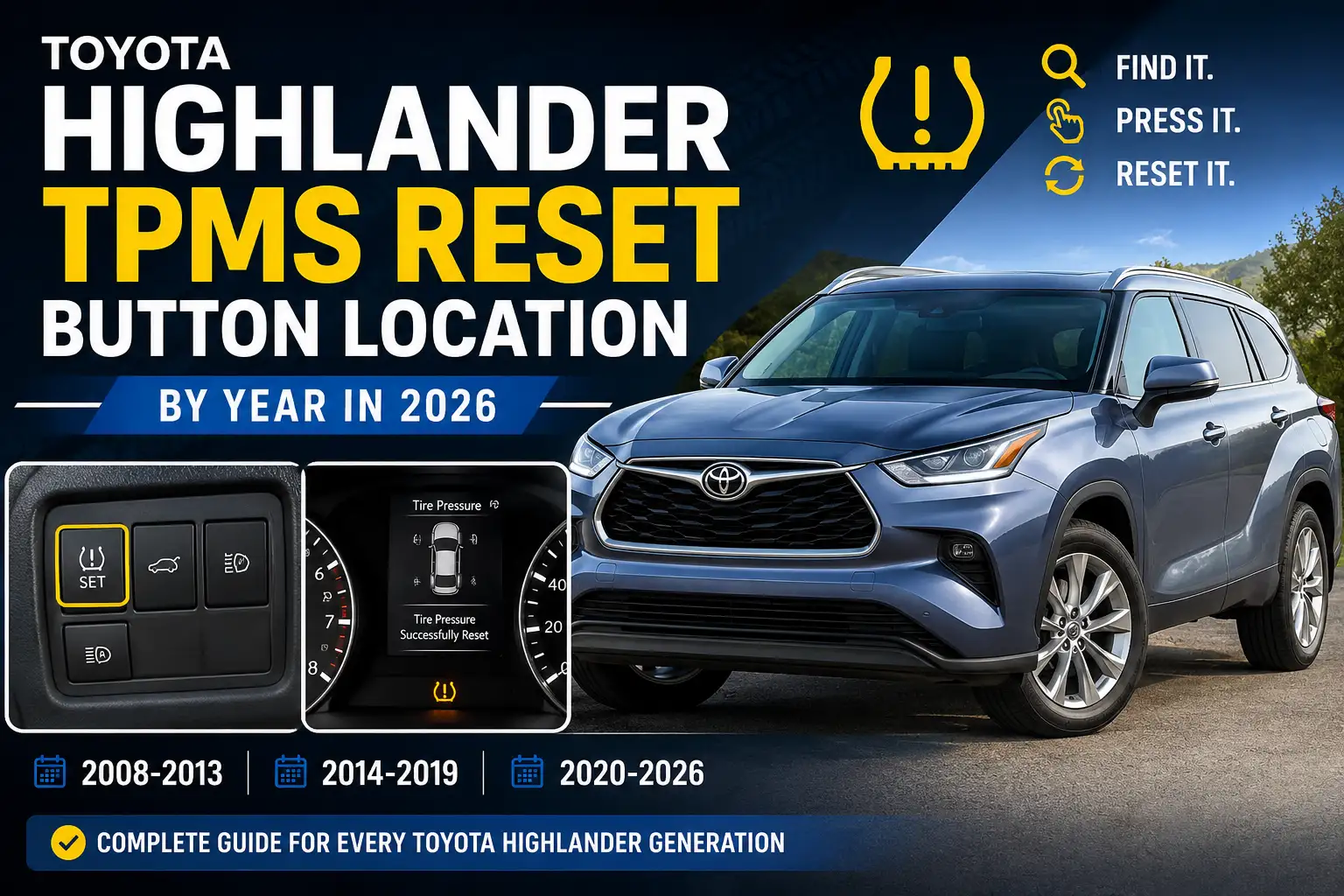
Toyota Highlander TPMS Reset Button Location by Year 2026
Last Updated on September 1, 2026 by Ryan
The Toyota Highlander TPMS reset button location changes depending on which generation you drive, and a few model years skip the button entirely. TPMS stands for Tire Pressure Monitoring System, the dashboard alert that warns you when a tire is low.
Owners of 2008 to 2013 Highlanders often spend several minutes feeling around blindly under the dash, while 2020 and newer models frequently have no driver-facing button at all.
Find your model year below, then check the troubleshooting section if pressing the button doesn’t clear the light.
Infographic summarizing the Toyota Highlander TPMS reset button location and whether the system self-resets, across the 2008 to 2013, 2014 to 2019, and 2020 to 2025 generations.


Toyota Highlander TPMS Button by Generation
2008–2013
Recessed panel under the steering column, near the left foot rest
Self-resets: Sometimes2014–2019
Labeled SET or TPMS RESET, below the wheel or under the glovebox
Self-resets: Rare2020–2025
No standard owner-accessible button on most trims
Self-resets: YesWhat Determines Your Highlander’s TPMS Button Location


![[2026 Upgraded] DooGooCoo Windshield Sun Shade for Toyota Highlander 2020-2025 2026 [Cooling…](https://m.media-amazon.com/images/I/51vHom8xtgL._SS500_.jpg)

Three things decide where your TPMS button is, and whether you even have one.
Your Highlander’s Model Year
Toyota changed this button’s location, and sometimes removed it, across three generations: 2008 to 2013, 2014 to 2019, and 2020 to 2025. Highlanders built before the 2008 model year may carry TPMS as optional equipment rather than a factory standard, so check your owner’s manual to confirm yours has the system at all.
Whether Your Trim Has a Physical Button
Even within the same model year, button presence is inconsistent. Several 2013 Highlander owners report no physical button on their dash at all, while other owners with the same year find one tucked under the steering column. Toyota’s RAV4 shows a similar pattern across its own generations, which our Toyota RAV4 TPMS reset button location guide covers in more detail if you drive both vehicles.
Solid Light or Blinking Light
A solid TPMS light and a blinking one mean different things, and only one of them responds to the button. We cover the difference, and what to do about each, later in this guide.
Start with your model year below.
Toyota Highlander TPMS Button Location 2008 to 2013


If your Highlander is a 2008 to 2013 model, the button sits in a recessed panel under the steering column, close to where your left foot rests while driving. It’s small, faces downward, and most owners describe finding it by feel rather than by sight.
To locate it:
- Sit in the driver’s seat and look up under the dash near the steering column, using a flashlight if needed
- Reach toward the right side of the steering column panel and feel for a small button
- If you find a blank rubber plug instead, that’s the traction control switch, not the TPMS button
Once you find it, turn the ignition to ON without starting the engine, then press and hold the button until the TPMS light blinks three times. Wait one to two minutes before driving.
Some 2013 Highlanders were built without this button at all. If yours doesn’t have one, properly inflate all four tires and the spare, then drive for several minutes. These units correct themselves once they confirm steady, correct pressure.
Highlanders built between 2014 and 2019 use a different layout.
Toyota Highlander TPMS Button Location 2014 to 2019
On 2014 to 2019 Highlanders, Toyota labeled this button “SET” or “TPMS RESET” and placed it below the steering wheel or under the glovebox, depending on trim. One 2019 XLE AWD owner described it as nearly impossible to find without removing trim panels.
The process works the same once you locate it. With the ignition ON and the engine off, fill all tires, including the spare, to the pressure listed on the driver’s door jamb sticker. Press and hold the SET button until the light blinks three times, then wait a couple of minutes before driving.
This button calibrates a new pressure baseline rather than clearing a sensor fault, which matters if the light stays on after you press it.
Newer Highlanders, 2020 and up, often skip the button entirely.
Toyota Highlander TPMS Button Location 2020 to 2025
If your Highlander is a 2020 or newer model, stop looking for a button on the dash. Most trims in this generation don’t have a driver-accessible TPMS reset button at all.
Instead, the system self-corrects automatically. Once you inflate all four tires, and the spare if your trim has one, to the correct pressure and drive for a few minutes, the light clears on its own. Many trims in this generation also display individual tire pressure readings on the multi-information display, so you can confirm the fix without guessing.
The only time this generation needs a true relearn is after a TPMS sensor is replaced or tires are rotated with mismatched pressures between axles. That relearn happens through the vehicle’s OBDII port using a professional scan tool, a shop-level procedure rather than something you do from the driver’s seat. A tire shop or dealer typically completes it in under 15 minutes as part of a routine service appointment. This is why so many 2020 and newer owners search for a button that doesn’t functionally exist on their trim.
Pressed the button and the light is still on? Here’s why.
Why the TPMS Button Will Not Clear the Light
Pressing the button calibrates pressure. It doesn’t clear a fault, and that difference explains most of the TPMS complaints found across Highlander owner forums.
Solid Light Versus Blinking Light
A solid TPMS light that stays on means one or more tires, including the spare, is reading low pressure. A light that blinks for roughly 60 to 90 seconds at startup before turning solid signals a different problem: the system has detected a malfunction, usually a sensor that has stopped communicating.
The Forgotten Spare Tire Cause
The single most common reason the light stays on after airing up all four road tires is a low spare. Many Highlander owners forget the spare carries its own sensor on most trims, and a reliable tire pressure gauge makes it far easier to check pressure on a tire that’s awkward to reach under the vehicle.
When It’s a Sensor Not the Button
TPMS sensor batteries typically last seven to ten years before they die, which is why blinking lights become more common on Highlanders as they pass the decade mark. A professional relearn after a sensor swap costs between $49 and $72 at most shops, while replacing a failed sensor starts around $99 per wheel, including the part and labor. If more than one sensor is approaching that age at once, many shops recommend replacing all four together to avoid paying for labor repeatedly.
One more thing worth checking before you assume it’s a sensor.
2023 to 2025 Highlander Recall Affecting TPMS Light Display
If your Highlander is a 2023 to 2025 model, check for an open recall before you assume a sensor problem. Toyota issued a safety recall, numbered 25TB08 and 25TA08, for an instrument panel software error that can prevent the TPMS light, along with the speed and brake system warnings, from displaying correctly at startup.
According to Toyota’s official recall announcement, dealers update the instrument panel software at no cost for most affected vehicles, while plug-in hybrid models may need an inspection or replacement of the instrument panel itself.
To check whether your Highlander is affected:
- Enter your VIN at nhtsa.gov/recalls or Toyota.com/recall
- Contact a Toyota dealer directly if you’d rather skip the online lookup
- Schedule the free software update if your VIN comes back affected
This recall doesn’t cause a TPMS light to appear. It can stop the light from showing on the display even when a real tire pressure issue exists, which is worth ruling out if nothing else in this guide explains your situation.
Use the chart below to find your generation at a glance.
Toyota Highlander TPMS Button Location Quick Reference Chart
Here’s the short version, by generation. Use this chart to confirm your Highlander’s button location, or to confirm you don’t need to hunt for one at all.
| Generation | Model Years | Button Location | Self-Resets Without Button |
|---|---|---|---|
| 2nd Gen | 2008 to 2013 | Recessed panel under the steering column, near the left foot rest | Some 2013 units have no button and self-correct after driving |
| 3rd Gen | 2014 to 2019 | Labeled SET or TPMS RESET, below the steering wheel or under the glovebox | Rare, most units need the button pressed |
| 4th Gen | 2020 to 2025 | No standard owner-accessible button on most trims | Yes, clears automatically after driving with correct pressure |
Resetting Your Highlander’s TPMS Light the Right Way
The Toyota Highlander TPMS reset button location depends entirely on which generation you drive, and on 2020 and newer models there often isn’t one to find. A solid light almost always means check your tire pressure, including the spare, before you suspect a sensor. A blinking light points to a system fault the button can’t fix on its own.
If you’ve checked pressure correctly and the light still won’t behave, rule out the 2023 to 2025 software recall before paying for diagnostics. For owners who want to track tire pressure more closely between checks, our best tire pressure monitoring systems guide covers aftermarket options worth considering.
Frequently Asked Questions About Highlander TPMS Resets
Where is the TPMS reset button on a 2012 Toyota Highlander?
On a 2012 Highlander, the button sits in a recessed panel under the steering column, near where your left foot rests. Reach up and to the right of the column by feel, since it usually can’t be seen without lying under the dash.
Why does my Highlander not have a TPMS reset button?
Some 2013 models and most 2020 and newer Highlanders don’t include a driver-accessible button. On these units, the light clears on its own after you properly inflate all tires, including the spare, and drive for a few minutes.
Does pressing the TPMS button actually reset the system?
No, pressing it calibrates a new pressure baseline rather than clearing a stored fault. If a sensor has failed or its battery has died, the button won’t turn off the light.
Why is my Highlander’s TPMS light blinking instead of solid?
A blinking light that turns solid after 60 to 90 seconds means the system detected a malfunction, usually a dead sensor battery. Sensor batteries typically last seven to ten years before this happens.
Is there a recall affecting the TPMS light on the 2023 Highlander?
Yes, Toyota recall 25TB08 and 25TA08 covers a software error on 2023 to 2025 Highlanders that can stop the TPMS light from displaying correctly at startup. Check your VIN at nhtsa.gov/recalls for a free dealer fix.