Nissan Rogue Transmission Reset Button: Truth & Facts
Last Updated on September 1, 2026 by Ryan
📋 Table of Contents
- 🎯 Key Takeaways
- Understanding the Role of the Nissan Rogue TCM
- Nissan Rogue Transmission Reset Made Easy: Your Essential Action Plan
- Signs Your Nissan Rogue CVT Needs a Software Reset
- Professional Diagnostic Tools vs. Manual TCM Clearing
- Long-Term Benefits of Transmission Control Calibration
- Conclusion: The Bottom Line on the Reset Button
- 💬 Quick Questions & Answers
- ❓ Frequently Asked Questions
There is no physical Nissan Rogue transmission reset button located on the dashboard or console of the vehicle. Instead, resetting typically refers to recalibrating the Transmission Control Module (TCM) via specific software tools or ignition sequences to resolve shifting lag.
🎯 Key Takeaways
Recommended Best Deal Products


- Takeaway 1:No physical reset button exists in the Nissan Rogue cabin.
- Takeaway 2:Resetting involves clearing stored TCM memory and shift patterns.
- Takeaway 3:Use a scan tool for the most reliable electronic reset.
- Takeaway 4:Resetting helps fix minor CVT lag and limp mode issues.
- Takeaway 5:Persistent transmission problems require a professional mechanical diagnostic check.
Have you ever spent hours scanning your dashboard for a “magic” button to fix a sudden car problem? If you drive a Nissan Rogue, you might be looking for a transmission reset button to solve a jerky ride. Many drivers believe there is a hidden physical switch that can instantly repair a lagging CVT. However, modern SUVs are more complex than a simple household appliance. Finding the truth about how your vehicle handles these resets is the key to maintaining your car’s long-term health.

Prime for Young Adults — 6 Months Free
Students and 18–24s get six months of Prime free, then half price.
Start 6 Months FreeThe Nissan Rogue is famous for its smooth ride, but that smoothness depends entirely on its unique transmission system. When the car starts acting up, it can feel incredibly frustrating and even a bit scary. Understanding the difference between a software glitch and a mechanical failure will save you time and money. Before you start pressing every button in your cabin, let’s look at what is actually happening under the hood. Knowing the facts helps you take control of your driving experience without the stress of the unknown.
Understanding the Role of the Nissan Rogue TCM
To understand why people look for a reset button, you first need to know about the Transmission Control Module, or TCM. Think of the TCM as the dedicated “brain” for your Rogue’s gearbox. This small but powerful computer is constantly talking to your engine. It decides exactly how to adjust the gear ratios in your Continuously Variable Transmission (CVT) to give you the best power. It does not just follow a set of static rules; it actually learns from you.

The Logic of Adaptive Learning
Your Nissan Rogue is smarter than you might think. The TCM uses something called “adaptive learning” to monitor your specific driving habits. If you have a heavy foot and love to accelerate quickly, the computer adjusts the transmission to respond with more power. If you are a calm driver who prioritizes fuel economy, the TCM shifts its logic to save gas. This customization makes the car feel personalized to your style. However, over time, the TCM can “learn” bad habits or get confused by different driving environments, leading to a ride that feels “off.”
Why the TCM is Essential for CVT Health
Unlike a traditional automatic transmission with fixed gears, the CVT relies on a belt and pulley system. This requires constant, precise adjustments that only a computer can handle. The TCM ensures the belt stays at the right tension and the pulleys move at the perfect moment. Without a healthy TCM, the transmission would likely wear out much faster. Here are a few things the TCM manages every second you are on the road:
- Fluid Pressure: It regulates the hydraulic pressure needed to move the internal pulleys.
- Shift Timing: It determines when to “shift” for maximum efficiency or speed.
- Sensor Communication: It listens to speed sensors to ensure the car knows exactly how fast it is going.
- Engine Coordination: It talks to the Engine Control Unit (ECU) to make sure the motor and transmission are in sync.
Nissan Rogue Transmission Reset Made Easy: Your Essential Action Plan
Recommended Best Deal Products
![[2026 Upgrade] Windshield Sun Shade Umbrella for Mazda CX-5/Nissan Rogue 2008-2026 Windshield…](https://m.media-amazon.com/images/I/41ncmmsNUxL._SS500_.jpg)

The Nissan Rogue is well-known for its fuel-efficient Continuously Variable Transmission (CVT), but over time, the Transmission Control Module (TCM) can “learn” suboptimal driving habits or become glitchy, leading to lag, stuttering, or a sluggish response. While many owners search for a physical “reset button,” the reality is that resetting a Nissan Rogue transmission involves a specific software-based sequence or a manual “pedal dance” to clear the adaptive learning memory. Following these steps correctly is vital because it recalibrates how the engine and transmission communicate, potentially saving you from expensive diagnostic fees at a dealership and restoring the smooth, responsive driving experience you expect from your Rogue.
Step 1: Vehicle Preparation and Safety Check
What you need: A flat, level parking surface, your vehicle’s key fob, and a stopwatch or smartphone timer.
Instructions: Before attempting any electronic reset on your Nissan Rogue, you must ensure the vehicle is in a safe and stable state. Park the car on a level surface to prevent any rolling, engage the electronic parking brake firmly, and ensure all doors are closed. It is critical that your battery is in good health; a low-voltage battery can cause the reset process to fail or lead to corrupted TCM data. Turn off all electronics, including the radio, air conditioning, and interior lights, to minimize electrical interference. If you have been driving recently, let the car sit for at least 10 minutes so the transmission fluid temperature stabilizes, as the TCM is sensitive to heat during the recalibration process.
Pro Tip: Check your dashboard for any active Check Engine Lights (CEL). If a hardware failure code is present (like a P0744 or P1778), a software reset will likely not fix the underlying mechanical issue.

Audible — Listen Free for 30 Days
One free credit a month and thousands of titles included.
Listen Free for 30 DaysStep 2: Accessing the Accessory Power Mode
What you need: The ignition key or Start/Stop button; no external tools required.
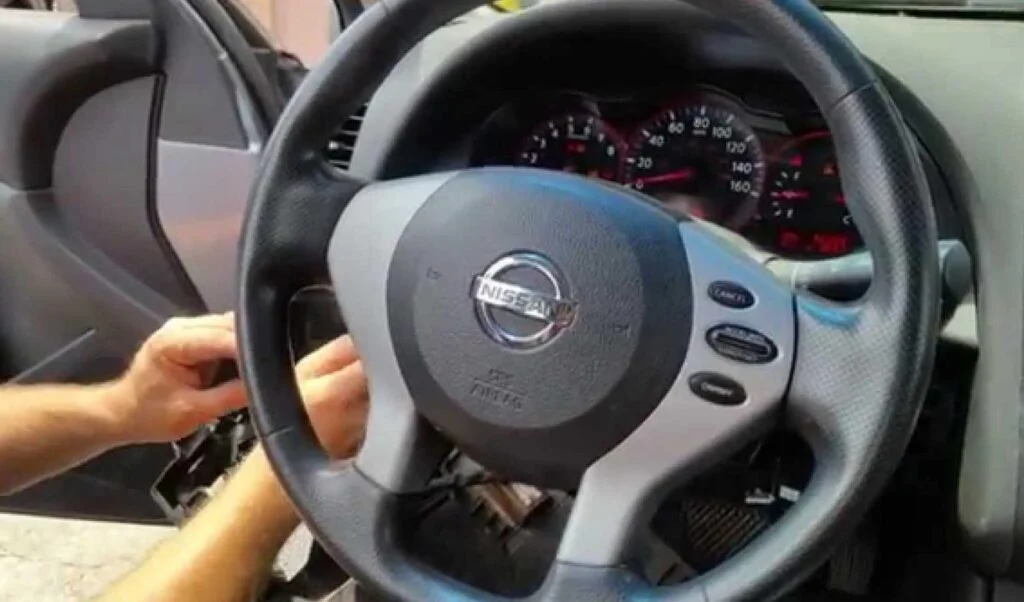
Instructions: To begin the “pedal-based” reset procedure—which serves as the manual alternative to a physical reset button—you need to put the Rogue into “ON” mode without actually cranking the engine. For models with a physical key, turn it two clicks to the “ON” position. For push-button start models, press the START button twice without your foot on the brake pedal. You will know you are in the correct mode when the dashboard lights up like a Christmas tree and the gauges sweep, but the engine remains silent. This step is crucial because it powers up the TCM, allowing it to receive input signals from the accelerator pedal without the engine’s mechanical interference.
Pro Tip: Ensure your foot is completely away from the brake pedal during this step. If the engine starts, you must turn it off and wait 30 seconds before trying again.
Step 3: The Accelerator Pedal Reset Sequence
What you need: Precise timing (use your smartphone timer) and a steady foot.
Instructions: Once the dash lights are on, wait exactly 5 seconds. Immediately after that 5-second mark, fully depress the accelerator pedal to the floor and hold it there for exactly 30 seconds. This is the most critical part of the process, as this sustained signal tells the TCM to enter a “Clear Adaptive Learning” mode. During these 30 seconds, do not let your foot slip or release the pressure even slightly. You won’t hear a beep or see a light change, but the internal computer is currently processing the request to dump the stored shift patterns that have been accumulated over thousands of miles of driving.
Pro Tip: Use a stopwatch rather than counting in your head. The Nissan TCM is notoriously picky about timing, and being off by even two seconds can result in the reset sequence failing to trigger.
Step 4: Cycling the Ignition System
What you need: 2 minutes of patience and the ignition switch.
Instructions: After holding the pedal for the full 30 seconds, release it completely. Immediately turn the ignition to the “OFF” position (or press the Start button once). Do not open the door or leave the vehicle yet. You must now wait for at least 2 minutes. During this period, the TCM is writing the “factory default” parameters to its non-volatile memory. If you interrupt this process by starting the engine or opening the driver’s door (which can trigger a power-save mode in some Rogue models), the reset may only be partial, leading to inconsistent shifting behavior. Sit quietly and let the vehicle’s electronic systems go through their power-down cycle completely.
Pro Tip: This is a great time to check your phone for any other maintenance reminders, but avoid using the car’s built-in infotainment system during this wait.
Audible Premium Plus — Annual Membership
12 audiobook credits up front, plus the full Audible catalogue.
See Annual PlansStep 5: The “No-Load” Engine Start
What you need: A clear path ahead and an observant ear.
Instructions: After the 2-minute wait is over, it is time to start the engine. Press the brake pedal and start the Rogue as you normally would. Once the engine is running, let it idle in “Park” for about 60 to 90 seconds. During this time, the TCM is communicating with the engine control module to establish the base idle speed and torque expectations. Do not touch the gas pedal, and ensure the A/C and defrost remain off. You may notice the RPMs fluctuate slightly; this is normal as the computer recalibrates the CVT’s steel belt tension and pulley positions at a standstill.
Pro Tip: If the idle feels excessively rough or the RPMs drop below 500, the reset may have cleared an idle-air relearn as well. Just let it stabilize; it usually smooths out within a minute.
Step 6: Performing the Relearn Drive Cycle
What you need: A stretch of open road with a speed limit of at least 45-50 mph.
Instructions: The transmission is now a “blank slate,” and you must teach it how to shift smoothly. Drive the vehicle onto a road where you can accelerate gradually. Accelerate from a complete stop to 40 or 50 mph using very light throttle (less than 25%). Let the car “shift” (vary its ratios) smoothly. Once you reach 50 mph, coast down to 10 mph without using the brakes heavily. Repeat this gentle acceleration and deceleration process 3 to 5 times. This teaches the CVT how to manage fluid pressure for smooth transitions. Avoid “flooring it” or aggressive maneuvers for the first 10 miles of driving after a reset, as this can teach the TCM “aggressive” habits right away.
Pro Tip: Try to perform this drive cycle on a flat road. Hills introduce load variables that can make the initial learning phase less consistent for the computer.
Step 7: The “Hard Reset” (Battery Disconnect Method)
What you need: A 10mm wrench or socket and safety gloves.
Instructions: If the pedal method does not resolve the lag or “rubber-band” feeling of the transmission, a “hard reset” may be necessary to fully discharge the capacitors in the TCM. With the engine off, use a 10mm wrench to disconnect the negative (black) battery terminal. Once disconnected, wait at least 30 minutes. Some technicians recommend touching the disconnected negative cable to the positive terminal (only the cable, NOT the battery posts!) for a few seconds to drain any residual “ghost” voltage. Reconnect the terminal and tighten it securely. This forces every module in the Nissan Rogue to reboot from scratch, which is often more effective for deep-seated software glitches than the pedal method alone.
Pro Tip: Be aware that a hard reset will also reset your clock, radio presets, and one-touch window settings. You will need to recalibrate your windows by holding the “up” switch for 5 seconds after they close.
Step 8: Final Inspection and Error Code Verification
What you need: An OBD-II scanner (optional but recommended).
Instructions: After completing the drive cycle, park the vehicle and let it idle for one minute. If you have access to a basic OBD-II scanner, plug it into the port under the dashboard to ensure no “Pending” codes have appeared. Even if the light isn’t on, the computer might flag a “CVT Fluid Deterioration” warning or a “Pressure Sensor” fault that indicates the reset was just a temporary fix for a mechanical problem. Check the transmission fluid level using the dipstick (if your model year has one) to ensure it is at the correct level and isn’t burnt. If the car drives significantly better, your reset was successful!
Pro Tip: If the transmission “whines” during the test drive after a reset, the issue is likely a clogged fluid filter rather than a software glitch. No amount of resetting will fix a physical blockage.
✅ Final Checklist
- Verified that the battery voltage was stable before starting the process.
- Completed the 30-second pedal hold with precise timing via a stopwatch.
- Allowed a full 2-minute “dwell” period for the TCM to save new data.
- Performed a gentle “relearn” drive cycle without aggressive acceleration.
- Confirmed that no Check Engine or CVT warning lights remain on the dashboard.
Important Notes:
- Safety Warning: Never attempt a transmission reset while the vehicle is in motion or in heavy traffic.
- When to Seek Help: If the Rogue continues to “slip” (RPMs rise but speed doesn’t) or makes a loud grinding noise, stop driving immediately. This indicates a mechanical belt failure in the CVT.
- Estimated Time: 15–30 minutes for the manual reset; up to 45 minutes for a battery-based hard reset.
- Cost Range: $0 (DIY) vs. $100–$200 for a dealership-level “Consult III” diagnostic and reset.
Signs Your Nissan Rogue CVT Needs a Software Reset
Sometimes, your Nissan Rogue might start acting like it has forgotten how to drive. You might notice that the car feels sluggish or that it takes a few seconds too long to respond when you hit the gas. These issues do not always mean you need a brand-new transmission. In many cases, the software has simply become “clogged” with old data or errors. When the TCM gets confused, it may benefit from a fresh start to clear out those electronic cobwebs.
Common Red Flags Behind the Wheel
Paying attention to how your Rogue feels during your daily commute is vital. You are the best judge of when something feels different. If the car used to be snappy but now feels like it is dragging through mud, the software might be the culprit. A software-related issue often manifests as a lack of communication between your foot on the pedal and the wheels on the pavement. If the hardware is fine but the “brain” is lagging, you will notice very specific behaviors.
Watch out for these common symptoms of a confused TCM:
- Delayed Acceleration: You press the gas, but the car hesitates for a second or two before moving.
- High RPMs: The engine revs loudly and high, but the vehicle does not seem to gain much speed.
- The “Rubber Band” Effect: The car feels like it is stretching and snapping back rather than accelerating smoothly.
- Limp Mode: The car suddenly loses power and refuses to go above a certain speed to protect itself from damage.
- Erratic Shifting: The car feels like it is jumping or jerking during a steady climb in speed.
When Software, Not Hardware, is the Culprit
It is important to distinguish between a broken part and a software glitch. If you hear loud grinding, whining, or clunking noises, you are likely dealing with a mechanical failure. Software issues are usually “silent” but frustrating. If your car feels physically fine but behaves unpredictably, a reset might be exactly what the doctor ordered. This process clears the “learned” data, allowing the TCM to start fresh and re-learn your driving habits from scratch. It is like rebooting a smartphone that has started to lag after months of heavy use.
Professional Diagnostic Tools vs. Manual TCM Clearing
Recommended Best Deal Products


![Au-TOMOTIVE GOLD Compatible Keychain and Keyring for Nissan Rogue [KC1540.ROG] - Premium…](https://m.media-amazon.com/images/I/31vIAKQQiDL._SS500_.jpg)
When you are dealing with a Nissan Rogue’s transmission behavior, there is often a debate between the “DIY quick fix” and the professional approach. While the internet is full of “hidden” pedal sequences intended to clear the Transmission Control Module (TCM), these manual methods have limitations. They primarily target the adaptive learning memory—the part of the computer that remembers how you drive—rather than the actual health of the transmission.
The Power of Bi-Directional Scan Tools
Unlike a standard code reader you might find at a local auto parts store, a professional-grade bi-directional scan tool can actually talk back to your Rogue. This is the closest thing to a real-world reset button. These tools allow technicians to perform a “TCM Power Balance” or “CVT Fluid Deterioration Date” reset, which are essential after a fluid change or a component repair.
- Precision: Professional tools can isolate whether a lag is caused by a software glitch or a failing solenoid.
- Data Logging: Technicians can watch real-time pressure changes within the CVT pulleys while the reset is being performed.
- Comprehensive Clearing: Manual methods often leave deep-seated “soft codes” behind, whereas a scan tool ensures a completely clean slate for the TCM.
Why Dealership Software (CONSULT-III) Matters
Nissan dealerships use a specific software suite called CONSULT-III Plus. While many independent shops have high-end scanners, the proprietary Nissan software is designed specifically to handle the delicate calibration of the Xtronic CVT. If your Rogue is experiencing significant “judder” or “hunting” for ratios, a simple manual memory clear won’t be enough. The dealership tool can recalibrate the belt tension and pulley pressure to factory specifications, something no sequence of pedal presses can achieve.
Long-Term Benefits of Transmission Control Calibration
Thinking of a transmission reset as just a way to stop a dashboard light is a mistake. When done correctly, recalibrating or resetting the TCM is a form of preventative maintenance. Your Rogue’s CVT is a highly adaptive piece of machinery that constantly adjusts to your acceleration habits, the weight of your cargo, and even the inclines on your daily commute.
Restoring “Like-New” Shift Quality
Over time, the TCM can “learn” bad habits, especially if you have recently changed your driving environment (like moving from flat highways to hilly city streets). A professional reset allows the transmission to start fresh, often resulting in a noticeable improvement in throttle response. You may find that the car no longer feels “sluggish” when you try to merge onto the highway, as the pulleys are no longer relying on outdated driving data.
Extending the Life of Your CVT
Heat is the number one enemy of the Nissan Rogue transmission. When the TCM is poorly calibrated, it may cause the belt to slip slightly or the fluid to work harder than necessary, leading to increased operating temperatures. By ensuring the software is calibrated correctly, you are:
- Reducing Mechanical Wear: Proper pulley synchronization prevents unnecessary friction on the steel belt.
- Improving Fuel Economy: A calibrated CVT finds the optimal “gear” ratio more efficiently, saving you money at the pump.
- Identifying Early Warnings: The process of resetting often reveals underlying pressure issues before they turn into a total transmission failure.
Pro Tip: If you are resetting your TCM because of performance issues, always check your CVT fluid level and color first. Software can’t fix “burnt” or depleted fluid.
Conclusion: The Bottom Line on the Reset Button
While the Nissan Rogue transmission reset button doesn’t exist as a physical switch on your dashboard, the concept of resetting the system is vital for maintaining a healthy vehicle. Whether you are clearing out old driving habits or recalibrating the system after a fluid flush, understanding the difference between a “manual trick” and a professional diagnostic reset is key. Relying on professional tools will always provide a more stable, long-term solution than temporary DIY fixes.
If your Rogue is acting up, start by checking for any stored OBD-II codes. If the symptoms persist, schedule a professional TCM calibration at a trusted shop. Don’t wait for a small lag to become a major repair—stay proactive with your CVT maintenance and keep your Rogue running smoothly for years to come!
💬 Quick Questions & Answers
Where is the Nissan Rogue transmission reset button?
There is no physical button; the transmission is reset through specific ignition sequences or a diagnostic tool.
Can a reset fix CVT shuttering?
A reset may resolve minor electronic glitches, but mechanical shuttering usually requires fluid changes or hardware repairs.
Does disconnecting the battery reset the transmission?
Yes, disconnecting the battery for 30 minutes can clear some temporary TCM memory and adaptive learning data.
Will a reset void my Nissan warranty?
No, performing a standard software reset or TCM clearing will not void your vehicle’s factory warranty.
How often should I reset my Nissan Rogue TCM?
Only reset the TCM if you experience shifting issues, after replacing parts, or after a fluid flush.
❓ Frequently Asked Questions
Is there a hidden button for the Nissan Rogue transmission reset?
No, the ‘reset button’ is a common misconception; the process is entirely electronic and handled through the Transmission Control Module. Most users refer to an ignition-key sequence or a scan tool command when using this term.
Why does the Nissan Rogue transmission enter limp mode?
Limp mode is a protective state triggered by the TCM when it detects overheating or sensor failures. Resetting the system can temporarily exit limp mode, but the underlying cause must be addressed to prevent damage.
Can a transmission reset improve fuel economy?
Yes, resetting the adaptive learning data forces the TCM to relearn your driving habits from scratch. This can lead to smoother gear transitions and potentially better fuel efficiency if the previous data was corrupted.
What is the difference between a reset and a reflash?
A reset clears temporary memory and adaptive data, while a reflash involves installing a completely new software version from Nissan. Reflashing is often necessary to fix known bugs in the Rogue’s CVT logic.
Will resetting the transmission fix a ‘check engine’ light?
It might clear the light temporarily if the code was related to a soft TCM error. However, if there is a hardware failure, the light will return almost immediately after the reset.
Can I use an OBD-II scanner to reset my Nissan Rogue transmission?
Yes, many high-quality OBD-II scanners have the ‘Clear TCM’ function which is the most effective way to reset the system. This method is safer and more precise than manual ignition sequences.