How To Find Jack Points On A Car Expert Guide How To 2026
Last Updated on September 1, 2026 by Albert Duke
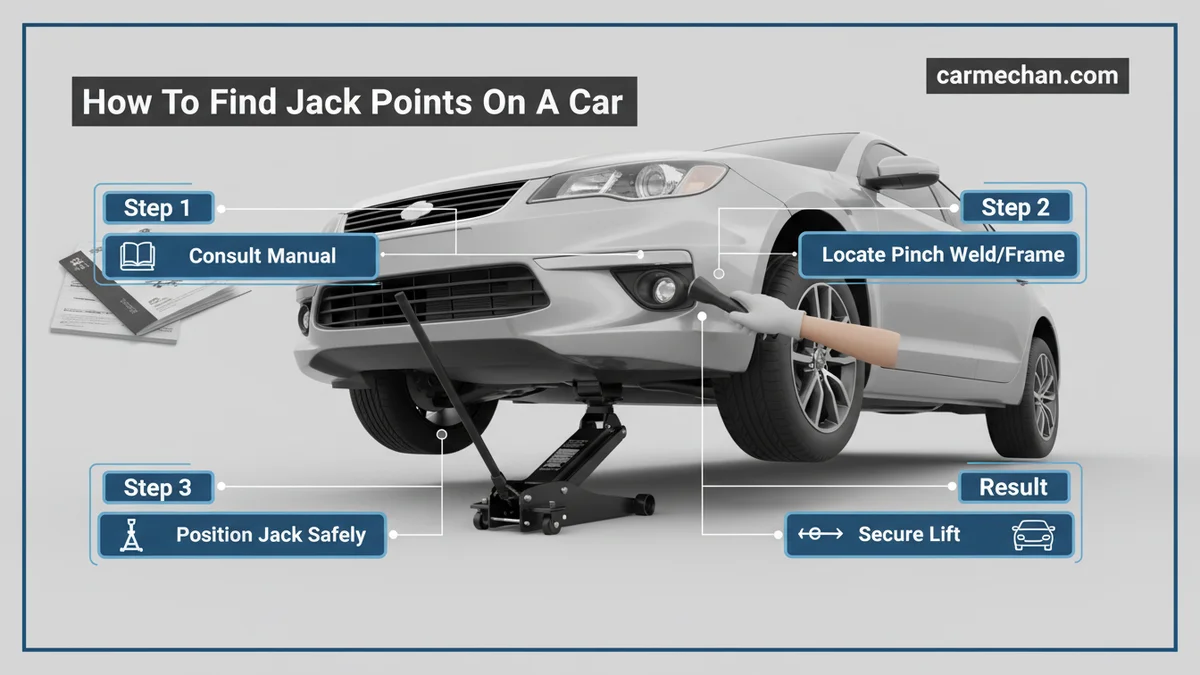
Knowing how to find jack points on a car is crucial for safe vehicle maintenance and repair. These specific, reinforced areas are designed to support your vehicle’s weight without causing damage, making proper identification and usage paramount for any DIYer.
Finding jack points on a car means locating the designated, reinforced areas on your vehicle’s frame or body specifically designed for lifting, crucial for safe maintenance. Mastering this skill gives you confidence for routine tasks like changing a flat tire or performing under-car inspections. Incorrect placement can lead to significant vehicle damage or, more critically, serious personal injury.
This comprehensive guide will equip you with the knowledge to identify correct lifting and support points, ensuring your safety and the longevity of your vehicle. We cover essential safety protocols, visual identification cues, and step-by-step instructions. Before we the specifics of locating these vital points, we must first establish a foundation of safety.
Quick Summary
Knowing how to find jack points on a car is crucial for safe vehicle maintenance and repair. These specific, reinforced areas are designed to support your vehicle’s weight without causing damage, making proper identification and usage paramount for any DIYer.
Key Takeaways
- Always prioritize safety with proper preparation and equipment.
- Jack points are reinforced spots for lifting, not support.
- Jack stand points are for secure support after lifting.
- Vehicle design (unibody vs. frame) dictates jack point types.
- Consult your owner’s manual for precise, model-specific locations.
Key Takeaways


- Always prioritize safety with proper preparation and equipment.
- Jack points are reinforced spots for lifting, not support.
- Jack stand points are for secure support after lifting.
- Vehicle design (unibody vs. frame) dictates jack point types.
- Consult your owner’s manual for precise, model-specific locations.
5 Crucial Safety Steps Before Lifting Your Car


Prioritizing safety before you even begin to lift your vehicle protects both you and your car. Statistics show that hundreds of preventable accidents occur annually due to improper vehicle lifting . Following these critical steps minimizes risk significantly.

Prepare Your Area
Always work on a flat, solid, and level surface, ideally concrete or asphalt. Avoid gravel, dirt, or sloped areas, which can compromise stability. Clear your workspace of any tools or debris that could cause trips or obstruct movement. Ensure adequate lighting.
[VISUAL NEEDED: Image showing a prepared work area with chocks, level ground]
Check Your Equipment
Inspect your jack and jack stands for any signs of damage, cracks, or leaks before use. Ensure all components are present and functioning correctly. Using damaged or inappropriate equipment severely increases the risk of an accident.
[VISUAL NEEDED: Image of jack and jack stands being inspected for damage]
Engage Parking Brake
Before lifting, always engage your vehicle’s parking brake. This prevents the car from rolling unexpectedly while you are positioning your jack or working underneath. The parking brake provides an essential layer of security.
Chock Your Wheels
Place wheel chocks firmly against the tires that remain on the ground. For front-end lifting, chock the rear wheels; for rear-end lifting, chock the front wheels. This crucial step prevents any accidental movement of the vehicle.
Understand Weight Limits
Be aware of your jack’s and jack stands’ weight capacities. Never exceed these limits. Your vehicle’s curb weight can be found in your owner’s manual or on a sticker in the driver’s side door jamb. Choose equipment rated well above your car’s weight.
With a safe environment established, let’s now explore the specific areas where your car is designed to be lifted.
How to Locate 3 Primary Vehicle Jack Point Areas


Identifying the primary structural areas where your vehicle can be safely lifted is fundamental for any under-car work. These reinforced zones are engineered to bear the vehicle’s weight without sustaining damage or compromising structural integrity. Knowing their appearance helps you quickly identify them.
Pinch Welds
Pinch welds are the most common jack points on unibody vehicles, visible as a seam running along the bottom edge of the rocker panels. They are reinforced with layers of high-strength steel. Manufacturers often indicate the specific jacking locations with small notches or arrows nearby.
[VISUAL NEEDED: Diagram/Photo highlighting pinch weld jack points]
Frame Rails
On body-on-frame vehicles, like many trucks and older SUVs, the main frame rails serve as ideal jack points. These are thick, rectangular metal beams running parallel to the vehicle’s length under the body. They offer a very stable and strong lifting surface.
[VISUAL NEEDED: Diagram/Photo highlighting frame rail jack points]
Suspension Components
Certain heavy-duty suspension components, such as the front subframe or sturdy mounting points for control arms, can also serve as safe jack points. Consult your owner’s manual for these specific locations, as improper use here can damage delicate suspension parts or steering linkages.
[VISUAL NEEDED: Diagram/Photo highlighting specific suspension component jack points, e.g., subframe points]
While these areas are ideal for lifting, it is equally critical to understand the difference between a lifting point and a stable support point.
Jack Points vs Jack Stand Points Clarified
Understanding the fundamental difference between where you position your jack and where you place your jack stands is paramount for vehicle stability. A jack is a temporary lifting device, while jack stands provide secure, long-term support. Mixing these roles can be incredibly dangerous.

Lifting Locations
Lifting locations, or jack points, are the specific, reinforced areas designed to withstand the concentrated force of a jack. These are where your jack raises the vehicle. A jack, however, is not designed for prolonged support and can fail due to hydraulic leaks or mechanical stress.
[VISUAL NEEDED: Diagram showing a jack lifting at one point and a jack stand placed adjacent for support]
Support Locations
Support locations, or jack stand points, are reinforced areas where jack stands safely cradle the vehicle’s weight. These are typically sections like frame rails, subframe mounting points, or sometimes the same pinch weld areas, but adjacent to where the jack was placed. OSHA guidelines emphasize that no one should ever work under a vehicle supported only by a jack .
[VISUAL NEEDED: Image of a jack stand correctly positioned under a frame rail/designated support point]
Why Differentiate
Differentiating these points is a safety imperative. A jack’s primary function is to lift, not to hold indefinitely. Jack stands, with their wide bases and locking mechanisms, distribute weight more effectively and provide a stable platform. Failure to use jack stands for support is a leading cause of vehicle-related accidents.
Now that we recognize the specific locations for both lifting and supporting, let us walk through the entire process of getting your car safely off the ground.
How to Safely Lift Your Car in 7 Simple Steps
Following a methodical, step-by-step approach ensures your vehicle is lifted and supported without incident. This detailed procedure minimizes risks and builds your confidence for any under-car tasks. Precision and patience are key throughout this process.
Gather Equipment
Collect all necessary tools: a properly rated jack, two or four jack stands, wheel chocks, and any personal protective equipment like gloves. Ensure all equipment is clean and in good working order before you begin the task.
Prepare Vehicle
Park your car on a level, firm surface. Engage the parking brake firmly. Place wheel chocks against the wheels that will remain on the ground to prevent any rolling. Remove the hubcap or loosen lug nuts slightly if you’re removing a wheel.
[VISUAL NEEDED: Image of a wheel chock properly placed]
Position Jack
Locate the correct jack point as identified in your owner’s manual or by visually inspecting the reinforced areas. Slide the jack under the vehicle until the jack pad is centered and securely in contact with the jack point. Ensure the jack is perpendicular to the vehicle.
Slowly Lift
Begin slowly raising the vehicle, watching carefully for any shifting or instability. Lift only high enough to allow clearance for the jack stands. Never put any part of your body under the vehicle while it is supported only by the jack.
[VISUAL NEEDED: Step-by-step diagram or photo series showing the entire jacking process, from initial jack placement to car resting on stands]
Place Stands
Once lifted, position your jack stands under designated, strong support points, ideally close to the jack point but not on the exact same spot. Extend the jack stands to the proper height and ensure they are locked into place securely. For example, if you’re lifting the front, place stands under the frame rails or subframe.
[VISUAL NEEDED: Close-up of correct jack stand placement]
Lower Onto Stands
Slowly and carefully lower the vehicle until its weight rests entirely on the jack stands. The jack should now be slightly unloaded, but remain in place as a backup safety measure. Double-check that the jack stands are firmly seated and stable.
Check Stability
Before working, gently push or shake the vehicle to confirm it is stable on the jack stands. If there’s any movement, re-evaluate and reposition your stands. Your safety depends on a completely stable platform.
While these steps apply broadly, specific vehicles often have unique considerations for jack point placement.
Where Are Jack Points on 3 Common Vehicle Types
Different vehicle designs necessitate slightly varied approaches to identifying appropriate jack points. Understanding these distinctions helps you correctly position your equipment, whether you own a compact car or a heavy-duty truck.
Sedan Spots
Most modern sedans are unibody constructions. Their primary jack points are typically the reinforced pinch welds along the rocker panels, often marked with small arrows or notches. Central front or rear subframe points can also be used as lifting points, with jack stands placed on the adjacent pinch welds or control arm mounting points .
[VISUAL NEEDED: Diagram of a sedan underside showing typical jack/jack stand points]
SUV Points
SUVs and crossovers can be either unibody or body-on-frame. Unibody SUVs will follow similar pinch weld and subframe guidelines as sedans. Body-on-frame SUVs will utilize the sturdy frame rails, especially near the suspension components. Axle housings are also common rear jack stand points for these larger vehicles.
[VISUAL NEEDED: Diagram of an SUV underside showing typical jack/jack stand points]
Truck Locations
Pickup trucks are almost universally body-on-frame vehicles. The frame rails are the primary and most secure lifting points. For the rear, the differential housing can be used as a central jack point, with stands placed under the axle tubes. Front lifting often involves frame rails or heavy-duty suspension components, avoiding thinner sheet metal.
[VISUAL NEEDED: Diagram of a truck frame showing typical jack/jack stand points]
Ensuring you know your specific vehicle’s lifting points is a crucial part of becoming a more confident and safer car owner.
Empowering Your DIY Car Maintenance Journey
By understanding how to find jack points on a car and practicing safe lifting procedures, you unlock a new level of confidence in vehicle maintenance. This knowledge empowers you to tackle tasks from tire rotations to brake inspections, saving time and money. Always consult your owner’s manual for model-specific details and prioritize safety above all else.
The lessons learned here will serve you for years to come, making your DIY efforts in 2026 and beyond both productive and secure. a safely lifted car is a car ready for successful work.
Common Questions About Car Jack Points
What Do Car Jack Points Typically Look Like?
Car jack points usually appear as reinforced metal flanges or flat areas on the vehicle’s frame or rocker panels. On unibody cars, they are often visible as pinch welds with small notches. Body-on-frame vehicles typically use sections of the main frame rails or axle housing, often marked or visibly thicker.
Can I Use a Jack on the Suspension Arm of My Car?
Using a jack directly on suspension arms is generally not recommended unless explicitly stated in your owner’s manual. Suspension components are not always designed to bear the entire vehicle’s weight in that manner. Incorrect placement can damage these parts or cause instability during lifting.
Is It Safe to Use a Bottle Jack on a Unibody Car?
Yes, a bottle jack can be safe for a unibody car if used with an appropriate adapter that fits the pinch weld or other designated jack point. Without an adapter, the concentrated force of a bottle jack can bend or damage the unibody structure. Always ensure correct contact.
How Do I Find the Central Jack Point on My Vehicle?
Many vehicles have central jack points, typically a sturdy crossmember at the front or the differential housing at the rear. These allow you to lift an entire end of the vehicle. Consult your owner’s manual for the exact location and ensure you have jack stands ready for immediate support.
Why Do Car Manufacturers Put Specific Jack Points on Cars?
Car manufacturers designate specific jack points to ensure structural integrity during lifting. These areas are reinforced to safely support the vehicle’s weight without causing damage to the chassis, suspension, or body panels. They are crucial for maintaining vehicle safety and preventing costly repairs.