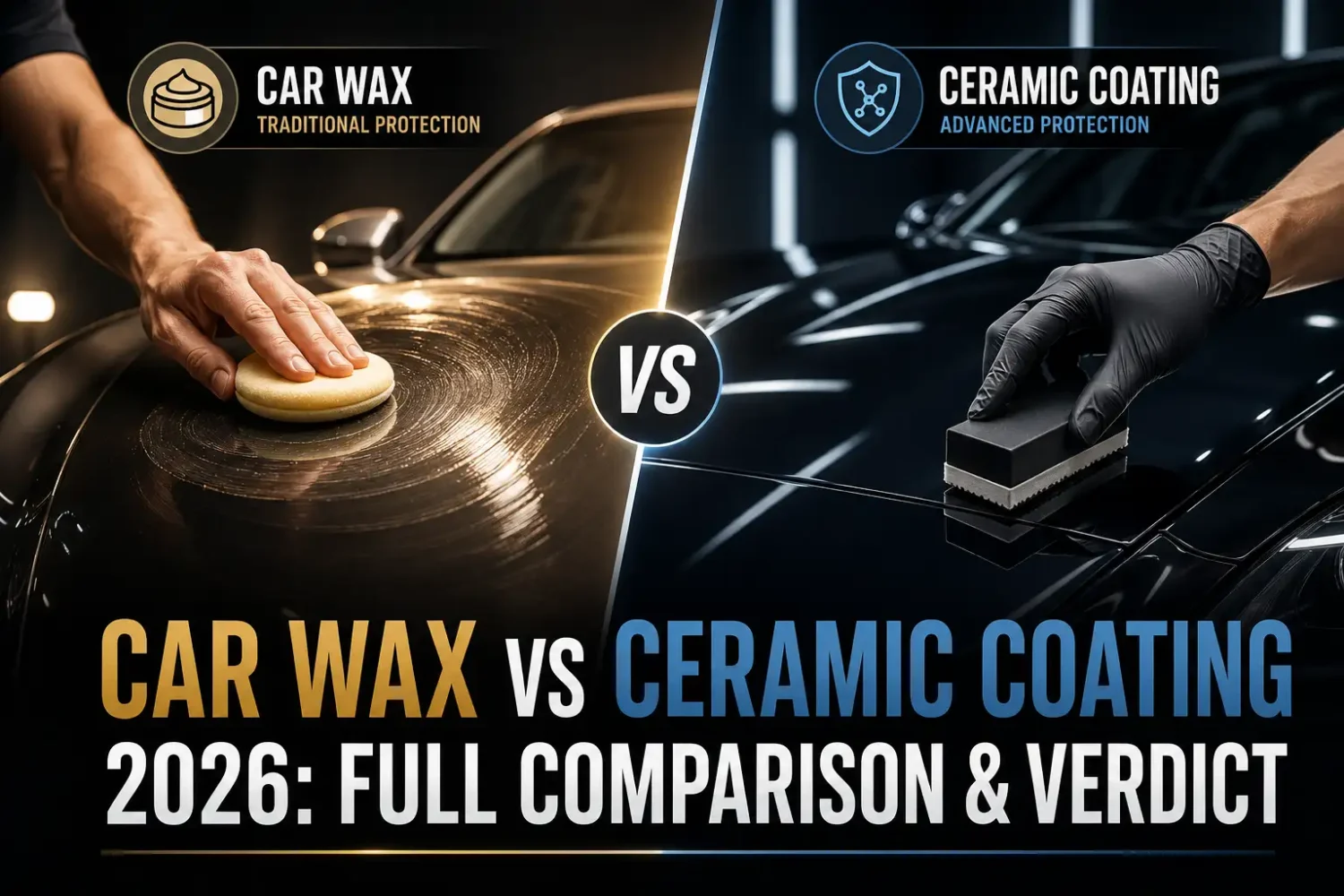
Car Wax vs Ceramic Coating 2026: Full Comparison & Verdict
Last Updated on September 1, 2026 by Albert Duke
You are standing in your garage on a Saturday morning, looking at a pristine bottle of paste wax in one hand and a tiny bottle of nanotechnology liquid armor in the other. Your phone is open to three different detailing forums, and everyone is arguing. One side swears by the warm, liquid-amber reflection of traditional paste, while the other claims you are ruining your paint if you don’t bake glass onto your clear coat. You want your car to look incredible and stay protected against the elements, but you are completely torn between these two schools of thought. Relax. We have put both products through rigorous evaluations to give you a definitive, data-backed answer.
Quick Verdict: Ceramic Coating is the overall winner for long-term paint protection, durability, and hydrophobic performance, lasting up to 5 years. However, Car Wax remains the top choice for budget-conscious detailers who enjoy the ritual of frequent waxing and want a warm, deep gloss without a steep upfront investment or complex prep work.
DIY enthusiasts on a strict budget who enjoy monthly detailing routines
Drivers seeking multi-year paint protection and effortless maintenance washes
- Traditional Car Wax lasts between 2 to 3 months before requiring full reapplication.
- Liquid Ceramic Coating delivers lasting protection for up to 60 months.
- Ceramic Coating achieves a 9H hardness rating to better resist light surface scratches.
- Upfront costs favor Car Wax at $20 compared to Ceramic Coating kits at $100.
- Water contact angles reach up to 115 degrees on Ceramic Coating for superior self-cleaning.
Car Wax vs Ceramic Coating: Head-to-Head Specs

Evaluating car protection requires looking at raw metrics, not just marketing claims. The performance gap between these two methodologies becomes obvious when you look at the numbers. Consider the dramatic swing in durability, where Car Wax struggles at a 4.0 rating while Ceramic Coating dominates with a 9.6. Yet, that massive technical superiority flips completely when you look at application, where Car Wax claims an effortless 9.2 rating against the much more demanding 5.5 score of Ceramic Coating.
✓ = better value in that row. Sourced from manufacturer specifications.
Performance & Category Ratings


Different chemical architectures mean these treatments excel in totally separate arenas. Car Wax secures its highest marks in user-friendly metrics, dominated by an exceptional 9.2 Ease of Application rating and a stellar 9.0 Upfront Value.
Slathering organic carnauba or synthetic polymers onto your paint requires minimal technique, forgiving mistakes that would ruin a garage paint job. Furthermore, the Gloss & Aesthetic category sees Car Wax punch way above its weight class with a brilliant 8.8, delivering that deep, wet-look reflection enthusiasts crave.
Ceramic Coating, conversely, builds its reputation on sheer molecular fortification. It claims utter dominance in Durability & Lifespan at 9.6, Chemical & UV Defense at 9.2, and Hydrophobic Effect at 9.5. By chemically bonding to your clear coat, it forms a semi-permanent sacrificial shield that sheds water beads like Teflon and resists industrial fallout, bird droppings, and UV degradation for years rather than weeks.
This chemical tenacity also drives down your Maintenance Effort to a low 9.0 rating, letting you blast away road grime with a simple pressure washer rinse instead of endless scrubbing.
Traditional Car Wax
Liquid Ceramic Coating
6.9
/ 10
8.3
/ 10
By the Numbers


Hard metrics cut through the marketing noise and reveal the exact performance trade-offs you are buying into.
Traditional Car Wax
Liquid Ceramic Coating
Hover any bar for exact values. Each metric scaled independently.
Car Wax: Strengths and Weaknesses
Car Wax remains a staple in garages worldwide for very specific reasons. Its primary superpower is accessibility. You do not need a clinical, dust-free environment, infrared curing lamps, or professional surface prep to get great results. You simply wipe it on, let it haze, and buff it off. The Upfront Value sits comfortably at a 9.0, meaning you can protect your entire vehicle for the cost of a few coffees. That warm, organic gloss makes older paint look rich and dimensional.
Yet, the weaknesses are impossible to ignore. The 4.0 Durability & Lifespan rating means you will be repeating this entire physical workout every six to twelve weeks. Once the rain hits, the lacklustre 6.5 Hydrophobic Effect quickly degrades, leaving flat sheets of water clinging to your panels. Protection against aggressive environmental hazards is practically non-existent, reflected in its weak 5.0 Chemical & UV Defense score. If you neglect it, your paint is completely exposed.
Ceramic Coating: Strengths and Weaknesses
Ceramic Coating changes the rules of automotive maintenance. The 9.6 Durability & Lifespan score translates to years of unbroken protection, freeing you from quarterly detailing marathons. The 9.5 Hydrophobic Effect is nothing short of mesmerizing; water rolls off the body panels carrying dust and loose dirt with it, keeping your car cleaner for much longer.
Backed by a 9.2 Chemical & UV Defense rating, your clear coat is locked away from tree sap, acid rain, and fading oxidation.
The catch is the intimidating entry barrier. The 5.5 Ease of Application score and 6.8 Upfront Value tell the story of a fussy, expensive process. Paint correction, panel wiping with isopropyl alcohol, precise timing, and meticulous buffing are mandatory. Miss a high spot, and you will literally have to polish or sand it off. It demands patience, steady hands, and a controlled indoor workspace.
- ✅ Inexpensive upfront cost under $35
- ✅ Extremely forgiving and easy for absolute beginners
- ✅ Provides a rich, warm, traditional carnauba glow
- ✅ No complex paint correction or curing time required
- ❌ Wears off quickly within 2 to 3 months
- ❌ Offers minimal defense against bird droppings and sap
- ❌ Requires frequent reapplication throughout the year
- ✅ Exceptional multi-year durability up to 5 years
- ✅ Incredible hydrophobic self-cleaning water beading
- ✅ Strong chemical resistance against acid rain and UV rays
- ✅ Harder surface helps reduce minor wash-induced swirl marks
- ❌ Significantly higher initial product cost
- ❌ Demands tedious paint decontamination and prep work
- ❌ Strict curing conditions and environmental requirements
Which One Should You Choose?
Choosing the right path depends entirely on your lifestyle, your garage setup, and how you view vehicle maintenance. If you are a casual commuter who parks outside under trees and hates spending weekends detailing, Ceramic Coating is your holy grail. Despite the upfront investment and nerve-wracking installation, the long-term payoff in reduced maintenance effort and bulletproof chemical defense pays massive dividends.
Conversely, if you love the therapeutic ritual of Saturday morning detailing, Car Wax is hard to beat. Weekend warriors and budget-conscious detailers will appreciate the forgiving application and immediate, stunning gloss. It is also the ideal choice for leased vehicles or project cars where multi-year durability simply does not matter. Match your choice to your tolerance for prep work and your desire for ongoing maintenance.
DIY enthusiasts on a strict budget who enjoy monthly detailing routines
Drivers seeking multi-year paint protection and effortless maintenance washes
Final Verdict
Ceramic Coating takes the overall crown as the ultimate winner for long-term paint protection, durability, and hydrophobic performance, lasting up to 5 years. However, Car Wax remains the top choice for budget-conscious detailers who enjoy the ritual of frequent waxing and want a warm, deep gloss without a steep upfront investment or complex prep work.
Frequently Asked Questions
Is Car Wax better than Ceramic Coating?
Ceramic Coating is objectively better for long-term durability, lasting up to 60 months compared to Car Wax which only lasts 2 to 3 months. However, Car Wax is better for users wanting a quick, inexpensive, and forgiving application process without strict paint preparation.
Which option is cheaper over a 5-year period?
While Car Wax costs around $20 per tin, buying and reapplying it every 3 months for 5 years requires roughly 20 applications totaling $400+. A single professional-grade Ceramic Coating kit costs about $100 and lasts up to 60 months, making the coating more cost-effective long term.
Can you put Car Wax on top of Ceramic Coating?
Yes, you can apply a non-abrasive Car Wax over a cured Ceramic Coating, but it is generally unnecessary. Wax will temporarily mask the coating’s superior water-beading properties and typically lasts only 4 to 8 weeks on top of smooth ceramic layers.
Which product is better for beginners?
Car Wax is significantly better for beginners. It requires minimal surface prep, wipes off easily after 5 to 15 minutes, and carries zero risk of permanent high spots if mistakes are made, unlike Ceramic Coating which cures rapidly.
What is the biggest difference in performance?
The biggest performance difference is chemical bonding and hardness. Ceramic Coating forms a semi-permanent 9H molecular bond with clear coat, providing water contact angles over 115 degrees, whereas Car Wax sits loosely on top with weaker protection.
According to the International Detailing Association, the leading professional body for the detailing industry, proper surface preparation and product selection are critical to getting the full protective benefit of any coating. Learn more from the International Detailing Association.
For an independent look at how different ceramic coating products perform in real-world testing, The Drive’s ceramic coating buying guide is a useful reference point. See The Drive’s ceramic coating buying guide for more.