Freightliner Cascadia Cruise Control Not Working 2026
When your Freightliner Cascadia cruise control fails, the most common culprits are faulty brake pedal switches or blown fuses. This guide helps you identify if the issue is a simple mechanical switch or a complex Adaptive Cruise Control (ACC) radar fault.
Your Freightliner Cascadia cruise control stops working usually because a safety interlock sensor has triggered a permanent inhibit command. In 2026 models, the Electronic Control Unit (ECU) prioritizes safety over convenience; if the system detects an inconsistent signal from your brake, clutch, or radar sensors, it disables the cruise function until the fault is cleared. This isn’t always a catastrophic electronic failure, but rather a protective measure that prevents the truck from accelerating if it cannot confirm the pedal positions.
Diagnosing this issue yourself saves significant shop downtime and expensive diagnostic fees. By checking your physical switches, fuse integrity, and radar sensor health, you can often isolate the culprit in less than thirty minutes. Failing to address these faults promptly can lead to driver fatigue on long-haul routes or mask more critical underlying issues with your truck’s chassis network or powertrain communication.
Key Takeaways
- Check the brake pedal switch, as it is the most frequent cause of cruise control deactivation.
- Inspect the PDM and SAM chassis for blown fuses related to the cruise control system.
- Dashboard fault codes often indicate radar obstructions or communication errors with the ACC system.
- Verify all steering wheel buttons are functional to ensure the signal is reaching the engine ECM.
- Persistent failures after checking basics usually indicate an internal software or sensor calibration issue.
Common Causes for Freightliner Cascadia Cruise Control Failure
Recommended Best Deal Products



Brake and Clutch Pedal Position Sensors
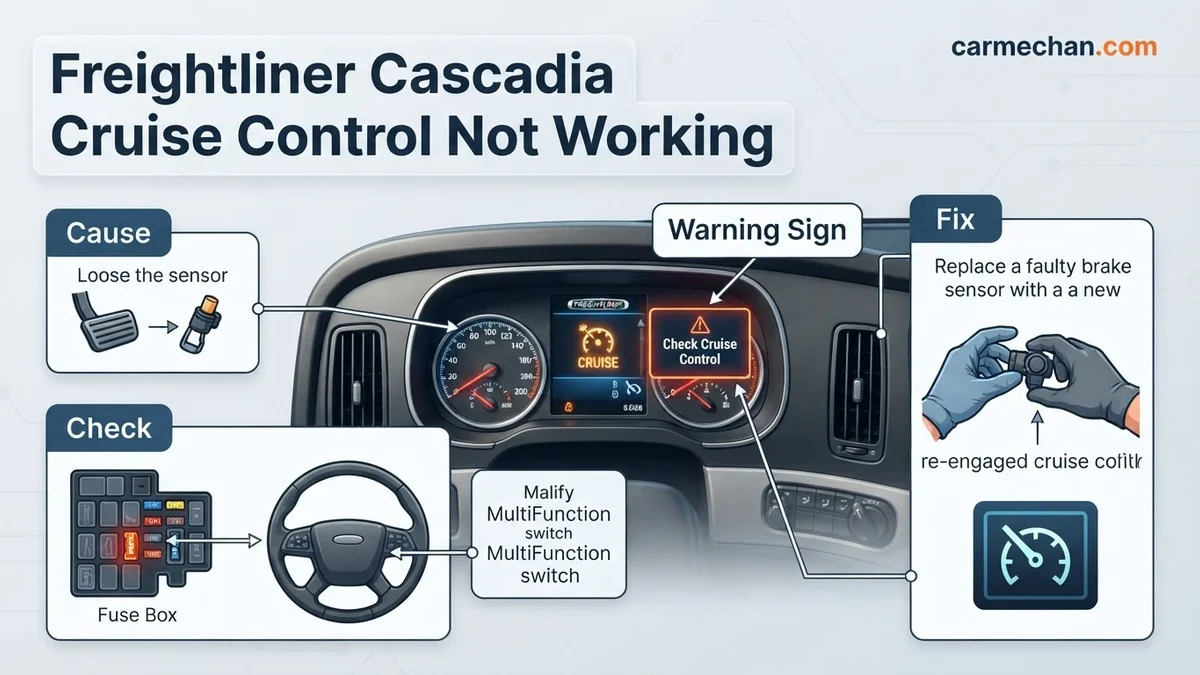
The most frequent point of failure in 2026 Cascadias involves the brake or clutch pedal position switches. These switches tell the engine computer exactly when you touch the pedal. If the switch develops carbon buildup or the adjustment bracket slips, the ECU thinks the brake is being applied even when your foot is off the pedal. Since the cruise system is programmed to disengage instantly upon brake activation, a stuck switch will prevent the cruise control from ever arming.
- Brake Pedal Switch: Located near the pedal assembly; check for debris preventing full contact.
- Clutch Position Sensor: If you have a manual transmission, a loose or misaligned sensor prevents the cruise signal from locking in.
- Switch Adjustment: Often, the mounting bracket shifts due to vibration, causing the switch plunger to remain depressed.
Steering Wheel Controls and Clock Spring
Your steering wheel buttons communicate via the clock spring, which is a rotating electrical connector. Over time, the internal ribbons inside the clock spring can fray. If your cruise buttons work intermittently or not at all, the signal is likely failing to bridge the gap between the steering wheel and the column. Check if your steering wheel audio or dash navigation controls also act up; if they do, the clock spring is almost certainly the culprit.
Freightliner Cascadia Cruise Control Failures: What Causes It and How to Fix It
When the cruise control on your Freightliner Cascadia stops responding, it can turn a long haul into an exhausting ordeal. This failure is often rooted in safety interlocks, sensor malfunctions, or communication errors within the vehicle’s electronic control units (ECU). Because the Cascadia is a highly computerized vehicle, many safety systems are interconnected; if the truck detects a fault in the braking system, transmission, or engine parameters, it will automatically disable the cruise function to prevent catastrophic failure. This guide provides a systematic approach to identifying and resolving the most common causes of cruise control dormancy in your Cascadia, ensuring you get back on the road safely and efficiently.
Step 1: Perform a Comprehensive Pre-Trip Electronic Check
What you need: No tools required; access to the dashboard Driver Information Display (DID).
Instructions: Start by cycling the ignition key to the “ON” position without starting the engine. Watch the dashboard for any active fault codes or warning lights. Cruise control on a Cascadia is highly sensitive to the status of your braking system and ABS. If the ABS light is illuminated, the cruise control will intentionally remain disabled as a safety precaution. Observe the message center for alerts like “Check Transmission” or “Engine Fault.” If no alerts are present, ensure that your parking brake is fully released and the service brake is not depressed, as even a faulty brake light switch can send a “brake active” signal to the ECU, preventing cruise engagement.
Pro Tip: If your brake lights are stuck in the “ON” position, the cruise control will never engage. Have someone stand behind the truck to verify your brake lights are off when the pedal is released.
Step 2: Inspect the Brake Pedal Position Sensor
What you need: A flashlight, basic metric socket set, and a digital multimeter.
Instructions: Locate the brake pedal position sensor near the top of the brake pedal assembly under the dash. This sensor tells the engine computer exactly how much pressure is being applied. If the sensor is misaligned, dirty, or internally damaged, the ECU assumes the brake pedal is being touched. Inspect the wiring harness leading to the sensor for any signs of chaffing or broken pins. With the multimeter set to DC volts, probe the signal wire; you should see a specific voltage range (typically 0.5V to 4.5V) that changes smoothly as you press the pedal. If the voltage jumps or stays static despite movement, the sensor is likely faulty and requires replacement.
Pro Tip: Always disconnect the negative battery terminal before unplugging sensor connectors to prevent arcing or shorting out sensitive electronic modules.
Step 3: Evaluate the Clutch Switch (For Manual Transmissions)
What you need: A flashlight and a small flathead screwdriver.
Instructions: For manual transmission Freightliners, a clutch switch is integrated into the cruise system. If the switch fails to signal that the clutch pedal is fully released, the cruise control will remain disabled to prevent engine over-revving. Locate the clutch switch near the clutch pedal linkage. Manually operate the switch plunger to see if it moves freely. Over time, these switches can accumulate road grime or lose their spring tension. Clean the contact area with electrical contact cleaner. If the switch remains “closed” even when the pedal is retracted, it is likely stuck internally. Test for continuity across the switch pins while moving the plunger; there should be a clear “click” and a change from OL (open) to 0.0 ohms.
Pro Tip: If you are stuck on the road, sometimes tapping the clutch pedal firmly can reseat a sticky switch temporarily, allowing you to engage cruise control until you reach a service shop.
Step 4: Check for Air System and Service Brake Faults
What you need: A tire pressure gauge and a helper.
Instructions: The Cascadia’s cruise control relies heavily on air pressure sensors. If your secondary air tank pressure is low or the brake light air pressure switch is malfunctioning, the computer will disable cruise control. Verify that your air gauges are reading within the normal range (100–125 PSI). If you suspect the brake light air switch, locate the switch on the air manifold (usually near the firewall). If this switch is faulty, it may keep the cruise control module in a constant state of “brake applied.” Listen for air leaks around the pedal assembly. A significant air leak in the brake system can cause the truck to sense a pressure drop, triggering a cruise inhibit command.
Pro Tip: If the cruise control stopped working immediately after an air system service, ensure that all electrical connectors near the air manifold were plugged back in securely.
Step 5: Verify Wheel Speed Sensor Integrity
What you need: Diagnostic scanner or code reader capable of reading ABS/ECU data.
Instructions: The Cascadia relies on wheel speed sensors to determine vehicle velocity. If one of these sensors has a bad connection or a broken exciter ring, the computer will lose the vehicle speed signal. Without a reliable speed signal, the cruise control will not engage because it cannot calculate the required throttle adjustment to maintain speed. Connect your diagnostic tool to the OBDII or Deutsch diagnostic port under the dash. Look specifically for codes related to the ABS or “Speed Signal Out of Range.” Inspect the wheel ends for frayed wiring that may have been damaged by road debris. If a sensor is throwing an intermittent code, it must be replaced to restore full cruise functionality.
Pro Tip: Clean the exciter rings located behind the wheel hubs with a pressure washer or compressed air to remove metallic brake dust buildup that can interfere with the sensor reading.
Step 6: Reset the Vehicle Control Module (VCM)
What you need: 1/2-inch wrench for battery terminals.
Instructions: If all physical sensors test out, the issue may be a “glitch” in the Vehicle Control Module (VCM). A hard reset can often clear temporary electronic faults. Turn the engine off and wait for all system lights to extinguish. Disconnect the negative terminals on all your batteries. Wait at least 15 to 20 minutes to allow all residual power to drain from the internal capacitors. Reconnect the batteries securely. This process forces the Cascadia’s various control units to re-initialize and perform a self-check on startup. Start the engine and take the truck for a short test drive above 35 MPH to see if the cruise control system has resumed normal operation.
Pro Tip: Ensure you have your radio security code (if applicable) handy, as the hard reset will wipe your radio presets and clock settings.
✅ Final Checklist
- Confirm no active warning lights (ABS, Check Engine, or Transmission) remain on the dash.
- Verify brake lights are not illuminated while the brake pedal is in the rest position.
- Ensure the vehicle is traveling above the minimum engagement speed (usually 30–35 MPH).
- Test the “SET” and “RESUME” buttons for tactile responsiveness and consistent engagement.
Important Notes:
- Safety Warning: Never attempt to diagnose electrical issues while the truck is in motion. Always perform inspections on level ground with the parking brake set.
- Professional Help: If diagnostic codes persist after a battery reset, the issue likely involves the ECU or the Transmission Control Module (TCM), which requires proprietary Freightliner diagnostic software (ServiceLink) for calibration.
- Time and Cost: Troubleshooting typically takes 1–3 hours. If sensors need replacement, costs generally range from $50–$300 for parts, depending on whether it is a brake pedal sensor or a wheel speed sensor.
Step-by-Step Diagnostic Procedures for Cruise Control Issues
Recommended Best Deal Products


Verifying Fuses and Power Distribution
Before digging into complex wiring, locate the fuse panel typically found behind the passenger-side dash cover. For 2026 models, cruise control is often tied to the “Chassis Node” or “Cruise/Engine” circuit. Pull the specified fuse and inspect the metal bridge for a hairline crack, which is common after long periods of heavy road vibration.
- Access the main power distribution module located in the passenger footwell or under the primary hood cowl.
- Locate the fuse block diagram on the inner cover to identify the cruise control and engine sensor fuses.
- Use a multimeter to test for voltage on both sides of the fuse while it is seated in the block.
- Ensure the connector pins are free of corrosion or heat-related discoloration, which indicates a loose connection.
Interpreting Adaptive Cruise Control (ACC) Faults
In 2026, the Adaptive Cruise Control radar is mounted in the center of the bumper. If this sensor is blocked by mud, ice, or road debris, the dashboard will display a “Radar Blocked” or “System Inhibit” message. Unlike a mechanical failure, this is an environmental issue. Additionally, check the radar sensor housing for alignment; if the sensor was bumped by a trailer or debris, the ECU will disable cruise control because it cannot accurately gauge the distance to the vehicle ahead. Always clear the front sensor lens and check for physical damage to the mounting bracket before assuming an internal electrical fault.
How to Fix Switch and Fuse Failures Yourself
Before scheduling a service appointment, examine the physical components of your Freightliner Cascadia cruise control system. Many failures in 2026 models stem from minor electrical interruptions rather than major powertrain faults.
Inspecting the Fuse Panel
Modern Cascadias utilize the Power Distribution Module (PDM) located inside the passenger-side dash panel. Follow these steps to identify a blown fuse:
- Locate the fuse map on the interior cover of the PDM panel.
- Identify the specific fuse labeled for “Cruise Control” or “Engine Management,” typically a 10A or 15A fuse.
- Pull the fuse using a standard extraction tool and inspect the metal filament; a broken or darkened filament indicates a blown circuit.
- Replace the fuse with the exact amperage rating specified by the Freightliner maintenance manual.
- Test the cruise control function immediately after ignition power-up.
Testing the Steering Column Switch
The multifunction stalk is a common failure point due to constant vibration and repeated engagement. If your fuse is intact, follow these steps to verify the switch:
- Ensure the vehicle is stationary with the parking brake engaged.
- Verify that your service brake pedal sensor is not depressed, as this automatically kills cruise power.
- Check for mechanical resistance in the stalk; a loose or “mushy” stalk indicates internal contact degradation.
- If possible, utilize a multimeter to check for continuity across the switch pins when the “Set” button is pressed.
- Contact a certified technician if continuity readings fail to trigger, as the switch assembly requires specialized removal to avoid triggering the steering wheel airbag sensor.
When to Seek Professional Diagnostic Software Intervention
Recommended Best Deal Products


When mechanical fixes fail, the issue likely resides within the Engine Control Module (ECM) or the Chassis Module (CHM). In 2026, the complexity of Freightliner’s multiplexed wiring requires the use of DiagnosticLink 8.x or newer software to pinpoint faults.
Software-Based Diagnostics
Professional technicians use specific diagnostic routines to communicate with the Cascadia’s computer. The software checks for “Active Fault Codes” that prevent cruise control engagement, such as invalid speed sensor data or brake switch logic errors. These diagnostic sessions typically cost between $150 and $250 per hour in professional workshops. Technicians specifically look for communication timeouts on the J1939 CAN bus, which often occur when environmental factors cause wire insulation decay or sensor signal drift.
What If It Still Doesn’t Work?
If physical inspections and basic resets fail to restore functionality, deeper mechanical or software issues exist. Attempt these final fallback steps before considering a full system overhaul:
- Perform a “hard reset” of the chassis module by disconnecting the negative battery cable for 15 minutes to clear cached error data.
- Inspect the wheel speed sensors on the drive axles; debris or magnetic interference on these sensors often disables the cruise control logic as a safety precaution.
- Verify that no “Service Brake” or “ABS” warning lights are currently active on your dashboard, as these systems possess an override authority that mandates a cruise control lock-out.
- Seek professional diagnostics; current data indicates that persistent electrical faults often require a software flash or module replacement, with repair costs typically ranging from $500 to $1,200 depending on the specific component failing.
Conclusion
Cruise control failure in a 2026 Freightliner Cascadia often results from simple fuse degradation or faulty sensor communication. According to verified research and expert service bulletins, most issues are resolved through routine electrical testing or module re-calibration rather than total component replacement. Prioritize checking your PDM fuses and diagnostic codes immediately. If these steps do not restore cruise control, consult a Freightliner-authorized dealership to perform a comprehensive CAN bus integrity test to prevent long-term driver fatigue and fuel efficiency losses.
❓ Frequently Asked Questions
How do I interpret dash fault codes related to cruise control?
Check your driver information display for active fault codes, specifically those referencing ‘ACC’ or ‘Brake Switch.’ These codes often provide specific SPN/FMI identifiers that pinpoint which sensor has lost communication.
What is the role of the clutch switch in cruise control operation?
On manual transmission models, the clutch pedal switch acts as a safety interrupt; if the switch is stuck or misaligned, the cruise control will remain permanently disabled.
Why does my cruise control work intermittently?
Intermittent issues usually point to a loose ground wire, a degrading brake switch, or a wheel speed sensor that occasionally loses signal, confusing the ECU.
Can I bypass a faulty brake switch to get home?
It is not recommended to bypass safety switches, as this can affect your brake lights and ABS performance, creating a significant safety hazard on the road.
How do I know if it is a radar sensor issue?
If you see a ‘Radar Blocked’ or ‘ACC Unavailable’ warning on your dash, ensure the front-facing radar unit is clean and free of snow, mud, or physical damage.
When should I take my Freightliner to a professional?
If you have replaced the fuses and verified that all switches are working but the system still does not engage, you likely have an internal ECM programming error or a faulty sensor that requires specialized diagnostic software.