Step-by-Step Guide How to Check Car Battery Voltage 2026
Last Updated on September 1, 2026 by Albert Duke


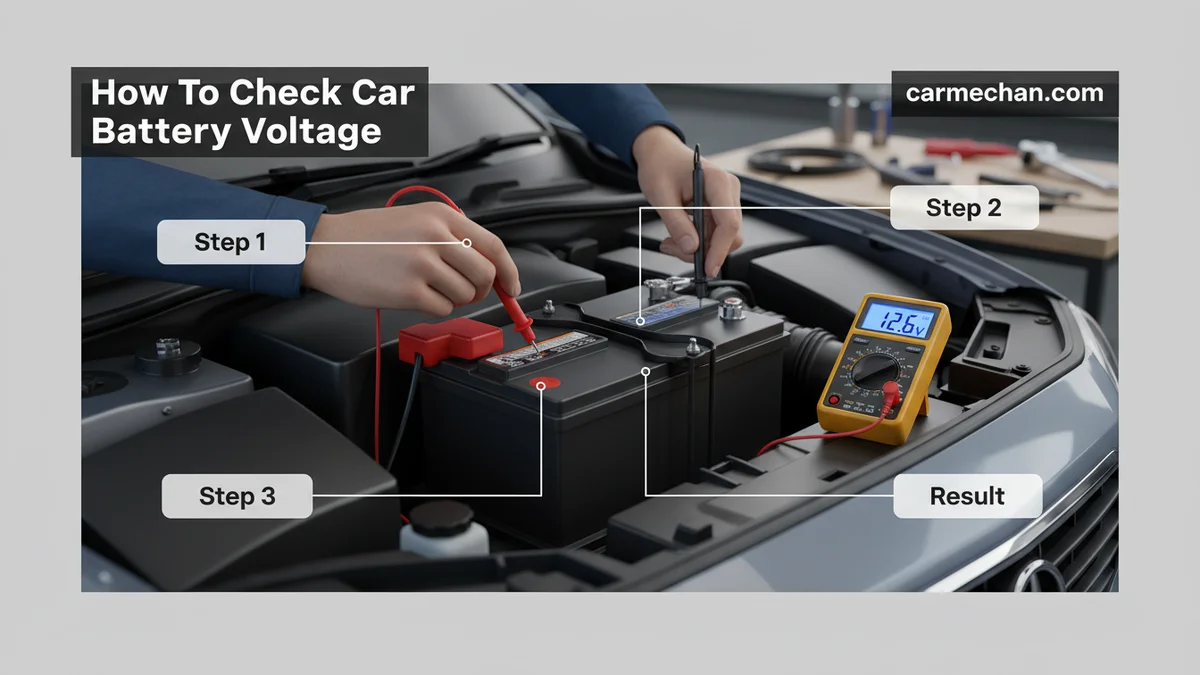
You can check your car battery voltage using a digital multimeter by connecting its probes to the battery terminals, ensuring the engine is off and the battery is at rest for accurate readings. This essential DIY diagnostic helps identify potential battery issues before they leave you stranded.
You can check your car battery voltage using a digital multimeter by connecting its probes to the battery terminals, ensuring the engine is off and the battery is at rest for accurate readings. This essential DIY diagnostic helps identify potential battery issues before they leave you stranded.
Understanding your car battery’s voltage is a fundamental step in proactive vehicle maintenance, potentially saving you from unexpected breakdowns and costly repairs in 2026. This guide will walk you through the process, from safety to interpreting your readings.
Key Takeaways:
- Always prioritize safety first when working with car batteries.
- A digital multimeter is the primary tool needed for accurate testing.
- Ensure the engine is off and the battery is rested for precise voltage readings.
- Voltage readings provide clear indications of your battery’s current health.
- Low voltage often signals a need for charging or eventual battery replacement.
Key Takeaways
- Always prioritize safety first
- A multimeter is the key tool
- Engine off, battery rested for accuracy
- Voltage readings indicate battery health
- Low voltage means charge or replace
3 Essential Safety Rules When Checking Car Battery Voltage
Working with car batteries requires careful attention to safety. Neglecting precautions can lead to serious injury from electrical shock, acid burns, or explosions. We emphasize these rules to protect you during the battery voltage check process. Prioritizing safety ensures a successful and risk-free diagnostic experience.

Gather Protective Gear
Always start by equipping yourself with the right personal protective equipment. Battery acid is corrosive, and electrical currents can be hazardous. This gear provides a critical barrier against potential harm.
- Safety glasses or goggles
- Chemical-resistant gloves (neoprene or nitrile)
- Long-sleeved shirt and pants
- Closed-toe shoes
Secure Your Workspace
Prepare the area around your vehicle before you begin any work. A clean, well-lit, and ventilated space minimizes risks. Ensure your car is on level ground with the parking brake engaged.
Remove any metal jewelry that could cause a short circuit. Keep bystanders and children at a safe distance from the engine bay. Avoid working in damp conditions to prevent electrical hazards.
Handle Battery Correctly
Car batteries generate explosive hydrogen gas, especially during charging. Never smoke or introduce open flames or sparks near the battery. Always avoid touching battery terminals with bare hands or metal objects. This prevents accidental shorts or burns. proper handling is paramount for your well-being.
With safety measures firmly in place, you are ready to prepare your tools for the accurate battery test.
How to Prepare Your Multimeter for Car Battery Test
The core tool for checking car battery voltage is a digital multimeter. This versatile device accurately measures electrical properties. Understanding its settings is crucial for obtaining precise readings. Proper setup ensures reliable results for your diagnostic needs.
Select Suitable Multimeter
While both analog and digital multimeters exist, a digital multimeter is highly recommended for battery testing due to its accuracy and ease of reading. Look for one that can measure DC (Direct Current) voltage. Most automotive stores and hardware shops carry affordable and reliable models. Ensure your multimeter has fresh batteries for optimal performance.
Configure Voltage Settings
Once you have your multimeter, you must set it correctly. This step is vital to avoid damage to the meter or inaccurate readings. Improper settings can render your results meaningless or even harm the device. Follow these steps carefully:
- Turn the multimeter’s dial to the DC Voltage setting, often marked with a “V” followed by a straight line and three dots above it (⎓) or simply “DCV”.
- Select a range appropriate for a 12-volt battery. This is typically the 20V DC range on most multimeters. Selecting a range too low could overload the meter, while too high might reduce precision.
- Insert the red probe into the port labeled “VΩmA” or “V” (for voltage).
- Insert the black probe into the port labeled “COM” (for common).
[VISUAL AID NEEDED: Image of a multimeter with the dial correctly set to DCV, ~20V range]
Ready Battery Terminals
Before connecting the multimeter, inspect your battery terminals. Corroded or dirty terminals can interfere with an accurate reading. Loose connections also impact electrical flow. Use a wire brush and a battery terminal cleaner to remove any buildup. Ensure connections are tight and free of debris.
A clean connection ensures the multimeter measures the battery’s true voltage. With your multimeter prepared and terminals clean, you are now ready to take the actual measurement.
How to Measure Car Battery Voltage in 4 Easy Steps
Measuring your car battery’s voltage is a straightforward process once safety precautions are observed and your multimeter is ready. This section details the steps to obtain an accurate reading. We recommend following these instructions precisely for the best results.

Ensure Battery Is at Rest
The most accurate battery voltage readings come from a battery at a “rest state.” This means the engine has been off for at least 3-4 hours, or ideally overnight. Turning off the engine allows the surface charge to dissipate, providing a true indication of the battery’s internal charge.
Avoid checking immediately after driving or charging the battery. The car hood should be open, allowing easy access to the battery. [VISUAL AID NEEDED: Image 1 showing engine off, hood open]
Attach Positive Lead
With the battery rested and your multimeter set to 20V DC, carefully attach the red (positive) lead from your multimeter. Locate the positive battery terminal, which is usually larger and marked with a plus (+) symbol. Connect the red probe firmly to this terminal. Ensure it makes good metal-to-metal contact.
This establishes the positive side of your circuit. [VISUAL AID NEEDED: Image 2 showing red multimeter probe connecting to positive battery terminal]
Connect Negative Lead


Next, connect the black (negative) lead from your multimeter. Find the negative battery terminal, which is typically smaller and marked with a minus (-) symbol. Attach the black probe firmly to this terminal, again ensuring good metal contact. You have now completed the circuit. The multimeter should display a reading.
[VISUAL AID NEEDED: Image 3 showing black multimeter probe connecting to negative battery terminal]
Read Voltage Display
Observe the number displayed on your multimeter screen. This numerical value represents your car battery’s resting voltage. Make a note of this reading for future reference. A stable reading indicates a successful measurement. If the display shows “OL” or “1.”, recheck your settings and connections.
The reading you see is the critical data point for diagnosing your battery’s health. [VISUAL AID NEEDED: Image 4 showing multimeter display with a voltage reading] Once you have this reading, the next step is to understand what it means for your vehicle.
What Do Your Car Battery Voltage Readings Mean
Simply getting a voltage reading is only half the task; interpreting it correctly is where the real diagnostic power lies. Understanding these numbers helps you determine your battery’s health and what actions might be necessary. Different readings indicate various states of charge and potential issues.
Understand Resting Voltage
A car battery’s resting voltage, measured after it has been off for several hours, is the primary indicator of its state of charge. A fully charged, healthy 12-volt car battery should read 12.6 volts or higher. Readings slightly below this might indicate a partially discharged battery.
Refer to the chart below for a detailed breakdown. This initial check is fundamental to assessing overall battery condition.
Interpret Low Readings
If your multimeter displays a reading below 12.4 volts after resting, your battery is likely undercharged. A reading around 12.0 volts suggests the battery is only about 25% charged, while anything below 12.0 volts indicates a deeply discharged or potentially dead battery. Consistent low readings point to either a charging system issue or a battery that is nearing the end of its life.
This requires immediate attention to prevent breakdowns.
Assess Cranking Voltage
Beyond resting voltage, you can perform a cranking voltage test, though it requires an assistant. While cranking the engine, ask your assistant to read the multimeter. During cranking, the voltage should not drop below 9.6 volts. A significant drop below this threshold, particularly to 9.0 volts or lower, often indicates a weak battery struggling to deliver enough current to start the engine.
This test assesses the battery’s ability to handle a load. [INTERNAL LINK: How to Conduct Advanced Car Battery Tests]
Verify Charging System
Once your engine is running, your car’s alternator takes over, charging the battery and powering electrical components. With the engine idling, place your multimeter probes on the battery terminals again. The reading should typically be between 13.8 and 14.7 volts. A reading outside this range might signal an issue with your alternator or voltage regulator.
If the voltage is too low, the battery isn’t getting charged; if too high, it could overcharge and damage the battery. Understanding these interpretations empowers you to decide on the next course of action for your car battery.
When to Charge or Replace Your Car Battery
After checking your car battery voltage and interpreting the readings, you will likely face one of two main scenarios: either your battery needs a charge, or it’s time for a replacement. Making the right decision can extend your battery’s life or prevent future car troubles. We guide you through these crucial choices.
Consider Battery Recharging
If your resting voltage is between 12.0 and 12.4 volts, a good charge might restore it to full health. Use a quality battery charger, following its instructions carefully. Slow charging over several hours is generally better for the battery than a quick boost. After charging, allow the battery to rest for a few hours and recheck the voltage.
If it holds above 12.6 volts, your battery is likely fine for now. [INTERNAL LINK: Guide to Safely Charging Your Car Battery]
Identify Replacement Signs
Several indicators suggest a battery needs replacement, even if it holds a charge temporarily. If your battery repeatedly drains, struggles to hold a charge after recharging, or drops significantly below 9.6 volts during cranking, it is likely failing. Other signs include:
- Slow engine cranking or clicking sounds when starting.
- Dim headlights or dashboard lights when starting.
- Corrosion buildup on terminals that returns quickly.
- A swollen or cracked battery case.
- The battery is over 3-5 years old.
If you observe these symptoms, especially combined with low voltage readings, replacement is the most prudent action. Ignoring these signs can leave you stranded.
Seek Professional Assessment
Sometimes, the diagnosis isn’t clear-cut, or you might prefer a professional opinion. If you are unsure about your readings or if your car exhibits unusual electrical behavior despite a seemingly healthy battery, consult a certified mechanic. They have specialized tools, like load testers, that can provide a more comprehensive battery and charging system diagnosis.
A professional can also correctly dispose of old batteries. Trusting experts ensures your car’s electrical system is in top condition. This completes your diagnostic journey, leading you to an appropriate solution for your battery’s health.
Frequently Asked Questions
What Is a Good Car Battery Voltage Range?


A healthy, fully charged car battery should measure 12.6 volts or higher when at rest. With the engine running, a good alternator should maintain a voltage between 13.8 and 14.7 volts. Readings outside these ranges indicate potential issues needing attention or further diagnosis.
How Often Should I Check My Car Battery Voltage?
You should check your car battery voltage at least twice a year, ideally before winter and summer, when extreme temperatures stress the battery. More frequent checks are wise if you notice slow cranking, have an older battery, or experience regular short trips. This proactive approach helps prevent unexpected failures.
Can a Car Battery Show Good Voltage but Still Be Bad?
Yes, a car battery can sometimes show good resting voltage but still be faulty. This often occurs if the battery has a high internal resistance or can’t deliver sufficient current under load. A load test performed by a mechanic is required to confirm if a battery is truly failing despite showing adequate voltage.
What Tools Do I Need to Check Car Battery Voltage?
To accurately check your car battery voltage, you primarily need a digital multimeter. Additionally, safety glasses, chemical-resistant gloves, and a wire brush for cleaning battery terminals are highly recommended. These tools ensure both precision in testing and your personal safety during the process.
What Does a Car Battery Voltage of 11.5 Volts Indicate?
A car battery voltage of 11.5 volts indicates a deeply discharged battery, likely nearing a completely drained state. At this level, your battery is probably unable to start your car. It requires immediate charging and further investigation into why it became so low. This reading suggests a significant problem.
Final Thoughts on Your Car Battery Check
Checking your car battery voltage is a vital skill for any car owner. You now possess the knowledge to safely perform this diagnostic task using a multimeter, interpret the readings, and decide on the appropriate next steps. Empowering yourself with this maintenance expertise means you are better prepared to address potential issues before they escalate.
Regular checks can significantly extend your battery’s lifespan and contribute to the overall reliability of your vehicle in 2026 and beyond. Stay safe, stay informed, and keep your car running smoothly.