Ford F-150 TPMS Reset Button Location and Relearn Guide
Last Updated on June 24, 2026 by Albert Duke
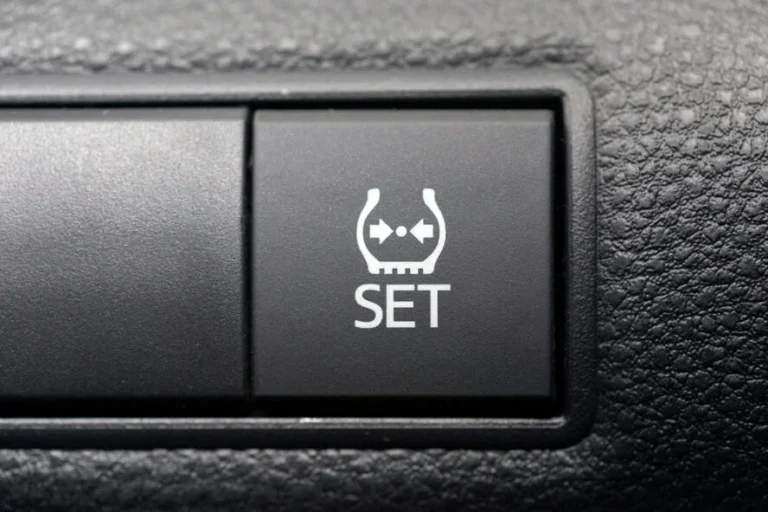
The Ford F-150 TPMS reset button location is not always a physical button under the dash. On many F-150 trucks, TPMS reset mode starts through a sequence, menu, or relearn procedure instead of a dedicated reset button.
TPMS means Tire Pressure Monitoring System. It watches tire pressure through sensors mounted at the wheels and warns you when pressure is low or when a sensor fault is detected.
The right fix depends on what happened before the warning appeared. Low pressure, tire rotation, new sensors, and a “Tire Pressure Sensor Fault” message do not all need the same reset. The first step is knowing whether your F-150 actually has a reset button or uses a relearn procedure instead.
Where Is the Ford F-150 TPMS Reset Button


Start your search under the driver-side dash, but do not assume your F-150 has a dedicated TPMS reset button. Many generic Ford TPMS guides say the reset button is below the steering wheel, near the lower dashboard, or around the fuse panel.
That advice can mislead F-150 owners because many model years use a reset or relearn sequence instead. Ford’s official reset procedure for later F-150 manuals describes turning the ignition on, then switching the hazard flashers on and off three times within 10 seconds to enter reset mode.
If you still want to check for a physical button, inspect these areas first:
- Under the steering wheel near the lower dash panel
- Around the driver-side fuse panel cover
- Near the parking brake or lower kick panel area
- Inside the instrument cluster settings menu, if your model supports menu-based tire settings
For most 2015 and newer F-150 owners, the practical answer is this: do not waste time looking for a labeled TPMS reset button if your owner’s manual gives a relearn sequence. Use the manual procedure for your exact model year.
Once you know where to check, the next question is which reset method matches your warning.
What Type of TPMS Reset Does Your F-150 Need

The right reset method depends on why the TPMS light came on. A simple low-pressure warning is different from a sensor relearn after tire rotation.
Low Tire Pressure Warning
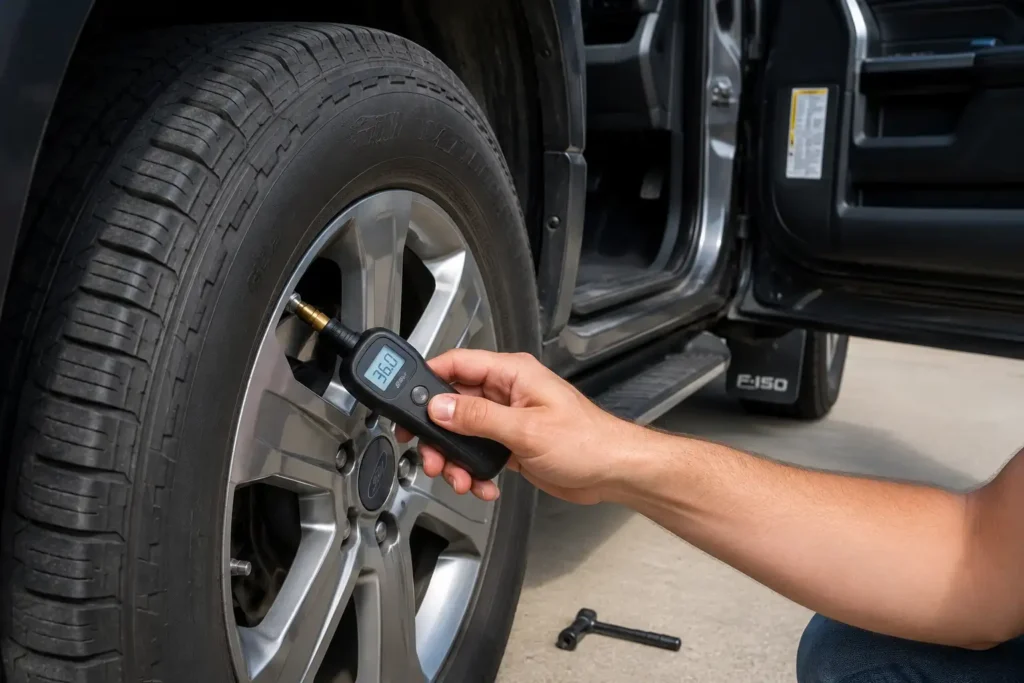
If the TPMS light came on after a cold morning or a slow leak, check tire pressure first. Inflate all tires to the pressure shown on the driver-door placard, not the maximum pressure printed on the tire sidewall.
A good tire gauge matters here. If your readings are inconsistent, check our guide to the best tire pressure gauge before chasing a reset problem that may only be a pressure reading problem.
After correcting the pressure, drive the truck and give the system time to update. If the sensors are healthy, no manual relearn may be needed.
Tire Rotation or Wheel Swap
If the light appeared after rotating tires or changing wheels, the truck may need to relearn which sensor is at each corner. Ford’s official reset procedure uses training mode so the truck can identify the tire sensors in sequence.
Some F-150 owners report that certain 2017 to 2019 trucks relearn after driving several miles, especially after a simple rotation. Treat that as owner-reported behavior, not a universal rule for every year and trim.
New TPMS Sensor Installed
A new TPMS sensor usually needs to be trained to the truck. If the sensor is not activated, the F-150 may not receive a pressure signal from that wheel.
Compatibility matters. Ford F-150 sensors can vary by year, frequency, and sensor type, so a cheap aftermarket sensor can still fail if it does not match your truck.
Tire Pressure Sensor Fault Message
A “Tire Pressure Sensor Fault” message is not the same as a low tire pressure light. It usually means the truck is not receiving a valid signal from one or more sensors.
A reset will not fix a dead sensor battery, an incompatible sensor, or a module communication problem. After the warning type is clear, the safest next step is the official Ford relearn procedure.
How To Enter Ford F-150 TPMS Reset Mode
On many Ford F-150 trucks, reset mode starts with a sequence, not a button. Ford’s official owner manual procedure says to drive the vehicle above 20 mph for at least two minutes, park safely, switch the ignition off, then switch the ignition on without starting the engine.
Use this process when your model year manual matches the Ford hazard-flasher reset procedure:
- Park in a safe place where you can reach all four tires.
- Make sure all tires are inflated to the pressure on the driver-door placard.
- Drive above 20 mph for at least two minutes.
- Park the truck and switch the ignition off.
- Switch the ignition on without starting the engine.
- Turn the hazard flashers on and off three times within 10 seconds.
- Listen for the horn and watch for the system indicator or training message.
- Begin training each tire sensor if the truck confirms reset mode.
Ford’s official manual page for resetting the Tire Pressure Monitoring System says the hazard flasher sequence must be completed within 10 seconds.
Older F-150 procedures may use a brake pedal and ignition cycle sequence instead. If your truck does not enter training mode with the hazard method, check the owner’s manual for your exact year before repeating random reset steps.
If your truck enters training mode, the next part is teaching it each tire sensor in the correct order.
How To Relearn F-150 Tire Sensors After Rotation
Training mode tells the truck which sensor belongs to each tire position. This matters after rotating tires because the truck may still think the old front-left sensor is at the front-left corner.
Ford’s relearn procedure commonly follows this order:
- Left front tire
- Right front tire
- Right rear tire
- Left rear tire
The truck should confirm each trained sensor with a horn chirp. Ford’s manual also warns not to wait more than two minutes between sensors, or the system can time out and force you to restart the full process.
There are two common ways to trigger each sensor. One method is to release air from the tire until the sensor transmits. The cleaner method is to use a TPMS activation tool at the sidewall near the valve stem.
Do not over-deflate the tire. If you use the air-release method, keep an accurate gauge nearby and reinflate each tire to the door-placard pressure after the relearn is complete.
But if the truck never responds to one wheel, the issue is probably not the reset sequence.
When You Need a TPMS Tool for an F-150
A TPMS reset button cannot activate a dead or incompatible sensor. If one wheel will not train, a tool helps you confirm whether the sensor is transmitting.
You may need a TPMS activation or training tool when:
- You installed new TPMS sensors
- You changed to aftermarket wheels
- You installed winter wheels
- One tire does not chirp during relearn
- The warning returns after a successful relearn
- The truck shows “Tire Pressure Sensor Fault”
Ford-specific TPMS training tools are sold through parts retailers and online marketplaces, but compatibility must be checked by year. For example, some aftermarket listings describe Ford-compatible training tools, but you should verify your F-150 year before buying or using one.
If you do not want to buy a tool, a tire shop can usually perform the relearn. RepairPal lists the average Ford F-150 TPMS relearn cost between $49 and $72, before taxes, fees, and location differences.
The tool question also explains why some F-150 owners still see the warning after trying every reset method.
Why the TPMS Light Stays On After Reset
If the TPMS light comes back, the truck is telling you the reset did not solve the root cause. The reset process only helps when the sensors are healthy and the tire pressures are correct.
Tire Pressure Still Low
Check all four tires when cold. Tire pressure rises after driving, so a warm reading can hide a low cold-pressure condition.
Set the pressure to the driver-door placard. Do not use the pressure printed on the tire sidewall as your normal setting because that number is usually the tire’s maximum pressure rating.
Sensor Battery Failed
Direct TPMS sensors use small sealed batteries inside the sensor body. REDI-Sensor explains that TPMS sensor batteries are sealed inside the housing and typically last 5 to 10 years, depending on sensor type and vehicle use.
When the battery dies, the sensor usually needs replacement. You cannot fix that with a reset sequence.
Wrong Sensor Installed
If a used wheel set or aftermarket sensor does not match your F-150, relearn may fail. The truck needs a compatible sensor signal before it can store that wheel position.
This is common after winter wheel swaps and used takeoff wheel purchases. A TPMS tool or tire shop scan can confirm whether each sensor is waking up and transmitting.
System Fault Needs Diagnosis
A persistent “Tire Pressure Sensor Fault” message may need scan-tool diagnosis. The issue can be a dead sensor, missing sensor ID, incompatible sensor, or less commonly a receiver or module problem.
If other dashboard warnings are also confusing you, our Ford F-150 check engine light reset guide explains why clearing a warning is different from fixing the problem behind it.
With the causes narrowed down, a quick decision table makes the next step easier.
Quick Decision Guide for F-150 TPMS Reset
Use this table if you only need the next best move for your F-150. The “reset button” answer changes because most F-150 cases involve a sequence, relearn mode, or sensor diagnosis instead of a dedicated button.
Ford F-150 TPMS Reset Decision Guide
Match the warning to the situation before looking for a reset button. Most F-150 TPMS fixes use pressure correction, relearn mode, or sensor diagnosis.
Light Came On After Cold Weather
The tire pressure is likely below the driver-door placard setting.
Light Came On After Tire Rotation
The truck may need to relearn which sensor belongs to each wheel position.
Light Came On After New Tires
A new or disturbed sensor may not be trained to the truck yet.
Warning Started After Wheel Swap
The wheels may have missing, wrong, or incompatible TPMS sensors.
Tire Pressure Sensor Fault Message
The truck is not receiving a valid signal from one or more sensors.
One Tire Will Not Train
The sensor may be dead, asleep, incompatible, or missing from that wheel.
| Situation | Likely Cause | Reset Button Needed | Best Next Step |
|---|---|---|---|
| TPMS light after cold weather | Tire pressure dropped | No | Inflate tires to door-placard pressure and drive |
| TPMS light after tire rotation | Sensor positions may need relearn | Usually no | Use Ford relearn mode or drive if your year self-learns |
| TPMS light after new tires | Sensor disturbed or not trained | No | Train sensors in the correct order |
| TPMS light after new wheels | Sensor mismatch or missing sensor | No | Verify sensor compatibility with a TPMS tool |
| Tire Pressure Sensor Fault | Sensor signal problem | No | Scan or test each sensor |
| One tire will not train | Dead or incompatible sensor | No | Replace or activate the sensor |
If your case still does not fit, the FAQ covers the edge cases owners ask most often.
What To Do Next With Your F-150 TPMS Light
The best next step is to match the reset method to the warning you see. The Ford F-150 TPMS reset button location is often not a physical button, especially on newer trucks that use relearn mode.
Start with tire pressure. Then use the official Ford reset or training procedure for your exact model year. If the warning returns, stop repeating the reset and test the sensors.
For most owners, the correct path is simple: pressure check first, relearn second, sensor diagnosis third.
FAQ
Does a Ford F-150 Have a TPMS Reset Button
Some Ford reset guides mention a TPMS reset button, but many F-150 model years use a sequence or relearn mode instead. Check your exact owner’s manual before assuming there is a physical button under the dash.
Where Is the TPMS Reset Button on a 2015 Ford F-150
A 2015 Ford F-150 commonly uses a TPMS training procedure rather than a simple labeled reset button. Owner forum discussions for 2015 F-150 trucks reference the hazard flasher training method, where the truck confirms training mode with a horn chirp.
How Do I Reset the TPMS Light on a Ford F-150 After Inflating Tires
Inflate all tires to the driver-door placard pressure, then drive the truck and see if the system updates. If the warning remains, follow the Ford relearn procedure for your model year instead of pressing random dash buttons.
Do I Need a TPMS Tool After Rotating F-150 Tires
You may not need a TPMS tool after a simple rotation if your truck self-updates tire positions. You may need one if training mode starts but one tire will not chirp, or if you changed sensors or wheels.
Why Does My Ford F-150 Say Tire Pressure Sensor Fault
“Tire Pressure Sensor Fault” usually means the truck is not receiving a correct signal from one or more TPMS sensors. Common causes include a dead sensor battery, incompatible replacement sensor, missing sensor ID, or failed relearn.
Can I Drive With the TPMS Light On in My F-150
You can usually drive carefully with the TPMS light on, but you should manually check tire pressure first. Low tire pressure can affect handling, tire wear, and safety, so do not ignore the warning just because the truck still drives normally.