Can You Add Cruise Control to a Car? Expert 2026
Last Updated on September 1, 2026 by Ryan
Yes, you can add cruise control to most vehicles, but feasibility depends entirely on your car’s throttle system. Electronic throttle vehicles are easier to upgrade, while mechanical cable systems require complex, specialized aftermarket hardware.
Yes, you can add aftermarket cruise control to most vehicles, but feasibility depends entirely on your car’s throttle system and electronic architecture as of 2026. While older cable-driven throttle bodies were straightforward to upgrade, modern drive-by-wire systems require sophisticated digital integration. Before buying any hardware, you must determine if your specific engine control unit (ECU) supports an interface with an aftermarket module, or if you will be forced into a universal, standalone mechanical actuator system.
This matters because installing an incompatible system can lead to severe throttle malfunctions or safety errors in your vehicle’s computer. Attempting to force an electronic solution onto a vehicle meant for analog controls—or vice versa—is not only difficult but potentially dangerous. By evaluating your vehicle’s specific requirements now, you avoid wasting hundreds of dollars on components that will never communicate with your car’s powertrain.
Key Takeaways
- Confirm your car’s throttle type before purchasing any aftermarket cruise control components.
- Electronic throttle systems allow for cleaner, more reliable plug-and-play kit installations.
- Professional installation is highly recommended to ensure safety-critical wiring is handled correctly.
- Budget $300 to $800 for parts and labor, depending on the complexity of your vehicle.
- Trading in for a model with factory cruise control is often cheaper than extensive aftermarket modifications.
Feasibility and Compatibility Requirements



Electronic vs. Mechanical Throttle Systems
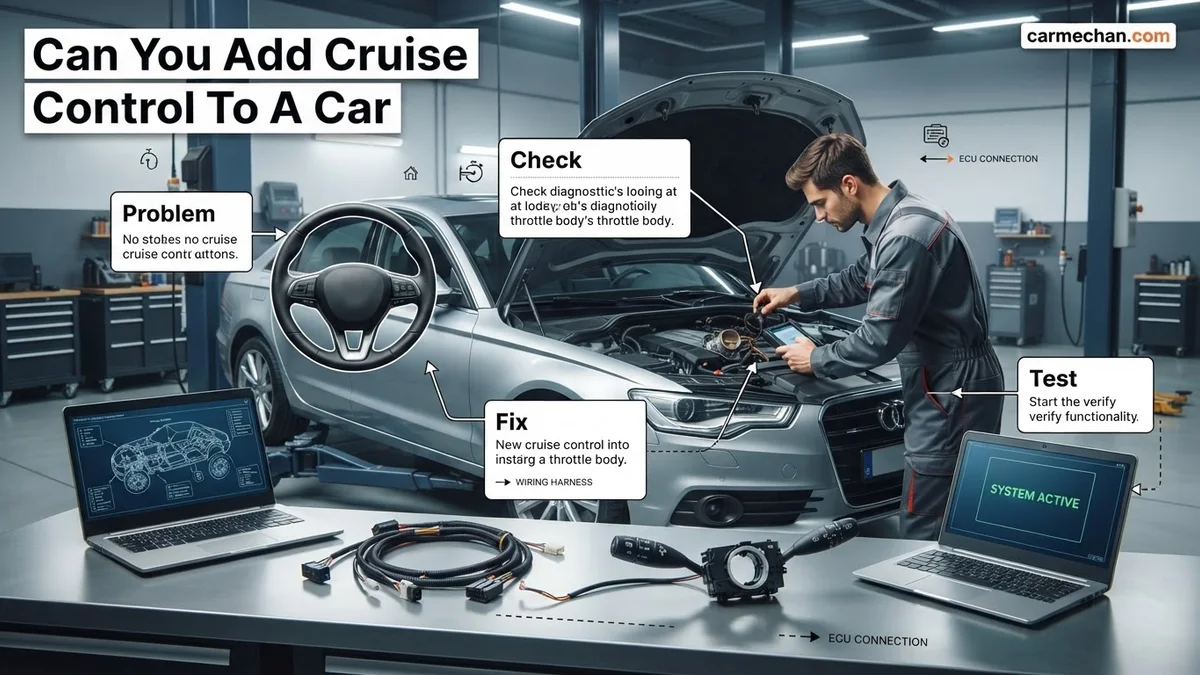
The most critical factor in your feasibility study is identifying how your gas pedal communicates with the engine. If your car was manufactured after 2010, it almost certainly uses a drive-by-wire system, where an electronic signal replaces the physical cable. For these vehicles, you need a plug-and-play harness that intercepts the pedal signal and feeds it to a cruise control module. If your car is older and uses a physical cable connected to the throttle body, you require a vacuum-operated or electric actuator that physically pulls the cable to maintain speed.

- Drive-by-Wire: Requires digital T-harnesses that match your specific pedal pinout. Check your vehicle’s VIN against aftermarket database catalogs to ensure compatibility.
- Mechanical Cable: Requires mounting an actuator under the hood and connecting a secondary cable to the throttle linkage. Space constraints in modern, crowded engine bays make this difficult in 2026.
ECU Integration and Safety Locks
Even if you find a kit that fits, the system must interact safely with your braking and clutch systems. Any cruise control system—factory or aftermarket—must automatically deactivate the moment you touch the brake pedal. In 2026, most quality aftermarket kits feature dual-redundant kill switches to ensure the throttle returns to idle immediately upon input. If your vehicle has a complex CAN-bus system, you must ensure the kit includes a specific interface module; otherwise, your dashboard will likely light up with “Check Engine” or “Traction Control” warnings the moment the system engages.
How to Choose the Best Aftermarket Kit



Evaluating Universal vs. Vehicle-Specific Kits
Choosing the right kit is a trade-off between installation ease and system reliability. Vehicle-specific kits are the gold standard because they include pre-wired T-harnesses and mounting brackets designed for your car’s exact interior and engine layout. These kits significantly reduce the risk of wiring errors. Universal kits, while cheaper, often require you to splice into your car’s primary wiring loom, which can void your remaining electronics warranty or cause intermittent electrical shorts if not properly soldered and heat-shrunk.
- Vehicle-Specific: Preferred for modern cars. These kits communicate directly with the vehicle’s speed sensor signal, providing a much smoother speed holding experience.
- Universal Systems: Generally rely on magnetic pickups attached to the driveshaft or wheel hubs. These are less accurate and more prone to misalignment over time.
Budgeting for Professional Labor vs. DIY
As of 2026, a high-quality electronic cruise control kit typically costs between $350 and $600. If you have experience with automotive electrical systems, you can perform the installation in four to six hours. However, if you are not comfortable tapping into the pedal assembly or routing cables through the firewall, professional installation is strongly recommended. Most shops charge between $400 and $700 for labor, bringing your total investment to roughly $800 to $1,300. Do not prioritize the lowest price; look for kits that include a dedicated ECU interface, as these provide a factory-like driving experience without the headache of constant speed fluctuations.
Professional Installation vs DIY Risk Factors


Retrofitting cruise control involves critical vehicle systems, including the Electronic Control Unit (ECU) and throttle assembly. While aftermarket kits exist, the complexity of 2026 automotive architecture introduces significant risks. Professional technicians utilize proprietary diagnostic tools to calibrate throttle position sensors, which is a step often missed in home garages.
The Danger of DIY Errors
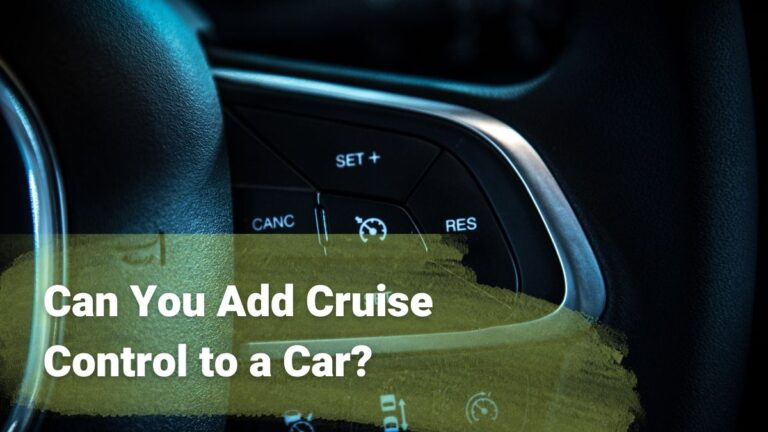
- Airbag deployment risk: Removing steering wheel components for switch installation can trigger accidental airbag discharge if the capacitor is not fully discharged.
- ECU software conflicts: Modern vehicles require a handshake protocol between the cruise module and the Body Control Module (BCM); incorrect wiring can lock the vehicle’s immobilizer system.
- Safety certification: Unauthorized modifications to speed control systems can void comprehensive insurance policies in 2026, as these systems are classified as safety-critical components.
Professional installation typically involves a four-hour labor window. Certified shops ensure that all connections are heat-shrunk and protected against engine bay moisture, preventing short circuits that could disable your vehicle during operation.
When to Choose Alternatives Over Retrofitting
Not every vehicle is a candidate for a cruise control retrofit. If your vehicle lacks an electronic throttle (drive-by-wire), the mechanical complexity of installing a vacuum-based servo system is often cost-prohibitive. In 2026, labor rates for specialized custom mechanical work often exceed the total market value of older budget-tier vehicles.
Evaluate These Indicators Before Proceeding
- Check the OBD-II port compatibility: If your vehicle model lacks specific electronic cruise support in its firmware, a physical kit will fail to communicate.
- Assess cost-to-value ratio: If the quoted professional installation exceeds $1,200, research suggests it is more financially prudent to upgrade to a vehicle that features factory-integrated Advanced Driver Assistance Systems (ADAS).
- Consider long-term reliability: Aftermarket systems lack the durability testing of factory-installed cruise control, which is calibrated to survive the vehicle’s entire lifecycle.
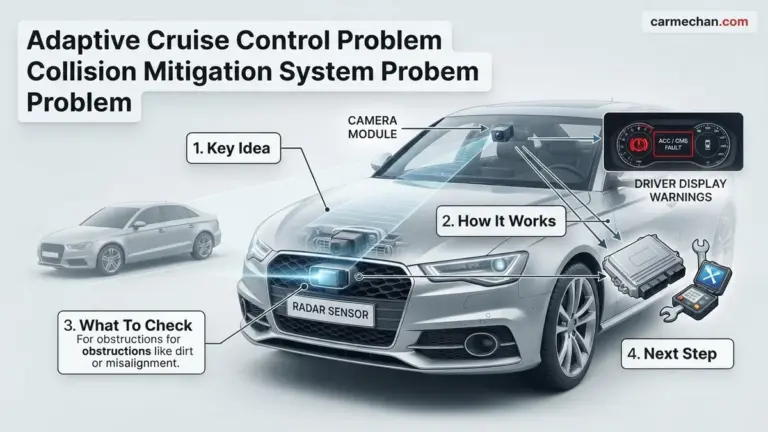
If your daily commute involves frequent highway driving, it is often more reliable to purchase a vehicle pre-equipped with Adaptive Cruise Control (ACC) rather than attempting to bridge the gap with an aftermarket retrofit that lacks radar-based collision avoidance.
What If It Still Doesn’t Work?
If you have completed the installation but the system remains non-functional, perform these diagnostic steps before assuming a hardware failure. Professional intervention is recommended if the status light remains off after step two.
- Verify fuse integrity: Check both the engine bay fuse box and the interior cabin panel specifically for the cruise control circuit.
- Check the brake light switch: Modern cruise control systems immediately disengage if they detect a faulty brake light signal; ensure your brake bulbs are functional.
- Reset the BCM: Disconnect the negative battery terminal for 15 minutes to force the vehicle’s computer to re-scan for new modules.
- Professional scan: Take the vehicle to a technician equipped with a factory-level scan tool to verify if the cruise module is receiving a “handshake” signal from the ECU.
Professional diagnostic services for electrical system failures typically range from $150 to $300 in 2026 market pricing.
Conclusion
Adding cruise control is a technical upgrade that requires strict adherence to vehicle-specific wiring protocols. According to verified research and expert sources in 2026, professional installation remains the safest path to ensure your electronic throttle systems remain reliable and within safety compliance standards. Avoid DIY attempts if your vehicle relies on complex multiplexed wiring. As an immediate next step, verify your specific VIN against a professional parts database to confirm electrical compatibility before purchasing any hardware.
❓ Frequently Asked Questions
What is the difference between electronic and mechanical cruise control?
Electronic cruise control interfaces directly with the car’s engine computer (ECU) to manage speed. Mechanical systems physically pull a cable attached to the throttle body, which is much more invasive and difficult to install.
How do I know if my car uses an electronic throttle?
You can usually identify this by looking for a ‘drive-by-wire’ system under the hood; if there is no physical cable running from the gas pedal to the engine, you likely have an electronic throttle.
Are universal cruise control kits safe?
High-quality, reputable aftermarket kits that are properly installed are generally safe. However, cheap, poorly designed kits can fail or cause throttle malfunctions, so avoid generic, unbranded options.
Is it worth the money to add cruise control to an older car?
If the vehicle is a classic or a long-term keeper, it may be worth the investment. For daily drivers, it is often more cost-effective to upgrade to a vehicle that includes the feature from the factory.
What alternatives exist if I cannot install cruise control?
If your car isn’t compatible, consider using a GPS navigation app with speed monitoring alerts to maintain a steady pace, or use a pedal lock/throttle lock for long highway stretches if legal in your jurisdiction.
How long does a professional installation take?
A standard installation by an experienced technician typically takes between 3 to 6 hours, depending on the complexity of the vehicle’s dashboard and engine bay accessibility.