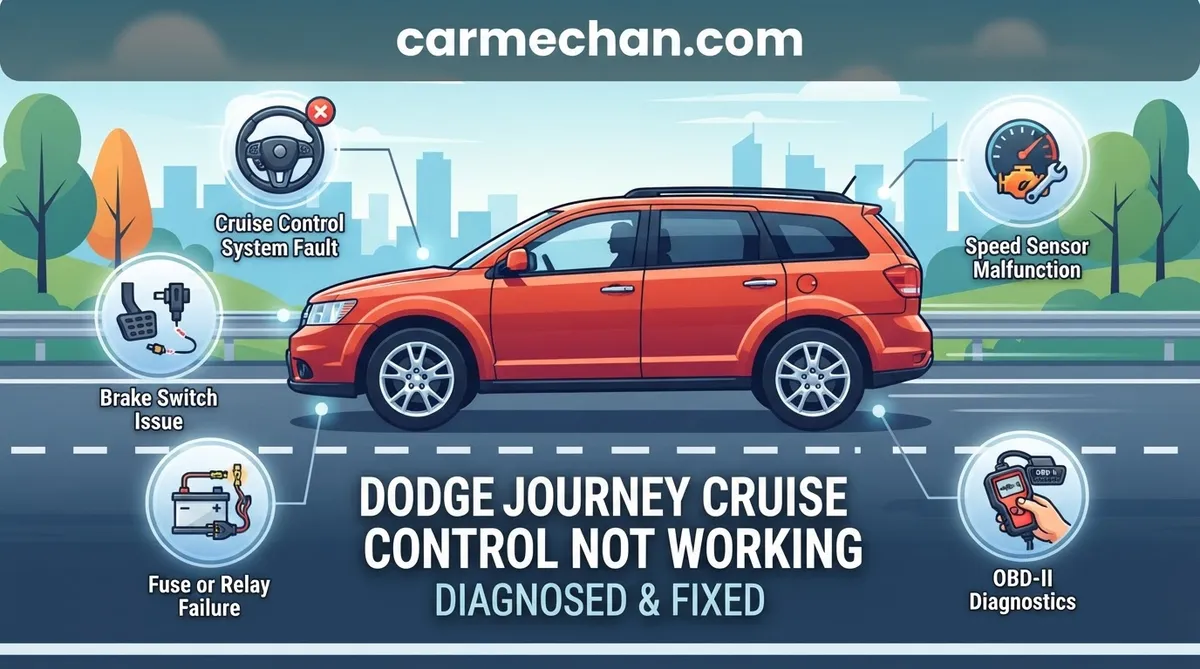
Dodge Journey Cruise Control Not Working: Diagnosed & Fixed
Nothing ruins a highway road trip faster than a cruise control system that refuses to engage. Many Dodge Journey owners face the frustration of pressing the ‘Set’ button only to receive no feedback or an immediate system drop-out. In this guide, we break down the most common culprits for Dodge Journey cruise control failure, from simple fuse replacements to advanced sensor diagnostics, so you can get back to stress-free cruising.
Primary Causes of Dodge Journey Cruise Control Not Working
Recommended Best Deal Products


Modern vehicle systems, particularly the Dodge Journey, rely on an integrated network of sensors to manage speed. The cruise control system is not a standalone component; it is a software-driven function residing within the Powertrain Control Module (PCM). Because it governs vehicle speed, the system is hard-coded with safety interlocks that disable functionality the moment a fault is detected in critical peripheral systems.
📤 Share Image

The Role of ABS and Check Engine Warning Lights
If your dashboard displays a Check Engine light or an ABS warning, your cruise control will almost certainly be disabled. The PCM requires a clean bill of health from the engine and braking systems to maintain speed safely. For example, if you have a failing ABS sensor, the vehicle loses its ability to calculate precise wheel speed. Rather than allowing an erratic cruise control system to surge, the computer kills the function entirely.

How Faulty Wheel Speed Sensors Disrupt Speed Logic
The Dodge Journey utilizes wheel speed sensors to verify that the vehicle is actually moving and to monitor for traction loss. If one sensor reports a signal that deviates from the others, the system flags it as a discrepancy. Even a minor electrical resistance change in an ABS sensor can cause the system to inhibit the cruise function, leaving the driver unable to engage the ‘Set’ feature.

Understanding PCM and CAN Bus Communication Errors
All internal modules, including the PCM, Body Control Module (BCM), and Transmission Control Module (TCM), communicate via a Controller Area Network (CAN) bus. If there is a communication break—often caused by frayed wiring or a failing module—the cruise control switch signals may never reach the engine controller. This “silent” failure is often diagnosed only through deep-scan OBD-II tools that can read manufacturer-specific codes.
Industry Data
Inhibition Rate during active ABS/Check Engine faults
Percentage of cruise failures linked to brake switch/fuses
Quick Fixes: Troubleshooting Your Cruise Control Electrical Circuit
Before assuming a mechanical failure, you must eliminate the common electrical offenders. The Dodge Journey’s electrical architecture is susceptible to blown fuses and switch fatigue, which are far easier to resolve than sensor replacements.
📋
Troubleshooting Procedure
Recommended Best Deal Products


Access the fuse box under the hood. Locate the fuse designated for “Speed Control” or “Cruise.” Use a test light or multimeter to check for continuity across the pins. A blown fuse here is often a sign of a short circuit in the steering wheel harness.
The cruise control system is hard-wired to disengage the moment the brake pedal is depressed. If the brake light switch is faulty or stuck in the “pressed” position, the PCM believes you are actively braking and will not allow cruise activation.
Constant use wears out the tactile contacts inside the steering wheel switches. If the buttons feel “mushy” or require excessive pressure, the internal contact point may be oxidized or worn, resulting in an open circuit.
Advanced Diagnosis for Dodge Journey Cruise Control Failures
When basic checks fail to identify the cause, we move into diagnostic territory involving serial data and internal component feedback. This requires an OBD-II scanner capable of reading enhanced codes beyond standard emission faults.
Clock Spring Continuity Testing Methods
The clock spring is a ribbon-cable assembly inside the steering column that allows electrical signals to pass from the steering wheel buttons to the vehicle wiring while the wheel turns. Physical damage or internal breakage in this component is a frequent cause of intermittent cruise control. Use a digital multimeter to check for continuity from the steering column connector to the cruise switch harness.
Using OBD-II Diagnostic Trouble Codes (DTC)
Advanced scanners can pull codes that indicate exactly where the signal is lost. Look for “P” codes related to the Throttle Position (TPS) or Vehicle Speed Sensor (VSS). A code like P0500 indicates a generic speed sensor fault, which is a definitive indicator of why the cruise control is inhibited. If the scanner shows live data for the TPS, ensure the percentage changes smoothly as you press the pedal; a “stuttering” sensor signal will cause the PCM to dump the cruise command.
Inspecting Throttle Body Position Sensor Feedback
The Dodge Journey uses Electronic Throttle Control (ETC). If the throttle body is dirty or the position sensor is failing to return accurate data, the PCM will not grant the system authority to govern speed. Carbon buildup can restrict the butterfly valve, preventing the fine-tuned adjustments needed for smooth cruise control operation.
Never attempt to service the airbag or steering wheel assembly without first disconnecting the battery and waiting at least 15 minutes for the SRS system to discharge. Accidental deployment can cause severe injury.
How to Properly Reset the Dodge Journey Cruise Control System
Recommended Best Deal Products


Often, a temporary glitch in the BCM or PCM can be cleared by performing a power-cycle reset. However, it is essential to understand that this does not fix hardware failures; it only clears “latched” error states.
- The Hard Reset: Disconnect the negative battery terminal for 10 minutes. This forces the modules to perform a cold boot upon reconnection. After reconnecting, you must complete a “drive cycle”—driving at various speeds for 15-20 minutes—to allow the modules to re-sync their data inputs.
- OBD-II Reset: If you own a scan tool, use the “Clear All Codes” function. This is more effective than a battery pull, as it specifically instructs the modules to drop any active fault flags in memory.
- Component Replacement: If the issue persists immediately after a reset, you are likely looking at a failing clock spring or a faulty brake switch, both of which require physical hardware replacement rather than software intervention.
- Warning Lights: If an ESP or ABS light persists after a reset, you must address those sensors first. The cruise control system will continue to be locked out until those specific trouble codes are permanently cleared.
✅ When to DIY
- Blown or corroded fuses
- Obvious wiring damage
- Dirty throttle body
- Brake switch replacement
❌ Leave to Pro
- Clock spring installation
- PCM reprogramming/flashing
- Complex CAN bus shorts
- Internal transmission sensor faults
Diagnosing a Dodge Journey cruise control failure requires a systematic approach. Start by addressing any active dashboard warning lights, as these are the most common inhibitors. If the dash is clear, verify your brake light switch and fuses, as these are frequent, low-cost failure points. If the system remains unresponsive, use a high-quality OBD-II scanner to pinpoint communication errors or sensor discrepancies. By methodically narrowing down the variables, you can restore your vehicle’s comfort and reliability.
If these steps do not resolve your issue, it is time to consult a qualified technician to prevent further damage to the PCM or transmission systems. Neglecting related warning lights can often lead to more expensive repairs down the line, so treat this diagnostic process as a priority for your vehicle’s health.
Dodge Journey Cruise Control Not Working: Frequently Asked Questions
Why does my cruise control light turn on but not set?
If the dashboard light illuminates but the system won’t set, the computer has likely detected an ‘inhibit’ signal. This usually points to a faulty brake pedal switch, which falsely tells the PCM that you are braking, or a discrepancy in wheel speed data. Check your brake lights; if they are always on, your switch is the primary suspect.
Can a bad wheel speed sensor cause cruise control to fail?
Yes, absolutely. The cruise control system relies on accurate vehicle speed input to maintain your set pace. If one of the four ABS/wheel speed sensors fails or sends erratic data, the PCM disables the cruise control functionality to prevent sudden acceleration or instability. An OBD-II scanner can identify which sensor is providing an inconsistent signal.
Does a blown brake light fuse affect cruise control?
Yes, in many cases, it does. The cruise control circuit is often wired in series or shares a common ground with the brake light circuit. If the fuse is blown, the cruise system may detect an open circuit in the brake pedal path, leading the module to default to a ‘fail-safe’ mode where it refuses to engage the throttle.
Is there a dedicated fuse for the cruise control module?
The Dodge Journey does not usually have one single fuse labeled ‘Cruise Control.’ Instead, the system is protected by multiple fuses in the TIPM (Totally Integrated Power Module) that power the PCM, the ABS module, and the steering control switches. You should inspect fuses M1, M2, and M17, as these commonly supply power to the auxiliary electronic systems.
What is a steering wheel clock spring and why does it affect cruise control?
The clock spring is a ribbon cable located behind the steering wheel that allows electrical signals to pass between the stationary steering column and the rotating steering wheel. Because the cruise control buttons are mounted on the steering wheel, a damaged clock spring interrupts the signal sent to the PCM, rendering the cruise buttons unresponsive or intermittent.