Cruise control has all of the following benefits except Debunked
Ever wondered why your instructor says cruise control is a tool, not a copilot? It is a common professional observation that drivers often mistake convenience-enhancing technology for autonomous assistance. This misunderstanding leads to dangerous misuse on the road. In this guide, we break down exactly what cruise control does, why it fails on hills, and why it is definitely not a substitute for human awareness during inclement weather.
Cruise Control Has All Of The Following Benefits Except Autonomous Capabilities
Recommended Best Deal Products


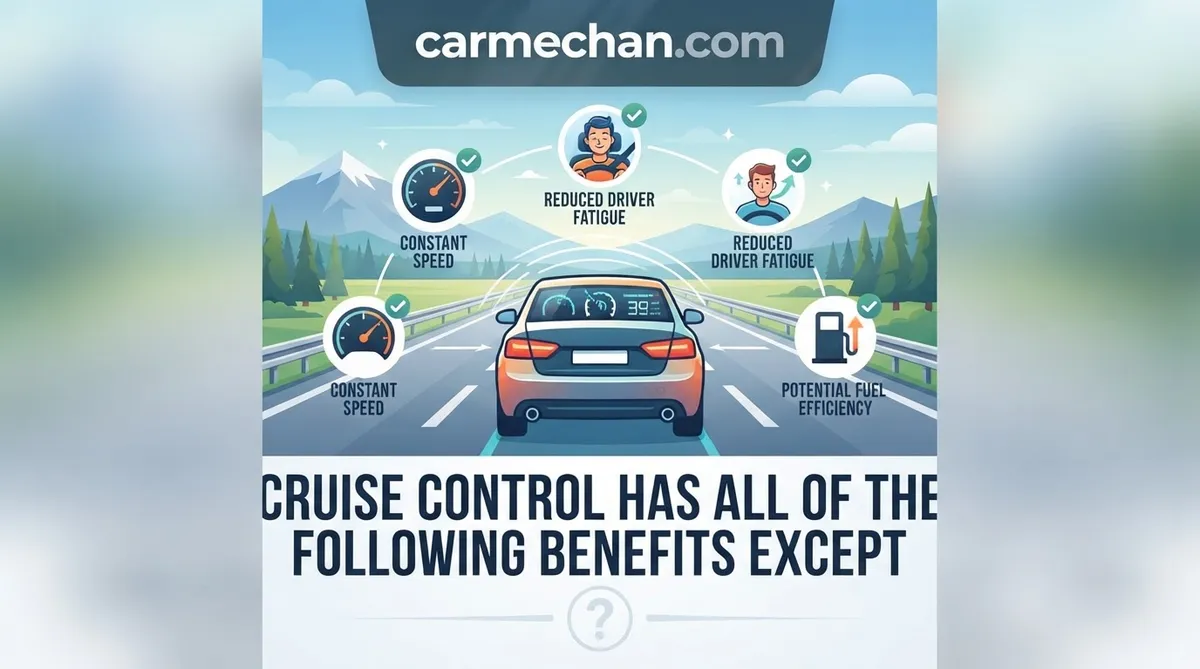
To understand the fundamentals of this system, one must first recognize its limitations. Cruise control was engineered to solve the “fatigued foot” problem—the physical discomfort that occurs when holding a throttle pedal at a fixed position for extended periods on monotonous, flat highways. It is, by design, a comfort feature.
📤 Share Image

Why It Is Not Semi-Autonomous Driving
A standard cruise control system is a reactive, not proactive, technology. It maintains a velocity by manipulating the throttle, but it has no “awareness” of the environment. Unlike modern ADAS (Advanced Driver Assistance Systems) that utilize LIDAR, radar, and cameras, standard cruise control possesses zero capability to detect traffic flow, lane position, or road debris. It does not steer, it does not brake for obstacles, and it does not recognize stop-and-go patterns. Treating it as a “set-and-forget” system is a fundamental error in driver behavior.

The Truth About Traffic and Terrain Monitoring
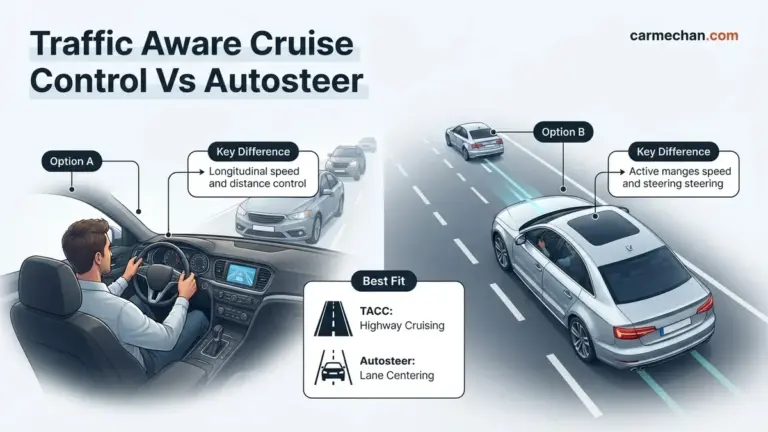
It is important to distinguish standard systems from Adaptive Cruise Control (ACC). While ACC can adjust speed based on the vehicle ahead using sensors, it still lacks the situational awareness required for complex maneuvers. Neither system is designed to handle mountainous terrain or heavy congestion. On inclines, standard cruise control can cause erratic throttle surging to maintain speed, often resulting in premature transmission downshifts and poor fuel management—the exact opposite of its intended efficiency benefit.
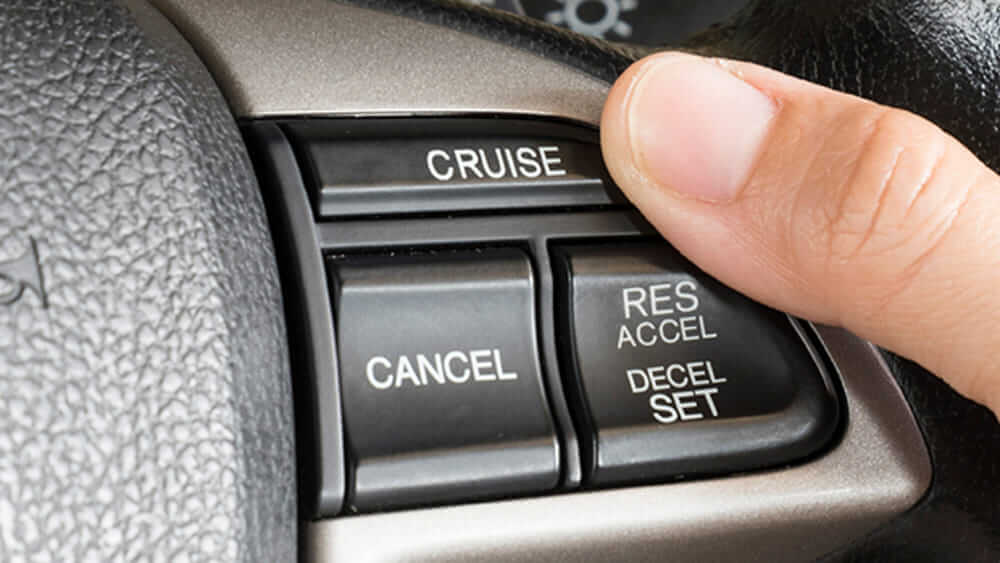
How Cruise Control Components Manage Speed Fundamentals
Understanding the architecture of the system reveals why it functions strictly as an assist tool. The interaction between the driver’s input and the engine’s mechanical response is governed by a closed-loop feedback system.
The ECU and Throttle Actuation Process
The Electronic Control Unit (ECU) acts as the brain of the operation. When you engage the system, the following process occurs:
- Input Initiation: You press ‘Set’ on your control module, signaling the ECU to record the current vehicle speed.
- Sensor Processing: The ECU continuously monitors signals from the speed sensor (often transmission-mounted or wheel-speed sensors).
- Throttle Manipulation: If the speed drops, the ECU instructs the actuator to open the throttle slightly to increase air/fuel intake.
- Safety Override: Crucially, the system maintains a high-priority “kill” signal from the brake pedal switch. As soon as the brake pedal is depressed, the circuit opens, and the throttle is immediately released, returning the engine to idle.
Speed Sensors and Input Modules Explained
The speed sensor is the most important input for maintaining stability. If this sensor sends an erratic signal due to electrical noise or mechanical failure, the cruise control will disengage as a safety precaution. Industry standards mandate that the system must fail-safe; if it cannot confirm velocity, it must turn itself off rather than risk unintended acceleration.
Cruise Control Has All Of The Following Benefits Except: Safety and Adverse Conditions
Never use cruise control on wet, icy, or snowy roads. In these conditions, the system can attempt to maintain a set speed even when your tires are losing traction, which may lead to hydroplaning or a total loss of vehicle control.
Avoiding System Use in Adverse Weather
One of the most persistent myths is that cruise control is suitable for highway travel regardless of weather. In reality, wet pavement creates a high risk of hydroplaning. If your tires lose contact with the road, the cruise control system will perceive the sudden spike in RPM (because the tires are spinning faster than the car is traveling) and may further increase power, causing a violent loss of traction when the wheels eventually regain contact with the tarmac.
Dangers of Erratic Throttle on Winding Roads
Winding roads require micro-adjustments in speed and cornering precision. Cruise control is not capable of “reading” a curve. By keeping the vehicle at a set speed through corners, the system may force you into a speed that is uncomfortable or unsafe for the geometry of the turn. Always prioritize manual throttle control when the road is anything but a straight, dry highway.
Comparing Cruise Control Features to Speed Limiters
To further refine your understanding of speed management tools, we must compare cruise control against speed limiters. While both involve velocity, their intent is vastly different.
The Reality of Fuel Economy and Hypermiling
Many drivers assume cruise control always saves fuel. This is not strictly true. On hilly terrain, the system is often less efficient than a skilled human driver. A human can anticipate an incline, slightly increasing speed before the hill or allowing momentum to carry the car over the crest, while the system waits until speed drops to apply more throttle. Skilled “hypermilers” often outperform automated systems because they manage kinetic energy with far greater foresight.
Troubleshooting Cruise Control Has All Of The Following Benefits Explained
If your system is not performing correctly, it is usually a sensor or electrical failure rather than a mechanical breakdown. Before seeking professional repair, follow this diagnostic sequence.
Most systems will not engage below 20-30 mph. Ensure you are at highway speeds before attempting to set the cruise.
If your brake lights stay on intermittently, the brake switch may be faulty, causing the cruise control to disengage immediately upon being set.
In older vehicles, vacuum lines operate the throttle actuator. A dry-rotted hose will cause the system to fail to maintain speed.
Diagnosing Erratic Speed Loss on Inclines
If your car loses significant speed on steep inclines, it is often due to transmission management. The ECU attempts to prevent “hunting” (rapid shifting between gears), which may lead to sluggish performance on steep grades. This is not a defect, but a programming parameter.
By The Numbers
MPH Activation Threshold
Driver Responsibility
Final Considerations for Intelligent Road Usage
Cruise control remains a powerful tool for reducing driver fatigue during long, consistent transit segments. However, it is fundamentally a passive convenience feature. To maintain safety, remember that the system provides comfort but never replaces active steering, environmental assessment, or collision avoidance.
Always consult your vehicle owner’s manual to understand the specific speed thresholds and limitations unique to your car’s model year and make. By maintaining manual control in poor weather and avoiding reliance on the system in complex traffic, you ensure that you are utilizing this technology as intended—as a supplement to your driving skills, not a replacement for them.
Cruise Control Has All of the Following Benefits Except: Frequently Asked Questions
Does cruise control save gas?
Yes, cruise control can save fuel, but only under specific circumstances. By maintaining a constant speed, the system prevents the ‘lead-foot’ effect and unnecessary acceleration/deceleration cycles. Research suggests it can improve fuel efficiency by up to 14% on flat, open highways. However, on hilly terrain, the system may downshift aggressively to maintain speed, which can actually consume more fuel than manual throttle management.
Should I use cruise control in the rain?
Absolutely not. Using cruise control in the rain is dangerous because it can contribute to hydroplaning. If your tires lose contact with the road, the cruise control may continue to send power to the wheels, causing them to spin faster. This sudden loss of traction, combined with the cruise control’s attempt to ‘correct’ the speed, makes regaining control of the vehicle significantly more difficult and hazardous.
How do I disengage cruise control instantly?
The most reliable way to disengage cruise control instantly is by tapping the brake pedal. This is a hard-wired safety feature in nearly all modern vehicles that immediately cuts power to the throttle and disengages the system. Alternatively, most systems have a ‘Cancel’ or ‘Off’ button on the steering wheel, but the brake pedal remains the primary, most intuitive method for immediate emergency disengagement.
Why does my car lose speed on hills with cruise control?
Most standard cruise control systems are programmed for fuel efficiency and may not be aggressive enough to maintain an exact speed on steep inclines. When the engine encounters a hill, the system may only adjust the throttle slightly. If the incline is steep enough, the car’s momentum will naturally decrease because the engine isn’t being pushed to its maximum power output to maintain the set velocity.
Is adaptive cruise control the same as standard cruise control?
No, they differ significantly. Standard cruise control maintains a set speed regardless of traffic. Adaptive cruise control (ACC) uses radar or cameras to monitor the distance to the vehicle ahead. It automatically modulates your speed to maintain a safe following distance, slowing down or speeding up based on traffic flow. While more convenient, ACC still requires constant driver attention and should not be considered a self-driving feature.