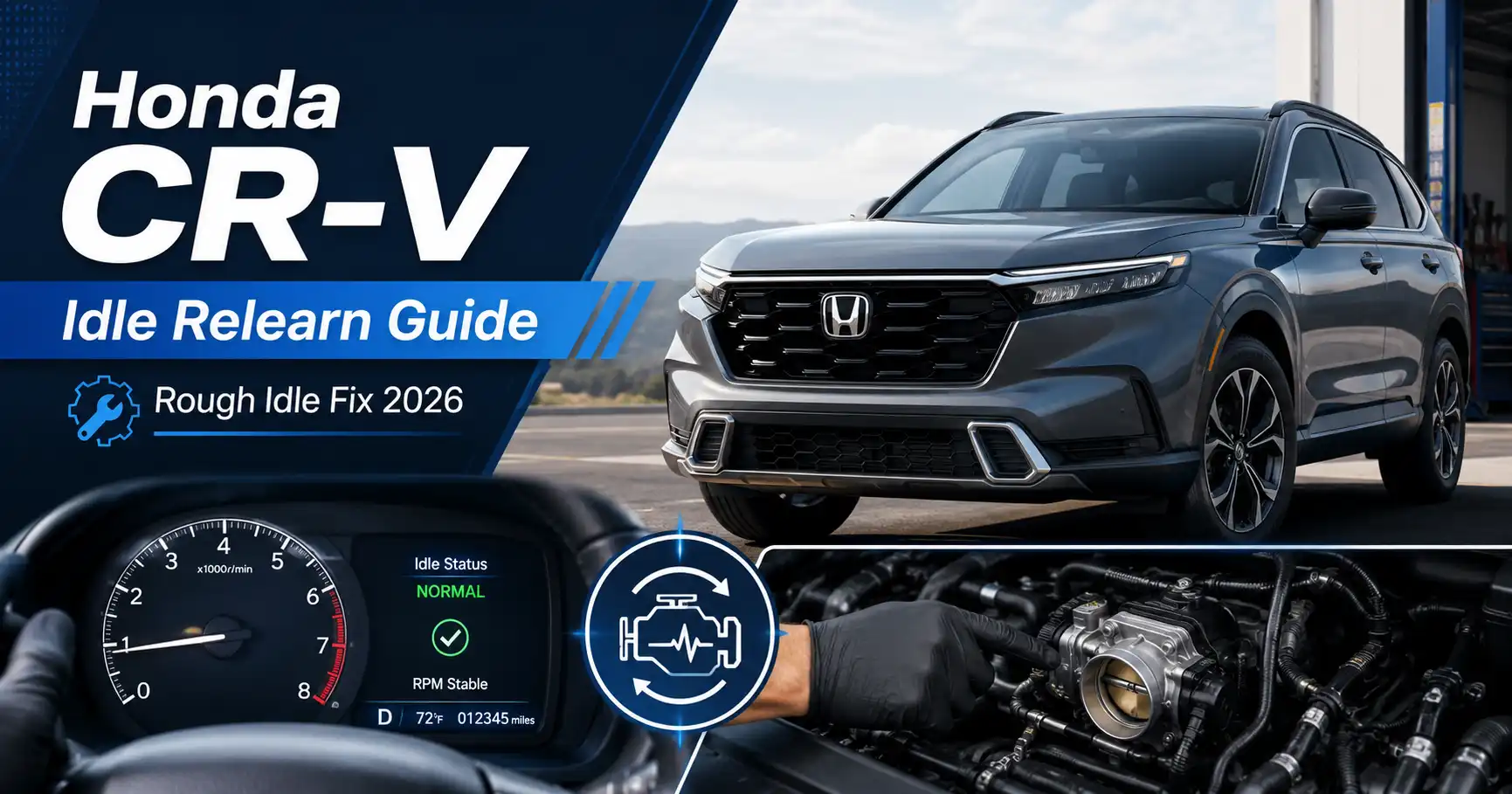
Honda CR-V Idle Relearn Guide for Rough Idle Fix 2026
Last Updated on June 24, 2026 by Albert Duke
A Honda CR-V idle relearn can fix rough idle after a battery disconnect, throttle body cleaning, PCM reset, or intake-related repair. The goal is simple: let the Powertrain Control Module, or PCM, relearn the correct closed-throttle idle baseline.
This does not fix every rough idle problem. If the CR-V has a vacuum leak, misfire, sensor fault, dirty throttle body, or active check engine light, the relearn may fail or the symptom may return.
Use this guide to decide when to try the relearn, when to scan for codes, and when the idle problem needs deeper diagnosis.
When Honda CR-V Idle Relearn Is Needed


Idle relearn makes sense when the CR-V started idling badly right after a reset or airflow-related service.
The PCM controls fuel, ignition, and idle behavior. When learned idle values are cleared or changed, the engine may idle too high, too low, or unevenly until the PCM relearns the correct baseline.
Common triggers include:
- Battery replacement or battery disconnect
- Dead battery jump start
- Throttle body cleaning
- Throttle body replacement
- PCM software update
- Intake hose removal
- Air filter box or intake duct work
- Idle fluctuation after clearing codes
Honda service bulletin language for some 2017 and 2018 CR-V procedures specifically says to reset throttle position learned values and then do the PCM idle learn procedure. That wording appears in Honda documents hosted by NHTSA for CR-V software and A/C control update work, including Honda bulletin instructions for resetting throttle position learned values and doing PCM idle learn.
That does not mean every CR-V idle complaint needs the same scan-tool reset. It means Honda treats idle learning as a real service step after some electronic throttle and PCM-related procedures.
Before starting the relearn, check the conditions that can make the procedure fail.
5 Checks Before Honda CR-V Idle Learn


The idle learn procedure only works if the CR-V is ready to relearn a clean baseline.

Do these checks before you start. Skipping them can make the idle relearn incomplete or misleading.
- Warm The Engine Fully
The engine needs to reach normal operating temperature. Many Honda idle learn procedures use a warm-up period before the closed-throttle idle phase.
A cold engine uses a richer fuel mixture and higher idle strategy. That is not the baseline you want the PCM to learn.
- Turn Off Electrical Loads
Turn off the A/C, defroster, headlights, audio system, heated seats, and other accessories.
Extra electrical load changes idle speed. The PCM should learn idle with the engine under minimal load first.
- Put The Transmission In Park Or Neutral
Use Park for an automatic transmission. Use Neutral for a manual transmission if applicable.
Do not hold the brake and do not press the accelerator during the final idle phase unless the procedure specifically calls for RPM hold during warm-up.
- Check For A Check Engine Light
If the check engine light is on, scan the CR-V before doing idle relearn.
A stored trouble code can explain the idle problem. For Honda owners who do their own diagnosis, a Honda-compatible scanner matters because basic code readers may only clear generic codes. We cover that tool choice in our guide to the best OBD2 scanner for Honda.
- Inspect The Intake Path
Check the air intake hose, air box clips, vacuum lines, and throttle body area.
A loose intake hose can create rough idle that looks like a relearn issue. Relearning idle with an active air leak will not solve the root problem.
Once those conditions are right, you can follow the idle relearn sequence.
How To Do Honda CR-V Idle Relearn
For many Honda models, the basic idle learn pattern follows a warm-up and closed-throttle idle sequence.
Use this as a practical owner-level procedure, but verify the exact procedure for your CR-V year, engine, and service condition. Honda bulletin documents confirm PCM idle learn as a service step on some CR-V procedures, but the exact steps can vary by model year and scan-tool workflow.
- Turn Everything Off
Park the CR-V safely. Set the parking brake.
Turn off the A/C, radio, lights, rear defogger, seat heaters, phone charger, and every other electrical load.
- Start The Engine
Start the engine and let it run without touching the accelerator unless your service procedure calls for a warm-up RPM hold.
Watch the idle. It may be high or uneven at first if the PCM has lost learned values.
- Warm The Engine To Operating Temperature
Many Honda idle learn references use a warm-up target where the engine reaches normal temperature and the radiator fan cycles.
A widely cited Honda idle learn pattern says to hold engine speed around 3,000 RPM with no load until the radiator fan comes on or coolant temperature reaches operating range. A repair database entry for a Honda ECM and PCM idle learn procedure lists the same general pattern, including all electrical items off, 3,000 RPM warm-up, and a closed-throttle idle phase.
- Let It Idle With Throttle Fully Closed
After warm-up, release the accelerator and let the CR-V idle on its own.
Do not press the gas pedal. Do not turn on accessories. Let the PCM see a stable closed-throttle idle condition.
- Wait About 5 Minutes
A common Honda idle learn pattern uses about 5 minutes of closed-throttle idle after warm-up.
If the radiator fan runs during this phase, do not count fan running time as part of the clean idle learn time. Fan operation adds electrical and engine load, which can affect idle speed.
If the idle smooths out and stays stable, the relearn likely helped. If it stays too high, drops too low, surges, or stalls, the CR-V may need a scan tool step first.
Honda CR-V Idle Relearn Flow
Use this quick flow after battery disconnect, throttle body cleaning, or PCM reset. Scan for codes first if the check engine light is on.
Turn Loads Off
Switch off A/C, lights, defroster, radio, chargers, and other electrical loads.
Start Engine
Start the CR-V and keep the transmission in Park or Neutral with the parking brake set.
Warm It Up
Let the engine reach operating temperature before the final closed-throttle idle phase.
Idle Hands Off
Release the accelerator and let the engine idle without touching the gas pedal.
Wait And Confirm
Give the CR-V about 5 minutes of stable idle, excluding radiator fan run time.
Scan for codes, inspect the intake hose and vacuum lines, then check whether a Honda-capable scan tool is needed to reset throttle position learned values.
When A Scan Tool Is Needed For CR-V Idle
A scan tool becomes important when the CR-V has stored throttle position values that a basic idle relearn cannot clear.
This is most common after throttle body cleaning, throttle body replacement, PCM software work, or repeated failed relearn attempts.
Throttle Position Reset
On electronic throttle Honda models, the PCM stores learned throttle position values.
Honda bulletin instructions for some 2017 and 2018 CR-V service procedures say to reset throttle position learned values before performing PCM idle learn. That is a scan-tool or service-information procedure, not the same as simply letting the engine idle in the driveway.
PCM Idle Learn
PCM idle learn is the step where the engine computer relearns the correct idle condition.
Some CR-Vs may relearn idle through the basic warm-up and idle sequence. Other cases may require Honda HDS or a capable diagnostic tool to reset learned values before the idle learn can complete.
Basic Scanner Limits
A basic OBD2 reader can usually read and clear generic engine codes. It may not reset Honda throttle position learned values.
If the idle issue started after throttle body service and the idle learn keeps failing, use a Honda-capable scan tool or have an independent Honda specialist perform the reset.
A failed relearn also points to problems outside the relearn procedure.
7 Problems Idle Relearn Will Not Fix
Idle relearn cannot correct a mechanical or sensor problem that is still active.
If the CR-V still idles badly after a proper relearn attempt, check these causes before repeating the same procedure again.
Vacuum Leak
A vacuum leak lets unmetered air enter the engine.
Common areas include intake hoses, PCV hoses, vacuum lines, and gaskets. If the leak remains, the PCM will struggle to hold stable idle.
Loose Intake Hose
A loose air intake hose can happen after air filter, throttle body, or intake work.
This is one of the easiest problems to miss. Make sure the hose is seated and clamped correctly.
Dirty Throttle Body
Throttle body cleaning can trigger idle relearn, but an uneven or incomplete cleaning can also cause idle problems.
If the plate sticks, airflow may not match what the PCM expects.
Bad MAP Or MAF Sensor Reading
Depending on CR-V year and engine setup, airflow and pressure sensor data help the PCM calculate idle control.
A sensor fault can create rough idle, hesitation, or fuel trim problems that idle relearn cannot erase.
Misfire From Plugs Or Coils
A misfire can feel like rough idle, but it is not an idle-learn problem.
If the check engine light flashes, stop driving aggressively and scan the vehicle. A flashing check engine light usually means an active misfire that can damage the catalytic converter.
Fuel Delivery Problem
A weak fuel pump, restricted injector, or fuel trim issue can make idle unstable.
Fuel system symptoms overlap with rough idle complaints. For maintenance-related fuel system research, see our guide to the best fuel injector cleaner.
P0507 Or Idle Speed Code
Code P0507 means the idle speed is higher than expected. AutoZone describes P0507 as a condition where the electronic throttle system registers idle RPM above the expected threshold, and notes that air intake or fuel injection problems may be involved in diagnosis through its P0507 idle speed diagnostic explanation.
If your CR-V has an emissions warning or related drivability message, our Honda-focused guide to Honda emissions system problem diagnosis can help you understand how idle, fuel trim, and emissions faults can overlap.
The quickest way to avoid guessing is to match the symptom to the next action.
3 Step Honda CR-V Idle Decision Guide
Use this decision guide when you are not sure whether to relearn, scan, or inspect.
| If This Happened | Try This First | What It Means |
|---|---|---|
| Battery was disconnected and idle is slightly rough | Basic idle relearn | PCM may need to relearn idle baseline |
| Throttle body was cleaned and idle is high | Scan tool reset if basic relearn fails | Learned throttle values may need reset |
| Check engine light is on | Scan codes before relearn | The idle issue may have a stored fault |
| Idle surges after several relearn attempts | Inspect intake leaks and sensors | A mechanical or sensor issue may still be active |
| Idle learn shows incomplete on scan tool | Use Honda-capable diagnostic equipment | Basic OBD readers may not perform the needed reset |
If the rough idle started immediately after a battery reset, a basic idle relearn is a reasonable first step.
If it started after throttle body service, the scan tool path becomes more likely. If the check engine light is on, scan first and relearn second.
Some symptoms are strong signs that the CR-V should be checked by a professional.
When To Visit A Honda Mechanic
Get the CR-V checked if the idle problem affects drivability or safety.
Do not keep repeating idle relearn if the engine stalls in traffic, the check engine light flashes, or the CR-V has misfire codes. Those symptoms can point to problems that need diagnosis, not just adaptation.
Visit a Honda mechanic or qualified shop if:
- The engine stalls at stops
- The check engine light flashes
- Misfire codes are stored
- Idle speed stays very high after relearn
- Idle learn will not complete on a scan tool
- The problem started after throttle body replacement
- The CR-V recently had PCM software work
Used CR-V owners should also consider model-year reliability patterns when persistent drivability issues appear. Our Honda CR-V best and worst years review gives broader ownership context beyond idle relearn.
With the warning signs clear, the final takeaway is simple.
Best Next Step For Honda CR-V Idle Issues
The right Honda CR-V idle relearn decision depends on what happened before the idle problem started.
If the issue began after a battery disconnect, try the basic relearn with the engine warm and all accessories off. If the issue began after throttle body cleaning or replacement, be ready for a throttle position learned value reset with a Honda-capable scan tool.
If the check engine light is on, scan codes before relearning idle. A relearn is useful only when the CR-V is mechanically sound enough to learn a stable idle baseline.
FAQ
Does A Honda CR-V Need Idle Relearn After Battery Replacement
Yes, a Honda CR-V may need idle relearn after battery replacement if the idle becomes rough, low, high, or unstable. If the engine idles normally after the battery is replaced, you may not need to do anything.
How Long Does Honda CR-V Idle Relearn Take
A basic Honda CR-V idle relearn usually takes about 10 to 15 minutes once the engine is ready. The time depends on warm-up, radiator fan cycling, and the final closed-throttle idle period.
Can I Do Honda CR-V Idle Relearn Without A Scanner
Yes, you can try a basic idle relearn without a scanner if the issue started after a battery disconnect. If the problem followed throttle body service or the relearn fails, a Honda-capable scan tool may be needed.
Why Is My Honda CR-V Still Idling High After Relearn
Your Honda CR-V may still idle high after relearn because of a vacuum leak, loose intake hose, dirty throttle body, sensor issue, or stored throttle learned value. Scan for codes and inspect the intake path before repeating the relearn.
Is It Safe To Drive A Honda CR-V With Rough Idle
It may be safe for a short drive if the idle is only slightly rough and no warning lights are flashing. Do not keep driving if the CR-V stalls, the check engine light flashes, or the engine shakes badly.