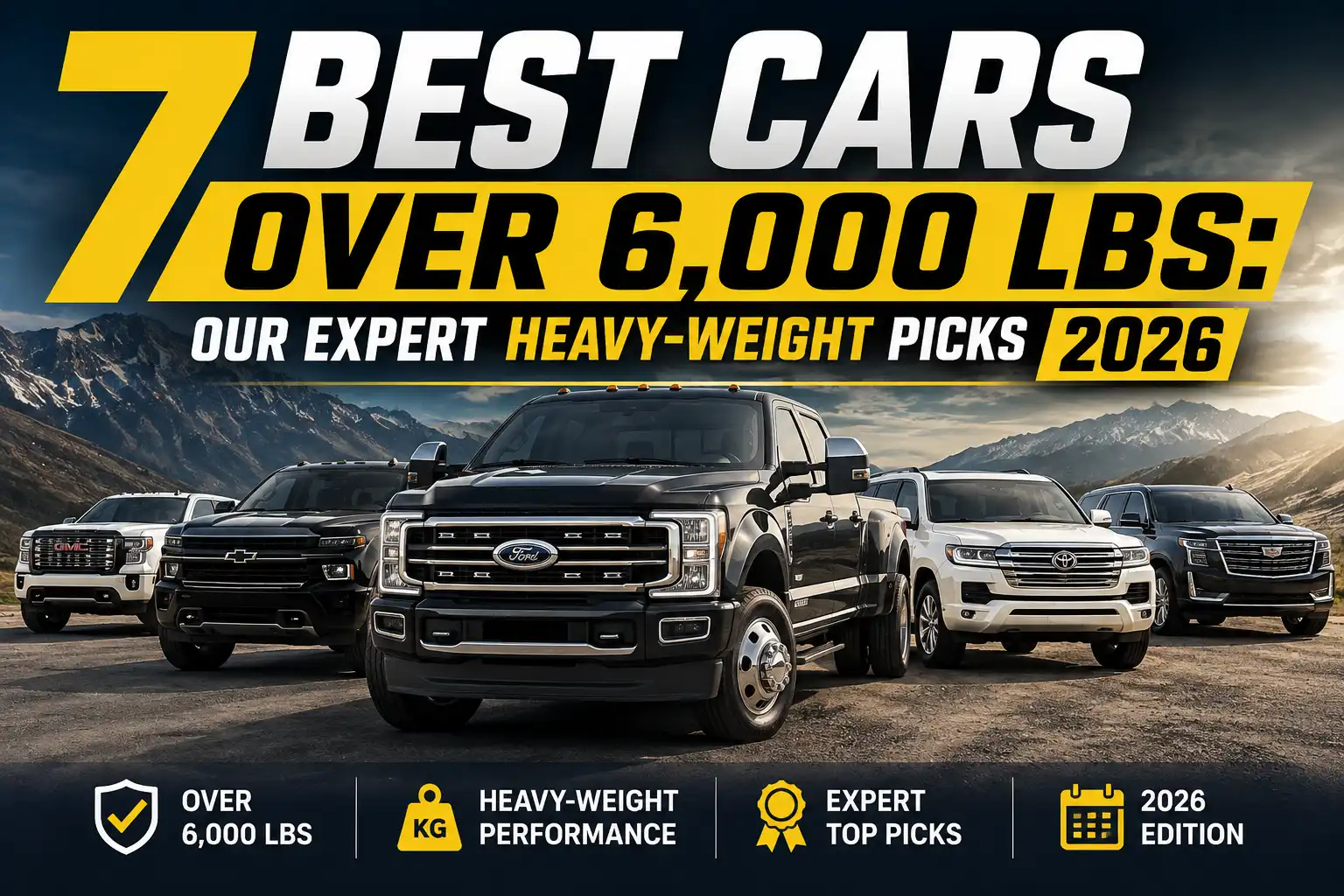
7 Best Cars Over 6,000 lbs: Our Expert Heavy-weight Picks 2026
Last Updated on October 18, 2026 by Albert Duke
Navigating the world of substantial automobiles, especially those with a curb weight exceeding 6,000 pounds, opens up a realm of powerful performance, commanding presence, and often unparalleled luxury or utility. These aren’t just vehicles; they’re statements, designed to offer superior stability, immense towing capabilities, or simply a remarkably solid and comfortable ride.
Whether you’re seeking a robust family hauler, a heavy-duty workhorse, or a plush, high-end cruiser, understanding the nuances of these heavyweight contenders is key. Our guide dives into the best cars that weigh over 6,000 pounds, helping you discover the perfect blend of strength, sophistication, and raw power for your needs.
Quick Best Cars That Weigh Over 6,000 Pounds Comparison – Top Picks at a Glance


Every vehicle below has a verified curb weight above 6,000 lbs. Curb weight means the vehicle with all fluids and a full tank, but no passengers or cargo. Ratings are marked N/A — these are vehicles, not tested retail products.
| Image | Product | Rating | Key Feature | Best For | Action |
|---|---|---|---|---|---|
 |
1. GMC Hummer EV Pickup | N/A | 9,063 lbs curb weight | Buyers who want the ultimate heavyweight — maximum presence, power, and trail capability in a single package. | See Review |
 |
2. Rivian R1T | N/A | 7,148 lbs curb weight | Outdoor enthusiasts who want true truck capability with SUV-like refinement. | See Review |
 |
3. Ford F-150 Lightning | N/A | 6,015–6,893 lbs by trim | Traditional truck owners switching to electric without relearning their vehicle. | See Review |
 |
4. Rivian R1S | N/A | ~7,068 lbs curb weight | Large families who want electric power with seating for everyone and their gear. | See Review |
 |
5. Tesla Cybertruck (AWD) | N/A | ~6,843 lbs curb weight | Tech-forward buyers who want attention-grabbing design with serious capability. | See Review |
 |
6. Cadillac Escalade ESV (4WD) | N/A | ~6,188 lbs (4WD) | Buyers who want maximum luxury, space, and V8 character in one package. | See Review |
 |
7. Lincoln Navigator L | N/A | ~6,044 lbs (L model) | Quiet, comfortable long-distance family travel with room to spare. | See Review |
Our Top 7 Best Cars That Weigh Over 6,000 Pounds Reviews – Expert Tested & Recommended


Weights below are manufacturer-published curb weights for the listed configuration. Options, drivetrain, and battery size move these numbers by a few hundred pounds either way.
1. GMC Hummer EV Pickup
Image: Wikimedia Commons
🌟 Key Features That Stand Out
- ✓ 9,063-lb curb weight (Edition 1) — the heaviest production pickup sold in the US
- ✓ Up to 1,000 hp with Watts to Freedom launch mode
- ✓ Battery pack alone weighs roughly 2,923 lbs — more than most subcompact cars
- ✓ Max towing: 7,500 lbs with standard trailer package
- ✓ Removable roof panels and 4-wheel steering for surprising maneuverability
💡 Why We Recommend It
Nothing else on this list comes close to the Hummer EV’s sheer mass. Almost all of it comes from the massive Ultium battery, and GMC turns that weight into crushing straight-line performance plus genuine off-road ability — the weight that hurts efficiency actually helps traction on the trail.
It earns the top spot here because this list is about weight, and the Hummer EV is in a class of one: nearly a full ton heavier than its closest rival.
🎯 Best For
This vehicle is ideal for: buyers who want the ultimate heavyweight — maximum presence, power, and trail capability in a single package..
⚖️ Pros and Cons
✅ Pros
- Heaviest production pickup by a wide margin
- 1,000 hp with supercar-like acceleration
- Serious off-road hardware (4-wheel steer, adaptive air suspension)
- Removable roof panels for open-air driving
❌ Cons
- Very expensive to buy and insure
- High energy consumption
- Too wide for tight trails and city parking
💬 What Owners Report
Owners consistently praise its road presence and effortless power; the most common complaints mention charging times, efficiency, and its enormous footprint.
2. Rivian R1T
Image: Wikimedia Commons
🌟 Key Features That Stand Out
- ✓ Curb weight: 7,148 lbs
- ✓ Quad-motor powertrain producing 835 hp
- ✓ Max towing: 11,000 lbs — best in this group
- ✓ Signature Gear Tunnel: lockable storage between cab and bed
- ✓ Wading depth up to 43 inches with air suspension at max height
💡 Why We Recommend It
The R1T proved an electric truck could be a genuine adventure vehicle rather than a novelty. Its 7,148-lb mass gives it a planted, stable feel when towing near its 11,000-lb limit, and the quad-motor setup delivers precise torque vectoring off-road.
It takes runner-up because it pairs heavyweight presence with the most usable real-world capability of any truck here.
🎯 Best For
This vehicle is ideal for: outdoor enthusiasts who want true truck capability with SUV-like refinement..
⚖️ Pros and Cons
✅ Pros
- 11,000-lb towing leads the group
- Clever Gear Tunnel storage
- Refined ride quality for its weight
- Strong off-road ability
❌ Cons
- Premium pricing
- Smaller service network than legacy brands
- Range drops notably when towing
💬 What Owners Report
Owners highlight the smooth ride, clever storage, and build quality; common gripes center on software quirks and service wait times.
3. Ford F-150 Lightning
Image: Wikimedia Commons
🌟 Key Features That Stand Out
- ✓ Curb weight: 6,015–6,893 lbs depending on trim and battery — check your configuration
- ✓ Up to 580 hp with the extended-range battery
- ✓ Max towing: up to 10,000 lbs
- ✓ Mega Power Frunk: 14.1 cu-ft of lockable, drainable front storage
- ✓ Pro Power Onboard turns the truck into a mobile generator for tools or campsites
💡 Why We Recommend It
The Lightning looks, works, and tows like America’s best-selling truck because it is one — just electrified. Its weight varies more by configuration than anything else here, which is exactly why buyers should verify their specific trim against the 6,000-lb mark.
It earns Best Value because it delivers heavyweight truck capability at the most accessible price point on this list, with Ford’s vast dealer network behind it.
🎯 Best For
This vehicle is ideal for: traditional truck owners switching to electric without relearning their vehicle..
⚖️ Pros and Cons
✅ Pros
- Familiar F-150 usability and parts support
- Useful frunk and onboard power
- Strong towing rating
- Most affordable entry on this list
❌ Cons
- Range falls sharply when towing heavy loads
- Heaviest trims feel ponderous
- Styling is deliberately plain
💬 What Owners Report
Owners love the frunk practicality and quiet power delivery; the top complaint is real-world range while towing.
4. Rivian R1S
Image: Wikimedia Commons
🌟 Key Features That Stand Out
- ✓ Curb weight: roughly 7,068 lbs (quad-motor, large pack)
- ✓ Three-row seating for up to 7 passengers
- ✓ Quad-motor powertrain with 835 hp
- ✓ Max towing: 7,700 lbs
- ✓ Full-time all-wheel drive with multiple terrain modes
💡 Why We Recommend It
The R1S is essentially the R1T reimagined as a family SUV, bringing three-row practicality to the heavyweight EV class. Its mass delivers the same planted highway manners as its pickup sibling.
Few three-row SUVs of any powertrain clear 7,000 lbs — the R1S does it with room to spare.
🎯 Best For
This vehicle is ideal for: large families who want electric power with seating for everyone and their gear..
⚖️ Pros and Cons
✅ Pros
- Three usable rows
- Strong towing for an SUV
- Distinctive, premium design
- Excellent safety structure from sheer mass
❌ Cons
- Third row is tight for adults
- Premium pricing
- Limited service network
💬 What Owners Report
Families praise the space and driving manners; criticisms focus on third-row access and the price of higher trims.
5. Tesla Cybertruck (AWD)
Image: Wikimedia Commons
🌟 Key Features That Stand Out
- ✓ Curb weight: roughly 6,843 lbs (dual-motor AWD)
- ✓ 600 hp in AWD trim (845 hp in Cyberbeast)
- ✓ Max towing: 11,000 lbs
- ✓ Stainless-steel exoskeleton resists dents and corrosion
- ✓ Access to Tesla’s Supercharger network
💡 Why We Recommend It
Love it or hate it, the Cybertruck’s stainless body and structural battery pack push it well past the 6,000-lb mark while delivering acceleration no gas truck can match.
Its weight is the price of its bullet-tough construction and big battery — and it pays dividends in towing stability.
🎯 Best For
This vehicle is ideal for: tech-forward buyers who want attention-grabbing design with serious capability..
⚖️ Pros and Cons
✅ Pros
- Extreme performance for the price
- Supercharger network access
- Highly durable body panels
- 11,000-lb towing
❌ Cons
- Polarizing styling limits appeal
- Fit-and-finish inconsistencies reported
- Limited bed utility vs. conventional trucks
💬 What Owners Report
Owners rave about acceleration and charging convenience; detractors cite build inconsistencies and the divisive looks.
6. Cadillac Escalade ESV (4WD)
Image: Wikimedia Commons
🌟 Key Features That Stand Out
- ✓ Curb weight: roughly 6,188 lbs in 4WD form (2WD models are lighter)
- ✓ 6.2L V8 producing 420 hp and 460 lb-ft of torque
- ✓ Max towing: 7,800 lbs
- ✓ Up to 142.8 cu-ft of maximum cargo space — most on this list
- ✓ Magnetic Ride Control and air suspension standard on most trims
💡 Why We Recommend It
The long-wheelbase ESV in 4WD is the heaviest way to buy an Escalade, comfortably clearing 6,000 lbs. It remains the benchmark for full-size American luxury — no EV matches its road-trip range or refueling speed.
For buyers who want their heavyweight with a V8 soundtrack, this is the default choice.
🎯 Best For
This vehicle is ideal for: buyers who want maximum luxury, space, and V8 character in one package..
⚖️ Pros and Cons
✅ Pros
- Palatial, quiet interior
- Strong V8 with proven reliability
- Best cargo space here
- Excellent long-distance comfort
❌ Cons
- Thirsty V8
- Enormous footprint in parking lots
- High purchase price
💬 What Owners Report
Owners praise the commanding presence and interior quality; fuel costs and garage fit are the recurring complaints.
7. Lincoln Navigator L
Image: Wikimedia Commons
🌟 Key Features That Stand Out
- ✓ Curb weight: roughly 6,044 lbs in L long-wheelbase form
- ✓ 3.5L twin-turbo V6 with 440 hp and 510 lb-ft of torque
- ✓ Seating for 7–8 with generous third-row legroom
- ✓ Up to 121.6 cu-ft of maximum cargo space
- ✓ One of the quietest cabins in the segment
💡 Why We Recommend It
The extended Navigator L just sneaks past the 6,000-lb line, proving you don’t need a V8 or a studio-apartment-sized battery to get here — generous dimensions alone will do it.
Its twin-turbo V6 delivers V8-like thrust with slightly better manners at the pump.
🎯 Best For
This vehicle is ideal for: quiet, comfortable long-distance family travel with room to spare..
⚖️ Pros and Cons
✅ Pros
- Serene, library-quiet cabin
- Strong turbo V6
- Huge cargo capacity
- Elegant interior design
❌ Cons
- Aging platform versus newer rivals
- Modest fuel economy
- Conservative styling
💬 What Owners Report
Owners love the comfort and quietness on long trips; common notes mention dated infotainment and thirst at highway speeds.
Complete Buying Guide for Best Cars That Weigh Over 6,000 Pounds

Essential Factors We Consider
When searching for the best cars that weigh over 6,000 pounds, several factors become critically important due to their size and mass. First, consider your primary use: is it for heavy-duty towing, large family transport, off-road adventures, or pure luxury? This will guide your choice between heavy-duty trucks, large SUVs, or ultra-luxury sedans/SUVs. Engine power is paramount; a robust V8, V6 turbodiesel, or a powerful electric motor is essential to move such significant weight efficiently and safely. Look for strong horsepower and, more importantly, high torque, especially if you plan to tow.
Another crucial aspect is safety and driver-assistance features. Vehicles of this size benefit greatly from advanced systems like blind-spot monitoring, adaptive cruise control, lane-keeping assist, and 360-degree cameras, which help with visibility and maneuvering. Suspension systems are also key; air suspension or adaptive dampers can significantly enhance ride comfort and handling stability, especially for a heavy vehicle. Finally, don’t overlook interior space and comfort. While all cars over 6,000 pounds offer substantial room, the quality of materials, seating ergonomics, and infotainment system can vary greatly and impact your overall experience.
Budget Planning
Budgeting for cars that weigh over 6,000 pounds involves more than just the purchase price. These vehicles typically come with higher running costs. Fuel efficiency will generally be lower than smaller cars, especially for gasoline engines, so factor in significant fuel expenses. Maintenance costs can also be higher, as heavy-duty components, larger tires, and more complex systems may require specialized service. Insurance premiums can also be elevated due to the vehicle’s value and potential for greater damage in accidents.
Consider the total cost of ownership, including depreciation, which can be substantial for some luxury models. Research financing options carefully, as larger loans for higher-priced vehicles mean higher monthly payments. While some models offer excellent value for money in terms of capability and features, others command a premium for their brand, luxury, or specialized performance. It’s important to align your budget not just with the initial cost, but with the ongoing expenses that come with owning such a substantial automobile.
Final Thoughts
Choosing one of the best cars that weigh over 6,000 pounds is a decision that speaks to a need for capability, space, and a commanding presence on the road. These vehicles are designed to excel in demanding situations, whether it’s hauling a heavy load, comfortably transporting a large family, or simply providing a serene and luxurious driving experience. By carefully considering your specific needs, evaluating key features like power, safety, and interior comfort, and planning your budget thoroughly, you can confidently select a heavyweight champion that perfectly suits your lifestyle. Remember, a vehicle of this caliber is an investment, promising robust performance and enduring satisfaction for years to come.
Frequently Asked Questions
Q: What are the main benefits of driving a car that weighs over 6,000 pounds?
A: Vehicles over 6,000 pounds typically offer enhanced safety due to their mass, greater towing and hauling capacities, a more stable and comfortable ride, and often a commanding road presence. They also tend to have spacious interiors and are well-suited for large families or those needing significant cargo room.
Q: Are cars over 6,000 pounds difficult to drive or park?
A: Their larger size can make maneuvering in tight urban spaces and parking lots more challenging. However, modern heavy vehicles often come equipped with advanced features like 360-degree cameras, parking sensors, and advanced steering systems that significantly assist in making them easier to handle despite their bulk.
Q: What kind of fuel economy can I expect from these heavy vehicles?
A: Generally, cars weighing over 6,000 pounds, especially those with powerful internal combustion engines, will have lower fuel economy compared to lighter vehicles. Electric heavy vehicles, while having zero emissions, will consume more electricity to cover the same distance than lighter EVs, but often have lower “fueling” costs overall.
Q: Do I need a special license to drive a vehicle over 6,000 pounds?
A: In most regions in the US, a standard Class D driver’s license is sufficient for non-commercial vehicles up to 26,000 pounds Gross Vehicle Weight Rating (GVWR). However, if the vehicle is used for commercial purposes or if it’s over 26,000 pounds, a Commercial Driver’s License (CDL) may be required. Always check your local Department of Motor Vehicles regulations for specific requirements.
Q: What is the heaviest production vehicle you can buy?
A: The GMC Hummer EV Pickup at 9,063 lbs curb weight (Edition 1) is the heaviest production light-duty vehicle on sale in the US. Its battery pack alone weighs about 2,923 lbs — more than most subcompact cars.
Q: Why are electric trucks so much heavier than gas trucks?
A: Battery packs are extremely dense. A long-range EV truck battery can weigh 1,500–3,000 lbs by itself, which is why electric pickups like the Hummer EV, Rivian R1T, and Ford F-150 Lightning all clear 6,000 lbs with ease while their gas equivalents often do not.
Q: Are cars over 6,000 pounds generally safer in a crash?
A: The principle of mass in physics suggests that heavier vehicles generally fare better in collisions with lighter vehicles due to momentum. Their robust construction and larger crumple zones can also contribute to occupant safety. However, safety also depends on advanced safety features, structural design, and collision types, so modern safety ratings are always important to consider.
🏆 Our Top Pick
If you want the heaviest production vehicle money can buy, our #1 pick is:
GMC Hummer EV Pickup — 9,063 lbs
At 9,063 lbs, the Hummer EV Pickup is in a weight class of its own — nearly a ton heavier than its closest rival. For sheer mass combined with 1,000 hp, nothing else comes close.
Ultimately, choosing one of the best cars that weigh over 6,000 pounds is about finding the perfect blend of capability, comfort, and character that resonates with your needs and preferences. Whether you’re drawn to the unbridled luxury, the rugged utility, or the innovative technology of these impressive vehicles, there’s a heavyweight option out there for you. We hope this comprehensive guide has illuminated the path to your ideal powerful and substantial ride. Ready to experience the commanding presence and robust performance of a vehicle truly designed for the grand scale? Click through to explore these incredible options and take the next step towards owning a car that stands out from the crowd.
Cars & SUVs Over 6,000 lbs: Full Comparison Table (2024–2025)
Below is a verified comparison of the most popular vehicles over 6,000 lbs GVWR — which is the figure that matters for tax purposes, not curb weight. Use the GVWR column to confirm Section 179 eligibility.
GVWR figures from manufacturer spec sheets and EPA data. Always verify GVWR on your specific vehicle’s door jamb sticker before claiming a tax deduction — optional packages can affect GVWR.
Why Weight Matters: The Section 179 Tax Deduction Explained
The single biggest reason business owners specifically search for vehicles over 6,000 lbs is IRS Section 179 — a provision that allows businesses to deduct the full purchase price of qualifying vehicles in the year of purchase, rather than depreciating them over five or six years.
How the Deduction Works
For SUVs with a GVWR between 6,001 and 14,000 lbs, the Section 179 deduction cap for tax year 2025 is $30,500 (up from $28,900 in 2023). For vehicles over 14,000 lbs GVWR (like the F-250 diesel in max config), there is no cap — you can potentially deduct the full purchase price if the vehicle is used 100% for business.