Are Nissan Skylines Illegal in the US? Import Laws Explained 2026
Last Updated on September 1, 2026 by Ryan

⚡ Key Takeaways
- A clear, direct answer on whether Nissan Skylines are generally illegal in the US.
- Detailed explanation of the specific laws and regulations (e.g., 25-year rule, NHTSA/EPA compliance) that govern import.
- Information on any legal avenues or exceptions for importing/owning a Skyline (e.g., Show or Display, Registered Importers).
- Understanding the risks and consequences of attempting to illegally import or register a Skyline.
- Guidance on how to verify the legality of a specific Skyline model or VIN.
The short answer to “are nissan skylines illegal in the US” is yes, many models are, primarily due to strict federal import regulations and the infamous “25-year rule.” This regulation dictates that vehicles under 25 years old typically cannot be imported unless they meet costly and often impractical Federal Motor Vehicle Safety Standards (FMVSS) and EPA emissions regulations.
Navigating these complex rules is essential for anyone aspiring to own this legendary JDM car. This article will clarify the legal pathways, crucial compliance requirements, and the precise procedural steps for legally importing a Nissan Skyline. Here is what you need to know about legally importing a Nissan Skyline.
1. Understanding the Scope of Nissan Skyline Import Regulations


This guide outlines the precise regulatory framework governing the importation of Nissan Skyline vehicles into the United States. We will address the federal requirements imposed by the Department of Transportation (DOT) and the Environmental Protection Agency (EPA) that dictate vehicle eligibility.
This protocol specifically covers passenger vehicles intended for on-road use and permanent registration. It does NOT cover vehicles imported solely for competition use, temporary importation by non-residents, or vehicles entering the U.S. for destruction or dismantling as parts.
| Applies To (Included) | Excludes (Not Covered) |
|---|---|
|
|
Understanding these boundaries is crucial before determining if this guide is appropriate for your specific needs. Now that we’ve established the serious implications of non-compliance, let’s consider who this detailed import guide is essential for.
2. Who Should Follow This Nissan Skyline Import Guide
This guide is specifically designed for individuals considering the importation of a Nissan Skyline into the United States. You should have a clear intention to legally own and register the vehicle for road use.
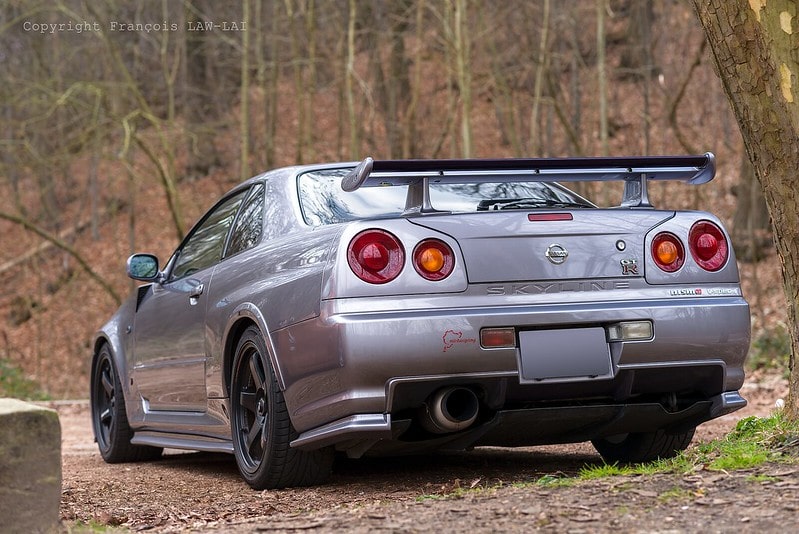
This information is for those seeking to understand the 25-year import rule, DOT/EPA compliance, and the official procedures for importing a Japanese Domestic Market (JDM) car. If you are a casual enthusiast seeking general knowledge without immediate import plans, or if you intend to bypass federal regulations, this guide is not for you.
Should You Use This Nissan Skyline Import Guide?
Considering the legality and complexities of Nissan Skyline imports in the US, this matrix helps determine if this guide is right for your situation.
YES, You Should
- You seek to legally import a Nissan Skyline that meets the 25-year rule for US entry.
- You have a dedicated budget for import fees, customs, registration, and potential modifications.
- You are patient with the potentially lengthy import process and detailed paperwork.
- You understand and are willing to navigate state-specific import, emissions, and titling laws.
- Your primary goal is to own a legally compliant, classic JDM vehicle for personal use.
NO, You Should NOT
- You are looking to import a brand new or recent model Skyline (e.g., R35 GT-R) not meeting the 25-year rule.
- You have a very limited budget and expect minimal additional costs beyond the vehicle purchase.
- You expect a quick, hassle-free process without needing to understand legal nuances.
- You intend to bypass or circumvent US import regulations (e.g., “show or display” for daily driving).
- You are unaware of the strict penalties for illegal vehicle importation into the US.
Once you confirm this guide is for you, we can proceed to the critical steps of the import process. Building on this understanding of who needs to comply, let’s the core protocols for legally importing a Nissan Skyline.
3. Core Protocol Legally Importing a Nissan Skyline in 5 Steps
Successfully importing a Nissan Skyline requires strict adherence to a multi-stage protocol to ensure federal compliance. Each step must be completed accurately to prevent delays, penalties, or vehicle confiscation.
Step 1 Verify Vehicle Age and Eligibility
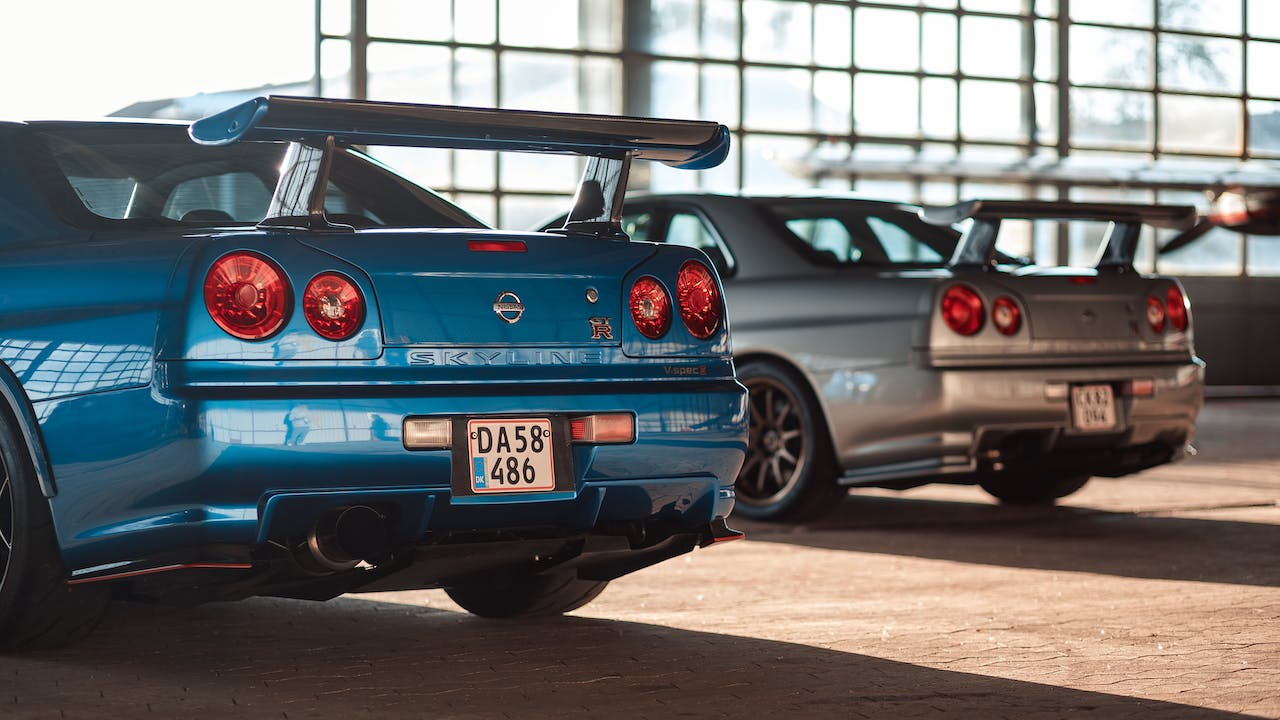
Step 1: Determine the precise manufacturing date of the Nissan Skyline. Verify that the vehicle is at least 25 years old from its manufacture date to the date of importation into the U.S. U.S. Customs and Border Protection (CBP) enforces regulations under 49 CFR Part 591, which outlines requirements for importing vehicles subject to federal safety standards, and 19 U.S.C.
§ 1625, guiding interpretive rulings and decisions on customs matters. This means that any vehicle like a Nissan Skyline must meet specific safety, bumper, and theft prevention standards or qualify for an exemption. (Source: ecfr.gov, uscode.house.gov)
If the vehicle is less than 25 years old, stop and determine if a “Show or Display” exemption applies (see Edge Cases). If not, the vehicle is generally inadmissible under standard import rules. Proceed only if the 25-year rule is met or an approved exemption is secured.
Step 2 Ensure EPA and DOT Compliance
Step 2: For vehicles less than 25 years old, work with a DOT-registered importer (RI) to modify the vehicle to comply with all applicable Federal Motor Vehicle Safety Standards (FMVSS). Simultaneously, work with an EPA-recognized Independent Commercial Importer (ICI) to ensure the vehicle meets all EPA emissions standards.
For a Nissan Skyline to be legally imported and registered in the U.S., it must comply with both Department of Transportation (DOT) safety standards as outlined in 49 CFR Part 591 and Environmental Protection Agency (EPA) emission standards found in 40 CFR Part 85, Subpart P.
These comprehensive regulations govern the vehicle’s structural integrity, crashworthiness, emissions output, and other critical aspects. (Source: ecfr.gov, epa.gov)
Verify that the chosen RI and ICI are properly registered and recognized by their respective agencies. If the vehicle is 25 years or older, this step is generally waived for FMVSS and EPA compliance, but state emissions/safety checks may still apply. If modifications are not feasible or too costly, stop the import process.
Step 3 Prepare Necessary Documentation
Step 3: Collect all required documentation, including the original title, bill of sale, proof of ownership, and form HS-7 (DOT declaration) and EPA form 3520-1 (emissions declaration). For vehicles under 25 years, include compliance letters from the RI and ICI. Upon importation, specific documentation is mandatory: CBP Form 7501 (Entry Summary) declares the vehicle’s value and duties, DOT HS-7 Form affirms compliance with safety standards or states an exemption, and EPA Form 3520-1 certifies emission compliance.
These forms must be accurately completed and submitted to U.S. Customs and Border Protection. (Source: cbp.gov, nhtsa.gov, epa.gov)
Organize all documents neatly and ensure they match the vehicle’s VIN and ownership details. If any document is missing or contains discrepancies, obtain correct versions before proceeding. Submit incomplete or incorrect documentation will result in rejection.
Step 4 Arrange Shipping and Customs Entry
Step 4: Contract with a reputable international shipping company experienced in vehicle transport and a licensed U.S. Customs Broker. The broker will facilitate customs clearance upon arrival. Present all prepared documentation to the Customs and Border Protection (CBP) officer. The general procedures for importing merchandise, including vehicles like a Nissan Skyline, are governed by 19 CFR Part 141, which details requirements for formal entry, documentation, and declaration to U.S.
Customs and Border Protection. This regulation ensures all imported goods are properly accounted for and assessed for duties and taxes. (Source: ecfr.gov, cbp.gov)
Verify that the shipping manifest accurately reflects the vehicle details. If the vehicle arrives without proper documentation or a customs broker, it may be subject to impoundment and significant fees. Pay all duties, taxes, and fees as assessed by CBP.
Step 5 Complete State Registration and Titling
Step 5: After federal customs clearance, present the CBP entry forms (e.g., CBP Form 7501) and all other import documentation to your state’s Department of Motor Vehicles (DMV) or equivalent agency. Fulfill all state-specific requirements for vehicle inspection, emissions testing, titling, and registration. Even after federal importation, registering a Nissan Skyline varies significantly by state; for instance, California has stringent separate emission standards (CARB) that even 25-year-old imported vehicles may need to meet.
Owners must consult their local Department of Motor Vehicles (DMV) or equivalent agency to understand specific requirements for title, registration, and state-level safety or emissions inspections. (Source: dmv.ca.gov, dmv.ny.gov, etc. – consult specific state DMV websites)
Verify that your state accepts the federal import documentation for titling. If the state requires additional modifications or has unique emissions standards not covered federally, ensure compliance before attempting registration. Failure to register within a specified timeframe may incur penalties.
While these steps outline the correct procedure, it’s equally important to understand scenarios where this protocol should not be applied. Now that we’ve covered the proper channels for legal importation, let’s address the critical contraindications for importing a non-compliant vehicle.
4. Contraindications for Importing a Non-Compliant Nissan Skyline
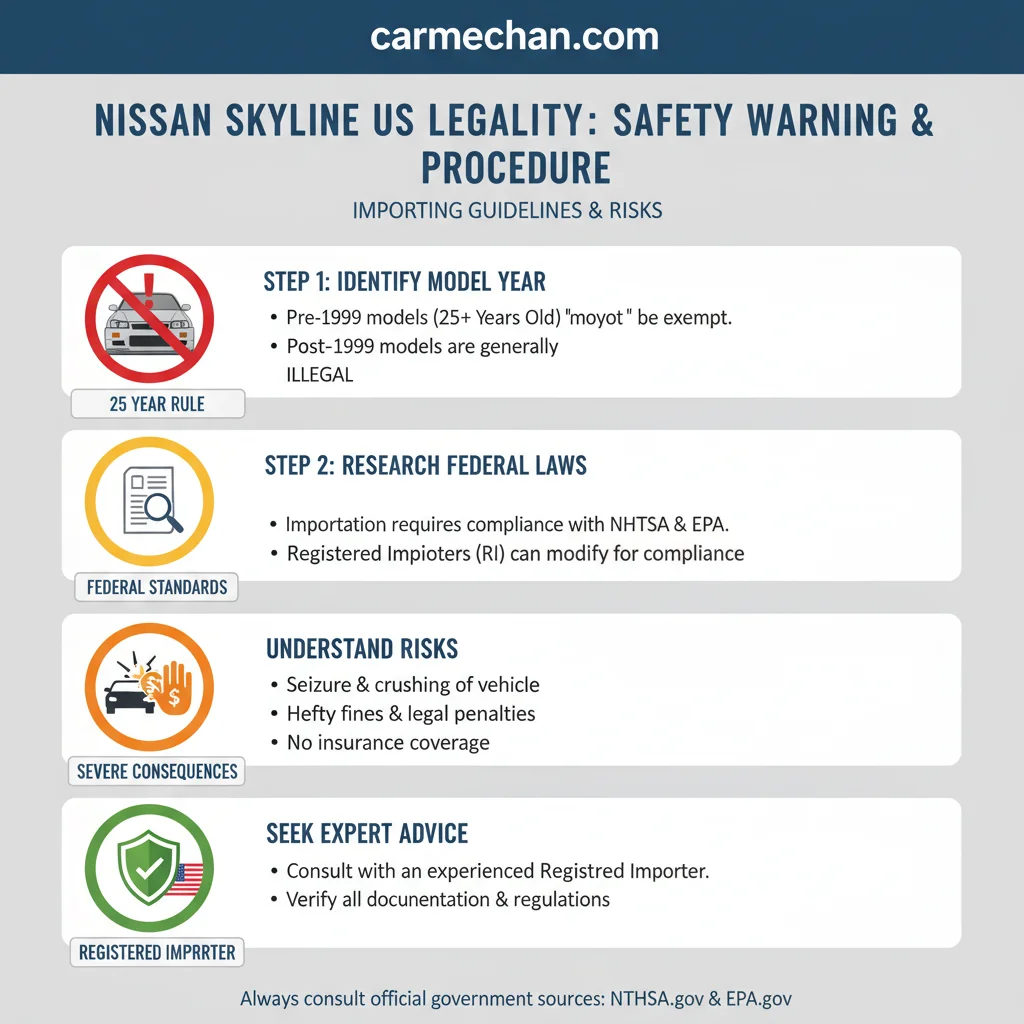
Certain conditions immediately disqualify a Nissan Skyline from legal importation under standard regulations, requiring a halt to the process. Proceeding under these conditions will result in significant legal and financial repercussions.
Do NOT proceed with importation if:
1. The Nissan Skyline is less than 25 years old AND lacks compliance certification from a DOT-registered importer and EPA-recognized Independent Commercial Importer.
2. The vehicle was stolen or is subject to a lien that prevents clear ownership transfer. Attempting to import a non-compliant Nissan Skyline can lead to severe penalties under 19 U.S.C. § 1595a(c), allowing U.S. Customs and Border Protection to seize and forfeit the vehicle. This civil penalty mechanism applies if the vehicle is imported in violation of import laws or regulations, regardless of intent. (Source: uscode.house.gov, cbp.gov)
3. You intend to misrepresent the vehicle’s age, condition, or purpose to circumvent import laws. This constitutes fraud and carries severe penalties. Intentionally smuggling a Nissan Skyline into the U.S. by making false declarations or evading customs procedures is a serious federal crime under 18 U.S.C. § 545, carrying penalties of up to 20 years imprisonment and substantial fines. This statute targets fraudulent importation aimed at circumventing federal laws. (Source: uscode.house.gov, justice.gov)
If any of these contraindications are present, stop all import activities immediately. Failure to do so will lead to vehicle seizure, substantial fines, and potential criminal charges. Do not attempt to modify a vehicle’s identification number (VIN) or manufacturer’s date for fraudulent purposes.
Beyond these outright prohibitions, many common errors can derail an otherwise compliant import attempt. This is why, ultimately, the dream of owning a Nissan Skyline in the US hinges entirely on adherence to federal regulations and meticulous planning.
5. Common Misapplications When Importing JDM Cars
We frequently observe critical missteps during the import process that lead to confiscation, fines, or failed registration. Avoiding these common misapplications is crucial for a successful Nissan Skyline import.

- Miscalculating the 25-Year Rule: People often count from the vehicle’s model year, not its precise manufacturing date. This can lead to importing a car that is technically 24 years and 11 months old, resulting in seizure at customs. A key exemption under 49 CFR Part 591, often referred to as the ’25-year rule,’ allows vehicles like certain Nissan Skylines (e.g., a 1999 Nissan Skyline GT-R imported in 2024) to be imported without conforming to Federal Motor Vehicle Safety Standards (FMVSS) if they are at least 25 years old from their original manufacture date. This rule exempts them from DOT compliance but not necessarily EPA emissions. (Source: ecfr.gov, nhtsa.gov)
- Ignoring State-Specific Requirements: A federally compliant imported vehicle may still not pass stringent state emissions or safety inspections (e.g., California). Failing to research state laws before importing can render the car unusable in your state. Even if a 25-year-old Nissan Skyline is federally legal to import, state-specific requirements for titling, registration, and emissions testing can still pose challenges. For example, some states require a physical inspection by the DMV or a state-certified mechanic to verify vehicle identification numbers (VIN) and ensure safety equipment is functional, potentially requiring modifications for turn signals or headlights not compliant with local standards. (Source: dmv.texas.gov, florida.dmv.com – consult specific state DMV websites)
- Attempting to DIY Compliance for Newer Vehicles: Importing a car under 25 years old without using a qualified Registered Importer (RI) and Independent Commercial Importer (ICI) for DOT and EPA modifications is a direct violation. Many believe they can perform modifications themselves, which is not legally permissible for certification purposes. For Nissan Skylines not old enough for the 25-year rule, a Registered Importer (RI) or Independent Commercial Importer (ICI) must perform extensive modifications and testing to bring the vehicle into compliance with both 49 CFR Part 591 (DOT safety standards) and 40 CFR Part 85, Subpart P (EPA emission standards). This process is extremely costly, often exceeding the vehicle’s value, and can take months or even years to complete. (Source: nhtsa.gov, epa.gov)
- Underestimating Costs and Time: Importers frequently underestimate the total cost, including shipping, duties, broker fees, state taxes, and potential compliance modifications. They also expect a rapid process, but import procedures can take months. This can lead to financial strain or abandoning the vehicle. All legally imported Nissan Skylines are subject to U.S. import duties and taxes, as per 19 U.S.C. § 1505, which mandates payment of duties upon entry. Typically, a 2.5% ad valorem duty applies to passenger vehicles, calculated on the purchase price, and a gas guzzler tax may also be assessed depending on the vehicle’s fuel economy. (Source: uscode.house.gov, cbp.gov)
These misapplications significantly increase the risk of an unsuccessful and costly import. Careful planning and adherence to precise regulations are paramount.
Even when following the protocol correctly, unique situations can arise that require specific adjustments to the standard procedure.
6. Edge Cases Specific Scenarios for Nissan Skyline Imports
Some Nissan Skyline import scenarios deviate from the standard protocol and necessitate alternative approaches to ensure legality. Understanding these specific situations can help you navigate less common pathways.
The Show or Display Exemption
This exemption permits the importation of certain historically or technologically significant vehicles that do not meet FMVSS, provided they are less than 25 years old. The vehicle must be certified by the DOT as having “historical or technological significance” and its use is restricted to 2,500 miles per year.
You must apply for and receive approval from the DOT before importation.
Non-Conforming Vehicles for Parts
It is possible to import a non-compliant Nissan Skyline for the exclusive purpose of dismantling it for parts. In this scenario, you must sign a declaration (HS-7, Box 4) stating the vehicle will never be registered or operated on public roads and must be rendered inoperable. This path does not allow for future registration or assembly of a road-legal vehicle.
Vehicles Imported by Non-Residents
Non-residents can temporarily import a non-compliant Nissan Skyline for up to one year for personal use, without modification, under a bond. The vehicle must be exported at the end of the temporary period. This is not a pathway for permanent importation and registration by U.S. residents.
If at any point the process becomes unclear or deviates significantly from these guidelines, professional intervention becomes necessary.
7. Escalation When to Consult a Licensed Import Broker or Attorney
If you encounter any deviation from the outlined protocol or face specific regulatory challenges, immediate escalation to a professional is mandatory. Attempting to navigate complex legal or compliance issues without expert assistance can lead to severe consequences.
If you receive a Notice of Seizure from U.S. Customs and Border Protection:
→ Contact a licensed customs attorney specializing in import/export law within 15 days to discuss your options for petitioning for release or mitigation.
If your state’s DMV refuses to title or register your federally cleared imported vehicle:
→ Consult with a local automotive attorney or a registered import broker to understand state-specific requirements and explore resolution options.
If you are unsure about the legitimacy of a “Show or Display” exemption application or a Registered Importer’s credentials:
→ Contact the National Highway Traffic Safety Administration (NHTSA) directly or consult with a licensed import broker before proceeding with any transactions.
Timely consultation with a professional can prevent costly mistakes and provide the expertise needed to resolve complex issues. Do not delay seeking professional advice when facing regulatory ambiguities or enforcement actions.
For further research and verification of the regulations discussed, consult the following authoritative sources.
8. References and Regulatory Documentation
The information provided in this guide is derived from the following federal agencies and legislative acts governing vehicle imports. We encourage all individuals to consult these primary sources for the most current and detailed regulatory information.
- U.S. Department of Transportation (DOT) / National Highway Traffic Safety Administration (NHTSA): Governs vehicle safety standards (FMVSS). Specific regulations can be found in 49 CFR Part 591 (Importation of Vehicles and Equipment).
- U.S. Environmental Protection Agency (EPA): Governs vehicle emissions standards. Relevant regulations are primarily in 40 CFR Part 85, Subpart P (Importation of Motor Vehicles and Motor Vehicle Engines).
- U.S. Customs and Border Protection (CBP): Oversees the entry of goods into the U.S. and collects duties/taxes. Relevant regulations are found in 19 CFR (Customs Duties) and forms like CBP Form 7501 (Entry Summary) and CBP Form 3461 (Entry/Immediate Delivery).
- Code of Federal Regulations (CFR): The codification of the general and permanent rules published in the Federal Register by the executive departments and agencies of the Federal Government. Specifically refer to Titles 19, 40, and 49.
- United States Code (U.S.C.): The codification by subject matter of the general and permanent laws of the United States. Key sections include 19 U.S.C. § 1625 (Customs Regulations) and 18 U.S.C. § 545 (Smuggling Goods into the United States).
Navigating the complexities of vehicle importation is challenging, but understanding these guidelines offers a clear path.
Frequently Asked Questions About Nissan Skyline Imports
5 Key Takeaways About Nissan Skyline Legality
Legally importing a Nissan Skyline into the US is a complex process primarily governed by the 25-year import rule, alongside stringent DOT and EPA compliance requirements. We have walked you through the five core steps: verifying age, ensuring compliance, preparing documentation, handling customs, and completing state registration.
vehicles less than 25 years old face significant hurdles, and misapplications can lead to severe penalties. Always consult official sources and licensed professionals if you encounter any ambiguities. Adhering strictly to these procedures is your only path to legally enjoying a Nissan Skyline on American roads.