Does BMW X3 Have Adaptive Cruise Control: Explained by Trim
Ever wondered if your BMW X3 is keeping an eye on the traffic ahead for you? Navigating the complexities of modern automotive technology can be daunting, especially when vehicle options change from year to year. Many owners struggle to distinguish between the standard cruise control included on every model and the advanced Active Cruise Control feature often reserved for premium trim levels. In this guide, we provide the expert information you need to identify, operate, and maintain the adaptive cruise control system in your BMW X3.
Understanding Does BMW X3 Have Adaptive Cruise Control
📤 Share Image
Dynamic vs. Active Cruise Control: Key Differences
It is vital to distinguish between two systems that often cause confusion. Dynamic Cruise Control (DCC) is standard on most BMW X3 models. This system maintains a set speed but does not automatically react to the vehicle in front of you. In contrast, Active Cruise Control (ACC)—the industry term for BMW’s adaptive system—continuously adjusts your speed to maintain a pre-selected distance from the vehicle ahead. If that vehicle slows down, your X3 slows down; if they stop, your X3 can come to a full stop.

Locating Your BMW X3 Driver Assistance Package
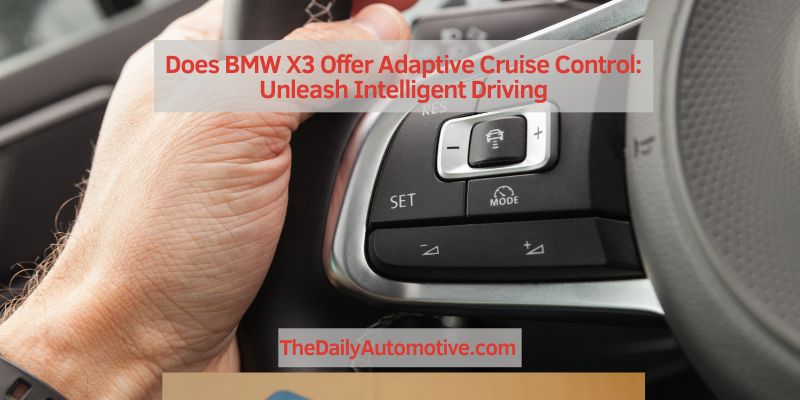
To determine if your specific X3 has this capability, the most reliable method is to examine the steering wheel controls. If you see buttons featuring horizontal distance bars (usually depicted as a car with vertical lines in front of it), your vehicle is equipped with Active Cruise Control. Alternatively, consult your vehicle’s window sticker for the Driver Assistance Professional Package. If you are buying used, utilize a professional VIN decoder to retrieve the factory build sheet, which will explicitly list all active safety features.

The Technology Behind How BMW X3 Have Adaptive Cruise Control
Radar Sensor and Stereo Camera Coordination
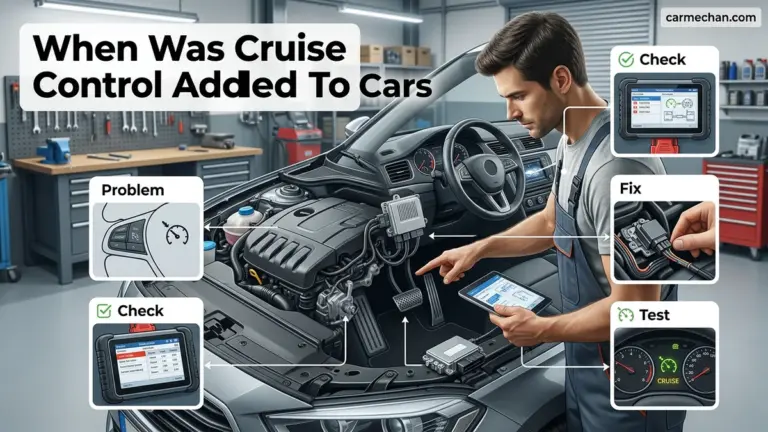
The system relies on a sophisticated fusion of hardware. A front-mounted radar sensor, typically housed in the lower center grille, measures the distance and closing speed of vehicles ahead. Simultaneously, a stereo camera mounted near the rearview mirror identifies lane markers and recognizes objects. By cross-referencing this data, the BMW iDrive system creates a high-fidelity map of your immediate environment, allowing for smooth, predictive acceleration and deceleration.
Electronic Control Unit: How Decisions Are Processed
The Electronic Control Unit (ECU) acts as the brain of the operation. It processes thousands of data points per second. When the radar detects a slow-moving vehicle, the ECU calculates the necessary braking force, engaging the Dynamic Stability Control (DSC) system to reduce speed. It is a semi-autonomous system; while the car manages longitudinal control, the driver must maintain constant oversight. It is not designed to replace human judgment, but to assist in reducing fatigue during long highway commutes or stop-and-go traffic.
Industry Data: System Performance
MPH Operating Range
Distance Settings
📋
Operating Your BMW X3 Adaptive Cruise Control
Press the ‘Cruise’ button on the left steering wheel spoke. A green icon will appear on your instrument cluster confirming the system is in standby mode.
Reach your desired speed and press ‘SET’. Use the +/- toggle to adjust velocity. Press the distance button (horizontal bars) to cycle through the four available following distance intervals.
Common Limitations of the BMW X3 Adaptive Cruise Control System
While these systems are highly reliable, they are not infallible. Understanding the operational boundaries is essential for any professional driver. Key pitfalls include:
- Environmental Hazards: Heavy snow, thick fog, or torrential rain can obscure the radar sensor, leading to a “Driver Assistance System Restricted” message.
- Stationary Object Detection: The system is primarily calibrated for moving traffic. In many versions, it may not reliably detect stopped vehicles if you are approaching them at high speed.
- Lane Geometry: In complex construction zones with shifting lane markings, the system can become confused. Always maintain manual control in these environments.
- Over-Reliance: Never treat the system as a fully autonomous feature. Driver attentiveness remains the most critical safety component of any BMW vehicle.
Even with the Driving Assistant Professional package, your BMW X3 requires your hands to be near the steering wheel and your eyes on the road. The system can disengage without warning if it loses track of its target or encounters a sensor failure.
Maintenance and Professional Troubleshooting
Troubleshooting Sensor Obstruction Errors
If your system flags an error, the first step is physical inspection. The radar sensor in the front bumper must be free of ice, heavy mud, or debris. A simple wipe with a soft microfiber cloth often resolves the issue. If the error persists, there may be a calibration issue or an internal fault with the radar unit itself, requiring a professional diagnostic scan via the dealership’s service portal.
Can You Retrofit Adaptive Cruise Control to an Older X3?
Many owners inquire about adding this feature later. While technically possible, it is rarely cost-effective. Retrofitting requires not only the radar sensor and wiring harness but also different steering wheel components, camera upgrades, and extensive software coding. For the average owner, the cost often exceeds the value of the upgrade. It is highly recommended to prioritize finding an X3 that already includes the package from the factory.
✅ Why It Is Reliable
- Seamless integration with engine/brake maps
- High-frequency radar provides accurate distance data
- Stop-and-Go functionality excels in heavy traffic
❌ Potential Issues
- Expensive repairs if the radar unit is damaged
- Calibration required after bumper work
- Performance drop in severe weather
Confirming if your model is equipped with the Driver Assistance Professional package is the best way to ensure you have the technology you expect. By mastering the steering wheel controls and understanding the environmental limitations, you can effectively utilize your BMW’s cruise capabilities to make every drive more relaxed. Always prioritize driver attentiveness, especially in stop-and-go traffic conditions, to get the most out of your vehicle’s safety stack. Check your BMW’s VIN or your original window sticker today to see exactly which driver aids your X3 is equipped with.
Does Bmw x3 Have Adaptive Cruise Control: Frequently Asked Questions
Is Adaptive Cruise Control standard on the BMW X3?
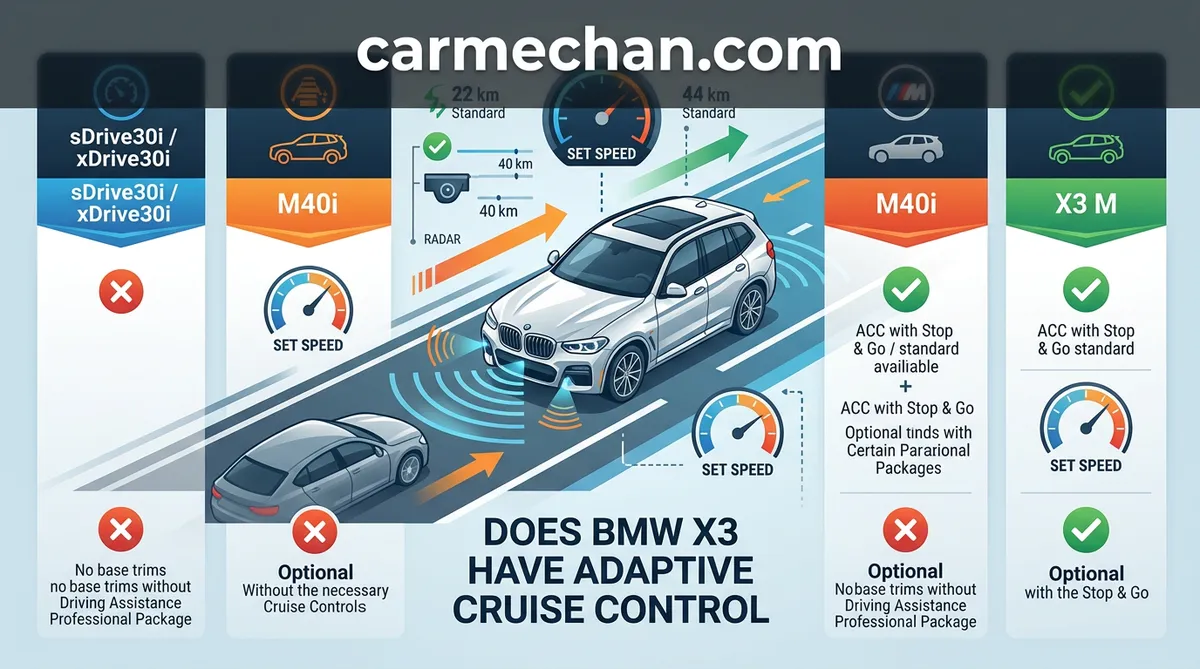
No, Adaptive Cruise Control (branded as Active Cruise Control with Stop & Go) is not standard on any BMW X3 trim level. It is historically offered as part of optional equipment groups, such as the Driving Assistance Professional or Premium packages. Buyers must explicitly select these packages at the time of order, meaning many base-level or mid-tier inventory units will not be equipped with the feature.
Can the X3 steer itself with cruise control?
Yes, if your BMW X3 is equipped with the ‘Driving Assistance Professional’ package, it includes ‘Steering and Lane Control Assistant.’ This allows for semi-automated driving functionality, providing subtle steering inputs to keep the vehicle centered in its lane at highway speeds. This should not be confused with fully autonomous driving; the driver must remain engaged and attentive at all times.
Does the X3 come to a complete stop in traffic?
Yes, when equipped with Active Cruise Control with Stop & Go, the BMW X3 can automatically decelerate to a complete stop if the vehicle in front does so. If the stop is brief, the car will automatically resume acceleration. If the vehicle remains stopped for an extended period, the driver must briefly press the ‘Resume’ button or tap the accelerator to initiate movement.
Can I upgrade my X3 to have Adaptive Cruise Control?
Retrofitting factory Adaptive Cruise Control is generally considered impractical and not recommended. It requires installing specialized radar sensors in the front bumper, replacing the steering wheel button cluster, and performing complex software coding and calibration that most dealerships will not authorize. It is significantly more cost-effective and reliable to source a vehicle that arrived from the factory with the hardware already installed.
How do I know if my X3 has the radar sensor?
You can identify the presence of the radar sensor by inspecting the lower front bumper. Models with Adaptive Cruise Control feature a distinct, usually rectangular or circular plastic sensor cover in the center of the air intake. Additionally, check the steering wheel controls: if you see specific ‘distance’ buttons with horizontal bars iconized, your vehicle is equipped with the radar-based cruise system.