Why Is Dental School So Expensive? Unpacking High Costs & Value
Last Updated on September 1, 2026 by Ryan
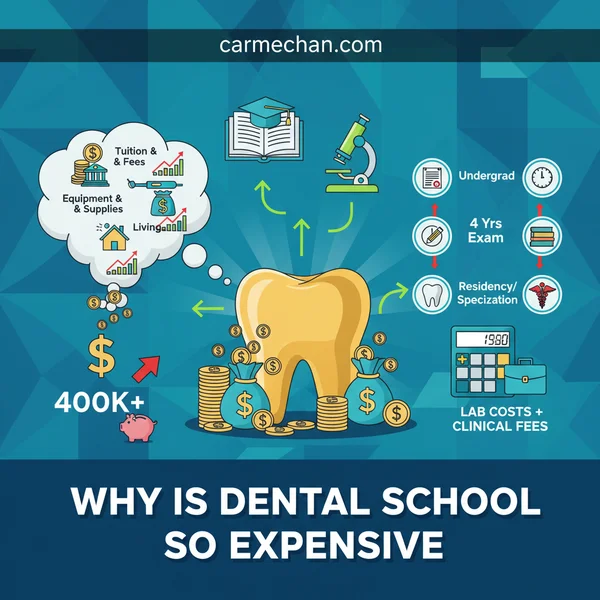
Dental school is inherently expensive primarily due to intensive clinical training, specialized equipment, and low student-to-faculty ratios, demanding significant institutional resources. This high investment covers sophisticated labs, costly materials, and expert instruction crucial for developing competent dental professionals.
🎯 Key Takeaways


- Clinical training facilities are a major cost driver.
- Specialized dental equipment requires huge investment.
- Low faculty-to-student ratios increase operational expenses.
- High-cost materials and lab maintenance add up.
- The expense reflects the profession’s high earning potential.
The sticker shock of dental school tuition is undeniable. You’re likely asking, why does this specific professional degree come with such a hefty price tag? The core answer lies in a confluence of highly specialized educational requirements and the unique operational demands of training future dentists. Unlike many other advanced degrees, dental education merges rigorous academic instruction with intensive, hands-on clinical training, necessitating a bespoke infrastructure that drives costs significantly higher.
Understanding these underlying expenses is crucial for prospective students. It allows you to contextualize the investment and appreciate the unique value proposition of a dental degree. This isn’t just about general university costs; it’s about the highly specific, intricate, and resource-intensive environment required to transform aspiring students into competent, ethical dental professionals ready to serve patients directly.
The Unique Cost Drivers of Dental Education
Dental schools operate under a set of financial pressures distinct from most university departments. The fundamental nature of dental practice demands a training environment that mirrors real-world clinics, leading to substantial infrastructure and operational expenses. These aren’t optional luxuries; they are indispensable components of a comprehensive dental education.

Specialized Equipment and Clinical Infrastructure
You cannot train a dentist with just textbooks and lectures. The very act of dentistry requires highly specialized, expensive equipment. Every student needs access to a fully functional operatory, which is essentially a miniature dental office.
- Dental Operatories: Each student requires a dental chair, sophisticated delivery units for drills and water, dedicated lighting, suction systems, and often integrated intraoral cameras. A single modern dental chair setup can cost upwards of $30,000-$50,000, and a school needs dozens, if not hundreds, of these.
- Advanced Imaging Technology: Digital X-ray units, panoramic X-ray machines, and increasingly, Cone Beam Computed Tomography (CBCT) scanners are essential for diagnosis and treatment planning. These systems represent six-figure investments per unit.
- Simulation Labs: Before working on actual patients, students hone skills in simulation labs. These labs feature high-fidelity mannequins with anatomically correct jaws, allowing practice with drills and instruments. Maintaining these labs, including consumables for the “patients,” adds significant expense.
- CAD/CAM Technology: Many schools now integrate computer-aided design and manufacturing (CAD/CAM) systems for creating crowns, bridges, and other restorations. These high-tech units and their associated software licenses are incredibly costly to purchase and maintain.
High-Cost Materials and Intensive Training
Beyond the fixed infrastructure, the day-to-day operation of a dental school clinic involves a constant outlay for specialized materials and the human capital required for close supervision.
- Consumables and Materials: Every filling, crown, impression, or root canal requires specific, often expensive, dental materials. Think of composite resins, impression materials, local anesthetics, sterile instruments, and disposable supplies. These are continuously purchased in vast quantities as students perform procedures. Schools often subsidize or entirely absorb the cost of these materials for student procedures.
- Patient Care Costs: While patients often pay reduced fees for treatment at dental schools, these fees rarely cover the full operational cost. The school effectively subsidizes much of the patient care, providing a crucial service to the community while ensuring students gain necessary clinical experience.
- Low Student-to-Faculty Ratios: Clinical dentistry is not learned in a lecture hall. It requires direct, one-on-one supervision from experienced dentists. For patient safety and effective learning, dental schools must maintain extremely low student-to-faculty ratios in their clinics, often as low as 1:4 or 1:6. This means employing a large number of highly qualified, practicing dentists as instructors, which is a significant payroll expense.
Institutional Factors and Rising Tuition Trends
Beyond the unique demands of dental education, broader trends within higher education and the specific operational needs of a professional school contribute significantly to the high cost you see. Dental schools are not immune to the financial pressures facing all universities, but they often face magnified versions of these challenges.
Administrative Overhead and Specialized Faculty
Running a professional school, particularly one with extensive clinical operations, requires a substantial administrative and support infrastructure. This isn’t just about general university management; it’s about specialized oversight for clinical compliance, patient records, materials procurement, and equipment maintenance.
- Highly Specialized Faculty Salaries: Dental school faculty are not just academics; many are highly experienced, often actively practicing dentists. Their salaries must be competitive with what they could earn in private practice, leading to higher compensation packages than faculty in many other academic departments. Attracting and retaining top talent in a field where private practice offers lucrative alternatives is a constant financial challenge for institutions.
- Extensive Support Staff: Beyond faculty, dental schools require a large support staff: clinic managers, dental assistants, lab technicians, sterilization staff, patient coordinators, and IT specialists to manage complex dental software and equipment. Each role is crucial for smooth, safe operation.
- Modern Facilities Maintenance: The sophisticated equipment and clinical spaces described earlier require constant maintenance, repairs, and technological upgrades. These are specialized tasks often performed by highly skilled technicians, adding to operational costs.
Accreditation and Research Demands
Accreditation is paramount for any dental school, ensuring the quality and integrity of the education provided. Meeting these stringent standards involves significant financial commitment. Furthermore, many dental schools are integrated into larger research universities, bearing some of the associated research infrastructure costs.
- Accreditation Compliance (CODA): The Commission on Dental Accreditation (CODA) sets rigorous standards for curriculum, facilities, faculty qualifications, and clinical experiences. Meeting and maintaining these standards requires ongoing investment in all areas of the school, from technology to curriculum development and faculty training. Non-compliance can jeopardize a school’s ability to operate.
- Research Infrastructure: Many dental schools are integral parts of major research institutions. While research often attracts grants, the underlying infrastructure – labs, specialized equipment, research administration, and faculty time dedicated to research – contributes to the overall institutional overhead that tuition helps to cover.
- Perceived Value and Market Demand: The dental degree holds significant perceived value, leading to high earning potential upon graduation. This strong market demand and the exclusivity of the degree can influence what institutions feel justified in charging for tuition. Schools know they are providing a pathway to a highly respected and financially rewarding career.
The Investment: Debt, Earning Potential, and ROI
While the sticker price of dental school can be daunting, it’s crucial to view it as a significant investment in a high-demand, well-compensated profession. Understanding the potential for debt alongside future earning potential helps paint a complete picture of the return on investment (ROI).
Navigating Dental Student Debt
Graduating from dental school often means carrying a substantial amount of student loan debt. Current averages hover in the range of $300,000 to $400,000 for a four-year program. This figure can be higher depending on the institution, whether you attended public or private school, and if you pursued advanced specialization. The key is to be proactive:
- Early Financial Planning: Research financing options and scholarships long before applying.
- Understand Interest: Interest accrues over time, significantly increasing the total repayment amount.
- Budgeting Skills: Develop strong budgeting habits during school to minimize additional borrowing for living expenses.
Earning Potential and Return on Investment (ROI)
The good news is that dentists enjoy a robust earning potential, which makes the hefty investment worthwhile for many. General dentists typically earn upwards of $160,000 to $200,000 annually, with specialists earning even more. This strong income allows graduates to manage their debt effectively over time.
Factors influencing your ROI include:
- Specialization: Orthodontists, oral surgeons, and endodontists often command higher salaries.
- Location: Earning potential can vary significantly by geographic region.
- Practice Ownership: Owning your practice can lead to greater income, though it comes with additional business responsibilities and costs.
Despite the initial debt, the long-term financial stability, career satisfaction, and ability to make a tangible difference in patients’ lives contribute to a very positive return on investment for many dental professionals.
Comparing Dental School Costs: Public vs. Private Options
When evaluating dental programs, one of the most significant cost differences you’ll encounter is between public and private institutions. Making an informed choice here can drastically impact your overall financial burden.
Public Institutions: A More Affordable Path
State-funded dental schools often present a more budget-friendly option, particularly for in-state residents. These universities receive government subsidies, which helps lower tuition rates compared to their private counterparts. For example, a student attending an in-state public university dental program might pay annual tuition and fees ranging from $30,000 to $60,000, whereas out-of-state tuition at the same school could be $60,000 to $90,000 or more.
Practical Tip: Prioritize applying to public dental schools in your home state. This is often the most strategic move for minimizing tuition costs. Even out-of-state tuition at a public school can sometimes be more competitive than a private school’s rate.
Private Institutions: Higher Price Tag, Unique Benefits
Private dental schools, unreliant on state funding, typically have significantly higher tuition costs. Annual tuition and fees at these institutions can range from $70,000 to $100,000 or more, regardless of your residency status. While the cost is higher, private schools often boast:
- Smaller class sizes, potentially leading to more individualized attention.
- Cutting-edge facilities and technology, sometimes more advanced than public counterparts.
- Unique curricula or specialized programs.
Specific Advice: If you’re considering a private institution, meticulously research their financial aid packages, scholarship opportunities, and alumni networks. While the sticker price is higher, some private schools offer generous aid that can make them competitive with public options, depending on your individual circumstances and merit.
The Bottom Line: Investing in a Rewarding Career
Dental school’s high cost stems from a confluence of factors: the specialized, equipment-intensive curriculum, a low student-to-faculty ratio, extensive clinical training requirements, and the need for highly skilled faculty and ongoing research. It’s a substantial financial undertaking, but one that opens doors to a respected, stable, and financially rewarding career.
Prospective students should approach this journey with careful financial planning. Research all available financial aid, prioritize public in-state options if possible, and meticulously plan for managing debt post-graduation. While the journey to becoming a dentist is costly, the ability to positively impact oral health, enjoy professional autonomy, and achieve significant financial security makes it a valuable investment in your future.
❓ Frequently Asked Questions
What specific equipment makes dental school so expensive?
Dental schools invest heavily in modern dental chairs, advanced digital imaging systems (X-ray, CT), CAD/CAM technology, and simulation labs with haptic feedback, all of which are costly to purchase, maintain, and regularly upgrade.
How do faculty-to-student ratios impact dental school tuition?
Effective clinical training requires a very low student-to-faculty ratio, often 4:1 or less, meaning more highly paid specialist instructors are needed per student, significantly increasing operational and salary costs for the institution.
Beyond tuition, what are the hidden costs of dental school?
Students face substantial additional costs for specialized instruments, textbooks, licensing exam fees, professional liability insurance, living expenses, and potentially expensive externships or rotations not fully covered by tuition.
Does research funding contribute to high dental school expenses?
Yes, dental schools often engage in cutting-edge research requiring expensive lab equipment, specialized materials, and highly qualified personnel, which indirectly contributes to the overall institutional budget and subsequently, tuition fees.
How does accreditation influence the cost of dental education?
Maintaining accreditation standards from bodies like the ADA Commission on Dental Accreditation (CODA) requires continuous investment in faculty development, state-of-the-art facilities, updated curriculum, and technology, ensuring quality but also adding to operational costs.
Is the return on investment (ROI) for a dental degree generally considered good despite the high cost?
Despite the significant upfront cost and student loan debt, the long-term earning potential for dentists is typically high, often justifying the investment over a career, though individual ROI varies based on debt load, specialty, and practice type.