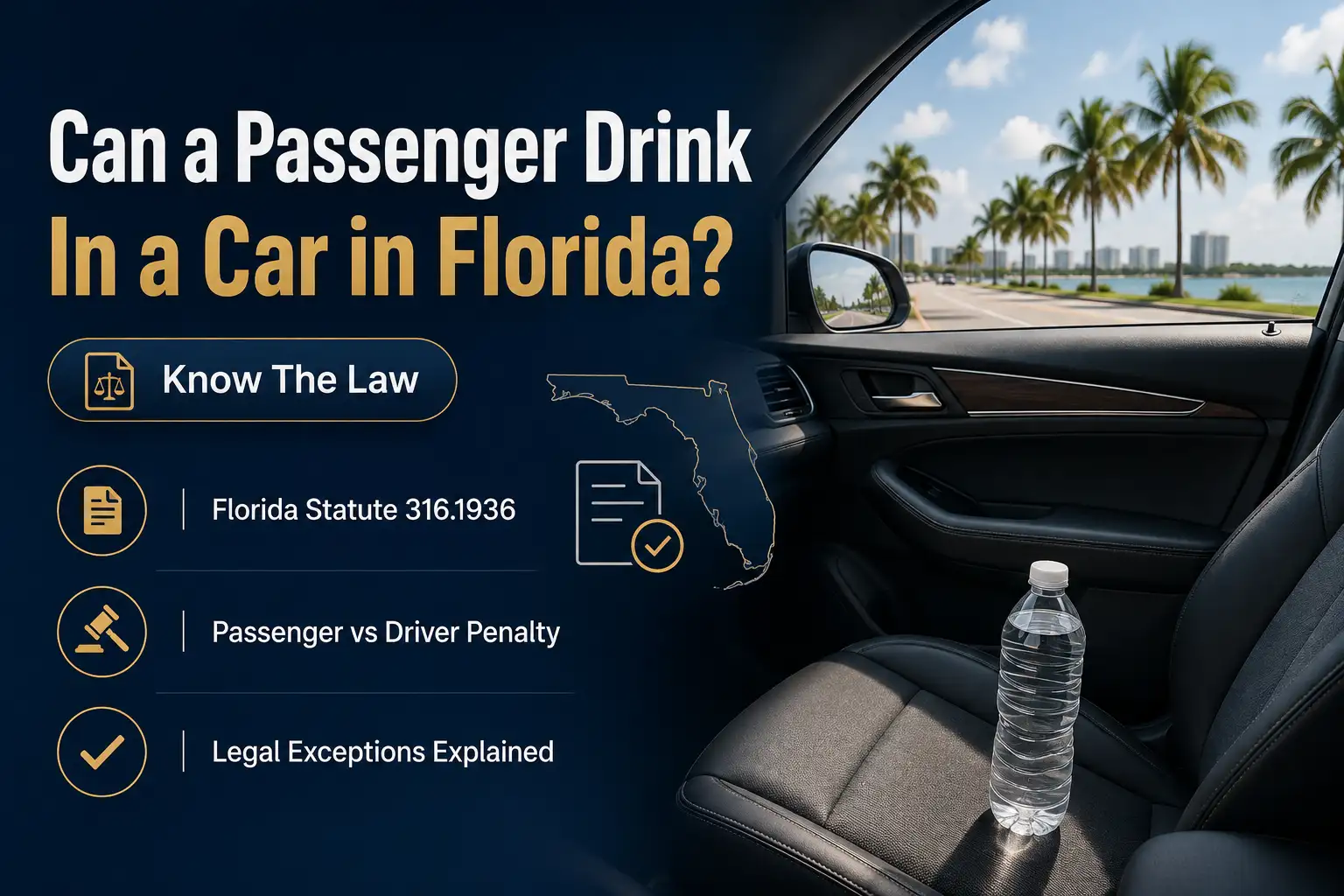
Can a Passenger Drink in a Car in Florida? What the Law Says
No, a passenger cannot drink in a standard car in Florida. Under Florida Statute 316.1936, it is illegal for anyone in a vehicle, whether driving or riding, to possess an open container of alcohol or consume alcohol while the vehicle is on a public road.
There are a handful of specific exceptions, mainly for commercial vehicles and motorhomes, and the penalty a passenger faces is different from what a driver faces. This guide breaks down exactly what the law covers, where it doesn’t apply, and how to stay compliant if you’re transporting alcohol in a personal vehicle.

Prime for Young Adults — 6 Months Free
Students and 18–24s get six months of Prime free, then half price.
Start 6 Months FreeWhat Florida’s Open Container Law Actually Says
Recommended Best Deal Products


Florida’s open container law is codified at Florida Statute 316.1936, which prohibits possessing or consuming alcohol in a vehicle on any road open to public travel, including streets, highways, and alleys. The statute defines an open container as any alcoholic beverage container that is immediately capable of being consumed from, or whose seal has already been broken.

That definition matters because it doesn’t require someone to actually be drinking. A can with the tab popped or a bottle with a broken seal counts as an open container even if no one has taken a sip. The law also applies even if the vehicle is parked on a public road, not just while it’s moving, which catches a lot of people off guard during a quick roadside stop.
Who gets cited depends on where the container is found. The law treats an open container as being in a passenger’s possession if it’s in that passenger’s physical control, and as being in the driver’s possession if it isn’t in a passenger’s control and isn’t secured in a locked glove compartment, locked trunk, or other locked nonpassenger area. This distinction is why simply moving a drink from one seat to another during a traffic stop doesn’t change who’s actually responsible under the statute.
Passenger Penalty Versus Driver Penalty
Florida treats a passenger’s open container violation differently than a driver’s. A passenger caught with an open container receives a non-moving violation, meaning it results in a fine but does not add points to their license. A university-published summary of Florida traffic laws confirms this split, noting that drivers receive a moving violation while passengers receive a separate, lower non-moving violation under the same statute.
A driver’s open container violation, by contrast, is a moving violation. That distinction matters for insurance, since moving violations are more likely to affect a driver’s premiums than a non-moving citation issued to a passenger, and Florida’s car insurance rates are already among the higher ones nationally even without added citations. Exact fine amounts can vary somewhat by county due to added court costs, so the specific total on a citation may differ from a flat statewide number.
The practical takeaway is that a driver has more at stake than a passenger does under this particular statute, even though both can be cited in the same traffic stop. That asymmetry is part of why the law separates possession by physical control in the first place.
When A Passenger Can Legally Drink In A Car
Recommended Best Deal Products


Florida’s law carves out specific exceptions where a passenger can legally have an open container. These generally apply to vehicles built and operated for paid passenger transport, not everyday personal cars, so most readers won’t qualify for them in day-to-day driving.
- Commercial vehicles: Limousines, party buses, and charter buses operated under a contract to transport passengers
- Buses with a commercially licensed driver: Passengers on a bus operated by someone holding a valid commercial driver’s license
- Motorhomes and RVs: Passengers in the living quarters of a motorhome, separate from the driver’s area
- Previously opened, resealed containers: For example, a recorked bottle of wine from a restaurant, as long as it’s stored outside the passenger area
The driver in any of these situations is still prohibited from possessing or consuming alcohol while operating the vehicle, even where passenger exceptions apply. The exception is specifically for passengers, not a general pass for everyone in the vehicle.

Audible — Listen Free for 30 Days
One free credit a month and thousands of titles included.
Listen Free for 30 DaysDoes This Apply To Uber And Lyft
Yes. Uber and Lyft drivers do not hold commercial driver’s licenses in the way the exception requires, so the standard open container law still applies to passengers riding in a rideshare vehicle. If a passenger has an open container and the vehicle is pulled over, that passenger can be cited under the same rules that apply to a personal car.
This surprises a lot of riders who assume a hired ride works like a limo or party bus exception. It doesn’t, since the commercial driver’s license requirement is the deciding factor, not simply whether the ride was booked through an app. The same logic applies to other on-demand ride services that use standard personal vehicles rather than commercially licensed drivers.
How To Legally Transport Alcohol In A Car
If you need to transport alcohol in a personal vehicle, keep any open or partially consumed containers in the trunk or a locked glove compartment, away from the passenger area entirely. A sealed, unopened container can generally be transported in the passenger area without issue, since it doesn’t meet the statute’s definition of an open container.
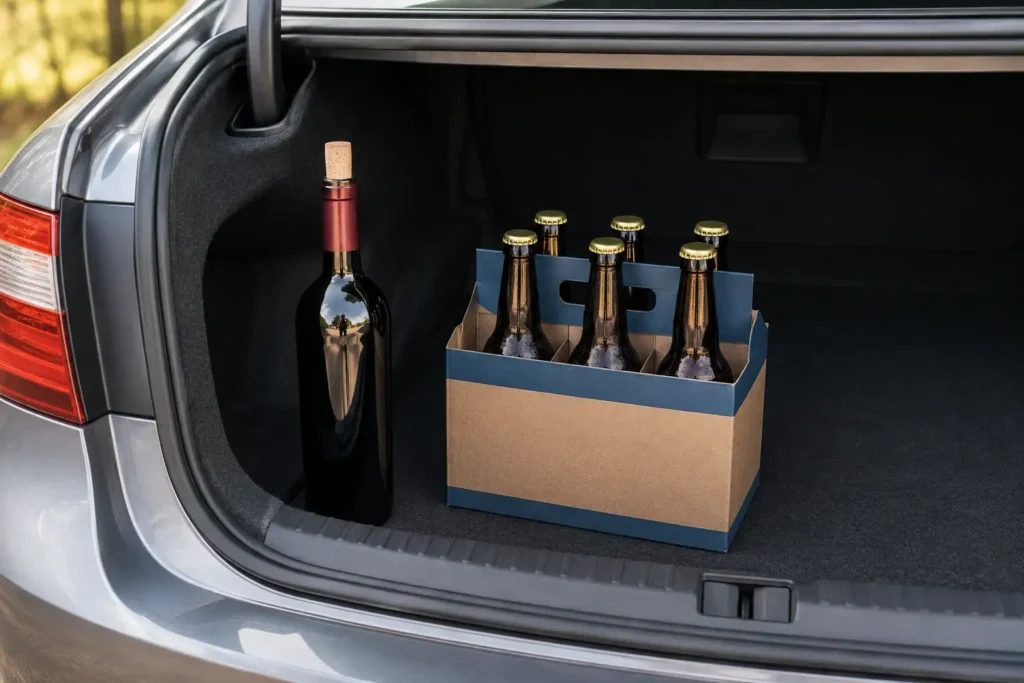
If a bottle was opened elsewhere, such as a restaurant sending home a recorked bottle of wine, store it in the trunk rather than the cabin to stay clearly within the law. This same approach applies to leftover drinks from a tailgate, beach day, or party, since it’s the container’s condition and location that matters, not the occasion.
When in doubt, treat any container that’s been opened as one that belongs in the trunk. This simple habit avoids the guesswork around what specifically counts as broken seal versus resealed, and keeps everyone in the vehicle clear of a citation.
Florida Passenger Open Container Quick Reference
The table below summarizes the most common situations readers ask about, based on the exceptions and definitions covered above.
| Situation | Legal Or Not | Penalty If Violated |
|---|---|---|
| Passenger drinking in a personal car | Not legal | Non-moving violation fine, no license points |
| Passenger drinking in a limo or party bus | Legal | Not applicable |
| Passenger drinking in Uber or Lyft | Not legal | Non-moving violation fine, no license points |
| Passenger drinking in RV living quarters | Legal | Not applicable |
| Sealed bottle stored in trunk | Legal | Not applicable |
Florida Open Container Law FAQ
Does the law apply if the car is parked?
Yes. The statute applies as long as the vehicle is on a road open to public travel, whether it’s moving or parked. Only being on private property, like a private driveway, moves outside the law’s reach, so a parking lot that’s open to public access still counts, including most shopping center and beach access lots.
Can a passenger hold a resealed bottle of wine?
A bottle that has already been opened and then resealed, such as a recorked restaurant bottle, still counts as an open container under the statute’s definition. It should be stored in the trunk rather than held in the passenger area for the rest of the ride home, even if the cork appears fully back in place.
What counts as the passenger area of a vehicle?
The passenger area generally means anywhere within reach of someone seated in the vehicle, as opposed to a locked glove compartment, locked trunk, or another locked nonpassenger storage area specifically excluded by the statute. An unlocked glove box or center console does not qualify for the exception, since it remains within a passenger’s reach.
Audible Premium Plus — Annual Membership
12 audiobook credits up front, plus the full Audible catalogue.
See Annual PlansCan local cities add stricter rules?
Yes. Florida law allows counties and cities to adopt additional local ordinances restricting alcohol possession in vehicles beyond the state law, so some areas may have added restrictions worth checking locally, particularly around beach access roads or entertainment districts where local rules tend to be tighter.
Is this the same as a DUI charge?
No. An open container violation is separate from a DUI charge. A DUI involves operating a vehicle while impaired, while an open container violation is about possessing or consuming alcohol in the vehicle regardless of impairment level, and a person can receive one without the other, including a passenger who was never at risk of driving at all.
Florida’s open container law makes it illegal for a passenger to drink or hold an open container in a standard personal vehicle, with specific exceptions for commercial vehicles like limos and party buses, and for the living quarters of a motorhome. Uber and Lyft do not qualify for the commercial exception, so the same rules apply there as in a personal car. The safest approach when transporting alcohol in any personal vehicle is to keep it sealed or stored out of the passenger area entirely.
This article explains Florida’s open container law in general terms and is not legal advice. If you’re facing a citation or have questions about a specific situation, consult a licensed Florida attorney for guidance tailored to your case.