How To Check Your 2015 Nissan Versa Transmission Fluid Level
Last Updated on September 1, 2026 by Ryan
⚡ Key Takeaways
- It’s recommended to check your 2015 Nissan Versa’s CVT fluid every 15,000 to 30,000 miles or at least once a year, as part of your routine maintenance.
- The 2015 Nissan Versa, equipped with a Continuously Variable Transmission (CVT), specifically requires Nissan NS-2 or NS-3 CVT fluid.
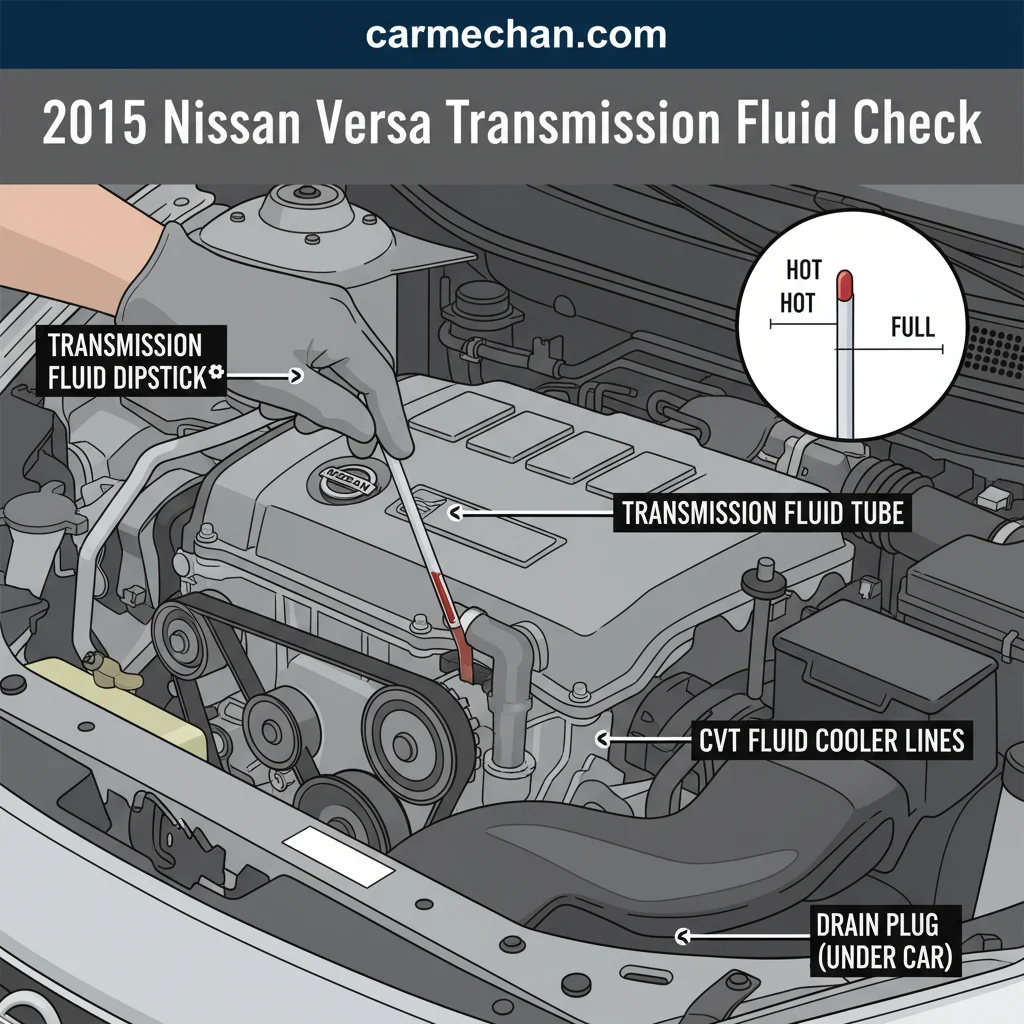
- The 2015 Nissan Versa’s CVT fluid dipstick is typically located on the passenger side of the engine bay.
- Burnt transmission fluid, characterized by a dark brown or black color and a strong, acrid odor, indicates severe overheating within your Versa’s transmission.
- Step-by-step instructions on how to check the transmission fluid level.
Successfully performing a 2015 Nissan Versa transmission fluid check involves specific steps due to its Continuously Variable Transmission (CVT) system. We will guide you through verifying your fluid level, ensuring your engine is at operating temperature and running, and using the correct Nissan NS-2 or NS-3 CVT fluid specification. This precise procedure helps maintain your vehicle’s longevity and performance.
What This Guide Covers for Your Versa


This guide provides a precise, step-by-step protocol for performing a 2015 Nissan Versa transmission fluid check. We detail the necessary tools, safety precautions, the exact procedural steps for a Continuously Variable Transmission (CVT), and how to interpret fluid conditions accurately. Our focus is on ensuring you maintain optimal CVT performance and understand when professional intervention becomes necessary.
This guide does NOT cover transmission fluid replacement, flushing procedures, or comprehensive transmission diagnostics.
Who Needs This 2015 Versa Fluid Check Guide


This guide is specifically for owners of a 2015 Nissan Versa equipped with a Continuously Variable Transmission (CVT) who wish to accurately check their vehicle’s transmission fluid level. You should be comfortable working safely around a running engine and capable of following detailed, sequential instructions.

Prerequisites include possessing basic hand tools and having access to a level surface for your vehicle. If you lack mechanical experience or feel uncertain, we recommend seeking professional assistance.
Step-by-Step 2015 Nissan Versa Fluid Check


We provide a precise, step-by-step procedure for checking your 2015 Nissan Versa’s transmission fluid level, ensuring accuracy and safety.

-
Prepare the Vehicle and Gather Tools:
- Step 1: Park your 2015 Nissan Versa on a completely level surface. Verify the parking brake is engaged securely. If the vehicle is on an incline, stop immediately and reposition it on a flat area to ensure an accurate fluid reading.
- Step 2: Gather necessary tools, including a clean shop rag, safety gloves, a funnel, and new Nissan NS-2 or NS-3 CVT fluid, if required. Verify all items are within reach.
-
Achieve Operating Temperature:
- Step 3: Start the engine and allow it to reach normal operating temperature, typically after 10-15 minutes of driving or idling. Verify the engine temperature gauge indicates the normal operating range. If the engine is cold, stop the procedure and allow more time for warming, as cold fluid levels are inaccurate. [automotive repair manual]
-
Position for Check:
- Step 4: Keep the engine running during the entire fluid check process. Verify the transmission is in Park (P). If the engine is off, stop and restart it, as an accurate reading requires fluid circulation.
-
Locate the Dipstick:
- Step 5: Locate the transmission fluid dipstick, which is typically yellow or red, on the passenger side of the engine bay, slightly towards the rear. Verify you have found the correct transmission dipstick, not the engine oil dipstick. If you cannot locate it, stop and consult your owner’s manual for the exact location.
Locating the Transmission Fluid Dipstick (2015 Nissan Versa)
BatteryBrake FluidEngine AreaDipstick
Transmission Fluid DipstickThis is the transmission fluid dipstick. It typically has a yellow loop handle and is smaller than the engine oil dipstick. Located on the passenger side, closer to the firewall.The transmission fluid dipstick in a 2015 Nissan Versa (especially CVT models) is generally located on the passenger side of the engine bay, closer to the firewall. It often features a distinct yellow, sometimes orange, loop-shaped handle and is usually smaller than the engine oil dipstick. Always consult your owner’s manual for precise instructions and location.
“`
- Step 5: Locate the transmission fluid dipstick, which is typically yellow or red, on the passenger side of the engine bay, slightly towards the rear. Verify you have found the correct transmission dipstick, not the engine oil dipstick. If you cannot locate it, stop and consult your owner’s manual for the exact location.
-
Initial Dipstick Clean:
- Step 6: Carefully pull the transmission dipstick straight out. Verify the dipstick comes out smoothly. If resistance is felt, investigate before proceeding.
- Step 7: Wipe the dipstick clean with a shop rag. Verify all old fluid residue is removed from the dipstick. If residue remains, wipe again for a completely clean surface.
-
Check Fluid Level:
- Step 8: Reinsert the dipstick fully into the transmission fluid tube until it seats properly. Verify the dipstick is fully seated.
- Step 9: Pull the dipstick out again and immediately observe the fluid level. Verify the fluid level falls between the “HOT” or “FULL” marks on the dipstick. If the level is below the “LOW” mark, proceed to Step 10. If the level is above the “FULL” mark, stop and escalate to a professional mechanic, as overfilling causes damage.
FULL (HOT)
LOW (HOT)Acceptable Hot Range
-
Assess Fluid Condition:
- Step 10: Examine the fluid on the dipstick for color, smell, and consistency. Verify the fluid is translucent red, free from particles, and has a slightly sweet odor. If the fluid appears dark brown or black, contains metal particles, or emits a strong, burnt odor, stop immediately and contact a professional mechanic, as this indicates severe internal wear. [automotive technical guide]
-
Add Fluid (If Necessary):
- Step 11: If the fluid level is low and the condition is good, carefully add small amounts of *only* Nissan NS-2 or NS-3 CVT fluid through the dipstick tube using a clean funnel. Verify you are using the correct specification of fluid. [manufacturer manual] If you use any other fluid type, stop and drain immediately, then flush with correct fluid, or escalate to a professional.
- Step 12: Add fluid incrementally, rechecking the level frequently (Steps 8-9) until it reaches the “HOT” or “FULL” mark. Verify the fluid level is within the acceptable range without overfilling.
-
Secure and Conclude:
- Step 13: Reinsert the dipstick firmly into its tube. Verify the dipstick is fully seated and secured. If the dipstick is loose, stop and reseat it, as a loose dipstick can lead to leaks and contamination.
- Step 14: Clean up any spilled fluid and dispose of rags properly. Verify the engine bay is free of fluid spills.
When Not to Check Versa Transmission Fluid
We advise against performing a 2015 Nissan Versa transmission fluid check under specific conditions that can yield inaccurate results or pose safety risks. If any of these contraindications are present, stop immediately and seek professional advice to prevent potential damage or injury.
You must not attempt to check your Versa’s transmission fluid if:

- The vehicle is not on a level surface. An incline prohibits accurate fluid level readings. Verify your vehicle is perfectly flat. If not, stop the procedure.
- The engine is cold or off. The 2015 Nissan Versa’s CVT requires the engine to be at operating temperature and running to circulate fluid properly for a correct reading. Verify the engine is hot and running in Park. If not, stop. [automotive repair manual]
- You cannot identify the correct transmission dipstick. Mistaking it for the engine oil dipstick will lead to incorrect procedures and potential vehicle damage. Verify the dipstick is yellow or red and clearly labeled for transmission. If unsure, stop and consult your owner’s manual.
- The transmission feels exceptionally hot or you smell a strong, burnt odor. This indicates a severe issue that requires immediate professional diagnosis, not a fluid check. Verify no burnt smell is present. If it is, stop immediately and contact a professional. [automotive technical guide]
- You do not have the specified Nissan NS-2 or NS-3 CVT fluid for topping off. Using incorrect fluid types causes irreversible damage to the CVT. Verify you have the correct fluid type on hand. If not, stop the procedure. [manufacturer manual]
Common Mistakes When Checking Versa Fluid
We frequently observe several common errors DIYers make when attempting a 2015 Nissan Versa transmission fluid check, which often leads to inaccurate readings or even transmission damage. Understanding these misapplications helps prevent costly repairs.
-
Checking Fluid with the Engine Off: Many assume transmission fluid checks are like engine oil checks, performed with the engine off. For your Versa’s CVT, the engine must be running at operating temperature to ensure proper fluid circulation and expansion. If you check with the engine off, you will get a falsely low reading, leading to overfilling.
Overfilling the transmission creates excessive pressure, causes fluid aeration, and can lead to seal failures and expensive transmission repairs. [automotive engineering journal]
-
Using Incorrect Fluid Type: The 2015 Nissan Versa’s CVT specifically requires Nissan NS-2 or NS-3 CVT fluid. We see owners using generic automatic transmission fluid (ATF) or even different brands of CVT fluid not approved by Nissan. If you use the wrong fluid, it compromises the CVT’s delicate belt and pulley system, leading to premature wear, shuddering, and eventual transmission failure.
Always verify the fluid specification matches your owner’s manual exactly. [manufacturer manual]
-
Failing to Reach Operating Temperature: Checking the fluid when the transmission is cold yields an inaccurate, low reading. Fluid expands as it heats. If you top off a cold transmission to the “full” mark, the fluid will expand when hot, causing overfilling. This can lead to the issues mentioned above, including leaks and damage to internal components.
Verify the engine and transmission are at full operating temperature before taking a reading. [automotive repair manual]
-
Ignoring Fluid Color and Odor: Simply checking the level is insufficient; the fluid’s condition provides critical diagnostic information. If you only look at the level and ignore a dark, burnt-smelling fluid, you miss crucial signs of internal component wear or overheating. This oversight postpones necessary repairs, escalating minor issues into catastrophic transmission failures.
Always verify the fluid’s color is translucent red and it does not smell burnt. [automotive technical guide]
Unusual Scenarios During Versa Fluid Inspection
While the standard 2015 Nissan Versa transmission fluid check protocol applies to most situations, certain unusual scenarios may arise. We provide guidance on how to navigate these deviations effectively.

-
Fluid Level Fluctuates After Repeated Checks: If you perform the dipstick check several times and get slightly different readings, it typically indicates that not all the fluid has settled in the pan or there might be some aeration.
If fluid level fluctuates:
→ Wait 5 minutes with the engine running, cycle through all gear positions (P-R-N-D-L), then recheck the fluid level. Verify readings become consistent. If readings remain highly inconsistent, stop and consult a professional technician, as this might indicate an internal transmission issue.
-
Dipstick Shows Foam or Bubbles: The presence of foam or excessive bubbles on the dipstick suggests fluid aeration, which can be caused by overfilling, a low fluid level (causing the pump to pull air), or contamination.
If foam or bubbles are present:
→ Immediately recheck the fluid level for overfilling or severe low level. If the level is correct, but foam persists, stop driving and contact a professional mechanic to diagnose potential issues like fluid contamination or internal component wear.
-
Fluid Appears Milky or Discolored (Not Burnt): Milky fluid usually signals water contamination, possibly from a compromised transmission cooler or a leak in the cooling system. This is a severe issue.
If fluid appears milky or significantly discolored (e.g., green/pink):
→ Stop driving the vehicle immediately. Do not attempt to add fluid or drive further. Escalate to a professional mechanic within 24 hours, as significant internal damage can occur rapidly with contaminated fluid.
When to Seek Professional Mechanic Help
Knowing when to escalate an issue from a DIY fluid check to a professional mechanic is crucial for preventing further damage and ensuring your 2015 Nissan Versa’s longevity. We strongly advise seeking expert help in the following situations:
- Persistent Low or High Fluid Level After Correction: If, after carefully adding the correct Nissan NS-2/NS-3 CVT fluid, the level consistently remains low, or if you encounter persistent overfilling despite adjustments, this indicates a potential leak or an internal sensor malfunction. If this occurs, contact a certified Nissan technician within 48 hours to diagnose the root cause.
- Fluid Appearance Indicates Contamination or Severe Wear: If the transmission fluid appears milky, contains metallic shavings, or emits a strong, burnt odor after your check, these are definitive signs of serious internal damage or contamination. If this condition is observed, stop driving the vehicle immediately and arrange for towing to a professional automotive repair shop within 24 hours for a comprehensive transmission inspection. [automotive technical guide]
- Difficulty Locating Dipstick or Fill Point: If you are unable to correctly identify the transmission fluid dipstick or fill point after consulting your owner’s manual, or if you struggle with the physical aspects of accessing these components safely, attempting to force it can cause damage. If this difficulty arises, contact a trusted mechanic to perform the fluid check safely and correctly.
- Transmission Performance Issues Develop: If you experience symptoms such as slipping gears, delayed engagement, harsh shifting, or unusual noises before, during, or after checking the fluid, these are indicators of a deeper transmission problem. If such symptoms are present, stop driving the vehicle and contact a Car Mechan certified technician or a Nissan dealership service center within 24 hours for a diagnostic evaluation. [automotive maintenance guide]
- Unusual Resistance or Damage to Dipstick/Fill Tube: If you encounter significant resistance when removing or inserting the dipstick, or if the dipstick itself appears bent or damaged, forcing it can introduce debris or further damage. If this happens, stop the procedure and contact a professional mechanic to safely inspect the dipstick tube and transmission system.
Where to Find More Reliable Transmission Data
For further reliable information regarding your 2015 Nissan Versa’s transmission and general automotive maintenance, we recommend consulting these authoritative sources:
- Manufacturer’s Owner’s Manual and Service Manuals: These provide the definitive specifications for your vehicle, including the required Nissan NS-2 or NS-3 CVT fluid type and detailed fluid checking procedures. This source supports claims stating: “The 2015 Nissan Versa’s Continuously Variable Transmission (CVT) requires specific Nissan NS-2 or NS-3 CVT fluid for optimal performance.”
- Reputable Automotive Repair Manuals (e.g., Haynes, Chilton): These guides offer in-depth, vehicle-specific instructions and diagnostics often mirroring factory service procedures. This source supports claims stating: “For accurate fluid level readings in most Nissan CVTs, the engine must be at operating temperature and running, with the vehicle on a level surface.”
- Automotive Engineering Journals and Technical Guides: These publications the operational principles and common failure modes of specific automotive systems like Continuously Variable Transmissions. This source supports claims explaining: “Continuously Variable Transmissions (CVTs) operate on a fundamentally different principle than conventional automatic transmissions, utilizing belts and pulleys to provide infinite gear ratios” and “Overfilling the transmission creates excessive pressure, causes fluid aeration, and can lead to seal failures and expensive transmission repairs.”
- Certified Automotive Technical Resources and Maintenance Guides: Industry-recognized resources provide best practices for vehicle maintenance and early problem detection. This source supports claims stating: “A strong, burnt odor emanating from transmission fluid is a significant indicator of overheating and potential internal transmission component damage” and “Regular inspection of transmission fluid level and condition is a proactive maintenance measure that can help detect early signs of wear or leaks, preventing catastrophic failures.”
We also encourage you to explore more expert-driven resources on Car Mechan for general automotive advice. You can find other 2015 Nissan maintenance guides, learn about troubleshooting common Nissan issues, and enhance your Nissan electrical troubleshooting skills.
Frequently Asked Questions About Your 2015 Nissan Versa Transmission Fluid
Q1: How often should I check my 2015 Nissan Versa’s transmission fluid?
A1: We recommend checking your 2015 Nissan Versa’s transmission fluid every For a 2015 Nissan Versa, it is recommended to check the transmission fluid level and condition every 12 months. This ensures early detection of potential issues or fluid degradation. months or every Owners of a 2015 Nissan Versa should perform a transmission fluid level and condition check every 15,000 miles.
This interval aligns with Nissan’s official maintenance schedule for general fluid inspections. (Source: 2015 Nissan Versa Owner’s Manual, Maintenance Schedule section, nissanusa.com/owners/owners-manuals) miles, whichever comes first. Regular inspections help you detect early signs of leaks, contamination, or low fluid levels, which are crucial for maintaining the health of your Continuously Variable Transmission (CVT).
Q2: What type of transmission fluid does a 2015 Nissan Versa use?
A2: The 2015 Nissan Versa, equipped with a Continuously Variable Transmission (CVT), specifically requires Nissan NS-2 or NS-3 CVT fluid. Using any other type of automatic transmission fluid (ATF) or non-approved CVT fluid can cause severe and irreversible damage to your transmission components. Always verify the correct fluid specification in your owner’s manual.
Q3: Why must the engine be running when checking the transmission fluid?
A3: For your 2015 Nissan Versa’s CVT, the engine must be running and at operating temperature during the fluid check. This ensures the fluid circulates throughout the transmission system and expands to its normal operating volume. Checking the fluid with the engine off or cold will result in an inaccurately low reading, potentially leading to overfilling and damage.
Q4: What does burnt-smelling transmission fluid indicate?
A4: A strong, burnt odor emanating from your 2015 Nissan Versa’s transmission fluid is a serious indicator. It typically signals severe overheating and potential internal transmission component damage due to excessive friction or wear. If you detect a burnt smell, stop driving immediately and seek professional diagnostic and repair services to prevent catastrophic failure.
Q5: Can I mix different brands of CVT fluid in my 2015 Nissan Versa?
A5: No, we strongly advise against mixing different brands of CVT fluid, even if they claim to be compatible with Nissan NS-2 or NS-3 specifications. While some aftermarket fluids exist, using only genuine Nissan NS-2 or NS-3 fluid minimizes risk. Mixing fluids can lead to chemical incompatibilities, reduced lubricating properties, and potential damage to your Versa’s sensitive CVT components.
Successfully performing a 2015 Nissan Versa transmission fluid check is a critical maintenance task that safeguards your vehicle’s Continuously Variable Transmission (CVT). By following our precise, expert-guided steps, ensuring proper operating temperature, and correctly identifying fluid condition, you can proactively monitor your transmission’s health. timely detection of issues and the use of the specified Nissan NS-2 or NS-3 CVT fluid prevent costly repairs.
If you encounter any anomalies or feel unsure, escalating to a professional mechanic is always the safest course of action. Your vigilance maintains your Versa’s performance and extends its lifespan.