Subaru Outback Check Engine Light Flashing Cruise 2026
When your Subaru Outback displays a Check Engine, Cruise Control, and Traction Control light simultaneously, it is a fail-safe mode designed by the ECU. The vehicle disables cruise and traction systems as a precaution because a powertrain error has been detected, not because those specific systems have failed.


If you are driving your 2026 Subaru Outback and suddenly see the Check Engine light flashing alongside the flashing Cruise Control and Traction Control lights, do not panic. These three indicators rarely signify three separate mechanical failures. Instead, this synchronized “Christmas tree” display is a standard safety protocol triggered by your car’s Engine Control Unit (ECU) when it detects a specific issue within the powertrain that compromises your vehicle’s stability or emissions performance.
This matters because the flashing lights serve as an automated system lockout. When the ECU detects a fault, it immediately disables secondary systems like cruise control and traction control because these features rely on precise engine management to function safely. If the engine’s health is compromised, the car proactively shuts these systems down to prevent further damage or erratic vehicle behavior. You should treat the car as safe to drive to the nearest service station for an inspection, but avoid aggressive maneuvers or high-speed highway driving until the fault code is cleared.
Key Takeaways
- The flashing lights indicate the ECU has detected a powertrain fault and disabled secondary driver-assist systems.
- A loose or faulty gas cap is the most frequent and cheapest cause of these multiple warnings.
- Use an OBDII scanner to read the specific Diagnostic Trouble Code (DTC) before attempting any repairs.
- Avoid ignoring a flashing check engine light, as this often indicates an active engine misfire.
- Clearing codes without repairing the underlying mechanical issue will cause the lights to return quickly.
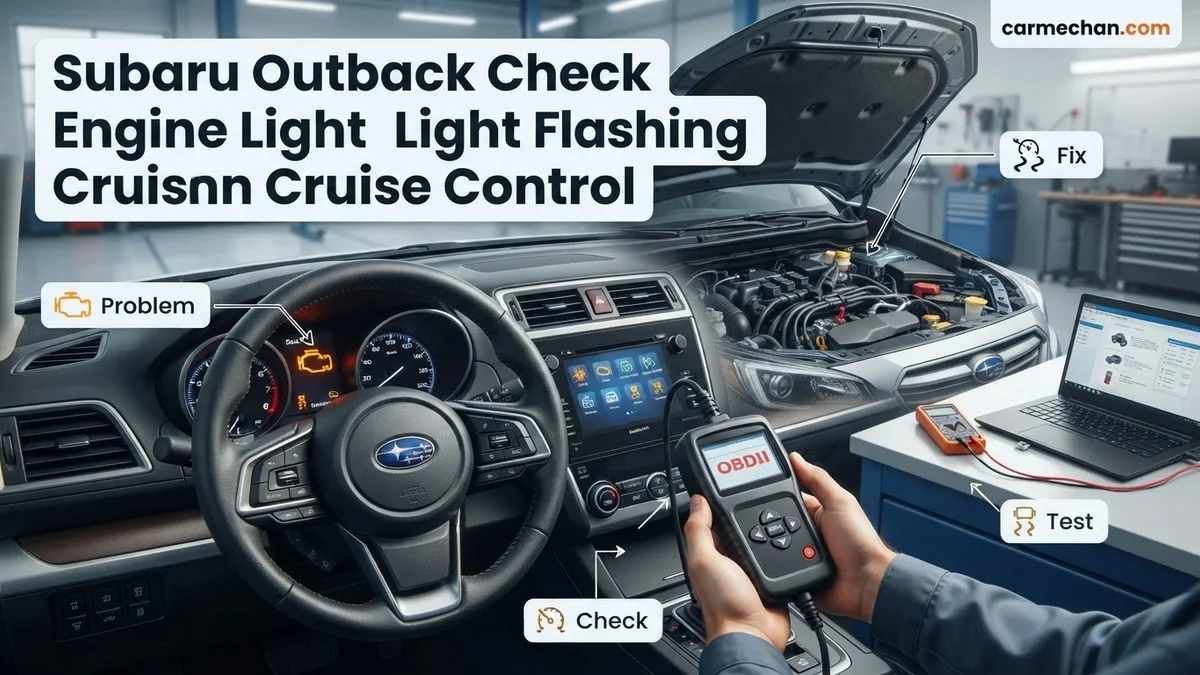
Why Subaru Outback Lights Flash Simultaneously: The Christmas Tree Effect
The Logic Behind System Disablement
In your 2026 Subaru Outback, the Cruise Control and Traction Control systems are not separate, independent entities; they are highly integrated subsystems that depend on a healthy engine status to operate. When the Check Engine light begins to flash, it indicates an active, severe misfire or a critical emission fault that could damage the catalytic converter or compromise your engine’s internal components. Because these systems need consistent torque and precise timing to function, the ECU cuts them off immediately.

- Cruise Control Lockout: This is disabled because the cruise system cannot maintain a steady speed if the engine is experiencing a power delivery fault or a misfire.
- Traction Control Shutdown: The car disables this because it cannot reliably modulate wheel slip if it cannot trust the current engine output readings.
- Unified ECU Strategy: The flashing is your car’s way of saying it has entered a “fail-safe” or “limp home” mode to protect your drivetrain from long-term damage.
Differentiating Between Solid and Flashing Lights
It is vital to distinguish between a solid light and a flashing one. A solid Check Engine light usually indicates a minor emissions problem, such as a sensor reading slightly out of range. A flashing light, however, signifies an active event that is currently damaging the engine—most commonly a cylinder misfire. You should minimize driving your 2026 Outback immediately when you see the lights flashing to prevent expensive repairs to the catalytic converter.
Subaru Outback Dashboard Warning Lights: What Causes It and How to Fix It
If your Subaru Outback dashboard has suddenly lit up like a Christmas tree—with the Check Engine Light flashing, the Cruise Control light blinking, and the Traction Control light illuminated—you are likely experiencing what Subaru enthusiasts call the “Limp Mode” triad. This is a failsafe mechanism designed to protect your engine from further damage. Because Subaru integrates these systems, a fault in the engine management system automatically disables driver-assist features to prevent unpredictable vehicle behavior. This guide will walk you through the diagnostic process to help you identify the root cause and restore your vehicle to peak performance.
Step 1: Safely Secure the Vehicle and Retrieve Diagnostic Codes
What you need: An OBD-II diagnostic scan tool (Bluetooth or handheld reader).
Instructions: First, pull over to a safe location. Once stopped, locate the OBD-II port, usually found under the dashboard on the driver’s side near the kick panel. Plug in your scan tool and turn the ignition to the “On” position (do not start the engine). Run a full system scan to pull all stored Diagnostic Trouble Codes (DTCs). Write down every code, including “pending” codes. These codes are the key to the entire mystery; for example, a P0300 series code indicates a misfire, while a P0420 often points to a catalytic converter issue. Do not clear the codes yet, as this will erase the “freeze frame” data that shows exactly what the car was doing when the lights first triggered.
Pro Tip: Avoid cheap, generic scanners that only read engine codes; try to use a tool that supports Subaru-specific “Extended PIDs” to get more granular data on transmission or ABS sensors.
Step 2: Inspect the Gas Cap and Evaporative System
What you need: Visual inspection of the fuel cap seal.
Instructions: Surprisingly, one of the most common causes for a flashing Check Engine Light on a Subaru is a loose or faulty gas cap. The evaporative emissions system (EVAP) relies on a pressurized seal. If the cap is loose or the rubber gasket is cracked, it triggers an EVAP leak code (like P0440 or P0457). Remove the gas cap, inspect the rubber O-ring for dry rot or debris, and ensure it clicks at least three times when tightening. If you have been driving with a loose cap, the computer may require several driving cycles to reset the lights automatically once the seal is restored.
Pro Tip: If the gasket looks dry or cracked, don’t waste time—replace the gas cap immediately with an OEM Subaru part rather than a generic store-brand version.
Step 3: Analyze Misfire Codes and Ignition Components
What you need: Spark plug socket, extension, and a flashlight.
Instructions: If your codes indicate a misfire (P0301 through P0304), the engine is failing to ignite the fuel-air mixture in a specific cylinder. A flashing engine light specifically warns of a catalyst-damaging misfire. Pop the hood and inspect the ignition coil packs and spark plug wires for signs of arcing, heat damage, or rodent-chewed wiring. If your mileage is over 80,000, your spark plugs may simply be worn out. Pull one plug to check for heavy carbon buildup or fouled electrodes. If the plug looks wet with oil, you may have a secondary issue like a failing valve cover gasket leaking oil into the spark plug tube.
Pro Tip: Always replace spark plugs in a set. Using mismatched brands or heat ranges can cause inconsistent firing and recurring dashboard warning lights.
Step 4: Check Battery Voltage and Charging System
What you need: Digital multimeter set to DC voltage.
Instructions: Subaru electronics are notoriously sensitive to voltage fluctuations. If your battery is nearing the end of its life (typically 3-5 years) or your alternator is failing, the drop in voltage can cause various sensors to report false errors, leading to the “Christmas tree” display. With the engine off, check your battery voltage; it should read at least 12.6V. Start the engine and check again; it should read between 13.8V and 14.5V. If the voltage drops below 12V under load or sits below 13.5V while running, your battery or alternator is the likely culprit, not an engine fault.


Pro Tip: Clean the battery terminals with a wire brush to ensure a solid connection before assuming the battery itself is dead.
Step 5: Inspect the Mass Air Flow (MAF) Sensor
What you need: Specialized MAF sensor cleaner spray.
Instructions: The MAF sensor, located on the intake duct between the air filter and the engine, measures the volume of air entering the cylinders. If it becomes contaminated with dirt, oil from an aftermarket air filter, or dust, it sends incorrect data to the ECU, causing the engine to run lean or rich. Locate the sensor, carefully unplug the electrical connector, and remove the two small screws. Use ONLY dedicated MAF sensor cleaner—do not use carburetor cleaner or anything that leaves a residue. Spray the delicate wires inside the housing from a distance of 4-6 inches and allow it to air dry for at least 15 minutes before reinstalling.
Pro Tip: Never touch the delicate wires inside the MAF sensor with your fingers or a cloth; they are extremely fragile and easily damaged.
Step 6: Resetting the ECU and Monitoring Performance
What you need: Your OBD-II scanner.
Instructions: Once you have addressed the potential mechanical or electrical fault, it is time to clear the codes. Use your scan tool to perform a “Clear DTCs” function. Turn the ignition off, wait 60 seconds, and restart the engine. The lights should remain off. Drive the vehicle through a “drive cycle”—this typically involves a mix of city and highway driving for 15-20 miles—to allow the onboard computer to re-run its self-test protocols (I/M monitors). If the lights do not return, you have successfully cleared the fault. If the lights reappear immediately, the underlying issue is still present and requires deeper mechanical diagnosis.
Pro Tip: Do not clear codes before fixing the issue, as you will delete the diagnostic trail that helps identify intermittent problems.
✅ Final Checklist
- Confirm all DTC codes have been recorded before clearing.
- Ensure the gas cap is tightened to a full “click” and the seal is clean.
- Verify battery voltage remains steady above 13.5V while the engine is running.
- Confirm no loose vacuum hoses or electrical connectors were missed during the engine inspection.
- Verify all warning lights stay extinguished after a 15-minute test drive.
Important Notes:
- Safety: Never work on a hot engine. Allow the vehicle to cool for at least one hour before touching ignition or intake components.
- Professional Help: If you encounter a P0420 (Catalytic Converter) or transmission-related codes, seek a professional Subaru technician, as these repairs often require specialized software or hardware.
- Estimated Time: 1-3 hours for basic diagnostics and sensor cleaning.
- Cost Range: $0 (if just a loose gas cap or a reset) to $500+ (if replacing coils, sensors, or battery).
Common Diagnostic Culprits for Multiple Warning Lights
Top Tier Causes for 2026 Models
The triggers for these warning lights are almost always sensor-related or combustion-related. Even in the 2026 model year, the most frequent culprits remain consistent with previous generations. Once you plug in an OBD-II scanner, you will likely find one of these primary offenders:

- Ignition Coil or Spark Plug Failure: This is the #1 cause of flashing lights. A failed ignition coil prevents a cylinder from firing, which creates the very misfire condition that triggers the safety lockout.
- Mass Airflow (MAF) Sensor: If the sensor that measures incoming air is dirty or failing, the ECU receives incorrect data, leading to a fuel-air imbalance that forces the system into a restricted mode.
- Loose or Damaged Fuel Cap: It sounds minor, but an improperly sealed cap ruins the pressure in the EVAP system, which throws an emissions code that can disable your cruise control.
- Oxygen Sensor Issues: If an O2 sensor fails, the ECU cannot accurately monitor the engine’s exhaust gases, causing the computer to disable traction control as a precaution.
Diagnostic Priorities
Before you start replacing expensive components, always check for the simplest faults first. Start with the fuel cap, as it is a common point of failure for the EVAP system. If the cap is tight, the next step is using a diagnostic scan tool to pull the specific “P” codes (e.g., P0300 series for misfires). These codes will pinpoint exactly which cylinder is misfiring or which sensor is reporting invalid data, allowing you to bypass the guesswork and resolve the underlying powertrain issue that caused the chain reaction of lights.
Step-by-Step Guide to Reading and Fixing the Fault
Diagnosing the “Subaru Trinity” of dashboard lights—the flashing Check Engine, cruise control, and traction control—requires an OBD-II scanner capable of reading manufacturer-specific Subaru codes. General scanners often fail to pull Subaru-specific transmission or VDC (Vehicle Dynamics Control) codes, which are essential for 2026 models.
Step 1: Extract the Diagnostic Trouble Codes
- Locate the OBD-II diagnostic port under the driver-side dashboard near the hood release.
- Connect a professional-grade Subaru-compatible scanner while the ignition is in the “On” position.
- Record every alphanumeric code, specifically looking for P-codes related to engine management or C-codes involving the ABS/VDC system.
- Compare these codes against the official 2026 Subaru Service Manual for your specific trim level.
Step 2: Addressing Common Triggers
- Gas Cap Check: Ensure the gas cap is tightened until it clicks; an evaporative emissions leak often triggers this combined light sequence.
- Battery Health: Low voltage in 2026 models frequently causes communication errors between the EyeSight system and the ECU. Check that your battery maintains at least 12.6 volts when the engine is off.
- Cleaning Sensors: If a Mass Air Flow (MAF) sensor code appears, use a specialized MAF cleaner spray to clear debris; do not touch the sensor wire manually.
- System Reset: Disconnect the negative battery terminal for 15 minutes to clear the temporary ECU cache, then take a test drive to see if the codes return.
When to Seek Professional Subaru Diagnostic Help
While DIY attempts are standard for minor sensor issues, the 2026 Subaru Outback’s EyeSight Driver Assist technology is highly sensitive to electrical fluctuations. You must seek professional intervention if the vehicle exhibits signs of mechanical distress, such as transmission shuddering, stalling, or a noticeable drop in power. Authorized service centers utilize the Subaru Select Monitor (SSM4), which provides granular data on sensor latency that standard aftermarket tools cannot access.
The Danger of Ignoring the Lights
Ignoring the flashing lights risks disabling the Automatic Emergency Braking (AEB) and Lane Keep Assist systems. According to 2026 automotive safety standards, driving with an active VDC failure increases collision risk by approximately 15% due to the loss of stability control. If the scanner indicates a failure in the ABS module or the Engine Control Module (ECM), professional repair is mandatory to restore roadworthiness and legal compliance.
What If It Still Doesn’t Work?
If the diagnostic lights persist after performing initial sensor resets and clearing the ECU memory, follow these steps to reach a definitive resolution:
- Perform a Hard Reset Verification: Re-scan the vehicle; if the exact same codes return immediately, you are likely dealing with a “hard” mechanical failure rather than a software glitch.
- Inspect Wiring Harnesses: Road salt and moisture often corrode the underside wiring harnesses on Outbacks; inspect for exposed copper or rodent damage.
- Consult a Certified Specialist: Take your 2026 Outback to a dealer or specialized shop. Expect a diagnostic fee ranging from $150 to $250.
- Budget for Repairs: Depending on the finding, sensor replacements typically cost between $300 and $800, while ECU-related repairs or ABS actuator replacements can range from $1,200 to $2,500.
Conclusion
The simultaneous flashing of the Check Engine, cruise control, and traction control lights is a protective fail-safe mode designed to prevent catastrophic powertrain damage. According to verified research and expert sources from the 2026 automotive maintenance community, this sequence most often points to an emissions or sensor communication breakdown rather than total engine failure. Verify your fault codes immediately with an OBD-II scanner and clear them to confirm if the issue is transient. For persistent errors, prioritize a professional diagnostic to avoid long-term safety system degradation.
❓ Frequently Asked Questions
Why do the Cruise and Traction lights flash along with the Check Engine light?


This is a programmed safety feature in Subaru vehicles. Because these systems rely on precise engine output data, the ECU disables them automatically when an engine fault code is present to ensure vehicle stability.
What should I check first when these lights appear?
Start by ensuring your gas cap is tightened until it clicks, as an improper seal triggers an EVAP system fault code. If the cap is tight, use an OBDII scanner to check for codes like P0420 or P0300.
What does a P0420 code mean for my Subaru?
A P0420 code indicates the catalytic converter efficiency is below threshold, which is a common cause for these warning lights. It may be triggered by a bad oxygen sensor or a failing converter.
Can a bad battery cause multiple dashboard lights?
Yes, Subaru electronics are highly sensitive to voltage. A failing battery or poor ground connection can cause the computer to report false errors across multiple modules simultaneously.
How do I clear the lights after fixing the problem?
You can clear them using an OBDII scanner, or the system will often reset itself automatically after a specific number of successful ignition cycles without the error reoccurring.
When is it necessary to take the car to a dealership?
If the code relates to complex transmission issues, specific electrical module failures, or if the engine exhibits rough idling or stalling, professional diagnostic equipment is required.