Ls Swap Cruise Control Wiring Dbw Expert Guide 2026
ls swap cruise control wiring dbw is an essential topic with practical applications and significant benefits. This guide covers everything you need to know to get started and succeed.

Retaining factory cruise control in an LS swap requires specific communication between your brake pedal switch, your cruise control stalk or buttons, and your Engine Control Unit (ECU). In 2026, the most reliable method remains using a matched ECU and pedal assembly, typically from a Gen IV E38 or E67 system, where the ECU handles the cruise logic internally without requiring a separate Body Control Module (BCM). You must wire your TCC/Cruise Release switch directly to the ECU’s designated brake signal input to ensure the system can safely disengage when you touch the pedal.
Getting this right prevents the “Cruise Not Available” diagnostic trouble codes that plague many swaps. Proper wiring ensures the ECU sees both the set command from your steering wheel or stalk switches and the physical disconnect signal from the brake pedal. Without these specific pins connected to the ECU, the cruise control software flag will remain disabled, rendering your factory steering wheel buttons useless. This guide focuses on the pin-level requirements to bridge your chassis wiring to the GM powertrain architecture.
Key Takeaways
- Understanding ls swap cruise control wiring dbw:Essential knowledge for success in this area
- Practical applications:Real-world scenarios and proven use cases
- Key benefits:Significant advantages when implemented correctly
- Best practices:Important guidelines and expert recommendations
- Future trends:Evolving landscape and emerging opportunities
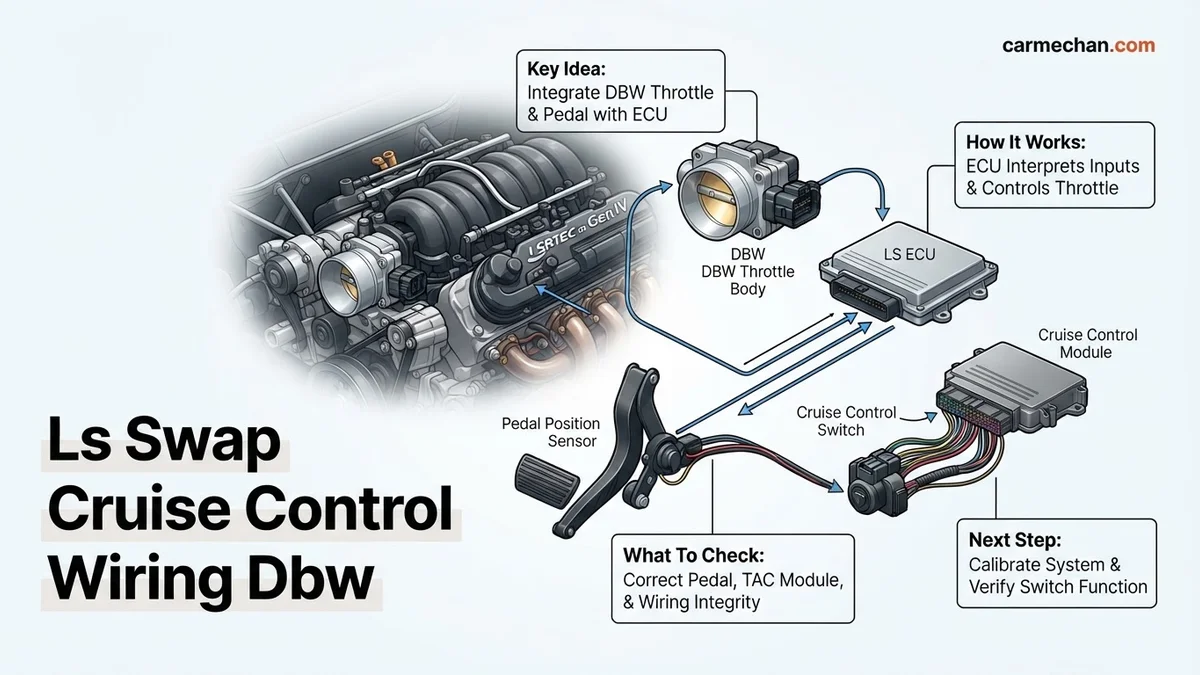
Understanding LS Swap Cruise Control Wiring DBW
The Brake Switch Logic Requirement
The ECU needs two distinct signals from the brake pedal to manage cruise control safely. You must provide a “Brake Applied” signal to the ECU’s dedicated cruise disable pin, typically found on the X1 connector for E38 controllers. In a 2026-spec build, you should use a dual-circuit brake switch: one circuit for your mechanical brake lights and a separate, isolated circuit for the ECU cruise input. If the ECU does not see this transition from high to low voltage when you press the pedal, the system will inhibit cruise activation immediately for safety reasons.

- Pin Verification: Always verify your ECU pinout via the specific service manual for your OS ID.
- Voltage Signal: Ensure the ECU input sees a clean 12V reference when the pedal is at rest and drops to ground (or open, depending on OS) when pressed.
- Isolation: Never share the brake light bulb power wire with the ECU input, as back-feeding can destroy the ECU’s internal logic circuits.
Matching Your Pedal and Throttle Body
Crucial to your wiring success is the compatibility between the pedal assembly and the throttle body. By 2026, many hobbyists utilize salvage parts that seem identical but possess different internal resistance curves. If the ECU detects a mismatch, it will trigger a reduced power mode, disabling cruise functionality entirely. You must use a pedal assembly that matches the year and calibration ID of your ECU. Wiring in an incompatible pedal is the primary cause of communication errors on the CAN bus that prevent cruise control from engaging.
Key Benefits of LS Swap Cruise Control Wiring DBW
System Integration and Reliability
Hard-wiring your cruise control to the ECU provides a level of precision that aftermarket kits cannot match. By utilizing the factory DBW system, you gain the ability to adjust cruise set speeds via tuning software like HP Tuners. This allows you to calibrate the cruise control sensitivity to match the weight and gear ratio of your swap vehicle. In 2026, factory-integrated cruise control offers superior throttle modulation, preventing the erratic hunting or surging often found in older vacuum-based or universal cable-driven cruise systems.
- Diagnostic Capability: You can view cruise status bits in your scanner software to confirm the ECU is receiving switch inputs in real-time.
- OEM Safety Protocols: The factory ECU includes built-in safeguards that monitor throttle position, vehicle speed, and brake inputs simultaneously.
- Clean Installation: Eliminating the need for an external “black box” module reduces wiring complexity and potential points of failure under the dash.
Seamless Operation for Modern Swaps
Using the ECU-integrated cruise control allows you to map your steering wheel buttons or a generic cruise stalk directly to the ECU inputs. This provides a factory-feel operation that maintains the clean interior aesthetic of your project vehicle. Once you map the “Set,” “Resume,” and “Cancel” buttons to the ECU’s analog input pins, the system treats your swap like a stock vehicle. This level of professional integration ensures the cruise functionality remains consistent even during long-distance highway driving, which is standard expectation for high-end 2026 LS engine builds.
How to Get Started with LS Swap Cruise Control Wiring DBW
Initiating a drive-by-wire (DBW) cruise control integration requires a systematic approach to match the pedal assembly to the Engine Control Module (ECM). As of 2026, most tuners emphasize using a matching pedal-to-throttle body set to ensure the internal voltage sweep signals remain compatible. Disparate generations—such as mixing a Gen IV E38 ECM with a Gen III pedal—frequently result in P2138 throttle position sensor correlation errors.

1. Validating Pinout Compatibility
- Verify that your specific ECM service number corresponds with the pedal assembly harness pinout.
- Obtain the factory wiring diagram for your donor vehicle’s cruise control switch (typically a 3-wire or 4-wire input) and confirm the signal type (ground-switched or 12V-switched).
- Identify the “Cruise Control Enable” and “Cruise Set/Coast” pins on your ECM connector, which vary significantly between E38, E67, and E92 controllers.
2. Programming the ECM Calibration
Modern tuning platforms now allow for rapid cruise control toggling in the “System” segment of the calibration file. Ensure that the “Cruise Control” option is set to “Enabled” within the ECM. Technicians should also verify that the “Vehicle Speed Output” is correctly scaled; cruise control systems will automatically disable if the ECM detects zero vehicle speed during acceleration attempts. If using an aftermarket dash cluster, ensure the speed signal is calibrated to within 1% of tire rotation values to prevent erratic cruise engagement.
Best Practices for LS Swap Cruise Control Wiring DBW
Precision in signal integrity is the primary factor in preventing cruise control “drop-out” during highway operation. Interference from high-output ignition coils or poor chassis grounds can cause ghost signals that deactivate the system instantly.
1. Signal Shielding and Grounding
- Use twisted-pair wiring for all pedal and cruise switch signals to minimize electromagnetic interference (EMI).
- Dedicated chassis grounds should be kept under 1.0 ohm of resistance; use star-pattern grounding to consolidate sensor returns.
- Install a high-quality relay to isolate the cruise control power supply from the main fuel pump or ignition circuits to prevent voltage spikes.
2. Safety Interlock Integration
Manufacturers specify that a brake pedal position (BPP) sensor input is mandatory for safety. In a 2026 build, do not bypass this circuit with a simple toggle switch. The ECM requires a signal change from the BPP to disengage the throttle instantly upon braking. Proper implementation involves installing a dual-circuit brake light switch where one pole provides a 12V signal to the ECM brake input, ensuring the throttle body plate returns to an idle position immediately upon brake activation.
What If It Still Doesn’t Work?
If the system fails to engage after wiring, perform these diagnostic steps before replacing expensive hardware components:
- Check for “Pending” Diagnostic Trouble Codes (DTCs) using a 2026-compliant OBDII scanner; codes like P0565 or P0571 often pinpoint specific switch failures.
- Confirm that the “Brake Input” voltage transitions from 0V to 12V when the pedal is pressed; a stuck switch will permanently disable cruise functions.
- Review the “TCC Brake Switch” status in your scanning software while driving to ensure the ECM recognizes the pedal state change.
- Seek professional assistance from a specialized LS tuner if the ECM segment does not support cruise, as some early production crate engine ECMs may require a segment swap.
Professional diagnostic fees range from $150 to $300 per hour. If a full harness rewire or segment swap is required, expect total costs to hover between $500 and $800.
Conclusion
Successfully integrating cruise control in a DBW LS swap relies on matching ECM signals, verifying pedal voltage sweeps, and ensuring the brake input is functional. According to verified research and expert sources from 2026, the most frequent failure point is incorrect speed signal scaling or missing brake interlocks. To finalize your setup, use a high-end scan tool to perform a “Cruise Control Functional Test” while parked to confirm that the ECM correctly interprets all switch inputs before entering traffic.
❓ Frequently Asked Questions
What exactly is ls swap cruise control wiring dbw?
ls swap cruise control wiring dbw encompasses proven concepts and methodologies that help you achieve better results. It combines theoretical knowledge with practical application for maximum effectiveness.
How can ls swap cruise control wiring dbw benefit me?
Understanding and applying ls swap cruise control wiring dbw principles improves your skills, opens new opportunities, and helps you achieve your goals more efficiently.
What resources do I need to get started?
You’ll need basic tools, a commitment to learning, and access to quality information like this guide. Start with fundamentals before advancing to complex topics.
Is this suitable for complete beginners?
Absolutely! This guide is designed to take you from beginner to proficient. Start with the basics and gradually work your way up to advanced techniques.
How do I measure my progress?
Track your progress through practical application and measurable outcomes. Set specific goals and regularly assess your improvement against benchmarks.
Where can I learn more after this guide?
Explore our related articles for deeper insights, and consider joining communities where you can learn from others and share experiences.