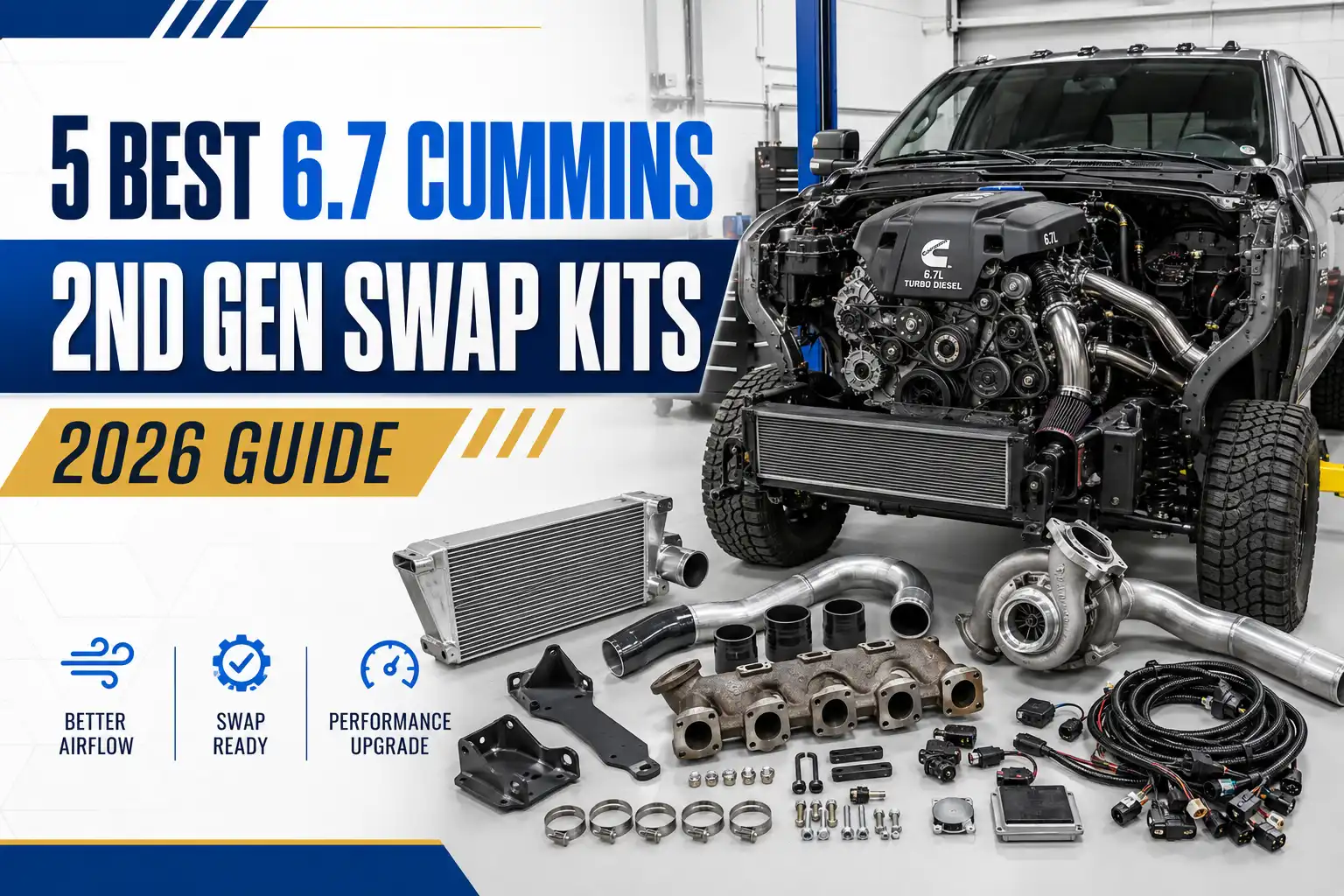
5 Best 6.7 Cummins 2nd Gen Swap Kits: 2026 Guide
Last Updated on September 1, 2026 by Albert Duke



If your 6.7 Cummins still runs the factory HE351VE or HE300VG variable-geometry turbo, you already know its limits: it spools fine for daily driving and towing, but it runs out of breath fast once you start chasing real horsepower. As FASS Motorsports explains, a “2nd gen swap” is the fix most serious Cummins owners land on — it replaces the factory VGT and its low-mount manifold with a fixed-geometry turbocharger (usually an S300 or S400 frame) mounted on a manifold styled after the 1994–2002 “2nd generation” Ram trucks, which ran a simple, center-mounted single turbo with no VGT electronics to fail.
Done right, a 2nd gen swap gets rid of the VGT’s stuck-vane fault codes for good, drops EGTs thanks to more even drive pressure across all six cylinders, and opens the door to turbos rated well past 700 horsepower. Done wrong — wrong turbo size for your use case, no supporting fuel and tuning work — it just means turbo lag and a truck that’s worse to drive than stock. We researched the kits that Cummins-specific shops actually build and sell, what’s included, what they cost, and who each one is really for, so you’re not guessing.
Quick Navigation
Quick Comparison Table
| Kit | Price Range | Fits | Best For | Link |
|---|---|---|---|---|
| MDC Diesel S400 2nd Gen Manifold Swap Kit | $3,265 – $4,540 | 2007.5–2018 & 2019-2024 6.7L | Complete turbo + manifold in one order | View Kit |
| Smeding Diesel S400 Kit | ~$3,265 | 2013–2018 & 2019–2024 6.7L | Fastest turnaround (ships in 24 hrs) | View Kit |
| Wehrli Custom Fabrication (WCFab) S400 Swap Kit | From $1,495 (bare kit) | 2003+ 5.9L & 6.7L | Budget-conscious builders sourcing their own turbo | View Kit |
| FKFab Cummins 2G Swap Kit | ~$3,500 CAD | 2019–2023 6.7L | Newest engine years, minimal cutting required | View Kit |
| Diesel Power Source (DPS) 3rd Gen Swap Kit | From $2,099 | 2007.5–2018 6.7L | Simplest install, keeps stock turbo location | View Kit |
Prices and turbo compatibility current as of 2025 — always confirm current pricing and stage options directly with the retailer before ordering, since S400/S300 turbo pricing shifts with material costs.
Detailed Product Reviews
#1. MDC Diesel S400 2nd Gen Manifold Swap Kit
Our verdict: The most complete out-of-the-box option if you want everything — turbo included — in one order.
What’s Included
- S400 series turbocharger (S464/83, S467/83, S472/87, or S475/87, in cast or billet wheel options)
- T4 2nd Gen style exhaust manifold (3-piece or high-flow stainless)
- 4″ second-gen location downpipe
- Bead-rolled intercooler piping and 5″ air intake with S&B filter
- Braided stainless oil feed and drain lines with billet fittings
- 6.7L-specific coolant plugs, fasteners, boots, and clamps
Why We Recommend It
MDC Diesel sells this as a genuinely complete kit, meaning you’re not chasing down a separate turbo purchase or compatible oil lines afterward. The turbo lineup spans from a quick-spooling S464 up to the S475 for owners chasing four-digit horsepower, and both cast and billet compressor wheel options are offered at each size — cast wheels are the budget-friendlier, still-durable option for most street/tow builds, while billet is worth the upcharge if you’re planning serious boost.
Best For
Owners who want to place a single order and receive everything needed for the swap, without sourcing a turbo separately.
#2. Smeding Diesel S400 Kit with Turbo and Manifold
Our verdict: The fastest-shipping option with a straightforward one-year warranty, good for owners who don’t want to wait weeks on a custom order.
What’s Included
- S400 series turbocharger (S464/83, S467/83, S472/83, or S472/87, cast or billet, including an SXE-R billet wheel option with a Steel 360 bearing)
- T4 three-piece exhaust manifold
- 4″ downpipe and 5″ air intake with S&B filter
- Oil feed and drain lines, intercooler piping, and installation hardware
Why We Recommend It
Smeding ships within 24 hours and backs the kit with a one-year, unlimited-mileage warranty — both unusual in a niche where 3-6 week lead times on custom manifolds are common. The 1.0 T4 exhaust housing is the size Smeding specifically recommends for the 6.7L, which takes the guesswork out of housing selection compared to kits that leave A/R sizing entirely up to the buyer.
Best For


Owners who want a turnkey kit without a long custom-build wait, and who want a documented warranty on the turbo itself.
#3. Wehrli Custom Fabrication (WCFab) S400 High Mount Swap Kit
Our verdict: The most budget-friendly entry point, best suited to builders who want to source their own turbo or already have one.
What’s Included
- 4″ shorty downpipe mating to the exhaust system V-band
- 5″ air intake with dry air filter
- Oil feed and drain lines, T4 spacer plate
- 3″ hot side intercooler pipe, silicone boots, clamps, and coolant hoses
- Powder-coated finish (multiple color options, with longer lead times on non-standard colors)
Why We Recommend It
WCFab is one of the most established names in Cummins-specific fabrication, and this kit’s base price is roughly half of the complete-with-turbo kits above because the turbocharger is sold separately — giving you the freedom to pick a specific brand, wheel, and bearing configuration rather than choosing from a fixed list. Note the kit is explicitly not compatible with race-cover style turbos or Banks Power intercoolers, so double-check your turbo and intercooler choice against WCFab’s compatibility notes before ordering.
Best For
Builders on a tighter budget, or anyone who already owns a turbo and just needs the manifold, downpipe, and plumbing to complete the swap.
#4. Felder Kustom Fabrication (FKFab) Cummins 2G Swap Kit
Our verdict: The best-engineered option specifically for the newest 6.7 Cummins model years.
What’s Included
- 4″ 304 stainless steel downpipe with titanium heat wrap
- 5″ 6061 aluminum intake with hidden sensor bungs
- 3″ 6061 aluminum hot-side pipe designed for extra AC component clearance
- 3/4″ manifold spacer, extended studs, gaskets, and VGT coolant plug kit
- Coolant reroute and firewall wiring heat sleeving
- Dual oil line system (-12 and -6 configurations)
Why We Recommend It
FKFab designed this kit around the 2019-2023 Cummins specifically, which is the newest and least-covered model range among 2nd gen swap kit makers. It’s compatible with True North Turbos (TNT) S-series chargers across several configurations, plus an optional Steed Speed T4 high-mount manifold. The “minimal cutting required” fitment is the standout feature if you’re not eager to take a grinder to factory heat shields.
Best For
Owners of a 2019-2023 6.7 Cummins who want a kit engineered specifically for that generation rather than adapted from an older platform.
#5. Diesel Power Source (DPS) 3rd Gen Swap Kit
Our verdict: The simplest install of the bunch — this keeps the turbo in the factory location instead of relocating it up top.
What’s Included
- S300 turbo with wastegated T3 turbine housing (S400 VGT available on higher stages)
- DPS 2-piece high-flow exhaust manifold
- Gaskets, studs, nuts, bolts, and complete installation hardware
- Stainless steel oil drain tube and water block-off plugs
- Optional Turbonator VGT upgrade for exhaust braking
Why We Recommend It
This is technically DPS’s “3rd gen” naming for a kit that keeps the turbo and manifold in the factory location, meaning it bolts up to your existing exhaust, intake, and intercooler connections with roughly a 3-hour install on an already-deleted truck — no relocation, no cutting factory heat shields. It also directly eliminates the factory VGT and the fault codes that come with it. Eight turbo stage options run from a 530 hp S363 up to a 1,000 hp S472 VGT, so it scales from mild to fairly serious builds without the labor of a full high-mount conversion.
Best For
Owners who mainly want the failure-prone factory VGT gone and a straightforward bolt-on install, without the extra labor of relocating the turbo.
Gauges and Supporting Parts You’ll Want After the Swap
Once the new turbo is in, you need a way to actually watch what it’s doing — a fixed-geometry turbo with no factory boost or EGT feedback is flying blind without aftermarket gauges. These are the categories worth budgeting for alongside the kit itself:
- Boost gauge: Lets you confirm the new turbo is building the boost your tune expects and catch a failing wastegate or leak before it causes damage. Browse boost gauges on Amazon →
- Pyrometer (EGT) gauge: Non-negotiable on a built 6.7 Cummins — exhaust gas temperature is the number one thing that damages a turbocharged diesel under sustained load or towing. Browse EGT gauge kits on Amazon →
- V-band clamps and gaskets: Keep a spare set on hand during install — it’s common to warp or damage a factory clamp while separating the downpipe, and a cracked gasket here causes an exhaust leak right at the turbo. Browse V-band clamp kits on Amazon →
- High-quality synthetic diesel oil: A higher-flowing turbo puts more demand on oil supply and cooling; sticking with a quality synthetic rated for diesel service protects the new turbo’s bearings from day one.
Frequently Asked Questions
What are the key differences between a T4 and T6 manifold when choosing a 2nd gen swap kit for my 6.7 Cummins?
T4 manifolds (used by every kit in this guide) are the standard for these swaps and generally offer better spool-up and daily-driving throttle response. T6 manifolds are better suited to very large turbos on all-out performance builds, sacrificing some low-end response for top-end flow.
How much can I realistically expect to spend on a complete, high-quality 2nd gen swap kit for my 6.7 Cummins, including installation?
A complete kit with turbo runs roughly $2,100 to $4,500 depending on brand and turbo stage, per the kits compared above. Installation costs vary by shop and region, but budget an additional $800 to $2,000 for labor if you’re not doing the install yourself — high-mount kits generally take longer to install than kits that keep the factory turbo location.
What size turbo should I choose for my 2nd gen swap if I’m primarily focused on towing heavy loads with my 6.7 Cummins?
For heavy towing, a smaller to mid-sized S300 or a modest S400 (like an S464) is recommended to maintain good low-end torque and minimize lag. Check our Ram 2500 towing capacity chart to weigh how turbo sizing decisions interact with your actual towing numbers.
Will I need to tune my 6.7 Cummins after installing a 2nd gen swap kit, and what happens if I don’t?
Yes — tuning is required after any 2nd gen swap to recalibrate fuel delivery, timing, and boost targets for the new turbo. Skipping this step risks poor drivability, excess smoke, and EGTs high enough to damage the engine. See our guide to the best 6.7 Cummins tuners for what to pair with the swap.
What are some common issues or “gotchas” I should be aware of during the 2nd gen swap installation process?
Common issues include improperly seated downpipe V-bands, incorrect oil drain routing causing turbo oil starvation, and mismatched coolant block-off plugs on kits that delete factory coolant passages. Take your time, follow the specific kit’s instructions (not a generic guide), and double-check every line before starting the truck.
How does a 2nd gen swap affect the exhaust brake on my 6.7 Cummins?
It depends on the kit. Kits that retain a VGT turbo (like the higher stages of the DPS 3rd gen kit, or the optional Turbonator VGT upgrade) preserve or improve factory-style exhaust braking. A fixed-geometry S400 swap with no VGT eliminates the factory exhaust brake function entirely unless you add a separate exhaust brake valve.
What routine maintenance is required after installing a 2nd gen swap kit on my 6.7 Cummins?


Stick to frequent oil changes with a quality synthetic rated for diesel/turbo service, and periodically inspect the turbo’s oil lines, intercooler boots, and manifold studs for leaks or loosening under heat cycling. Watching boost and EGT gauges regularly will catch most developing problems before they become expensive.
What are the pros and cons of using a used turbocharger with a 2nd gen swap kit to save money?
A used turbo can lower the up-front cost of a bare kit like WCFab’s, but it carries real risk of hidden bearing wear or a cracked housing that won’t show up until it’s installed. If going this route, have the turbo inspected or rebuilt by a diesel-specific shop before install, and weigh that cost against simply buying a complete new kit.
Final Thoughts
Choosing the right 2nd gen swap kit for your 6.7 Cummins comes down to matching the kit to your actual goals, not just the biggest turbo on the page. If you want everything in one order with a turbo already selected, the MDC Diesel S400 kit and Smeding Diesel S400 kit are both strong, well-documented choices. If budget matters more and you’re comfortable sourcing your own turbo, WCFab’s bare kit is the most cost-effective entry point. And if you mainly want the failure-prone factory VGT gone without the labor of a full high-mount relocation, the DPS 3rd gen kit is the simpler path.
Whichever kit you choose, budget for a proper tune and a set of boost and EGT gauges alongside it — the turbo hardware is only half the job. Take your time with the install, torque everything to spec, and get the truck professionally tuned before you lean on the extra power. Happy swapping.
Disclosure: This article contains affiliate links to Amazon and links to third-party diesel performance retailers. If you purchase through our links, we may earn a commission at no extra cost to you. We only recommend products and shops we believe add value to our readers. Pricing and turbo availability are subject to change — always confirm current pricing and stock directly with the retailer.