How To Strap A Car To A Trailer Safely Step-by-Step 2026
Last Updated on September 1, 2026 by Albert Duke


Safely strapping a car to a trailer requires understanding the right equipment, preparing both the vehicle and trailer meticulously, and following a precise step-by-step process. Adhering to best practices for tie-down points and tension ensures your vehicle remains secure throughout its journey, preventing damage and accidents.
Successfully strapping a car to a trailer is a critical skill for safe vehicle transport, whether moving a classic, a project car, or a non-runner. Improper securing methods can lead to catastrophic accidents, vehicle damage, and legal complications on the road. Our guide provides you with the essential knowledge to secure your vehicle confidently.
This comprehensive tutorial will walk you through the necessary equipment, meticulous preparation steps, and a precise sequence for securing any car. We aim to equip you with the best practices for safe car hauling in 2026. Understanding these methods ensures your precious cargo arrives safely at its destination.
The first step to a secure tow always involves gathering the correct equipment.
Key Takeaways
- Choose correct tie-down straps for vehicle type.
- Always inspect equipment before each use.
- Balance the car’s weight properly on the trailer.
- Secure vehicle at four primary tie-down points.
- Recheck straps frequently during transport.
What 3 Essential Tools Secure Your Car Safely?

The right tools are non-negotiable for safe car transport. Using inadequate or damaged equipment puts your vehicle and others at risk. Prioritize quality and appropriate ratings for every item you use.
Tie Down Straps
Choosing the correct tie-down straps is paramount. Ratchet straps are common for their tensioning ability. Wheel nets secure the tires directly, allowing the vehicle’s suspension to work during transport. Axle straps wrap around the axle or suspension components. Always check the working load limit (WLL) of your straps. For instance, a typical 2-inch wide polyester ratchet strap might have a WLL of 3,333 pounds, requiring at least four such straps for a 10,000-pound vehicle .
Ramps and Winches
Loading a non-running or project car often requires assistance. Sturdy ramps provide a gradual incline for safe vehicle loading. Ensure they are wide enough and have sufficient capacity for your car’s weight. A trailer winch is invaluable for pulling vehicles onto the trailer without manual effort. Electric winches offer convenience, while manual winches are reliable alternatives. Select a winch with a pulling capacity exceeding your vehicle’s gross weight.
Wheel Chocks
Once your car is positioned on the trailer, wheel chocks prevent any forward or backward movement. These small but mighty tools stabilize the vehicle during strapping and unexpected stops. They are especially crucial before and during the tightening of straps. Place them securely against the tires on both sides.
Once you have the right gear, preparing your vehicle and trailer correctly becomes the next critical step for a smooth journey.
How to Prepare Your Car and Trailer Properly?
Preparation is as crucial as the strapping itself to prevent accidents. A thorough check before you begin saves time and prevents potential hazards. Never rush this vital stage.
Inspect Gear
Before every tow, meticulously inspect all your equipment. Check tie-down straps for fraying, cuts, or damaged ratchets. Examine your trailer for structural damage, proper tire pressure, and functional lights. Ensure the hitch connection is secure and the safety chains are crossed and attached. A damaged strap can fail catastrophically during transit [Internal Link: how to maintain trailer equipment].
Load Evenly
Proper weight distribution on the trailer is fundamental for safe towing. Aim to position your vehicle so that 60% of its weight rests over the front half of the trailer, typically just ahead of the trailer’s axles. This “60/40 rule” prevents trailer sway and provides stable handling . Too much weight at the rear can cause dangerous fishtailing.
Clear Path
Select a level, firm surface for loading your vehicle. This provides stability for both the trailer and the ramps. Clear any debris or obstacles from the loading area and the path onto the trailer. Ensure your ramps are securely attached to the trailer and will not slip during loading. Use a spotter if available for added safety during this maneuver.
With your equipment ready and the area prepped, it’s time to learn the precise sequence for safely strapping your car.
How to Strap Your Car in 6 Clear Steps?

Securing your vehicle to a trailer is a methodical process. Following these steps ensures maximum safety and stability. Do not deviate from the sequence.
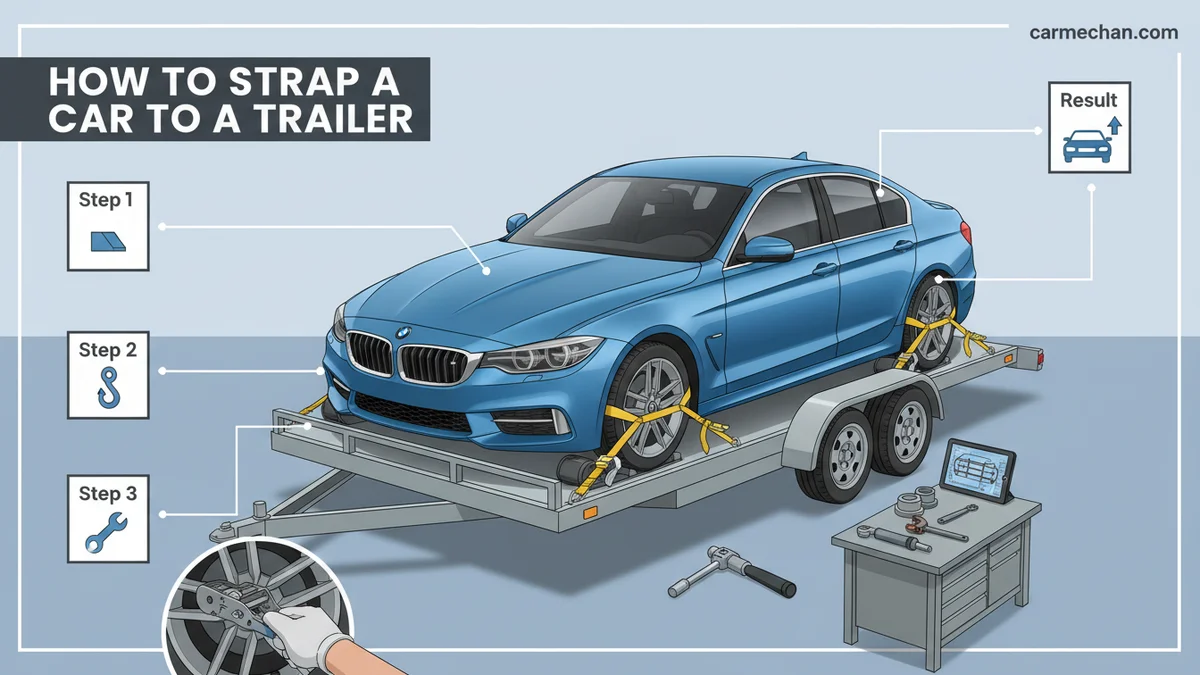
1. Drive On
Slowly and carefully load your car onto the trailer. If using a winch, guide the car onto the trailer, ensuring it stays centered. Drive the vehicle onto the trailer, stopping exactly where your weight distribution calculations dictate. Engage the parking brake once the car is in position. For an automatic transmission, select “Park”; for a manual, leave it in gear.
2. Attach Points
Identify the strongest tie-down points on your vehicle. These are typically the frame, solid axle components, or reinforced suspension areas. Avoid attaching straps to steering components, brake lines, or plastic trim. For wheel nets, place them over the tires. For axle straps, loop them around the axle or lower control arms.
3. Secure Front
Attach two primary tie-down straps to the front of your vehicle. Ensure the straps pull slightly forward and outward, forming a V-shape. This angle provides both forward and lateral resistance. Hook the other end of the straps securely to the trailer’s D-rings or designated anchor points. Each strap should have a dedicated anchor.
4. Secure Rear


Mirror the front strapping process at the rear of the vehicle. Attach two more primary tie-down straps. These straps should pull slightly backward and outward. This creates opposing forces with the front straps, locking the vehicle in place. This “X-pattern” or complementary V-shape is crucial for preventing movement in any direction.
5. Apply Tension
Begin ratcheting each strap tight, alternating between front and rear, and left and right. This ensures even tension across all four points. The straps should be snug enough to prevent any vehicle movement. Avoid over-tightening to prevent damage to the vehicle’s suspension or the straps themselves. The car should feel like an integral part of the trailer.
6. Final Check
Before moving, perform a thorough walk-around. Double-check all four straps for tightness and proper routing. Ensure no straps are rubbing against sharp edges. Verify the parking brake is engaged, and the shifter is in place. Tug on the vehicle to confirm it is completely immobile on the trailer. Recheck all connections after the first 10-15 miles of travel.
Understanding the basic steps is vital, but choosing the right strapping method, like wheel nets versus axle straps, refines your technique for ultimate security.
Wheel Nets Versus Axle Straps for Towing?
The dilemma of choosing between wheel nets and axle straps is common for secure car hauling. Both are effective, but each offers distinct advantages depending on your vehicle and trailer. Make an informed decision.
Wheel Net Benefits
Wheel nets secure your car by encompassing the tires directly. This method allows the vehicle’s suspension to remain active and absorb road shock during transit. It’s often preferred for vehicles with delicate undercarriages or custom suspensions. Wheel nets distribute the force evenly over the tire, preventing pressure points on suspension components. They typically prevent tire flat-spotting on long journeys.
Axle Strap Advantages
Axle straps secure the vehicle by looping around its axles, frame, or sturdy suspension components. This method directly ties the chassis to the trailer. It is ideal for vehicles with low ground clearance where reaching over the wheels might be difficult. Axle straps are generally and can provide a very rigid connection. They are often used with chains for heavy-duty applications [External Link: manufacturer guide on heavy duty strap types].
Choosing Method
Your choice often depends on the specific vehicle and trailer combination. For classic cars or those with sensitive suspensions, wheel nets are usually the gentler option. For race cars or vehicles with easily accessible, strong frame points, axle straps can be very effective. Consider ease of attachment and the potential for damage to bodywork or suspension. Always ensure chosen methods have appropriate weight ratings for 2026. .
Making informed choices about your tie-down method is crucial, as avoiding common errors is paramount for damage-free transport.
5 Critical Mistakes to Avoid While Strapping?
Even experienced haulers can make mistakes. Awareness is key to prevention and ensuring a safe journey for your vehicle. Learn from common pitfalls.
Incorrect Angles
A common error is attaching straps at shallow angles. Straps need to pull both horizontally and vertically to effectively secure the load. Aim for a 45-degree angle from the attachment point on the vehicle to the anchor point on the trailer. Angles that are too flat offer less resistance to movement. Angles that are too steep primarily pull down, which is less effective against horizontal forces.
Over-Tightening
While straps must be tight, excessive tension can cause significant damage. Over-tightening can deform the vehicle’s suspension components, damage tires, or even bend chassis parts. It also prematurely wears out your straps, leading to potential failure. Tighten until there is no perceptible movement, but avoid straining the vehicle or straps.
Skipping Checks
Failing to inspect your equipment before use is a critical oversight. Equally dangerous is neglecting re-checks after the initial miles of travel. Straps can loosen due to road vibration or vehicle suspension settling. Always pull over safely after 10-15 miles to re-tension all straps. Perform quick checks at every fuel stop.
Ignoring Balance
Improper weight distribution is a recipe for disaster. Placing too much weight at the rear of the trailer causes it to sway violently, making the tow vehicle difficult to control. Too much weight at the front can overload the tow vehicle’s rear axle. Always aim for that 60/40 front-to-rear weight distribution for stability.
Using Worn Straps
Using straps that are frayed, cut, or otherwise damaged is extremely dangerous. The integrity of the strap is compromised, and it could snap under load, causing the vehicle to shift or detach. Regularly inspect your straps. Discard any that show signs of significant wear or damage. Invest in high-quality straps from reputable manufacturers.
By understanding and avoiding these common pitfalls, you significantly enhance the safety and security of your car transport.
Your Journey to Secure Car Transport in 2026
Safely strapping a car to a trailer is a skill that blends careful preparation with precise execution. Our guide has traversed the critical aspects of this process, from selecting the right equipment to understanding optimal strapping techniques. your diligence in these steps directly translates to the safety of your vehicle and others on the road.


Always prioritize safety by inspecting all gear, balancing your load correctly, and securing your car at its strongest points. Recheck your straps diligently throughout the journey. By applying these best practices in 2026, you ensure a secure and uneventful transport of any vehicle. Your commitment to these methods protects your investment and ensures peace of mind.
Answering Your Top Car Hauling Questions
How Tight Should Straps Be on a Car Trailer?
Straps should be tight enough to eliminate slack and prevent any vehicle movement. Avoid over-tightening, which can damage the vehicle’s suspension or the straps themselves. The car should feel firmly planted to the trailer without excessive strain.
What Are the Best Tie Down Points for Towing a Car?
The best tie-down points include the vehicle’s frame, axles, or suspension components designed for load bearing. Dedicated wheel nets cradling the tires are also highly effective, especially for sensitive suspensions. Avoid steering or cosmetic parts.
Can I Use Chains to Secure a Car on a Trailer?
Yes, G70 transport chains are excellent for securing heavier vehicles, especially in conjunction with chain binders. They offer superior strength and durability compared to straps for certain applications. Always use them with appropriate ratings and protection for the vehicle.
How Do I Know If My Trailer Can Safely Tow My Car?
Check your trailer’s Gross Vehicle Weight Rating (GVWR) and your tow vehicle’s towing capacity. The car’s weight plus the trailer’s empty weight must not exceed these limits. Consult your vehicle and trailer owner’s manuals for precise specifications.
Should I Leave My Car in Gear When Towing It on a Trailer?
Yes, for a manual transmission, leave it in first gear or reverse to provide additional resistance against rolling. For an automatic, ensure it is in “Park.” Always engage the parking brake, even with the transmission in gear.