How Does the Cruise Control Work: Deconstructed and Explained
Ever wondered how your car maintains a steady speed without your foot touching the gas pedal? For many drivers, cruise control is a “set it and forget it” feature, yet this reliance often leads to common misconceptions about how the system actively monitors and adjusts vehicle dynamics. In this guide, we break down exactly how the system works, the sensors involved, and how to use it safely in 2026.


Understanding How Does The Cruise Control Work: The Basics
📤 Share Image
The Closed-Loop Feedback Concept
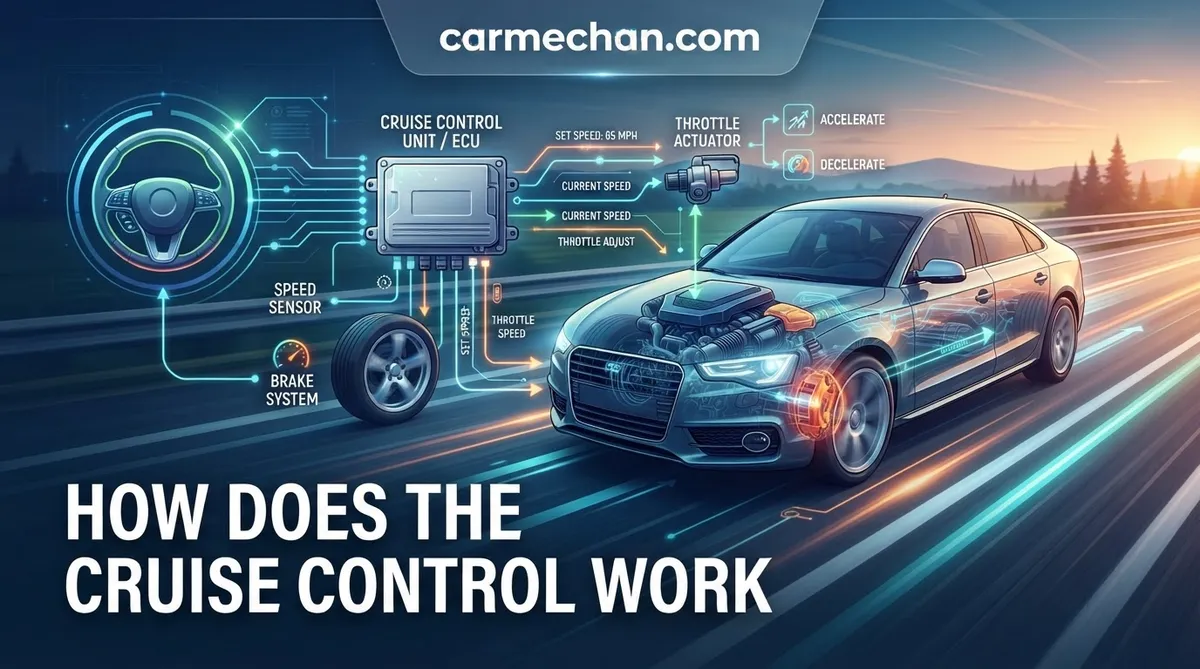
To understand how cruise control functions, think of it as a sophisticated thermostat for your vehicle’s speed. In engineering terms, this is a closed-loop feedback system. When you set a target speed, the vehicle’s Electronic Control Unit (ECU) locks onto that value as the “set point.”
The system continuously compares your current speed—monitored by wheel speed sensors—against that set point. If the actual speed drops below the target (for example, on an incline), the ECU instructs the throttle to open further, increasing power to compensate. Conversely, if the car exceeds the target, the system pulls back on the throttle. This constant adjustment loop ensures the vehicle maintains a consistent pace, much like a thermostat monitors room temperature and adjusts the heating output to match the desired setting.

Why Cruise Control Is Not Autonomy
A critical distinction for any driver to master is the difference between speed maintenance and autonomous driving. Cruise control is a comfort feature, not a safety-critical pilot system. It does not “see” the road, understand traffic patterns, or recognize obstacles. While modern vehicles feature increasingly intelligent assistance, the fundamental cruise control system relies entirely on the driver to steer and remain prepared to take control at a moment’s notice. Supervision is non-negotiable; the system is designed to relinquish control instantly upon human intervention, such as tapping the brake pedal.
Core Components: How Does The Cruise Control Work Mechanically?
Modern cruise control systems have evolved from mechanical cables to complex digital architecture. Here is how the primary components interact to keep you moving at a steady pace:
- Electronic Control Unit (ECU): The “brain” of the operation. It receives input from the driver and sensors, calculates the necessary throttle position, and executes commands.
- Speed Sensor: Usually integrated with the transmission or the Anti-lock Braking System (ABS), this provides the ECU with a precise, real-time pulse signal indicating the exact velocity of the vehicle.
- Throttle Actuator: In modern drive-by-wire vehicles, the ECU sends an electronic signal to the electronic throttle body, which adjusts the butterfly valve to control air intake and engine power.
- Brake/Clutch Interrupt Sensors: These are critical safety interlocks. When you press the brake or clutch, these sensors send an instant electrical signal to the ECU to disengage the cruise system, immediately cutting power to the throttle.
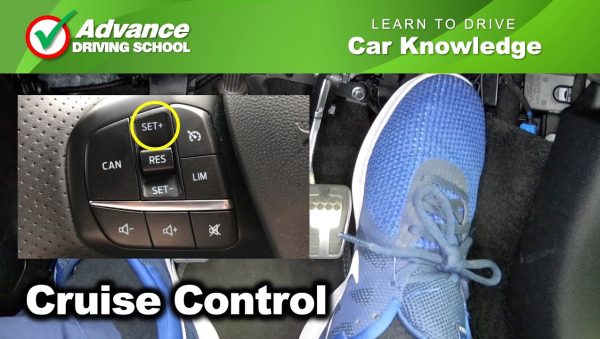
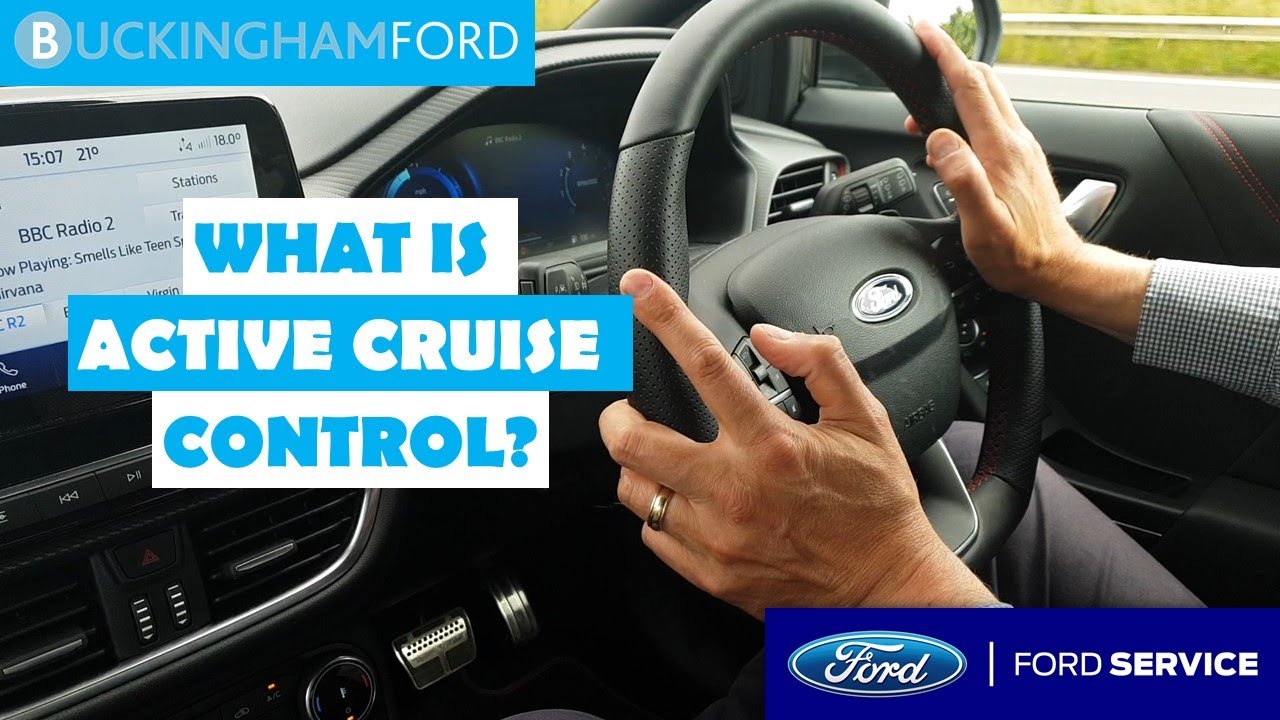
- Control Switches: Located typically on the steering wheel, these buttons (Set, Resume, Cancel, +/-) serve as the interface for the driver to communicate their speed requirements to the system.
Step-by-Step Guide: How to Master Your Cruise Control System
📋
Operating Your System Safely
Ensure your vehicle is at a safe cruising speed—most systems require a minimum speed threshold, typically between 25 and 45 km/h (or mph)—before pressing the “On” or “Cruise” button.
Once active, press the “Set” button to lock in your current velocity. Use the “+” or “-” buttons to fine-tune your speed incrementally without needing to touch the pedals.
Tapping the brake or pressing “Cancel” disengages the system. To return to your previous set speed automatically, press “Resume” once you have reached a safe speed.
Cruise Control vs. Adaptive Systems and Speed Limiters

Understanding the distinction between these technologies is essential for modern driving. Standard cruise control provides fixed-speed maintenance, whereas adaptive and limiting systems introduce higher levels of situational logic.
Industry Data
Min. Speed (km/h)
Driver Liability
Essential Safety Pitfalls and Usage Warnings
Why Rain and Ice Create Hazards
A common and dangerous mistake is using cruise control during inclement weather. On wet or icy roads, your tires rely on delicate traction. When the cruise control detects a loss in speed due to hydroplaning, it may inadvertently increase throttle to regain the set speed. This sudden burst of power can break tire traction, leading to a spin or loss of control that the system is not programmed to counteract.
The Myth of Autonomous Cruise Control
Despite the complexity of the PID Controller (Proportional-Integral-Derivative) used by the ECU to smooth out speed adjustments, cruise control lacks the perception required for true autonomy. It cannot anticipate road curvature or sudden stops by vehicles ahead unless it is a specific Adaptive Cruise Control (ACC) system, and even then, its capabilities are strictly bounded. Never treat the system as a replacement for attentive driving.
On steep downhill grades, standard cruise control may struggle to maintain speed if engine braking is insufficient. The vehicle will likely exceed your set speed as gravity takes over. Always be prepared to override the system with the brake pedal in these conditions.
✅ Best Practices
- Always remain alert and keep your feet positioned near the pedals.
- Use cruise control primarily on straight, dry, and lightly traveled highways.
- Refer to your owner’s manual for model-specific activation quirks.
Mastering the Road Ahead
Ultimately, cruise control is a sophisticated tool designed to enhance driver comfort during long, steady stretches of road. It acts as a refined feedback loop, managing the engine’s throttle to counteract speed variances, but it is strictly an aid, not a pilot. You must always maintain situational awareness, especially in changing weather or traffic conditions where the system’s logic can be easily overwhelmed by road physics. By understanding these mechanical boundaries and staying engaged as the primary operator, you can use cruise control effectively to reduce fatigue and maintain a consistent, efficient driving pace.
Check your owner’s manual for specific speed activation thresholds in your vehicle model to ensure you are operating the system within the manufacturer’s design parameters.
How Does the Cruise Control Work: Frequently Asked Questions
Does cruise control save fuel?
Yes, it generally saves fuel by maintaining a consistent velocity and preventing the erratic throttle inputs caused by human foot fatigue. By keeping the engine at a steady RPM and reducing unnecessary acceleration and deceleration, modern cruise control systems optimize the air-fuel ratio for sustained cruising efficiency, leading to measurable fuel savings on long, flat highway journeys.
Why does my cruise control turn off when I hit a bump?
If cruise control disengages over bumps, it often indicates a mechanical sensitivity in the brake pedal switch or an intermittent loss of data from the wheel speed sensors. The system is designed to kill power immediately if it detects a braking event or signal disruption. A loose brake switch or a failing sensor can mistakenly trigger this ‘safety off’ command when the chassis jolts.
Is it safe to use cruise control in the rain?


No, it is generally advised against using cruise control in rain or slippery conditions. In the event of hydroplaning, the cruise control may mistakenly interpret the sudden loss of tire grip as a drop in speed and accelerate the wheels to compensate, leading to a total loss of traction and vehicle control. Always maintain manual control of the accelerator during inclement weather.
Does cruise control work in manual transmission cars?
Yes, cruise control can function in manual transmission vehicles, but it operates under stricter limitations. Because changing gears would disconnect the engine from the transmission, engaging the clutch or shifting gears will almost always force the cruise control to disengage. It is designed to hold speed only within a specific gear; once you depress the clutch, the system identifies the disconnection and terminates the speed-maintenance function.
What is the minimum speed for cruise control engagement?
Most vehicle manufacturers set the minimum engagement speed between 25 and 30 mph. This limitation is in place because the system relies on steady throttle response and consistent wheel rotation data, which are less stable at very low speeds. Attempting to set the cruise at neighborhood speeds is often locked out by the ECU to prevent misuse in urban, high-traffic, or pedestrian-heavy environments.