Honda Adaptive Cruise Control Stop and Go: Mastered for 2026
Ever wondered if your Honda could take the stress out of your daily commute? Navigating bumper-to-bumper traffic is a chore that demands constant micro-adjustments to your braking and acceleration, leading to unavoidable driver fatigue and increased risk of human error. The Honda Adaptive Cruise Control (ACC) with Low-Speed Follow (LSF) system is engineered to solve exactly that. By automating the pace of your vehicle in dynamic traffic, it transforms the driving experience. This guide provides the expert information needed to safely and effectively leverage this technology for a more reliable, comfortable, and professional driving experience.
Technical Foundations of Honda Adaptive Cruise Control Stop and Go



📤 Share Image

The Role of Millimeter-Wave Radar and Monocular Cameras
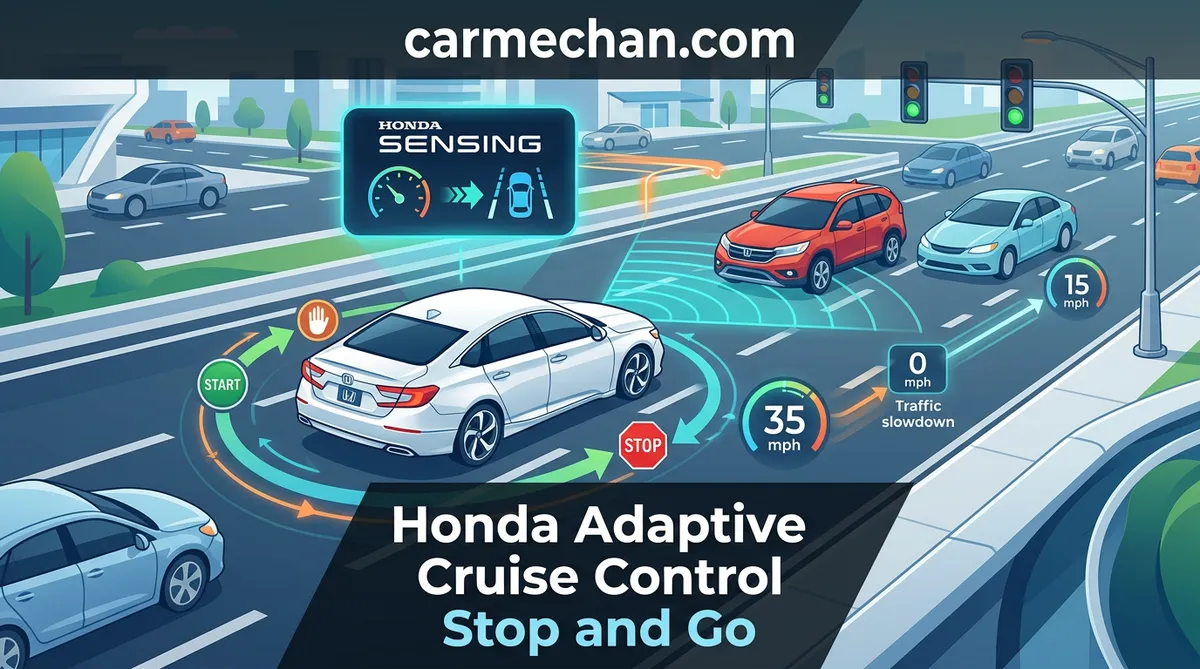
The sophisticated nature of the Honda Sensing suite relies on a process known as sensor fusion. By combining data from a front-facing millimeter-wave radar and a monocular camera, the system builds a high-fidelity map of the road ahead. The radar excels at measuring the precise distance and closing speed relative to the vehicle in front, while the camera identifies the type of vehicle—car, truck, or motorcycle—and monitors lane markings. The Electronic Control Unit (ECU) acts as the brain, processing these inputs in milliseconds to modulate throttle and braking inputs seamlessly.
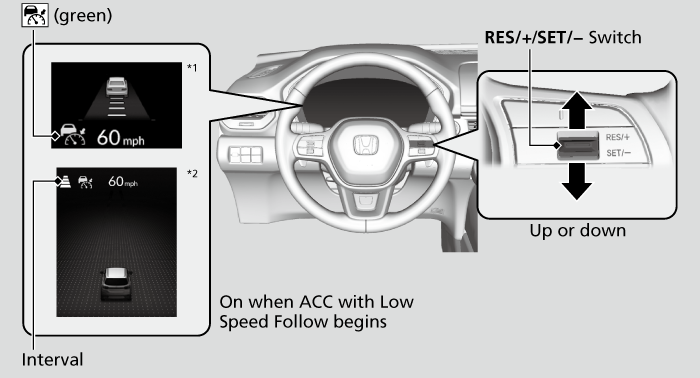
How Low-Speed Follow Changes the Driving Experience
Standard cruise control is a relic of highway-only driving, but Low-Speed Follow (LSF) expands the system’s operational range to 0 to 90+ mph. This feature allows your Honda to follow the vehicle in front all the way to a complete stop, and then accelerate once traffic begins to move again. This synergy between the braking system and the cruise control logic is what separates a basic driver-assist feature from a modern, traffic-ready assistant. It effectively eliminates the “stop-go-stop” tedium by maintaining a set distance, allowing the vehicle to handle the low-speed crawling found in congested urban environments.

Mastering Honda Adaptive Cruise Control Stop and Go Controls


📋
Step-by-Step Guide


Press the MAIN button on your steering wheel. An ACC indicator will appear on your driver information interface. Accelerate to your desired cruising speed and press SET.
Use the distance interval button on the steering wheel to toggle between four preset distances. These settings determine how closely your vehicle follows the lead car, providing a customized experience based on traffic flow and road conditions.
If the car comes to a complete stop for an extended period, the LSF system will pause. To resume, gently tap the accelerator pedal or press the RES/SET button on the steering wheel once the lead vehicle begins moving forward.
Honda Sensing System Safety and Performance Limits
Why Stationary Objects Challenge Radar Sensors
It is vital for every driver to understand that Honda Adaptive Cruise Control is an assist system, not a substitute for attentive driving. A common pitfall is the system’s difficulty in detecting stationary objects. Because the radar is calibrated to prioritize moving vehicles to reduce false braking, it may not immediately recognize a vehicle that has already come to a complete stop at a traffic light or a disabled vehicle on the shoulder. Always be prepared to intervene when approaching non-moving traffic.
Environmental Factors That Cause Sensor Occlusion
The camera and radar system rely on a clear line of sight. Environmental factors such as heavy rain, dense snow, or thick fog can lead to sensor occlusion, where the system provides an alert indicating that it is temporarily unavailable. Similarly, extreme sun glare or mud/ice buildup on the front Honda emblem—where the radar is housed—can force a system deactivation. In these scenarios, the system will provide an audible and visual warning to the driver, at which point the driver must immediately resume full manual control.
Always keep your front grill and windshield (near the rearview mirror) clean. Even a thin layer of road grime or frost can degrade the precision of the radar and camera, leading to unexpected deactivations.
Troubleshooting Common Honda Stop and Go Issues
When the system does not act as expected, the issue is often a minor oversight rather than a mechanical failure. Use this diagnostic list to restore normal function:
- Clear Sensor Obstructions: Check the front Honda badge and the upper windshield area for mud, snow, or excessive grime. If the radar or camera “sees” too much interference, it will disable the cruise control for safety.
- Check System Status: Ensure your Electronic Stability Control (VSA) is enabled. If VSA is turned off, the cruise control system will frequently fail to activate or will shut down shortly after being set.
- Understand Deactivation Scenarios: The system may deactivate if you perform an abrupt steering maneuver or if the vehicle’s speed drops below a specific threshold without LSF engaged.
- Verify Brake System Health: If the Electronic Brake Booster reports a fault, the cruise control and Low-Speed Follow will be disabled as a fail-safe measure. A dashboard warning light will accompany this.
Never rely on Adaptive Cruise Control in stop-and-go traffic if you are distracted or tired. While the system can stop the car, it does not guarantee a collision-free experience. Always maintain situational awareness.
Industry Data Summary
MPH Range
Follow Intervals
Final Guidance on Reliable Honda Cruise Control Operation
Honda Adaptive Cruise Control is a powerful, professional-grade tool for reducing driver fatigue on long trips and in dense, repetitive traffic. By understanding that the system works best when sensors are pristine and the driver remains the ultimate authority, you can maximize both safety and convenience. Remember that the system is designed to complement your driving, not replace it.
Always remain alert, as the system’s ability to identify stationary objects is limited. Keep your sensors clean to ensure the most reliable data feedback. For the best results, consult your specific model’s owner’s manual to confirm the exact implementation of the Honda Sensing suite in your vehicle, as features can vary between trim levels and model years.
Honda Adaptive Cruise Control Stop and Go: Frequently Asked Questions
Does ACC work in heavy rain or fog?
Adaptive Cruise Control is a vision-and-radar-based system and can struggle in heavy rain, fog, or snow. Severe weather reduces the visibility of the camera and can cause signal scattering for the radar, leading to system disengagement or reduced reliability. Always maintain manual control in low-visibility conditions to ensure safety and maintain the professional standard of defensive driving.
Can the system detect motorcycles or pedestrians?
While the system is highly advanced, it is primarily optimized to detect other passenger vehicles. Detection of motorcycles, bicycles, or pedestrians is not guaranteed and can be inconsistent due to their smaller radar cross-section. The system is designed as a support feature; you must never rely on it to detect vulnerable road users in place of your own visual vigilance.
Will the car automatically resume driving after a stop?
If the vehicle comes to a complete stop as part of the traffic flow, it will remain stopped for a short duration. If the preceding vehicle starts moving within that window, your car will automatically resume. If the stop lasts longer, you must gently press the accelerator or press the ‘RES/+’ button to confirm it is safe to resume movement.
What does the ‘Radar Obstructed’ message mean?
This message indicates that the millimeter-wave radar sensor located in the front grille is covered by snow, ice, mud, or debris, preventing it from ‘seeing’ the road. To fix this, safely pull over and gently clean the sensor area. If the error persists after clearing the debris, the system may require a professional diagnostic service at an authorized Honda dealership.
Can I use ACC on winding roads?
Adaptive Cruise Control is optimized for highway driving with gentle curves and predictable traffic. On sharp, winding roads, the system may lose track of the vehicle ahead because the radar signal cannot follow the curvature of the lane. Use caution and manual steering control on curves to ensure the system does not incorrectly lock onto vehicles in adjacent lanes.