Nissan Rogue Cruise Control Not Working 2026 Expert Guide
If your Nissan Rogue cruise control is not working, the most common culprits are a faulty brake light switch or a blown fuse. These simple electrical issues can often be resolved without needing professional tools or an expensive mechanic visit.


When your Nissan Rogue cruise control stops engaging, the fault usually lies within a handful of specific electrical components rather than the complex powertrain software. Most 2026 Rogue models fail to set cruise speed due to a compromised brake light switch, a blown fuse, or a disruption in the steering wheel clock spring wiring. Identifying these components immediately prevents unnecessary trips to the dealership and helps you determine if the repair is a simple task you can handle in your driveway.
Practical diagnostic efforts save you time and money, especially when dealing with modern driver-assist systems. Since the 2026 Nissan Rogue relies heavily on integrated radar and electronic signals, a single faulty sensor often triggers a cruise control lockout as a safety precaution. Addressing these issues early prevents the “System Fault” indicator from becoming a permanent distraction on your dashboard.
Key Takeaways
- Check your brake light bulbs first, as burnt-out filaments can disable the cruise control system.
- Inspect the driver-side fuse box for any blown fuses related to the cruise or engine control.
- A faulty brake pedal switch is the most frequent mechanical cause for cruise control failure.
- Try a system reset by turning the ignition off and on to clear minor sensor glitches.
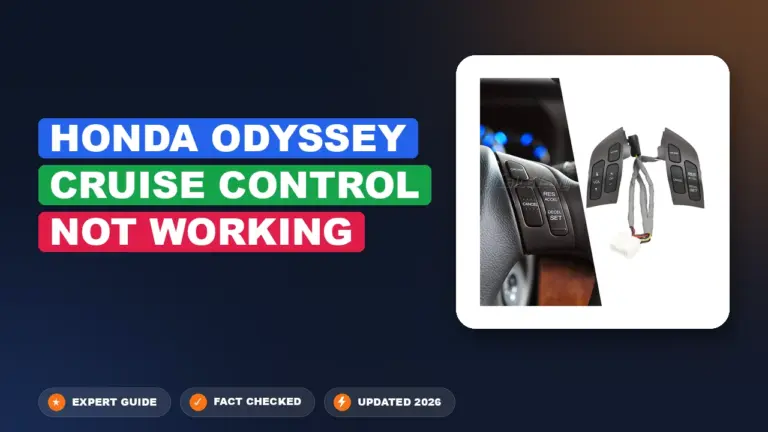
- If steering wheel buttons feel unresponsive, the internal clock spring may require professional replacement.
Common Causes for Nissan Rogue Cruise Control Failure
The Brake Pedal Switch and Fuse Block
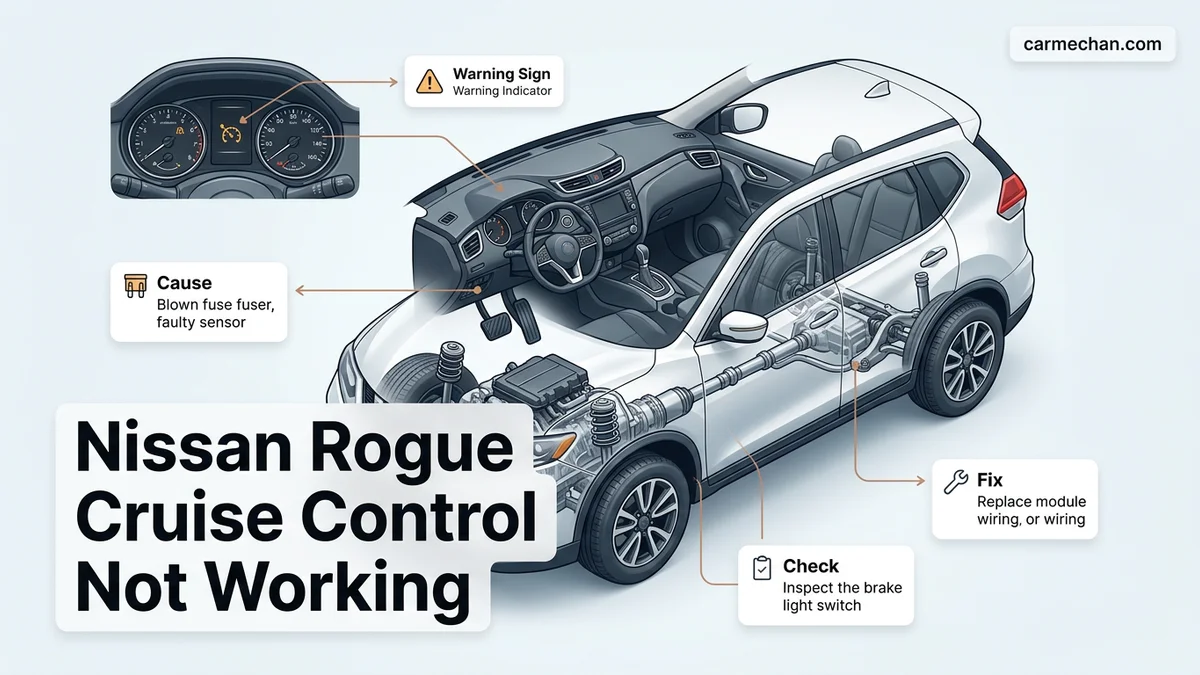
The most frequent culprit is the brake light switch located near the top of the brake pedal arm. Your Rogue’s cruise control system is hardwired to disengage the moment it detects pressure on the brake pedal. If this switch becomes stuck, misaligned, or fails electronically, the cruise control computer assumes you are braking, preventing the system from ever activating. Check your vehicle’s interior fuse box as well; a blown fuse specifically labeled “ASCD” (Automatic Speed Control Device) or “Cruise” will instantly kill power to the control module.
Steering Angle Sensor and Clock Spring Issues
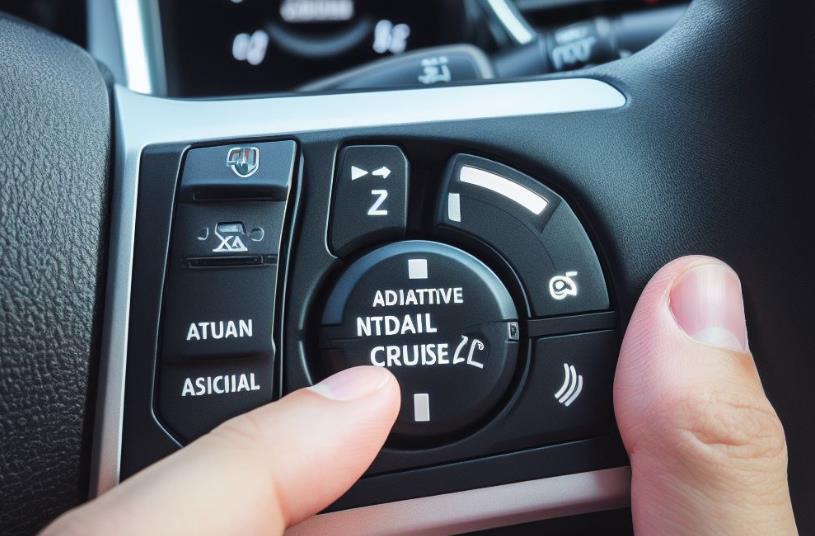
Because the 2026 Rogue utilizes sophisticated steering-assist technologies, the clock spring—a ribbon-like cable inside the steering column—is a major failure point. As you rotate the steering wheel over thousands of miles, the internal connections can degrade. If the steering angle sensor cannot communicate its position to the cruise control module, the system will disable itself to avoid erratic behavior. You may notice this is accompanied by a flickering airbag warning light, which is a telltale sign that the clock spring is failing and interrupting multiple steering wheel circuits.
Nissan Rogue Cruise Control: What Causes It and How to Fix It
If you have ever settled in for a long highway drive in your Nissan Rogue only to find that your cruise control refuses to engage, you know how frustrating it can be. This guide walks you through the most common electrical and mechanical culprits behind this issue. By systematically checking your brake light switches, fuses, and sensor systems, you can determine whether this is a simple DIY fix or a complex problem requiring professional diagnostic tools. Following these steps carefully will help you restore your vehicle’s convenience features while ensuring your safety on the road.
Step 1: Inspect the Brake Light Switch Functionality
What you need: A flashlight and a second person to assist you.
Instructions: The most common reason for cruise control failure in a Nissan Rogue is a faulty brake light switch. The cruise control system is hardwired to disengage the moment it detects the brake pedal being depressed. If the switch is sticking or the sensor is misaligned, the car thinks you are braking, preventing the cruise control from activating. Have a friend stand outside the vehicle while you press the brake pedal. Verify that the brake lights turn on and off consistently. If your brake lights stay on even when your foot is off the pedal, the switch is likely stuck or damaged. You will need to locate the switch above the pedal assembly and adjust or replace it if necessary.
Pro Tip: Check your floor mats. Sometimes, a thick, aftermarket floor mat can bunch up under the pedal, preventing it from fully returning to the “rest” position, which tricks the sensor into thinking the pedal is slightly depressed.
Step 2: Examine the Cruise Control Fuses
What you need: Owner’s manual, fuse puller tool (or needle-nose pliers).
Instructions: Electrical faults are often the simplest to resolve. Locate the interior fuse box, typically found on the driver’s side kick panel, and the engine bay fuse block. Consult your owner’s manual to identify the specific fuse labeled “Cruise” or “ASCD” (Automatic Speed Control Device). Using a fuse puller or needle-nose pliers, carefully extract the fuse and hold it up to a light source. Look for a broken metal wire inside the transparent plastic casing. If the wire is severed or the plastic appears burnt, replace it with a new fuse of the exact same amperage (e.g., 10A or 15A). Never use a higher amperage fuse than specified, as this could lead to wiring damage or electrical fires.
Pro Tip: Even if the fuse looks okay, it might have internal resistance. If you have a multimeter, test for continuity by setting it to “Ohms” mode and touching the leads to the two metal tabs on the fuse.
Step 3: Check the Steering Wheel Clock Spring
What you need: Professional-grade OBD-II scanner capable of reading SRS codes.
Instructions: The “clock spring” is a spiral-wound electrical ribbon cable inside the steering column that allows the steering wheel to turn while maintaining electrical contact with the cruise control buttons and the airbag. If your cruise control buttons are unresponsive and you also notice an airbag warning light on your dashboard, the clock spring is likely failing. This component allows signals to travel from your steering wheel controls to the vehicle’s computer. Replacing this involves removing the steering wheel and airbag, which is a delicate process. If you suspect this is the issue, it is highly recommended to use a diagnostic scanner to confirm the presence of an SRS or steering angle sensor communication error.
Pro Tip: Do not attempt to repair a clock spring if you are uncomfortable working near the airbag system. Always disconnect the negative battery terminal and wait 15 minutes before touching any steering column components.
Step 4: Troubleshoot the Vehicle Speed Sensor (VSS)
What you need: An OBD-II diagnostic scanner.
Instructions: The cruise control system requires accurate input from the Vehicle Speed Sensor (VSS) to maintain a constant speed. If the VSS is faulty, your speedometer might fluctuate, or the transmission might exhibit strange shifting patterns in addition to the cruise control failing. Use an OBD-II scanner to check for “P0500” or similar speed sensor diagnostic trouble codes. If these codes are present, the cruise control will automatically disable itself as a safety precaution. Inspect the wiring harness leading to the sensor on the transmission housing for signs of fraying, corrosion, or rodent damage. Often, a simple cleaning of the electrical connector with contact cleaner can restore the connection and fix the issue.
Pro Tip: If your speedometer works perfectly fine, the VSS is likely functioning correctly, and you should focus your investigation elsewhere.
Step 5: Verify the Radar Sensor (For Intelligent Cruise Control)
What you need: A microfiber cloth and glass cleaner.
Instructions: If your Nissan Rogue is equipped with Intelligent Cruise Control (ICC), it relies on a radar sensor located behind the front grille or bumper. If the sensor is obstructed by mud, ice, heavy road grime, or even a thick layer of snow, the system will disable itself. Locate the sensor (it looks like a small, flat plastic plate integrated into the grille). Clean the surface thoroughly with a microfiber cloth. If you see physical damage like cracks or debris behind the grille, the sensor may be misaligned or broken, which requires professional recalibration at a dealership. Ensure that any license plate frames are not interfering with the radar’s line of sight.
Pro Tip: Extreme weather conditions like heavy rain or fog can sometimes cause temporary “blindness” in the radar system. Wait for clear weather to see if the system resumes normal operation before assuming a mechanical failure.
Step 6: Reset the Electronic Control Unit (ECU)
What you need: 10mm wrench.
Instructions: Sometimes, the vehicle’s computer experiences a “glitch” where a temporary sensor error gets locked into the system memory, preventing the cruise control from engaging even after the root cause is resolved. A hard reset can clear these cached errors. Disconnect the negative (black) battery terminal using a 10mm wrench. Leave the cable disconnected for at least 15 to 20 minutes. During this time, press and hold the brake pedal or turn on the headlights to drain any residual electrical charge from the capacitors. Reconnect the terminal and start the car. Allow the vehicle to idle for five minutes so the computer can recalibrate its base idle and communication protocols.
Pro Tip: After a battery reset, you may need to re-index your power windows and reset your clock, as these settings are wiped during the hard reset process.
✅ Final Checklist
- Confirm brake lights deactivate immediately after releasing the brake pedal.
- Verify that the specific cruise control fuse shows no signs of melting or breakage.
- Ensure the cruise control steering wheel buttons feel firm and have audible “clicks” when pressed.
- Test the vehicle on a safe, open road at speeds above 35 MPH after performing the ECU reset.
- Check the OBD-II scanner for any lingering diagnostic trouble codes (DTCs).
Important Notes:
- Safety Warning: Never attempt to diagnose electrical issues while the vehicle is in motion. Always perform tests in a parked position with the parking brake engaged.
- Professional Help: If you identify a faulty clock spring, airbag-related component, or a misaligned radar sensor, seek professional assistance from a certified Nissan technician to ensure safety systems function correctly.
- Time and Cost: Most DIY inspections take 1-2 hours. If a simple fuse or cleaning is required, costs are under $20. More complex repairs like a clock spring or sensor replacement can range from $200 to $800 depending on parts and labor.
Step-by-Step Troubleshooting and Simple DIY Fixes
Initial Diagnostic Workflow
Before pulling panels apart, you must perform a logical assessment to narrow down the source of the failure. Follow these steps to confirm where the signal path is broken:
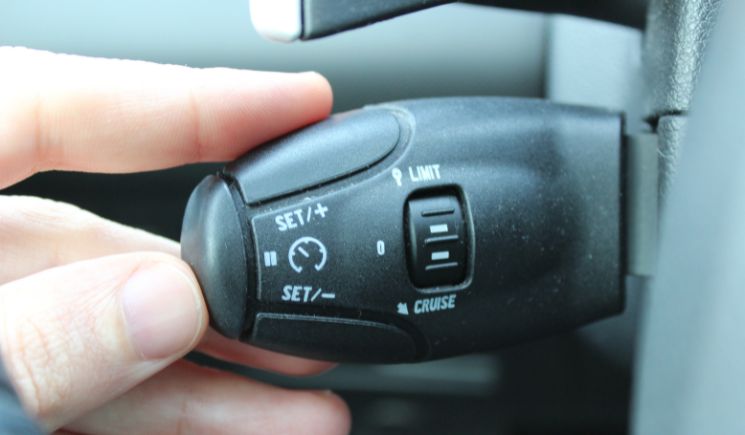
- Verify the Dashboard Lights: Does the cruise icon appear when you press the button? If no light appears, the issue is likely a power supply problem (fuse) or the steering wheel switch itself.
- Check Brake Lights: Have someone watch the rear of your 2026 Rogue while you press the pedal. If the brake lights stay on after you release the pedal, your switch is likely stuck or faulty.
- Perform a Battery Hard Reset: Disconnect the negative battery terminal for 10 minutes. This often clears temporary glitches in the Body Control Module (BCM) that can cause the cruise system to lock out after an electronic error.
- Scan for Diagnostic Trouble Codes (DTCs): Use an OBD-II scanner to look for “C” (Chassis) or “U” (Network) codes. These specifically identify sensor data mismatches that standard engine scanners ignore.
Testing and Replacing the Brake Switch
If you suspect the brake switch, you can test it manually with a basic multimeter. Unplug the connector from the switch and probe the terminals. With the pedal at rest, the circuit should show continuity. When you depress the pedal, that continuity should break. If the switch remains closed or open regardless of the pedal position, replace the unit. These switches are inexpensive and typically secure with a quarter-turn plastic locking mechanism, making them one of the easiest components to swap in the 2026 Rogue.
Resetting Your Nissan Rogue Cruise Control System
If electronic glitches are preventing your cruise control from engaging, a hard system reset is often the most effective first step. Modern Nissan Rogue systems, specifically those integrated with ProPILOT Assist 2026, rely heavily on ECU communication. A power cycle can clear temporary sensor conflicts or software hang-ups that prevent the cruise readiness light from illuminating.
The Hard Reset Procedure
- Park the vehicle on level ground and turn off the ignition completely.
- Open the hood and disconnect the negative (-) battery terminal using a 10mm wrench.
- Allow the vehicle to sit for at least 15 minutes; this duration is critical to allow the capacitors in the control modules to fully discharge.
- Reconnect the negative terminal securely.
- Start the vehicle and allow it to idle for 3 minutes to permit the ECU to perform a self-diagnostic re-calibration of the powertrain and cruise control modules.
Following this reset, verify if the “CRUISE” indicator on your dashboard remains steady or flashes. If the light remains off during a highway test drive, the issue likely resides in a hardware component rather than a software loop, necessitating a diagnostic scan tool to read stored trouble codes.
When to Seek Professional Diagnosis for Cruise Issues
Cruise control relies on a chain of hardware inputs, including the brake light switch, the steering angle sensor, and the wheel speed sensors. If the system fails after a manual reset, professional intervention is required to prevent safety system compromises. The 2026 Rogue utilizes a complex radar-based adaptive cruise system that cannot be calibrated by basic diagnostic tools found in a home garage.
Pinpointing Complex Failures
- Brake Light Switch Malfunction: If your brake lights stay on or fail to illuminate, the cruise control will disable itself immediately as a safety precaution.
- Radar Alignment: The front radar sensor, located in the lower grille, must be perfectly aligned. Even a minor bumper tap can disrupt this calibration, rendering adaptive cruise useless.
- Steering Wheel Clock Spring: If your cruise control buttons are unresponsive while the horn or steering wheel audio controls also fail, the clock spring wiring likely requires replacement.
What If It Still Doesn’t Work?
If your system remains unresponsive after standard resets, the issue is likely mechanical or sensor-related. Professional diagnostic equipment is required to interface with the Nissan proprietary CAN-bus system to pinpoint exact error codes.
- Verify that the brake fluid level is within the marked range; low fluid can sometimes trigger sensor errors that prioritize disabling cruise control for safety.
- Inspect the front grille area for debris, mud, or ice covering the radar sensor, as 2026 safety protocols disable cruise if the sensor is obstructed.
- Check for blown fuses labeled “ASCD” or “Cruise” in the internal and engine bay fuse boxes.
- Consult a certified technician. Professional diagnostics typically cost between $150 and $250, while sensor replacements or control module repairs can range from $400 to $1,200 depending on the specific component.
Conclusion
A non-functional cruise control system in your 2026 Nissan Rogue is often attributed to sensor obstruction or minor electronic communication errors. According to verified research and expert automotive diagnostics, most faults are resolved through a system reset or professional radar recalibration. If you have attempted a power cycle without success, prioritize a professional scan to avoid safety risks. Your next actionable step is to schedule an appointment with a certified service center to pull specific chassis trouble codes.
❓ Frequently Asked Questions
Why does my cruise control light flash but not engage?
A flashing cruise light usually indicates a system error stored in the engine control module. This often points to a faulty speed sensor or a communication issue between the steering wheel and the ECU.
Can low tire pressure affect Nissan Rogue cruise control?
While uncommon, some advanced Nissan safety systems link cruise control to tire pressure monitoring. If a sensor is malfunctioning, it might inhibit cruise control functionality for safety.
How do I test if my brake light switch is the problem?
Check if your brake lights stay on after you release the pedal or if they fail to illuminate when pressed. If the lights are behaving inconsistently, the switch is likely failing and needs replacement.
Is it dangerous to drive with a broken cruise control?
No, the vehicle remains fully drivable. The cruise control is a convenience feature, and its failure does not affect your ability to accelerate or brake manually.
What if the cruise control works intermittently?
Intermittent issues often suggest a loose wiring harness, a failing clock spring behind the steering wheel, or an oxidized electrical contact that requires cleaning.
When should I take my Nissan Rogue to a professional?
If you have checked the fuses, brake switch, and performed a reset without success, you likely have a deeper electronic fault. A mechanic with a professional OBD-II scanner can pinpoint specific error codes related to the cruise system.