Drivers Should Avoid Using Cruise Control: Hazards Decoded
For decades, cruise control has served as a staple of highway travel, often marketed as a tool for driver convenience and fuel efficiency. However, the industry has frequently seen this feature misused as a “set-it-and-forget-it” mechanism. Drivers often rely on automated speed maintenance systems in environmental and traffic conditions where mechanical intuition and immediate physical control are mandatory for safety. This guide provides expert, professional advice on identifying high-risk scenarios and explains why, for your safety, specific driving conditions demand that you disable your cruise control entirely.
Why Drivers Should Avoid Using Cruise Control in Hazardous Conditions


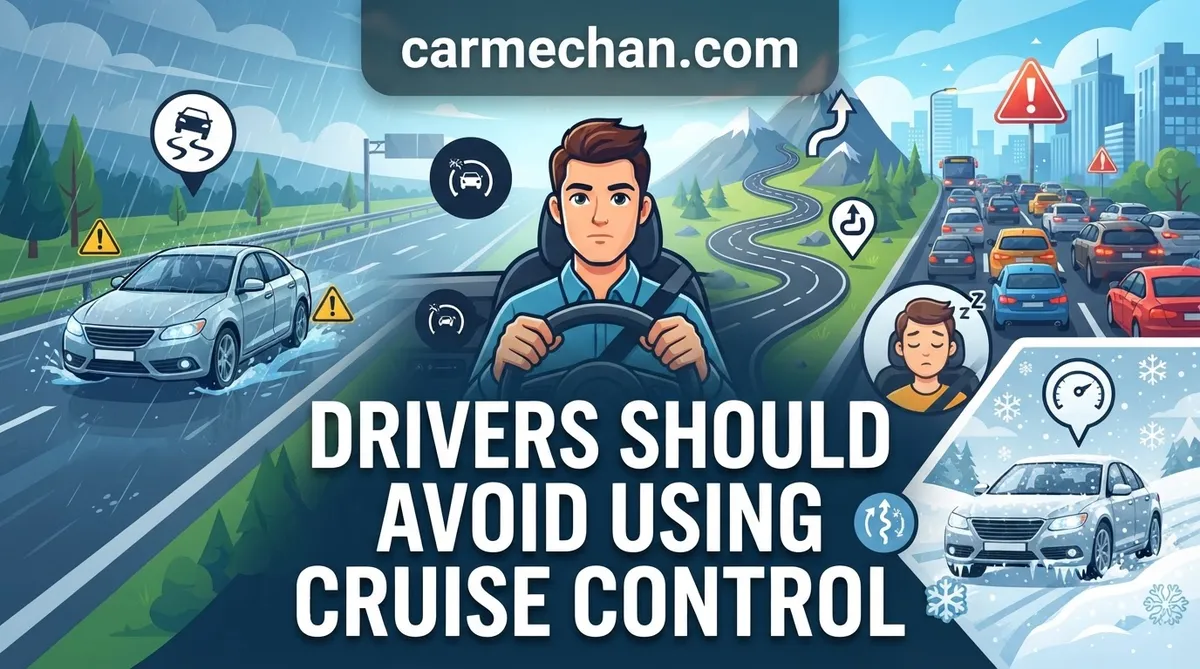
The primary danger of modern cruise control lies in its inability to interpret road surface conditions. While your vehicle may be equipped with sophisticated safety systems, standard cruise control does not communicate with road-surface sensors to identify hazards such as oil slicks, black ice, or standing water.
📤 Share Image
Hydroplaning Risks and Speed Maintenance
Hydroplaning occurs when a thin layer of water separates the tire from the road surface, leading to a complete loss of steering and braking control. When cruise control is active, the vehicle maintains a constant velocity regardless of tire grip. If a vehicle hits a patch of standing water while under cruise control, the system will often attempt to maintain the “set” speed even as traction vanishes. This prevents the necessary, intuitive micro-adjustments a human driver would make—such as lifting off the throttle—to help the tires regain contact with the pavement.

Why Cruise Control Fails on Slippery Surfaces
Inclement weather demands active throttle modulation. On snow or ice, the Electronic Stability Control (ESC) and Anti-lock Braking System (ABS) work to manage wheel slip. However, these systems are designed to supplement—not replace—the driver’s judgment. When cruise control is engaged in slippery conditions, it may counteract the safety measures these systems are trying to deploy. If the vehicle begins to lose traction, the cruise control may continue to send torque to the wheels to maintain speed, potentially triggering a spin.

Limited Traction Awareness in Standard Systems
Standard cruise control systems are fundamentally “blind” to external physics. They are programmed with the assumption that the road is dry and the vehicle has adequate tire contact. By keeping the vehicle in a state of locked speed, the system removes the human element of “traction awareness,” where a driver feels the road through the steering wheel and pedals. Relying on automation when the environment dictates caution is a leading cause of loss-of-control incidents on highways during rain or light snow.
Terrain Hazards: When Drivers Should Avoid Using Cruise Control
The geometry of the road significantly influences the safety profile of your vehicle. Electronic systems excel on long, straight stretches, but they perform poorly when faced with complex, non-linear terrain.
The Danger of Using Cruise Control on Winding Roads
On winding roads, a vehicle must balance lateral grip against forward momentum. If cruise control is engaged, the system does not account for the curve’s radius. It may maintain a throttle setting that is too aggressive for a sharp turn, forcing the tires to struggle for grip at the very moment they are being taxed by cornering forces. This inertia-driven error can lead to understeer, where the vehicle pushes wide of its intended lane. Maintaining “driver-in-the-loop” engagement is the only way to ensure the speed is modulated appropriately for the curvature of the road.
Managing Speed Transitions in Mountainous Terrain
Mountainous terrain presents a unique mechanical challenge. As the road grade changes, the cruise control system will frequently force the transmission to “hunt” for the correct gear to maintain speed. This results in unnecessary downshifting, increased transmission heat, and erratic power delivery. Experienced drivers know that mountain driving requires smooth, intentional power adjustments; the jerky, reactive nature of a cruise control ECU can disrupt the vehicle’s balance when climbing or descending steep grades.
Critical Safety Protocol: How to Safely Manage Cruise Control Systems
If you choose to use cruise control in ideal conditions, you must treat it as a temporary convenience, not a replacement for your active attention. Follow this professional guide to maintain vehicle control at all times.
📋
Step-by-Step Guide
Always hover your right foot near the brake pedal, even when the system is engaged. This ensures you can override the throttle actuator in milliseconds if you identify a hazard.

Avoid activating cruise control below 25-30 mph. Most factory systems are not designed for the low-speed variability found in residential or stop-and-go zones.
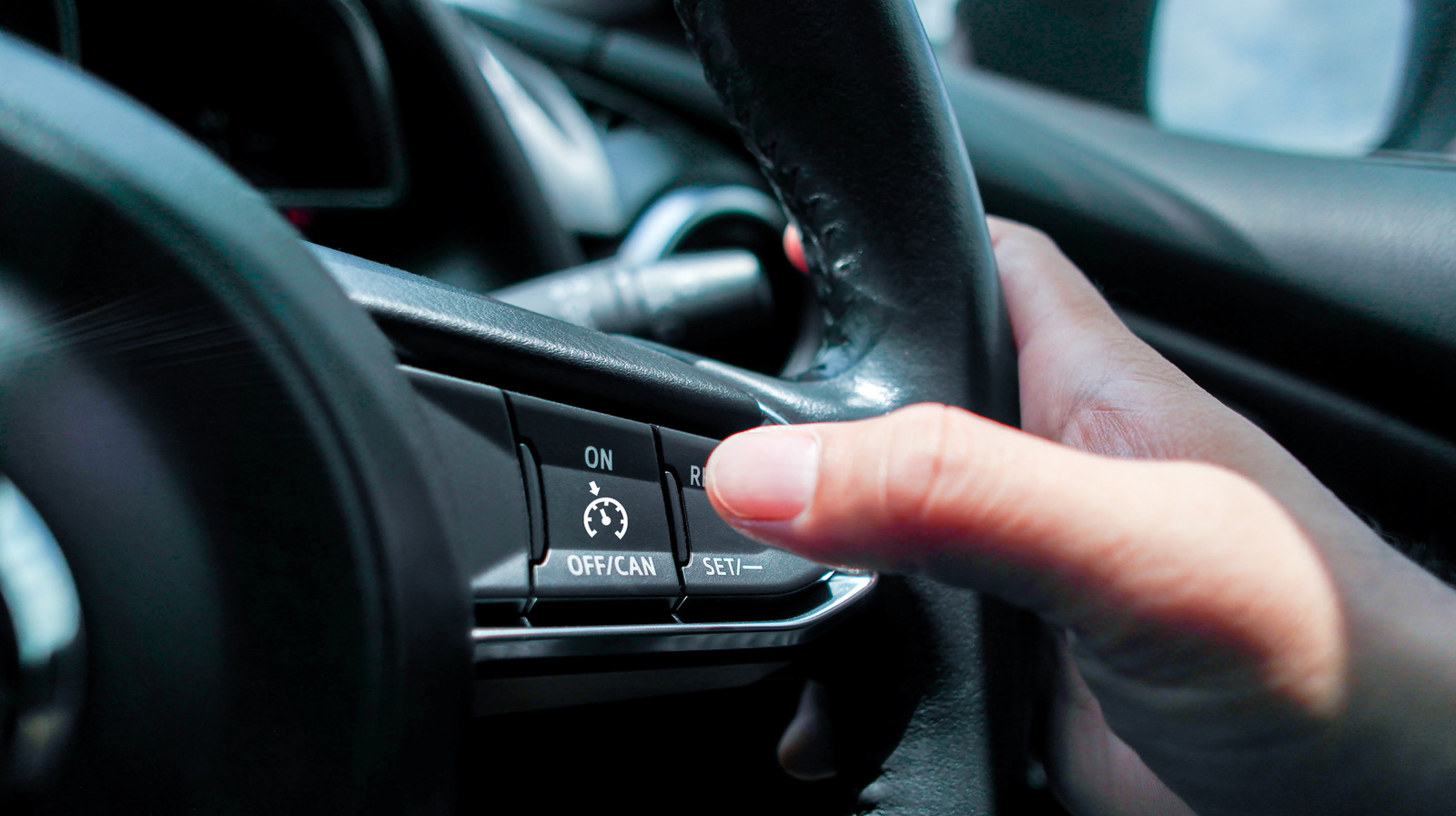
The most reliable way to disengage cruise control is a firm, deliberate press of the brake pedal. This sends an immediate electronic signal to the ECU to cut throttle, overriding any steering wheel switch commands.
Technical Limits: Why Drivers Should Avoid Using Cruise Control
It is a common error to conflate standard cruise control with modern Adaptive Cruise Control (ACC). While ACC uses radar and cameras to maintain distance, it is still subject to significant system latency and should not be used as a substitute for human observation.
The Dangers of Fatigue and Reduced Engagement
Long-distance travel with cruise control leads to cognitive “de-tuning.” When you do not need to manage the throttle, your mental engagement with the driving task decreases significantly. This state, often called “highway hypnosis,” slows your reaction time when an unexpected event occurs, such as a vehicle cutting into your lane or debris on the road.
Why Stop-and-Go Traffic Requires Manual Control
Cruise control should never be used in stop-and-go traffic unless the system is specifically rated for “traffic jam assist” or “pilot” functions. Standard systems are prone to surge, where the vehicle accelerates quickly to catch up to the car ahead, only to brake sharply. This creates a dangerous “accordion effect” in heavy traffic and contributes to rear-end collisions.
By The Numbers
Required Driver Attention
Systems Sensing Road Surface
Conclusion: Prioritize Safety Through Engagement
To maintain a reliable and professional standard of driving, you must acknowledge the physical limitations of automated speed systems. Cruise control is a tool intended solely for dry, straight, and level highway environments where road conditions are predictable and traffic density is low. When you encounter inclement weather, winding roads, or stop-and-go traffic, these are immediate triggers to deactivate the system. Driver engagement remains the ultimate safety feature in every vehicle, and manual throttle control is the most effective way to ensure a predictable and safe driving experience. Stay alert, maintain full physical control of your vehicle, and always keep your feet positioned to override the system at a moment’s notice.
Drivers Should Avoid Using Cruise Control: Frequently Asked Questions
Is it safe to use cruise control in the rain?
No. Using cruise control in the rain is highly discouraged. If your vehicle hydroplanes, the system may interpret the loss of resistance as a drop in speed and increase power, causing your wheels to spin faster. This can lead to a total loss of traction and stability control, making it difficult to regain control of your vehicle on wet surfaces.
Does cruise control save gas in heavy traffic?
Contrary to common belief, cruise control is inefficient in heavy or stop-and-go traffic. The system frequently attempts to maintain a precise speed by accelerating and braking aggressively, which consumes more fuel than human-controlled, modulated acceleration. Manual driving allows you to anticipate traffic flow, coasting effectively and reducing the need for constant, energy-intensive speed adjustments.
Is it safer to use cruise control at night?
Generally, no. Night driving reduces your field of vision and makes it harder to identify road hazards, debris, or wildlife. When using cruise control, your reaction time to unexpected obstacles is slowed because your feet are not hovering over the pedals. In low-light conditions, maintaining active control of both steering and speed is critical for quick emergency response.
Can I use cruise control on mountain roads?
You should strictly avoid cruise control on mountain roads. The system is calibrated for relatively flat terrain; it does not ‘see’ curves or steep inclines. It will often accelerate on sharp turns where you need stability or downshift unexpectedly on descents, which can compromise handling and safety. Manual control is required to navigate variable grades and tight corners safely.
How often should I service my cruise control system?
While there is no set mileage interval for cruise control maintenance, you should have it professionally inspected if you notice delayed engagement, inconsistent speed holding, or if your vehicle’s dashboard displays a warning light related to ADAS (Advanced Driver Assistance Systems). Regular software updates provided by the manufacturer during routine service visits help ensure the reliable performance of modern adaptive systems.