Check engine light comes on when using cruise control: De-mystified
Imagine driving down the highway when suddenly, your cruise control kicks off, a warning light flashes, and your dashboard lights up like a Christmas tree. Many drivers immediately panic, assuming their cruise control module has suffered a catastrophic failure. In reality, the cruise control system is often working exactly as it should—it is simply reacting to a broader issue within the vehicle’s engine management system. In this guide, we’ll explain why your car triggers this behavior and how to use simple diagnostics to identify the root cause and get your cruise control back online.
Why the Check Engine Light Comes On When Using Cruise Control


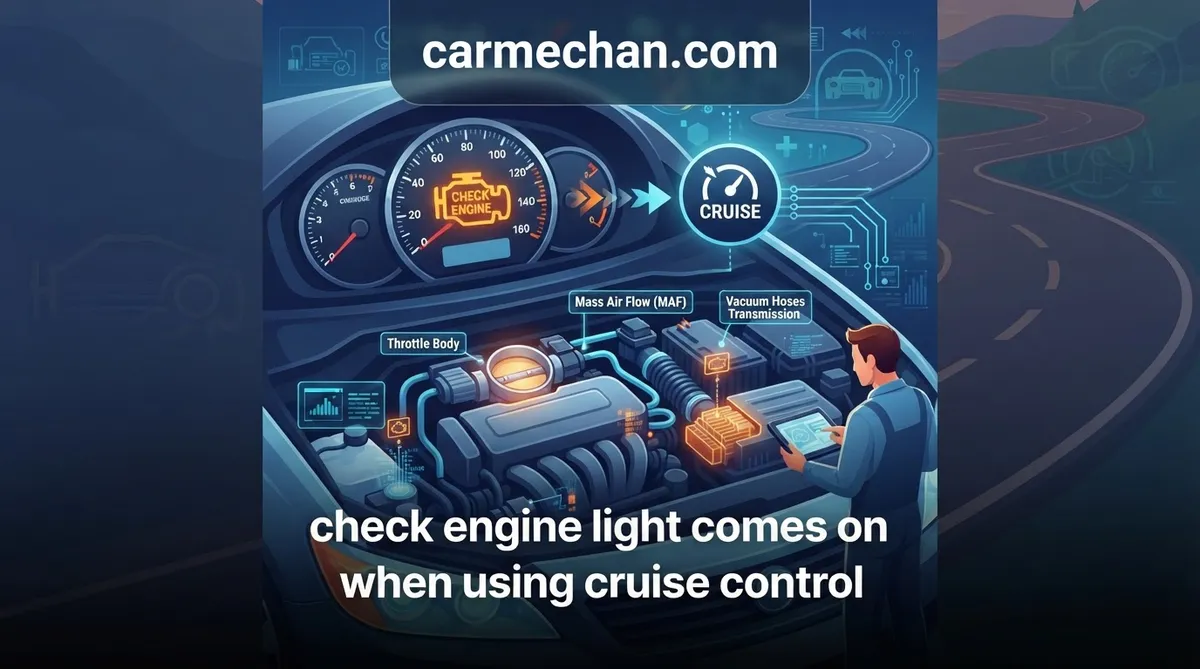
The relationship between your vehicle’s cruise control and the check engine light (CEL) is defined by safety logic. Modern vehicles are complex ecosystems of interconnected modules, and the cruise control system is considered a secondary, non-essential function. When the ECU detects a fault—whether it involves emissions, fuel trim, or transmission synchronization—it immediately triggers a fail-safe mode.
📤 Share Image

Understanding Fail-Safe Modes
When the ECU identifies a Diagnostic Trouble Code (DTC), it evaluates whether it is safe to maintain automatic throttle control. If the engine is misfiring, running lean, or struggling with sensor discrepancies, the computer deems it irresponsible to let an automated system manage acceleration. Consequently, it disables the cruise control system. This is a deliberate protection mechanism designed to prevent the cruise control from fighting against an erratic engine, which could lead to loss of control or further component damage.

How the ECU Manages Throttle-by-Wire
In modern “throttle-by-wire” vehicles, there is no physical cable connecting your pedal to the engine. Instead, a sensor sends a signal to the ECU, which then commands the electronic throttle body. Because the cruise control relies on this exact same electronic communication loop, any “noise” or conflict in the sensor data caused by an engine fault will force the cruise control to disengage. It is rarely the cruise control module that has failed; it is the engine’s inability to provide clean data to the system.
Industry Data
Cases related to sensor data errors
Actual cruise control hardware failure
Common Triggers for Cruise Control and CEL Malfunctions


Because the cruise control system draws information from several key engine sensors, a failure in any of these components often triggers the CEL and kills cruise control simultaneously.
Air Intake and Fuel Trim Sensors
- Mass Air Flow (MAF) Sensor: Contamination or electrical failure here causes incorrect air-fuel mixtures. The ECU detects this mismatch and disables cruise control to protect the catalytic converter.
- Throttle Position Sensor (TPS): Inconsistency in the TPS reading makes it impossible for the cruise control to maintain a steady speed, triggering a system disablement.
The Role of Brake Light Switches
One of the most common causes of cruise control failure is a faulty brake light switch. The system is designed to turn off as soon as it detects the pedal being pressed. If the switch is malfunctioning or stuck, it sends a constant signal to the ECU that the brakes are active, effectively blocking the cruise control from engaging while triggering a warning light.
Vehicle Speed Sensor Errors
The cruise control system requires a constant, accurate speed reading. If the Vehicle Speed Sensor (VSS) produces intermittent or erratic signals, the cruise control cannot calculate how to maintain a set speed. This often correlates with transmission shifting issues or speedometer fluctuations, serving as a primary indicator of a sensor fault.
How to Diagnose Check Engine Light and Cruise Control Faults


📋
Step-by-Step Guide
Plug an OBD-II scanner into the diagnostic port under your dashboard. Do not clear the codes immediately. First, record all stored codes (e.g., P0100 for MAF, P0500 for Speed Sensor) to identify the specific component triggering the issue.
Compare the codes against the vehicle’s repair manual. A P0300 (misfire) confirms an engine performance issue that necessitates disabling the cruise, whereas a P0500 confirms a speed sensor issue that directly disables the cruise control function.
Repairing the Underlying Cause of Cruise Control Disablement
Once the code is identified, the repair must be targeted. For instance, if the code indicates a dirty MAF sensor, cleaning it with a dedicated MAF spray is often sufficient. If the code points to a physical component like a brake light switch, replacement is mandatory.
Addressing Sensor Faults Correctly
Always use OEM-specified sensors whenever possible. Aftermarket sensors, especially mass air flow and speed sensors, often have slightly different impedance values that can prevent the ECU from recognizing the new part, causing the CEL to return shortly after clearance.
Never disconnect the battery to “reset” the check engine light. Doing so wipes adaptive memory (fuel trims and transmission shift points), which can cause the vehicle to run poorly for the next 50-100 miles while it relearns settings.
Why Battery Disconnection is Risky
Beyond losing radio presets and clock settings, disconnecting the battery can lead to an incomplete OBD-II “drive cycle.” Many states require these “readiness monitors” to be set for an emission test. Clearing the code via an OBD-II scan tool is the professional method that preserves these crucial adaptations while effectively signaling to the ECU that a repair has been performed.
Safety and Troubleshooting When Cruise Control Fails
Address the Root
Ignoring the CEL because the engine “feels fine” can result in permanent damage to components like catalytic converters or transmission solenoids.
Avoid Part Cannons
Don’t replace parts randomly based on an educated guess. If the code persists after a sensor replacement, you may have a wiring harness issue, not a faulty part.
If your cruise control remains disabled even after the CEL is cleared, or if the light returns immediately upon engaging cruise, the issue likely lies within the PCM (Powertrain Control Module) communication bus. This requires expert diagnostic equipment and should not be attempted by DIYers.
The link between a check engine light and cruise control is fundamentally a matter of engine management integrity. By understanding that your vehicle’s computer system prioritizes engine safety over convenience features, you can approach the diagnosis methodically. Always remember that the engine fault is the primary problem and the cruise control disablement is merely the side effect. Address the engine fault, and in almost every case, your cruise control will resume normal operation. If you possess a diagnostic code that remains persistent, consult a certified technician to avoid compounding, expensive repairs.
Check Engine Light Comes on When Using Cruise Control: Frequently Asked Questions
Is it safe to drive with the cruise control disabled?
Yes, it is generally safe to drive the vehicle with the cruise control disabled, provided the check engine light is not flashing and the engine is operating smoothly. However, the light indicates an active fault in the engine management system. You should avoid long-distance travel and have the vehicle scanned by a professional immediately to prevent potential secondary damage to the catalytic converter or engine components.
Does a flashing cruise light mean the same as a steady check engine light?
In many vehicles, particularly Subaru and Toyota models, a flashing cruise light is often a secondary symptom triggered by the primary check engine light. While the steady check engine light indicates an emissions or engine performance fault, the flashing cruise light serves as a notification that the cruise control module has been ‘locked out’ by the ECU for safety reasons. Always prioritize reading the check engine code first.
Can a loose gas cap cause my cruise control to turn off?
Yes, a loose or faulty gas cap is one of the most common causes of this specific issue. An improperly sealed cap allows fuel vapors to escape, triggering an Evaporative Emission (EVAP) system error code. Because the vehicle’s computer views any emissions-related error as a potential threat to environmental compliance, it will often disable the cruise control system as a precautionary measure until the fault is resolved.
What is the most frequent sensor fault that impacts cruise control operation?
The Mass Air Flow (MAF) sensor and the Throttle Position Sensor (TPS) are the most frequent culprits. These sensors provide the raw data the ECU uses to calculate engine load. If the MAF sensor sends erratic signals, the ECU cannot accurately determine the engine load, making it impossible to maintain a steady speed. Consequently, the computer defaults to disabling the cruise control entirely to maintain safe operation.
Does this issue happen more frequently in high-mileage vehicles?
Yes, high-mileage vehicles are more prone to this because components like rubber vacuum hoses, gas cap seals, and electrical connectors are subject to heat cycles and environmental degradation over time. A small vacuum leak that wasn’t an issue at 50,000 miles may become significant enough to trigger an error code by 150,000 miles, as the intake system’s tolerances shift with engine age.