10 Best Front and Rear Dash Cams (2026): Compared
Last Updated on October 18, 2026 by Ryan
Looking for the best dash cam front and rear setup? Compare ten exact Amazon listings here by front and rear resolution, channel count, parking power and package contents. A rear-windshield camera usually connects to the front unit by cable; built-in Wi-Fi generally connects the main camera to your phone.

Quick pick: Start with the VIOFO A229 Plus for balanced 2K front/rear coverage. Compare the 70mai A900 or VIOFO A229 Ultra for dual 4K, and the Vantrue N4 Pro S if you also need a cabin camera. Affiliate disclosure: We may earn a commission from qualifying purchases through links on this page, at no extra cost to you.
Full Spec Comparison Table


| Product | Front | Rear | Cabin | Wi-Fi | GPS | Parking power | Included storage | Check Latest Price |
|---|---|---|---|---|---|---|---|---|
| VIOFO A229 Plus 2CH | 2K | 2K | No | 5GHz | See maker specs | Hardwire kit | Check bundle | Check Latest Price |
| 70mai A900 2CH | 4K | 4K | No | Wi-Fi 6 | See maker specs | Optional power kit | 64GB in linked bundle | Check Latest Price |
| VIOFO A329S 2CH | 4K/60 fps | 2K | No | Wi-Fi 6 | See maker specs | Hardwire kit | Check bundle | Check Latest Price |
| BlackVue Elite 10 2CH | 4K | 4K | No | 5GHz + cloud option | See maker specs | Hardwire included* | 64GB in linked bundle | Check Latest Price |
| Vantrue N4 Pro S 3CH | 4K | 2.5K | 1080p | 5GHz | See maker specs | Optional hardwire kit | Check bundle | Check Latest Price |
| VIOFO A229 Pro 2CH | 4K | 2K | No | 5GHz | See maker specs | Hardwire kit | Check bundle | Check Latest Price |
| Thinkware U3000 PRO 2CH | 4K | 2K | No | Check listing | See maker specs | OBD cable included* | 64GB in linked bundle | Check Latest Price |
| ROVE R2-4K DUAL | Upscaled 4K | 1080p | No | 5GHz | See maker specs | Optional hardwire kit | 128GB in linked bundle | Check Latest Price |
| REDTIGER F7NP 2CH | 4K output | 1080p | No | 5.8GHz | See maker specs | Optional hardwire kit | Check bundle | Check Latest Price |
| VIOFO A229 Ultra 2CH | 4K | 4K | No | 5GHz | See maker specs | HK4 in linked bundle | Check bundle | Check Latest Price |
We evaluated over 20 dual-channel systems, cross-referencing real-world test footage, verified buyer reviews, and expert analysis from Vortex Radar, Wirecutter, and DashboardCameraReviews.com. We weighted four factors equally: video quality (front and rear), parking mode reliability, app and GPS usability, and total cost of ownership including required accessories.
2026 Buying Notes and Related Questions


This guide answers searches such as best front and rear dash cam, best 4K front and rear dash cam and best dash cam with a rear camera. Older year phrases can lead here, but all listed offers and model names were checked for this 2026 refresh.
A rear windshield camera typically uses the supplied extension cable to the front unit. Wi-Fi usually serves phone setup and clip transfer; it does not mean the rear camera is wireless. If you want a cable-free rear installation, confirm that exact feature in the manufacturer instructions before buying.
- Coverage: choose front/rear or front/cabin/rear before comparing models.
- Video: compare both channel resolutions and sensor details, then inspect actual sample clips for your lighting conditions.
- Parking: verify the maker’s compatible hardwire, OBD or battery accessory and low-voltage cutoff.
- Storage and app: check card capacity/endurance, file-transfer method and the included cable and card.
Quick decision: choose two exterior channels for incidents ahead and behind; add a cabin channel for passenger coverage. Then check the included storage card, rear-cable length, parking-power kit and vehicle fit for the exact Amazon bundle.
Front and Rear Dash Cam: Six Buying Checks


Before the product reviews, use these six checks. They affect whether a dual-channel system actually records the footage you need; we do not assign market-size or reliability scores without an auditable source.
- Confirm the rear unit films through the back windshield, not toward the cabin.
- Allow enough rear cable for the vehicle body and hatch movement.
- Compare simultaneous front and rear recording modes, not front-only maximum resolution.
- Plan an endurance-rated memory card with enough capacity for two or three channels.
- For parking recording, verify the compatible power kit and battery voltage cutoff.
- Check whether cloud access requires an LTE module, hotspot, plan or subscription.
- Test both cameras and review clips after installation, before relying on the system.
How We Evaluated These Cameras
This is a specification and listing comparison, not a hands-on road test. We checked the exact Amazon ASIN and image for each card, then cross-checked recording modes and key features against the manufacturer’s published product page. Prices, stock and bundle contents can change; confirm the selected offer before ordering.
Quick Recommendations at a Glance
| Product | Best for | Front + rear | Cabin | Check Latest Price |
|---|---|---|---|---|
| VIOFO A229 Plus 2CH | Balanced dual-channel value | 2K + 2K | No | Check Latest Price |
| 70mai A900 2CH | Dual 4K recording | 4K + 4K | No | Check Latest Price |
| VIOFO A329S 2CH | Premium front recording | 4K/60 fps + 2K | No | Check Latest Price |
| BlackVue Elite 10 2CH | Cloud-capable monitoring | 4K + 4K | No | Check Latest Price |
| Vantrue N4 Pro S 3CH | Rideshare / cabin coverage | 4K + 2.5K | 1080p | Check Latest Price |
| VIOFO A229 Pro 2CH | 4K front / 2K rear | 4K + 2K | No | Check Latest Price |
| Thinkware U3000 PRO 2CH | Radar parking features | 4K + 2K | No | Check Latest Price |
| ROVE R2-4K DUAL | Simple starter bundle | Upscaled 4K + 1080p | No | Check Latest Price |
| REDTIGER F7NP 2CH | Budget-oriented bundle | 4K output + 1080p | No | Check Latest Price |
| VIOFO A229 Ultra 2CH | Dual 4K with hardwire kit | 4K + 4K | No | Check Latest Price |
Our comparison uses channel configuration, stated recording resolution, parking-power requirements, storage and app features. We do not present numerical ratings, customer-review totals or video-quality findings as our own tests.
VIOFO A229 Plus 2CH — Best Value Front and Rear Dash Cam
The A229 Plus is our balanced front-and-rear pick. Its two Sony STARVIS 2 IMX675 sensors record 2K video on both channels. That makes the rear camera a meaningful part of the system instead of a low-resolution add-on.
The rear windshield camera connects to the front unit with a cable. Built-in 5GHz Wi-Fi is for transferring clips to a phone; it does not make the rear unit wireless. GPS and voice control are built in. Check the selected Amazon bundle for a card, CPL filter and parking-power accessories. Manufacturer specifications
Pros: dual 2K recording, STARVIS 2 on both channels and clear manufacturer setup guidance. Cons: no built-in cloud service; continuous parking coverage needs an appropriate hardwire power source. Best for: everyday drivers who want useful rear footage without paying for dual 4K.
70mai A900 2CH — Best Dual 4K Front and Rear Dash Cam

The 70mai A900 is a true dual-4K option: the manufacturer specifies 4K front and 4K rear recording at 30 fps. It is a more relevant comparison for drivers who want detail behind the car than a front-4K/rear-1080p package.
The linked Amazon offer includes a 64GB card at the time of our listing check; confirm package contents before ordering. Wi-Fi 6 helps transfer files to a phone, while remote 4G functions require compatible optional hardware and a connection plan. Its external rear camera still uses a cable. Manufacturer specifications
Pros: 4K on both channels and front/rear HDR. Cons: larger files require more storage, and connected/parking features need extra hardware. Best for: drivers who prioritize maximum stated resolution on both exterior views.
VIOFO A329S 2CH — Best Premium Front and Rear Dash Cam

The A329S pairs a 4K/60 fps front channel with a 2K rear channel. It suits a driver who wants smoother high-resolution front footage and an external rear camera, while accepting that its rear recording is not 4K.
VIOFO supports fast Wi-Fi 6 transfers and optional external SSD storage. The exact Amazon bundle linked here includes a CPL-600 filter; verify its other accessories on the offer page. Use the manufacturer’s compatible power kit and voltage-cutoff settings for parking recording. Manufacturer specifications
Pros: 4K/60 fps front, 2K rear and optional SSD workflow. Cons: higher storage demand and extra parking-power cost; rear view is 2K. Best for: drivers who value premium front detail and flexible storage.
BlackVue Elite 10 2CH — Best Cloud-Connected Dash Cam

The Elite 10 2CH records 4K on both exterior channels according to BlackVue. Its main distinction is cloud-capable remote access for owners willing to set up a compatible hotspot or optional LTE connection.
Remote alerts and live access depend on connectivity, the current BlackVue service terms and the chosen plan. The linked Amazon package showed a 64GB card and hardwire cable when checked; confirm those inclusions and the exact 2CH version at checkout. Manufacturer specifications
Pros: dual 4K and optional remote monitoring. Cons: connectivity and potential subscription costs add complexity. Best for: drivers who need access to parked-car events when away from the vehicle.
Vantrue N4 Pro S 3CH — Best Three-Channel Dash Cam for Rideshare

The N4 Pro S covers three directions: exterior front, passenger cabin and exterior rear. Its linked Amazon specification lists front 4K, cabin 1080p and rear 2.5K in the three-channel configuration. This is the appropriate choice when a front/rear 2CH camera would leave passenger interactions unrecorded.
Check local recording and consent rules before using an interior camera. The rear unit is cabled to the front system, and parking recording requires a compatible continuous power setup. Confirm storage-card and cable contents for the selected Amazon offer. Manufacturer specifications
Pros: front, cabin and rear coverage in one system. Cons: more wiring, more storage use and cabin privacy considerations. Best for: rideshare and delivery drivers who specifically need interior evidence.
VIOFO A229 Pro 2CH — Best 4K Front and 2K Rear Dash Cam

The A229 Pro gives you 4K front and 2K rear recording with STARVIS 2 sensors on both channels. It is the step up from the A229 Plus when front-channel detail matters more than dual 4K.
Its rear module mounts on the back glass and connects by cable. Built-in 5GHz Wi-Fi transfers footage to a phone; it is separate from the rear-camera link. Review the exact Amazon package for SD card, filter and parking kit before buying. Manufacturer specifications
Pros: 4K front and useful 2K rear with documented manufacturer specs. Cons: rear is not 4K and parking needs a suitable power accessory. Best for: drivers who want stronger front resolution in a familiar dual-channel setup.
Thinkware U3000 PRO 2CH — Best Parking-Feature Dash Cam

The U3000 PRO is Thinkware’s current 4K-front/2K-rear dual-channel model with dual STARVIS 2 sensors and radar-assisted parking features. That makes it a more accurate current product than the older U1000 model this slot previously described.
The linked Amazon offer showed a 64GB card and OBD power cable at our check. Confirm the exact U3000 PRO 2CH kit, available parking modes and vehicle compatibility before ordering. Radar parking behavior depends on the prescribed power and setup. Manufacturer specifications
Pros: front/rear STARVIS 2 and manufacturer-documented radar parking. Cons: setup and package verification matter; cloud/LTE options may require more hardware. Best for: drivers who care most about parking features.
ROVE R2-4K DUAL — Easiest Front and Rear Bundle to Start With

The ROVE R2-4K DUAL is a simple front-and-rear package with an included 128GB card in the linked Amazon offer. ROVE describes the front 4K output as upscaled; it should not be presented as native 4K capture. The rear channel records 1080p.
Its app and 5GHz Wi-Fi simplify clip transfer, but the rear camera still needs its supplied cable routed to the back glass. Check the package for the cable length and obtain the compatible hardwire accessory if parked recording is important. Manufacturer specifications
Pros: card included in the checked bundle and a straightforward two-camera package. Cons: rear is 1080p and front 4K output is upscaled. Best for: buyers who prefer a ready-to-start kit over maximum rear resolution.
REDTIGER F7NP 2CH — Best Budget-Oriented Front and Rear Dash Cam

The REDTIGER F7NP is a budget-oriented external front/rear package with 4K-output front recording and a 1080p rear view. Its current specification includes a STARVIS 2 sensor and 5.8GHz Wi-Fi for app transfer. Avoid assuming it will match a dual-2K or dual-4K system on rear-camera detail.
Check the exact Amazon offer for the supplied microSD card and rear extension cable. Parking mode needs a compatible hardwire kit and correct voltage cutoff, not just the included driving power adapter. Manufacturer specifications
Pros: two exterior views and a lower-cost product tier. Cons: rear video is limited to 1080p, with parking accessories extra. Best for: drivers who need basic front/rear coverage on a tighter budget.
VIOFO A229 Ultra 2CH — Best Dual 4K Bundle with Parking Power

The A229 Ultra 2CH uses Sony STARVIS 2 IMX678 sensors for 4K recording on both exterior channels. It replaces the front-and-cabin Garmin Tandem previously placed in this front-and-rear slot: the Ultra includes a true exterior rear camera.
The linked Amazon bundle lists the HK4 hardwire kit; confirm the package and vehicle installation requirements before checkout. A hardwire kit can support parked recording when installed with the proper cutoff setting. The rear camera still connects by cable. Manufacturer specifications
Pros: dual 4K and a matching hardwire bundle. Cons: higher file sizes, more installation work and no cabin view. Best for: drivers who want high-resolution front/rear evidence and parking power in one selected offer.
What Dash Cam Reviews Get Wrong
Three common buying mistakes are worth avoiding when comparing front and rear dash cams. The specifications and setup instructions below matter more than unverified review counts or a single marketing score.
First, the rear camera may have lower resolution than the front. Compare simultaneous channel specs: the A229 Plus is 2K+2K, A229 Pro is 4K+2K, and A900 or A229 Ultra are 4K+4K. Sensor and lighting conditions still affect real footage.
Second, continuous loop recording is hard on storage. Choose a card that meets the camera maker’s capacity and endurance guidance, format it in the camera and check its health periodically. Required size depends on bitrate, channel count and how long you want to retain clips.
Third, a parking-mode menu does not guarantee recording after the ignition turns off. Match the camera to an approved hardwire/OBD/battery power accessory and set low-voltage protection. Some Amazon bundles include a kit; others do not.
How To Choose the Right Dash Cam Front and Rear for Your Situation
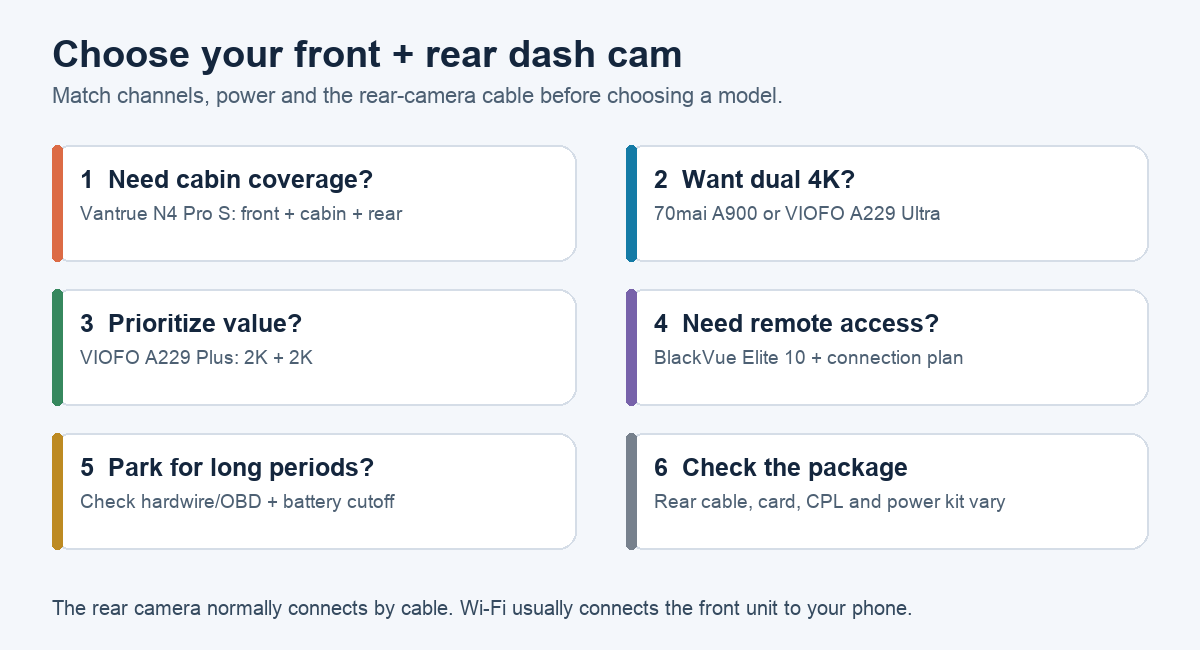
Start with coverage. The VIOFO A229 Plus is the balanced two-camera option; Vantrue N4 Pro S adds cabin recording; A900 and A229 Ultra offer dual 4K exterior views. Choose based on the view you need rather than a headline price.
For street or lot parking, compare the required power accessory and battery cutoff. BlackVue Elite 10 can provide remote access when a compatible internet connection and current service plan are set up; recording locally is separate.
For rideshare, choose the Vantrue N4 Pro S if passenger footage is necessary. A front-and-cabin-only unit is not equivalent to an external rear-windshield camera.
For hot climates, check the current operating-temperature rating in the maker’s manual, mount position and local parking conditions. A supercapacitor can help avoid a heat-sensitive internal battery but does not make any model immune to heat.
Route the rear cable along the vehicle trim while leaving room for airbag deployment and hatch movement. If wiring near airbags or vehicle power is unfamiliar, use a qualified installer.
Recording Specs and Package Value — What to Compare
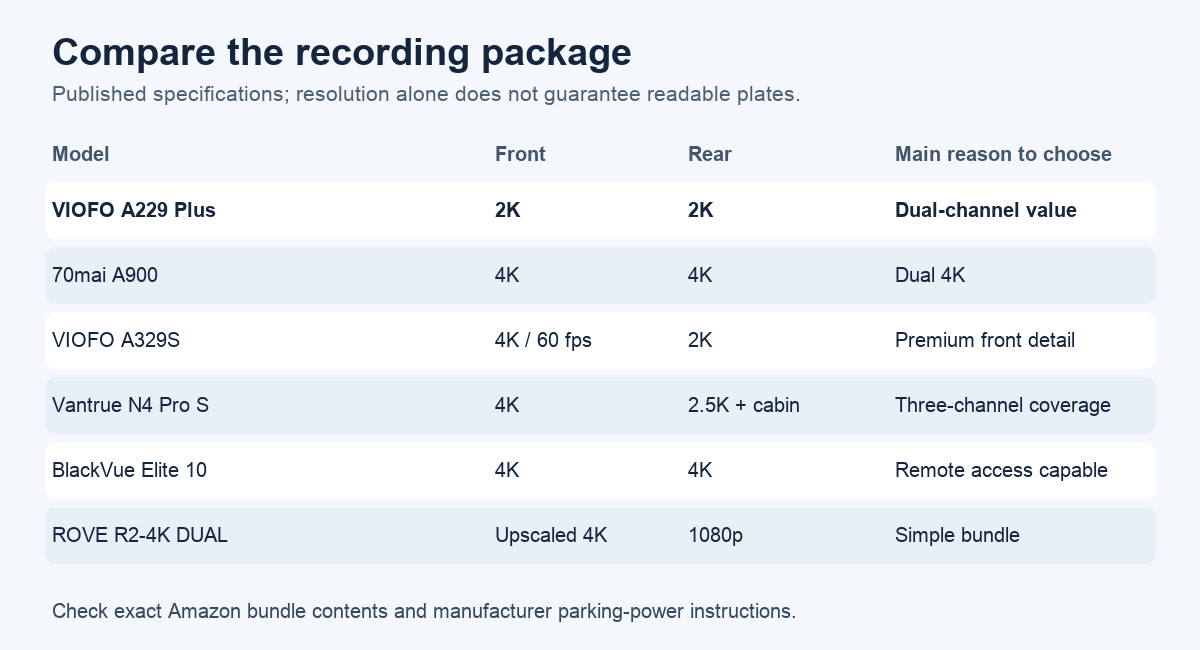
Compare the full package, not a fixed price from a previous year. Amazon offer prices and bundled accessories change. The chart keeps six verified recording configurations in one place.
For balanced 2K footage front and rear, start with the A229 Plus. Its value depends on the price and accessories in the live offer, not an assumed dollar amount.
For 4K on both exterior channels, compare the 70mai A900 and VIOFO A229 Ultra. The checked A900 listing includes a 64GB card; the checked Ultra bundle includes an HK4 hardwire kit. Recheck both before buying.
The A329S is different: its headline 4K/60 fps applies to the front channel, while the rear is 2K. That is a useful tradeoff if front motion detail is your priority.
BlackVue Elite 10 is the cloud-capable specialist. Budget for the connection and any current service cost if remote monitoring is the reason you choose it.
The Top Three Front and Rear Dash Cams Head to Head
| Feature | VIOFO A229 Plus | 70mai A900 | VIOFO A329S |
|---|---|---|---|
| Front recording | 2K | 4K/30 fps | 4K/60 fps |
| Rear recording | 2K | 4K/30 fps | 2K |
| Exterior channels | Front + rear | Front + rear | Front + rear |
| Parking power | Compatible hardwire | Compatible optional kit | Compatible hardwire |
| Wi-Fi | 5GHz | Wi-Fi 6 | Wi-Fi 6 |
| Storage offer | Check bundle | 64GB in checked listing | Check bundle |
| Best reason | Balanced 2K + 2K | Dual 4K | 4K/60 front |
When A229 Plus wins: you want 2K recording on both exterior views and do not need dual 4K. Check current offer contents before comparing total installation cost.
When A900 wins: you want manufacturer-specified 4K recording on both exterior channels. A larger endurance card may be sensible for longer retention; the selected listing’s stated card inclusion should be verified.
When A329S wins: you prioritize 4K/60 fps front recording and accept a 2K rear channel. Its optional SSD support adds another storage workflow; parking power remains an installation decision.
Our Final Verdict on the Best Dash Cam Front and Rear
For most everyday drivers, start with the VIOFO A229 Plus 2CH: it balances 2K recording on both exterior channels with a straightforward product package. This is an editorial recommendation based on published specifications, not a claimed road test.
Choose the 70mai A900 or VIOFO A229 Ultra if both exterior views must be 4K. Choose the Vantrue N4 Pro S when a cabin view is essential, the A329S for 4K/60 fps front video, or BlackVue Elite 10 when cloud-capable remote access is the deciding feature.
Before ordering, confirm the exact Amazon ASIN, rear camera and cable, memory card, and parking-power kit. Format the card in the camera, install the rear cable safely and test both recording channels after setup.
Frequently Asked Questions
Do I need a rear camera, and is it wireless?
A rear camera adds evidence from behind the car, but whether it is worth the cost depends on where and how you drive. In these systems, the exterior rear camera normally connects to the front unit by cable. Wi-Fi commonly serves app setup and file transfer, not a wireless rear link.
What rear-camera resolution should I choose?
1080p can establish events behind the car, while 2K and 4K record more pixels when conditions allow. Plate readability still depends on distance, motion, lighting, lens and compression. Compare simultaneous front/rear modes rather than the front-only headline.
Can a dash cam lower my car insurance?
A dash cam may help document an incident, but discounts and claim treatment vary by insurer and location. Ask your insurer about its current policy; do not assume buying a camera guarantees a discount or a particular liability result.
Do I need to hardwire my dash cam for parking mode?
Usually you need a compatible hardwire kit, OBD cable or separate battery for recording while parked if the normal accessory socket turns off with the ignition. Check your vehicle power behavior, the camera maker’s instructions and the low-voltage cutoff setting.
What SD card should I use in a front and rear dash cam?
Use a card within the manufacturer’s stated capacity and speed requirements, preferably an endurance model rated for continuous recording. Format it in the camera, check for recording errors and plan capacity around the number of channels and desired retention time.
Affiliate disclosure: We may earn a commission from qualifying purchases through links on this page, at no extra cost to you. Product recommendations come from current listing and manufacturer-spec research; we have not independently road-tested these ten units.