2013 honda odyssey tpms reset no button: Walked Through Step by Step
Seeing the TPMS (Tire Pressure Monitoring System) light on your 2013 Honda Odyssey and scouring the manual for a reset button that simply isn’t there? You are not alone. Many owners are initially confused because other vehicle manufacturers—and even other Honda models—frequently utilize a physical reset button located under the steering column or inside the glove box. The absence of a physical button on your 2013 Odyssey often leads to the false assumption that the system has suffered a mechanical failure. In reality, the process is entirely digital. In this guide, we will walk you through the precise i-MID calibration steps to clear your warning light and explain why your vehicle utilizes a sophisticated software-based approach rather than standard physical reset hardware.
Why the 2013 Honda Odyssey TPMS Reset No Button Design Exists
Recommended Best Deal Products


📤 Share Image
Indirect TPMS vs. Direct Sensor Systems
The primary reason for the “missing” button is the engineering architecture of your vehicle. While some cars use “Direct TPMS,” which involves expensive, battery-powered sensors physically mounted inside each tire valve stem, the 2013 Honda Odyssey employs an “Indirect TPMS.” This system is designed for durability and lower long-term maintenance costs. Instead of transmitting radio-frequency pressure data to the car’s computer, it relies on the vehicle’s existing wheel speed sensors to detect anomalies.
The Role of ABS Sensors in TPMS Calibration
The Indirect TPMS operates by measuring the rotational speed of your wheels via the ABS (Anti-lock Braking System) sensors. When a tire loses air pressure, its rolling radius changes, causing it to rotate slightly faster than the other wheels. The MICU (Multiplex Integrated Control Unit) monitors these rotational disparities. Because the system calculates pressure based on speed, it requires periodic re-calibration or a “fresh start” whenever you adjust tire pressures or rotate your tires. This process is software-driven, eliminating the need for a physical, mechanical reset button.
2013 Honda Odyssey TPMS Reset No Button: Step-by-Step Calibration
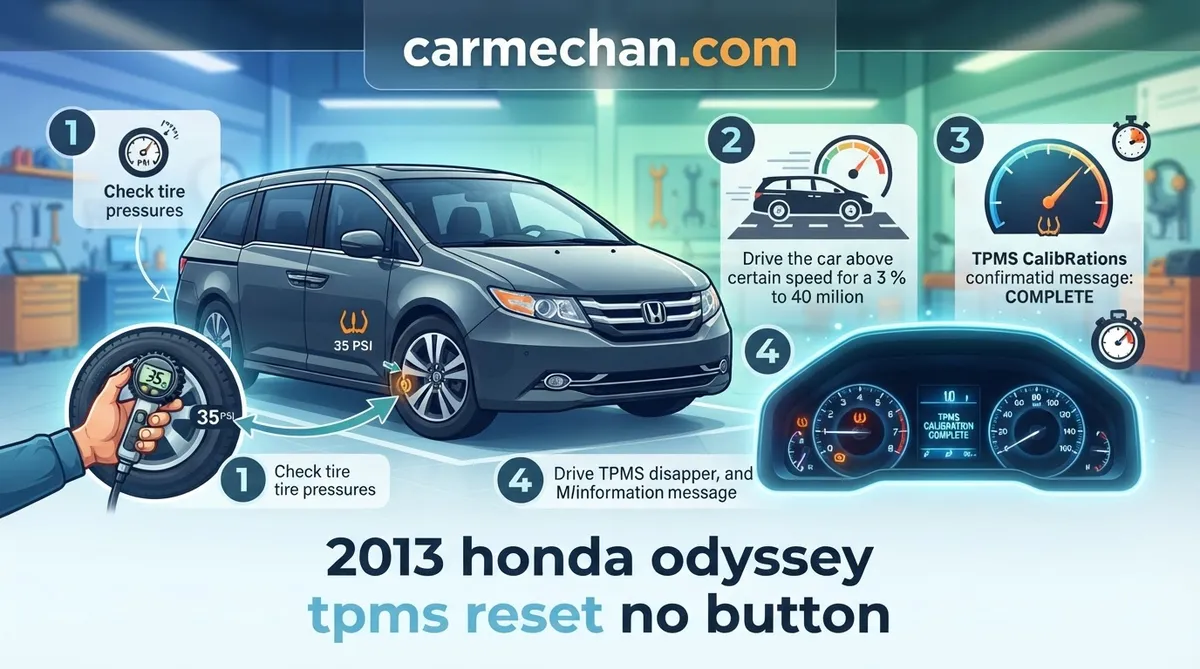
Before you attempt to initialize the system, ensure all tires are inflated exactly to the door jamb placard specifications. If the pressures are uneven before you start the calibration, the system will “learn” the incorrect baseline, causing the light to reappear shortly after.
Preparing Your Tires for Calibration
Calibration is a clean slate process. It tells the MICU, “The current speeds are the new normal.” You must verify the cold tire pressure (the tires should not have been driven on for at least three hours) against the sticker located on the driver’s side door jamb. Do not rely on the maximum pressure listed on the tire sidewall.
📋
Initialization Guide
Recommended Best Deal Products


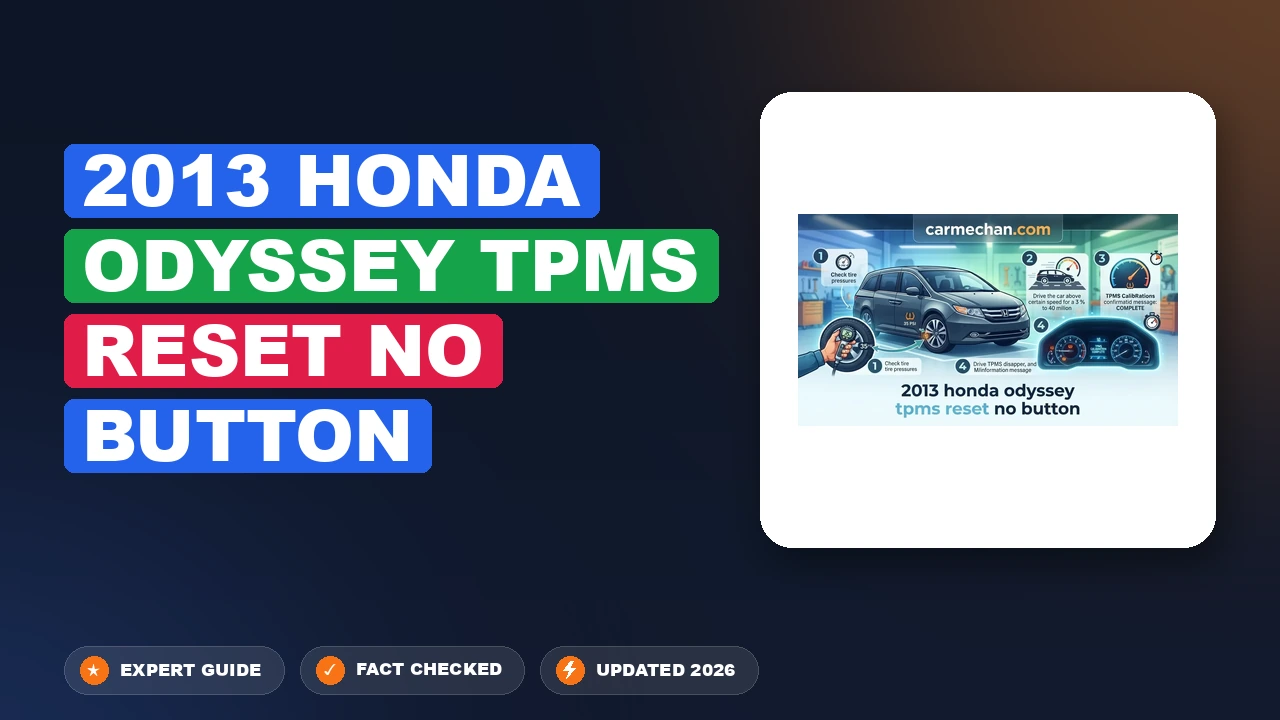
Turn the ignition to the “ON” position (or press the Start button twice without pressing the brake). Use the steering wheel mounted controls to navigate to the “Vehicle Settings” menu on your i-MID screen.
Select “TPMS Calibration” from the menu options. Once selected, choose “Initialize” to trigger the process. The system will confirm the request on the cluster display.
Calibration Driving Requirements for 2013 Honda Odyssey
Required Driving Time and Speed Ranges
Unlike systems that reset at the touch of a button, the 2013 Odyssey’s indirect system requires active, real-world data to complete the calibration. Once you select “Initialize,” the system begins a learning phase in the background. Research indicates that for the MICU to establish an accurate baseline, the vehicle must be driven for approximately 20 to 40 minutes. Ideally, this should occur at speeds between 30 and 65 mph.
How Road Conditions Impact Learning Cycles
Consistent speeds on a highway allow the system to calibrate more rapidly. Stop-and-go city traffic, heavy cornering, and sudden acceleration can extend the learning cycle. If the process is interrupted—for example, if you turn off the vehicle—the system typically pauses and resumes when you begin driving again. Do not be alarmed if the warning light does not disappear immediately upon starting the car; it requires the successful completion of the driving cycle to store the new calibration data to the backup memory.
By The Numbers
Minutes Required
MPH Speed Range
Troubleshooting 2013 Honda Odyssey TPMS Reset No Button Failures
Recommended Best Deal Products


Why the Warning Light Returns After Calibration
- Uneven Tire Wear: If tires on the same axle have significantly different tread depths, the system may interpret the difference in rotation as a pressure loss.
- Temporary Spare Usage: Using a space-saver spare tire will almost certainly trigger the light, as the diameter difference is detected immediately by the ABS sensors.
- Slow Leaks: If one tire has a puncture that loses pressure over several hours, the system will eventually flag the inconsistency during your next drive.
Distinguishing Software Initialization from Mechanical Faults
If you have correctly performed the initialization and driven the vehicle for the required time, yet the light remains illuminated, you may be dealing with a hard fault. In this case, the issue is not with the TPMS software, but with the hardware monitoring the wheels. If a specific wheel speed sensor fails, it will trigger a Diagnostic Trouble Code (DTC) in the ABS module. Because the TPMS relies on these sensors, a fault in the ABS system will automatically disable the TPMS, rendering your calibration attempts unsuccessful. At this stage, professional diagnostic tools are required to retrieve the specific DTC and pinpoint which sensor or module needs replacement.
Never ignore a blinking TPMS light. While a solid light usually indicates a pressure calibration issue, a blinking light almost always indicates a system fault, such as a failing wheel speed sensor or a communication error within the MICU. In these cases, calibration will not resolve the issue.
The 2013 Odyssey utilizes an indirect system based on wheel speed rather than tire-pressure sensors. Calibration is a simple, menu-driven process that requires zero tools. Always ensure your tire pressures are set to the exact door-jamb specifications before you begin. Don’t be discouraged if the light doesn’t vanish instantly; it requires 20-40 minutes of driving to successfully restore the system. If your TPMS light continues to flash or illuminate despite proper inflation and calibration, please visit your local Honda dealer to check for wheel speed sensor Diagnostic Trouble Codes (DTCs).
2013 Honda Odyssey Tpms Reset No Button: Frequently Asked Questions
Why is there no reset button under my steering wheel?
The 2013 Honda Odyssey utilizes an automated TPMS relearn system. Unlike previous generation Hondas that required a physical button to trigger a calibration, this system is designed to continuously monitor signals from the wheel sensors. Once the system detects that the tires are at the correct pressure and the vehicle is in motion, it automatically updates its internal values without requiring driver input.
Do I need a scan tool to reset the TPMS on a 2013 Odyssey?
In most standard scenarios where only tire pressure needs to be corrected, a scan tool is not required. The vehicle performs its own reset once properly inflated tires are detected during driving. However, if you have replaced a sensor or are dealing with a ‘System Fault’ light, a professional OBD-II scan tool is necessary to read specific diagnostic trouble codes and confirm which sensor is malfunctioning.
Does tire rotation require a TPMS calibration?
Yes, but it is an automated process. Because the 2013 Odyssey uses individual radio-frequency sensors in each wheel, the vehicle’s computer can detect the new position of the tires through signal triangulation after you drive for several miles. You do not need to manually input the new tire locations; simply rotate them, ensure pressures are set to the door-jamb specification, and drive until the system updates.
What is the difference between a solid and flashing TPMS light?
A solid light indicates that one or more of your tires is significantly under-inflated, typically 25% below the recommended PSI. A flashing light, however, indicates a system malfunction. This usually means a sensor battery has died, the sensor itself is physically damaged, or there is a communication error between the wheel sensors and the TPMS control unit. Flashing requires a professional diagnostic scan.
Can cold weather trigger the TPMS light even if my tires are fine?
Yes, ambient temperature drops directly affect air density. As air gets colder, it contracts, causing the PSI reading to drop. If your tires were already near the threshold, a cold night can easily push them low enough to trigger the sensor. This is a common occurrence in autumn. Always check pressures in the morning before driving to ensure an accurate reading once the tires are cold.