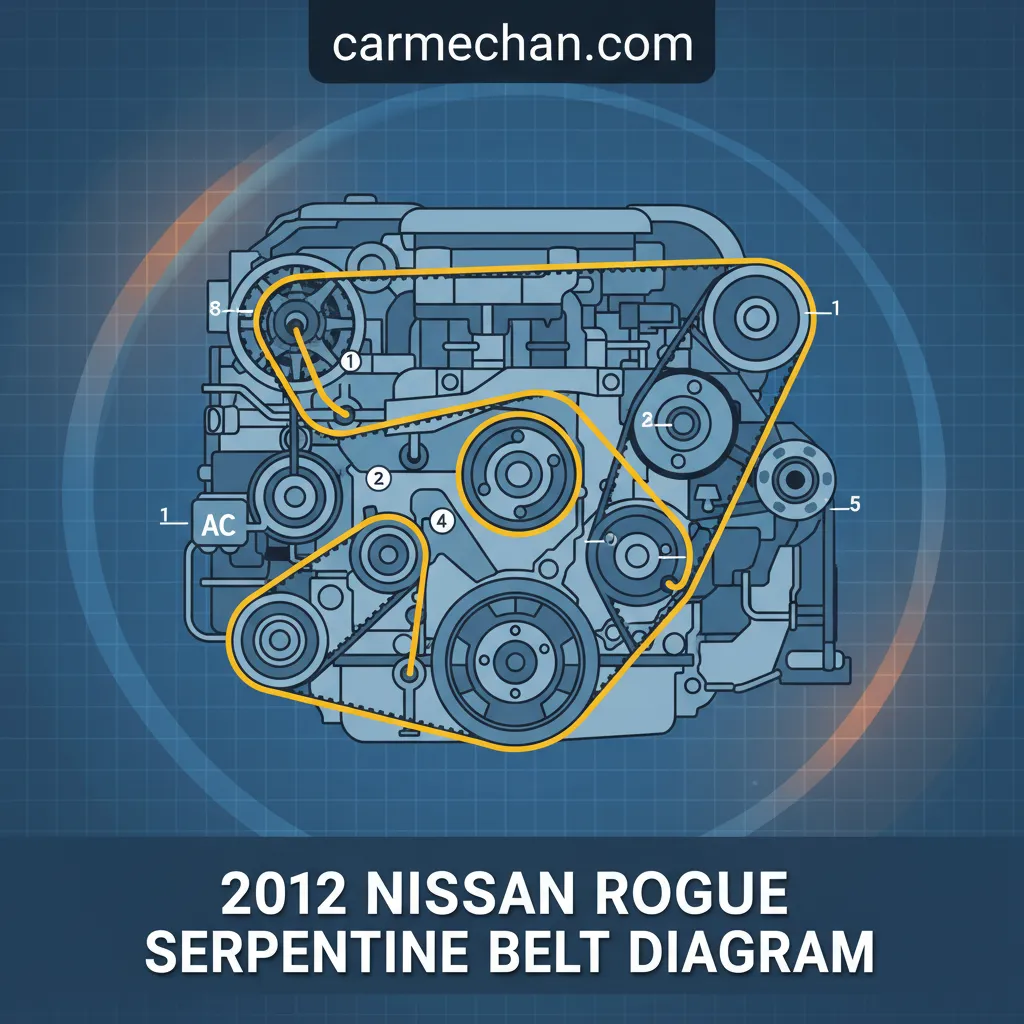
2012 Nissan Rogue Serpentine Belt Diagram: Identification And Replacement Guide
The serpentine belt, a seemingly simple component, is the lifeline that powers your 2012 Nissan Rogue’s most critical accessories, from the alternator to the power steering. When issues arise—be it an ominous squeal or a complete failure—locating and understanding the precise serpentine belt diagram for your specific 2012 Rogue model, and knowing how to act, becomes paramount for maintaining vehicle integrity and operational safety. This expert guide provides an authoritative blueprint: the definitive 2012 Nissan Rogue serpentine belt diagram, coupled with professional, step-by-step instructions for identification, inspection, and replacement, ensuring your vehicle’s reliable performance.


Understanding the 2012 Nissan Rogue Serpentine Belt System
📤 Share Image
The serpentine belt in your 2012 Nissan Rogue is far more than just a rubber strap; it is the central power conduit for numerous critical engine accessories. As a single, continuous belt, it efficiently transfers rotational energy from the engine’s crankshaft to multiple peripheral components, ensuring their simultaneous operation. This design is a hallmark of modern engine architecture, replacing older multi-belt systems with a more compact and reliable solution.
Critical Components Driven by the Serpentine Belt
In the 2012 Nissan Rogue, particularly with the prevalent QR25DE engine variant, the serpentine belt is responsible for powering a suite of essential systems:
- Alternator: Generates electrical power to run vehicle systems and recharge the battery.
- A/C Compressor: Pressurizes refrigerant for the air conditioning system, keeping the cabin cool.
- Power Steering Pump: Provides hydraulic assistance for effortless steering.
- Water Pump: Circulates coolant through the engine to prevent overheating.
A sudden failure of this belt, for instance, mid-drive, would immediately impact all these systems. Imagine losing power steering assist, having your air conditioning cease, seeing your battery light illuminate due to a non-charging alternator, and subsequently observing your engine temperature gauge rapidly climb towards the red zone as the water pump stops circulating coolant. This scenario underscores the belt’s critical role in maintaining vehicle operational safety and comfort.
The Role of the Tensioner System
To ensure optimal belt performance, maintaining correct tension is crucial. The 2012 Nissan Rogue typically employs an automatic spring-loaded tensioner. This sophisticated component automatically adjusts the belt’s tension, compensating for minor stretch and wear over time. This consistent tension prevents belt slippage, which can cause squealing noises and reduced efficiency, and also protects against excessive tension that could prematurely wear out bearings in the driven components.
Belt Construction and Durability
Modern serpentine belts are engineered for durability and high performance. They are constructed from advanced synthetic rubber compounds, often reinforced with tensile cords made of polyester or aramid fibers. Their distinctive multi-ribbed design is specifically engineered for efficient power transfer, providing greater surface area contact with the pulleys compared to older V-belts. A quality serpentine belt for your 2012 Nissan Rogue is designed to last, with a typical lifespan ranging from 50,000 to 100,000 miles or 4-7 years, depending on manufacturer recommendations and driving conditions. Utilizing a professional-grade replacement is paramount for reliable and long-lasting performance.

Accessing and Deciphering the 2012 Nissan Rogue Serpentine Belt Diagram
Successfully replacing your 2012 Nissan Rogue’s serpentine belt hinges entirely on accessing and accurately interpreting the correct routing diagram. This diagram is your indispensable map, guiding the belt’s path around the various pulleys.
Where to Locate Your Diagram
As a trusted automotive expert, I can confirm several common, reliable locations where you can find the serpentine belt diagram specific to your 2012 Nissan Rogue:
- Under the Hood Sticker: Often, Nissan places a decal under the hood, typically on the radiator support, fender well, or hood underside. This sticker explicitly details the belt routing. This is usually the quickest and most convenient reference.
- Owner’s Manual: Your vehicle’s owner’s manual contains a comprehensive section on routine maintenance, which usually includes the serpentine belt diagram.
- Official Service Manuals: The most authoritative source is the official Nissan Factory Service Manual (FSM). These manuals provide complete, detailed diagrams and procedures. Many professional workshops rely exclusively on these.
- Online Automotive Databases: Reputable online resources like AllData, Mitchell1, or even high-quality forums dedicated to Nissan Rogue models often host accurate diagrams. Always cross-reference with at least one other source if using an unofficial diagram.
Interpreting the Diagram
Once you have the diagram, understanding its symbols is key. A typical diagram for your 2012 Nissan Rogue’s QR25DE engine will present a top-down or front view of the engine accessories, with the crankshaft pulley usually positioned centrally and serving as the primary driver. You will see various circles or ovals representing each pulley:
- Crankshaft Pulley: The large pulley at the bottom, directly connected to the engine.
- Alternator Pulley: Typically higher up, connected to the charging system.
- A/C Compressor Pulley: Usually lower down, often with a clutch visible.
- Power Steering Pump Pulley: Position varies, but identifiable by its connection to the power steering system.
- Water Pump Pulley: Often near the engine block, circulating coolant.
- Idler Pulleys: These simply guide the belt and do not drive any accessory. They are typically smooth.
- Tensioner Pulley: This pulley is mounted on an arm, usually with an arrow indicating the direction to move it to relieve tension.
The diagram will show lines representing the belt’s path, often with directional arrows indicating the correct rotation. Pay close attention to how the ribbed side of the belt contacts ribbed pulleys and the smooth side contacts smooth idler pulleys.
Always verify the diagram for your specific 2012 Nissan Rogue’s engine variant, primarily the QR25DE. Minor differences between engine years or sub-models can lead to incorrect installation, causing immediate belt squeal, premature wear, or even complete detachment. A diagram coded ‘QR25DE Serpentine Belt Routing’ confirms you have the right guide.
A common mistake is assuming all Rogue models share the same diagram. For example, using a diagram for an earlier model year or a different engine entirely would lead to a frustrating and ultimately failed installation, as the routing paths and pulley configurations would not match. Always prioritize using a diagram directly from the official Nissan service manual as your most reliable reference.

Pre-Replacement Diagnostics and Essential Tools for the 2012 Rogue
Before embarking on a serpentine belt replacement, a thorough diagnostic check and proper tool preparation are critical. This expert approach ensures not only a successful replacement but also prevents overlooking underlying issues that could prematurely fail your new belt.
Diagnosing Serpentine Belt Wear and Damage
Inspect your 2012 Nissan Rogue’s serpentine belt for these tell-tale signs of wear:
- Cracks: Look for both transverse cracks (across the belt ribs) and longitudinal cracks (running parallel to the ribs). Industry standards often suggest replacement if three or more cracks are visible per inch on the ribbed surface.
- Glazing: A shiny, hardened appearance on the belt’s surface indicates it’s losing its grip, often leading to squealing noises, especially on cold starts or during heavy accessory loads (like turning the steering wheel sharply).
- Fraying Edges: Worn or frayed edges suggest the belt is rubbing against something or is misaligned.
- Missing Ribs or Chunks: Any missing material indicates severe degradation and immediate replacement is necessary.
A persistent squealing noise upon cold start that eventually subsides, or one that reappears under load, is a classic indicator of a worn belt or a failing pulley.
Inspecting Pulleys and Tensioners
While the belt is off, it’s the opportune moment to inspect all pulleys:
- Idler and Tensioner Pulleys: Spin each pulley by hand. Listen for any grinding, squealing, or clunking noises, which indicate worn bearings. Attempt to wiggle each pulley; any excessive play or wobbling means the bearing is failing and the pulley requires replacement.
- Accessory Pulleys: Check the alternator, A/C compressor, power steering pump, and water pump pulleys for any physical damage, bent edges, or excessive play. Ensure their grooves are clean and free of debris.
Essential Tools for Replacement
To perform this job with professional efficiency and safety, gather the following tools:
- Serpentine Belt Tool Kit: This specialized tool often includes various length handles and crowfoot wrenches designed to easily fit into tight spaces and engage the tensioner.
- Standard Ratchet/Breaker Bar: A 1/2-inch drive ratchet or breaker bar is usually needed if using a square drive tensioner tool, or appropriate size for the tensioner bolt (e.g., 14mm, 17mm, or 19mm hex socket).
- Socket Set: Essential for any ancillary components that may need to be moved for access.
- Torque Wrench: Crucial for ensuring any removed components or new pulleys are tightened to manufacturer specifications.
- Gloves and Safety Glasses: Non-negotiable for personal protection.
- Flashlight or Work Light: For clear visibility in the engine bay.
- New Serpentine Belt: Ensure it’s a quality OEM-equivalent or higher-grade belt. A high-quality belt for the 2012 Rogue typically costs $20-$50.
Critical Safety Precautions
Adhering to safety protocols is paramount for any automotive work:
- Disconnect Battery: Always disconnect the negative battery terminal to prevent accidental engine cranking or electrical shorts.
- Engine Cool-Down: Ensure the engine is completely cool to prevent burns from hot components or fluids.
- Stable Vehicle Support: If lifting the vehicle for better access (often not strictly necessary for a belt, but beneficial for other inspections), use a hydraulic jack and securely support the vehicle with jack stands on a level surface. Never rely solely on a jack.
- Clear Workspace: Remove any loose tools or obstructions from the engine bay.
Never attempt to work on an engine with hot components or while it is running. The serpentine belt system involves rapidly moving parts that can cause severe injury. Always ensure the engine is off, cool, and the battery is disconnected before beginning any work.
Step-by-Step Serpentine Belt Replacement on the 2012 Nissan Rogue
Replacing the serpentine belt on your 2012 Nissan Rogue is a straightforward procedure when approached systematically and with precision. This comprehensive guide ensures a professional and correct installation.
📋
Step-by-Step Guide


Before starting, ensure your 2012 Nissan Rogue is parked on a level surface, and the engine is completely cool. Disconnect the negative terminal of the battery using an appropriate wrench to prevent accidental electrical issues or engine cranking. If greater access is needed from underneath, lift the front of the vehicle using a hydraulic jack and secure it with sturdy jack stands. Ensure maximum stability.
Identify the automatic serpentine belt tensioner. Typically, this component on the 2012 Nissan Rogue will have a hex head (often 14mm or 19mm) or a square drive (commonly 1/2-inch) designed to accept a wrench or breaker bar. Place your ratchet/breaker bar or specialized serpentine belt tool onto the tensioner bolt/square drive. Apply steady, controlled leverage to rotate the tensioner arm away from the belt (usually clockwise). This action compresses the internal spring, relieving tension from the belt. While holding the tensioner in the retracted position, carefully slide the old belt off one of the easier-to-reach pulleys, such as the alternator or a smooth idler pulley. Once loose, gently release the tensioner and remove the old belt completely, paying close attention to its original routing for visual reference before it’s fully off.
With the old belt removed, take this opportunity to thoroughly inspect all pulleys (alternator, A/C, power steering, water pump, idlers, tensioner). Clean any accumulated dirt, grime, or rubber debris from their grooves using a brush or rag. Ensure no grit remains that could damage the new belt. As previously mentioned, check for any play or noise in the pulley bearings; replace any worn components now, as failing pulleys can lead to immediate belt failure or persistent squealing, even with a new belt.
Using your verified 2012 Nissan Rogue serpentine belt diagram, begin routing the new belt. Start by placing the belt around the crankshaft pulley, which often serves as the central anchor. Work your way around all the stationary pulleys (alternator, A/C, power steering, water pump, idlers), leaving the tensioner pulley for last or for one of the final pulleys to install. Ensure the ribbed side of the belt sits correctly in the ribbed grooves of the driven pulleys, and the smooth side contacts any smooth idler pulleys. A common error is routing the belt incorrectly, resulting in immediate squealing or the belt dislodging during engine operation. Double-check your routing against the diagram multiple times before proceeding.
Once the belt is routed correctly around all pulleys except the tensioner, use your tool to retract the tensioner arm again. This will create enough slack to slip the new belt over the tensioner pulley. Slowly release the tensioner, allowing its spring to apply the correct tension to the new belt. Perform a visual verification: ensure the belt is perfectly seated in all pulley grooves, with no edges overlapping or misalignments. Reconnect the negative battery terminal. Start the engine briefly and listen carefully for any squealing, chirping, or unusual noises. Turn the steering wheel from lock to lock and engage the A/C to ensure all accessories function smoothly. If any bolts were loosened during the process, refer to your owner’s manual or service manual for specific torque specifications. Finally, perform a short test drive to confirm all systems are operating normally.
Common Serpentine Belt Issues and Preventative Maintenance for the Rogue
Even with a new serpentine belt, understanding common issues and implementing a robust preventative maintenance strategy is crucial for the long-term reliability and operational health of your 2012 Nissan Rogue. Addressing minor issues promptly can save significant time and expense.
Diagnosing Serpentine Belt Noises
Various noises emanating from the serpentine belt system often indicate specific problems:
- Squealing: This is the most common complaint and can stem from several sources:
- Belt Wear: A glazed or hardened belt loses friction, causing it to slip.
- Improper Tension: A loose belt will slip; an overly tight belt can strain bearings.
- Pulley Misalignment: Even a slight misalignment can cause the belt to rub or seat incorrectly, leading to noise and premature wear.
- Contaminated Surfaces: Oil, coolant, or power steering fluid leaks can contaminate the belt and pulleys, drastically reducing friction.
- Chirping/Ticking: Often indicative of minor belt misalignment or a slight defect in the belt itself. It can also point to a failing bearing in an idler or tensioner pulley, especially if the noise is rhythmic.
- Grinding/Rumbling: Almost always a sign of a severely worn or failing bearing within an accessory component or an idler/tensioner pulley. This requires immediate attention.
A scenario where a persistent squeal remains even after a new belt has been installed strongly suggests a misaligned pulley or a failing bearing in one of the accessory components or the tensioner itself, necessitating further expert investigation beyond just the belt.
Implications of a Failing Serpentine Belt
Ignoring a minor squeal or any other sign of belt distress can lead to a catastrophic failure with significant consequences:
- Loss of Power Steering Assist: Steering becomes extremely difficult, especially at low speeds.
- Non-Functional Air Conditioning: The A/C compressor will not engage, leading to a loss of cooling.
- Dimming Headlights/Battery Drain: Without the alternator, the battery will not charge, eventually leading to a complete electrical system shutdown.
- Engine Overheating: The water pump ceases to circulate coolant, which can quickly lead to severe engine damage (e.g., blown head gasket, warped cylinder head).
Ignoring a minor squeal can escalate into an emergency situation where multiple accessory failures occur simultaneously during a critical driving moment, such as on a highway or in heavy traffic. This highlights the value of preventative maintenance over reactive repairs.
Preventative Maintenance and Quality Parts
To ensure the longevity and reliable operation of your 2012 Nissan Rogue, implement a consistent preventative maintenance schedule:
- Regular Visual Inspections: Perform a visual check of the serpentine belt and all related components (pulleys, tensioner) every 15,000 miles or annually, or during every oil change, as recommended by professional technicians. Look for the signs of wear detailed in Section 3.
- Prompt Replacement: Adhere to manufacturer-recommended replacement intervals, even if the belt appears superficially fine. The internal structure can degrade unseen.
- Use Quality Components: Always opt for OEM-equivalent or higher quality replacement belts from reputable brands. While a cheaper belt might save a few dollars upfront, it significantly compromises longevity and quality performance, leading to more frequent replacements and potential component damage.
The cost savings of preventative maintenance versus emergency repairs are substantial. Addressing a worn belt proactively prevents potential towing costs, additional damage to other components (like an alternator or A/C compressor failing due to sudden belt shock), and the inconvenience of unexpected breakdowns.
Enhanced Reliability
Regular checks prevent unexpected failures, ensuring your Rogue starts and runs consistently.
Cost Savings
Proactive replacement is far cheaper than emergency repairs, towing, and potential cascading damage.
Optimal Performance


A properly functioning belt ensures all accessories operate at peak efficiency, from power steering to A/C.
The 2012 Nissan Rogue’s serpentine belt is vital, powering essential accessories; regular inspection is critical for preventative maintenance. Accurate identification and interpretation of the specific serpentine belt diagram are fundamental for correct routing and reliable system operation. A systematic approach, utilizing proper tools and techniques, ensures a professional and safe serpentine belt replacement, preventing costly future failures. Ensure your 2012 Nissan Rogue maintains peak operational reliability. Utilize this trusted guide to confidently inspect, understand, and service your serpentine belt, or consult with a qualified automotive professional for expert assistance.
Frequently Asked Questions
How often should the serpentine belt be inspected on a 2012 Nissan Rogue?
It is professionally recommended to inspect the serpentine belt on your 2012 Nissan Rogue at least annually or every 15,000 miles, whichever comes first. During inspections, check for signs of wear such as cracks, fraying, glazing, or missing ribs. Proactive inspection ensures early detection of issues, preventing unexpected failures and ensuring reliable accessory function for your vehicle.
What are the common signs of a failing serpentine belt on a 2012 Rogue?
Common indicators of a failing serpentine belt on a 2012 Rogue include persistent squealing or chirping noises, especially during cold starts or sharp turns. Other signs are loss of power steering assist, a non-functioning air conditioner, dimming headlights due to alternator issues, or an overheating engine due to a faulty water pump. Addressing these promptly is crucial for vehicle safety and performance.
Is it difficult to replace the serpentine belt on a 2012 Nissan Rogue?
For an experienced DIY enthusiast with the correct tools and the specific 2012 Nissan Rogue serpentine belt diagram, replacement is a manageable task. However, proper tensioner manipulation, belt routing, and safety precautions are critical. If you lack confidence or specialized tools, engaging a professional automotive technician is a reliable and recommended approach to ensure correct installation and prevent potential damage.
Can a 2012 Nissan Rogue run without a serpentine belt?
No, a 2012 Nissan Rogue cannot run for any significant period without a serpentine belt. The belt drives crucial components like the alternator (for charging the battery), power steering pump, and water pump. Operating without it will quickly lead to a dead battery, loss of steering control, and severe engine overheating, potentially causing catastrophic engine damage. Immediate attention is required if the belt breaks.
What is the difference between a serpentine belt and a timing belt?
The serpentine belt, found on the outside of the engine, drives external accessories like the alternator and power steering pump. In contrast, the timing belt (or timing chain) is located inside the engine, synchronizing the rotation of the engine’s camshaft and crankshaft. A serpentine belt failure will strand you, but a timing belt failure can lead to severe and costly internal engine damage. Both require distinct maintenance schedules.